
Homework Answers
Add Answer to:
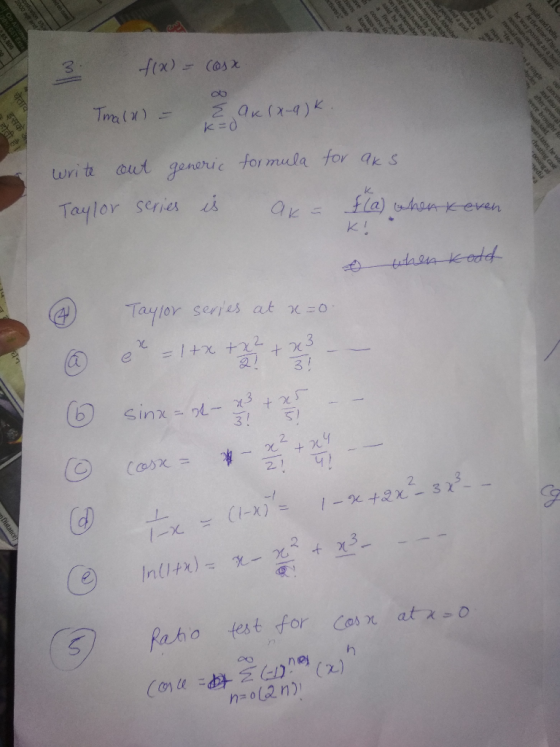
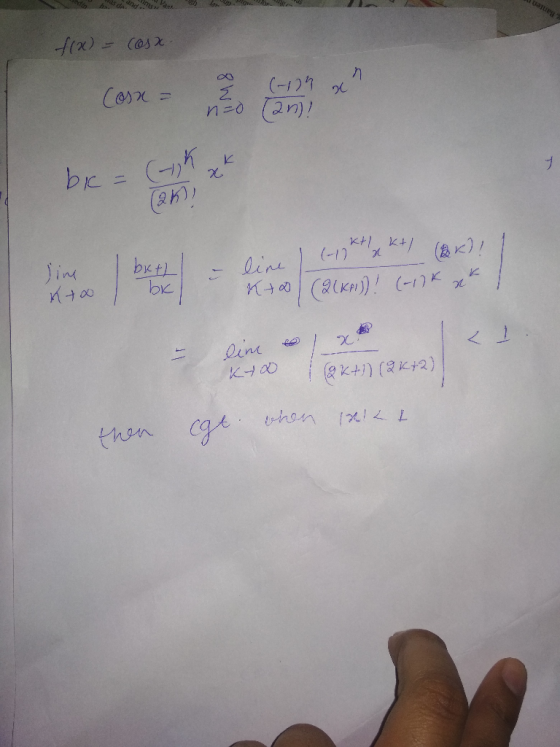
3. The outcome of this process, illustrated for f(r) = cos(z), is to produce polynomials T...
Solve the Taylor Series. 1. (a) Use the root test to find the interval of convergence of-1)* に0 (b) Demonstrate that the above is the taylor series of f()- by writing a formula for f via taylor'...
 Solve the Taylor Series.
1. (a) Use the root test to find the interval of convergence of-1)* に0 (b) Demonstrate that the above is the taylor series of f()- by writing a formula for f via taylor's theorem at α-0. That is write f(x)-P(z) + R(x) where P(r) is the nth order taylor polynomial centered at a point a and the remainder term R(x) = ((r - a)n+1 for some c between z and a where here a 0. Show...
Solve the Taylor Series.
1. (a) Use the root test to find the interval of convergence of-1)* に0 (b) Demonstrate that the above is the taylor series of f()- by writing a formula for f via taylor's theorem at α-0. That is write f(x)-P(z) + R(x) where P(r) is the nth order taylor polynomial centered at a point a and the remainder term R(x) = ((r - a)n+1 for some c between z and a where here a 0. Show...
(-1)-1 n2 is absolutely convergent. 1. (2 points) Prove that cos n is convergent or divergent....
 (-1)-1 n2 is absolutely convergent. 1. (2 points) Prove that cos n is convergent or divergent. 2. (2 points) Determine whether the series - (Use cos n<1 for all n) 3. (3 points) Test the series -1) 3 for absolute convergence. (Use the Ratio Test) 2n +3) 4. (3 points) Determine whether the series converges or diverges. 3n +2 n-1 (Use the Root Test) 5. (3 points) Find R and I of the series (z-3) 1 Find a power series...
l. (Taylor Polynonial for cos(ar)) Fr f(z) = cos(ar) do the following. (a) Find the Taylor polynomials T.(r) about O fo...
 l. (Taylor Polynonial for cos(ar)) Fr f(z) = cos(ar) do the following. (a) Find the Taylor polynomials T.(r) about O for f(x) for n 1,2,3,4,5 (b) Based on the pattern in part (a), if n is an even number what is the relation between T(r) and TR+1(r)? (c) You might want to approximate cs(ar) for all x in。Ś π/2 by a Taylor polynomial about 0. Use the Taylor polynomial of order 3 to approximate f(0.25) when a-2, i.e. f(x)-cos(2x). d)...
5. Let f(z) = arctan(z) (a) (3 marks) Find the Taylor series about r)Hint: darctan( You may assume that the Taylor series for f(x) converges to f(x) for values of r in the interval of convergence...
 5. Let f(z) = arctan(z) (a) (3 marks) Find the Taylor series about r)Hint: darctan( You may assume that the Taylor series for f(x) converges to f(x) for values of r in the interval of convergence (b) (3 marks) What is the radius of convergence of the Taylor series for f(z)? Show that the Taylor series converges at z = 1 (c) (3 marks) Hence, write as a series. (d) (3 marks) Go to https://teaching.smp.uq.edu.au/scims Calculus/Series.html. Use the interactive animation...
Solve the taylor series and include every steps. I. (a) Use the root test to find the interval of convergence of Σ(-1)4. (b) Demonstrate that the above is the taylor series of _ by writing a formu...
 Solve the taylor series and include every steps.
I. (a) Use the root test to find the interval of convergence of Σ(-1)4. (b) Demonstrate that the above is the taylor series of _ by writing a formula for f via taylors theorem at a = 0. That is write /(z) = P(z) + R(z) where P(z) is the nth order taylor polynonial centered at a point α and the remainder term R(r)- sn+(e)(-a)t1 for some e 0 O. Show that...
Solve the taylor series and include every steps.
I. (a) Use the root test to find the interval of convergence of Σ(-1)4. (b) Demonstrate that the above is the taylor series of _ by writing a formula for f via taylors theorem at a = 0. That is write /(z) = P(z) + R(z) where P(z) is the nth order taylor polynonial centered at a point α and the remainder term R(r)- sn+(e)(-a)t1 for some e 0 O. Show that...
1. Consider the power series nr3n 8Tn (a) Determine the radius of convergence of the series. (b) The series is the Maclaurin series for some function f(z). Give the Maclaurin seres for (r)dr, and fin...
 1. Consider the power series nr3n 8Tn (a) Determine the radius of convergence of the series. (b) The series is the Maclaurin series for some function f(z). Give the Maclaurin seres for (r)dr, and find the radius of convergence of that series. 10 marks
1. Consider the power series nr3n 8Tn (a) Determine the radius of convergence of the series. (b) The series is the Maclaurin series for some function f(z). Give the Maclaurin seres for (r)dr, and find the...
1. Consider the power series nr3n 8Tn (a) Determine the radius of convergence of the series. (b) The series is the Maclaurin series for some function f(z). Give the Maclaurin seres for (r)dr, and find the radius of convergence of that series. 10 marks
1. Consider the power series nr3n 8Tn (a) Determine the radius of convergence of the series. (b) The series is the Maclaurin series for some function f(z). Give the Maclaurin seres for (r)dr, and find the...
16. (a) Approximate f(r)= xlnx by a Taylor polynomial with degree 3 at a=1. (b) Estimate the accuracy of the approx...
 16. (a) Approximate f(r)= xlnx by a Taylor polynomial with degree 3 at a=1. (b) Estimate the accuracy of the approximation f (x) T (x) when x lies in the interval 0.5 rs 1.5 17. Find the first three nonzero terms in the Maclaurin series for the function f (x) = --_" and (r+3) its radius of convergence.
16. (a) Approximate f(r)= xlnx by a Taylor polynomial with degree 3 at a=1. (b) Estimate the accuracy of the approximation f...
16. (a) Approximate f(r)= xlnx by a Taylor polynomial with degree 3 at a=1. (b) Estimate the accuracy of the approximation f (x) T (x) when x lies in the interval 0.5 rs 1.5 17. Find the first three nonzero terms in the Maclaurin series for the function f (x) = --_" and (r+3) its radius of convergence.
16. (a) Approximate f(r)= xlnx by a Taylor polynomial with degree 3 at a=1. (b) Estimate the accuracy of the approximation f...
Expand the function f(z) = (z−1)/(3−z) in a Taylor series centered at the point z_0 =...
Expand the function f(z) = (z−1)/(3−z) in a Taylor series centered at the point z_0 = 1. Give the radius of convergence r of the series.
Question 2, non-calculator Question 1, calculator The curve C in the x-y-plane is given parametrically by (x(t), y(t), where dr = t sine) and dv = cos| t The Maclaruin series for a function f is give...
 Question 2, non-calculator Question 1, calculator The curve C in the x-y-plane is given parametrically by (x(t), y(t), where dr = t sine) and dv = cos| t The Maclaruin series for a function f is given by r" for 1 sts 6 a) Use the ratio test to find the interval of convergence of the Maclaurin series for f a) Find the slope of the line tangent to the curve C at the point where t 3. b) Let...
(1 point) Consider a function f(x) that has a Taylor Series centred at z = 1...
 (1 point) Consider a function f(x) that has a Taylor Series centred at z = 1 given by 00 Ż an(z - 1)" D If the radius of convergence for this Taylor series is R-4, then what can we say about the radius of convergence of the Power Series (x - 1)"? 0720 O AR 6 B. R=24 OC. R-2 OD. R = 8 O ER=4 OF. It is impossible to know what R is given this information
 Solve the Taylor Series.
1. (a) Use the root test to find the interval of convergence of-1)* に0 (b) Demonstrate that the above is the taylor series of f()- by writing a formula for f via taylor's theorem at α-0. That is write f(x)-P(z) + R(x) where P(r) is the nth order taylor polynomial centered at a point a and the remainder term R(x) = ((r - a)n+1 for some c between z and a where here a 0. Show...
Solve the Taylor Series.
1. (a) Use the root test to find the interval of convergence of-1)* に0 (b) Demonstrate that the above is the taylor series of f()- by writing a formula for f via taylor's theorem at α-0. That is write f(x)-P(z) + R(x) where P(r) is the nth order taylor polynomial centered at a point a and the remainder term R(x) = ((r - a)n+1 for some c between z and a where here a 0. Show...
 (-1)-1 n2 is absolutely convergent. 1. (2 points) Prove that cos n is convergent or divergent. 2. (2 points) Determine whether the series - (Use cos n<1 for all n) 3. (3 points) Test the series -1) 3 for absolute convergence. (Use the Ratio Test) 2n +3) 4. (3 points) Determine whether the series converges or diverges. 3n +2 n-1 (Use the Root Test) 5. (3 points) Find R and I of the series (z-3) 1 Find a power series...
 l. (Taylor Polynonial for cos(ar)) Fr f(z) = cos(ar) do the following. (a) Find the Taylor polynomials T.(r) about O for f(x) for n 1,2,3,4,5 (b) Based on the pattern in part (a), if n is an even number what is the relation between T(r) and TR+1(r)? (c) You might want to approximate cs(ar) for all x in。Ś π/2 by a Taylor polynomial about 0. Use the Taylor polynomial of order 3 to approximate f(0.25) when a-2, i.e. f(x)-cos(2x). d)...
 5. Let f(z) = arctan(z) (a) (3 marks) Find the Taylor series about r)Hint: darctan( You may assume that the Taylor series for f(x) converges to f(x) for values of r in the interval of convergence (b) (3 marks) What is the radius of convergence of the Taylor series for f(z)? Show that the Taylor series converges at z = 1 (c) (3 marks) Hence, write as a series. (d) (3 marks) Go to https://teaching.smp.uq.edu.au/scims Calculus/Series.html. Use the interactive animation...
 Solve the taylor series and include every steps.
I. (a) Use the root test to find the interval of convergence of Σ(-1)4. (b) Demonstrate that the above is the taylor series of _ by writing a formula for f via taylors theorem at a = 0. That is write /(z) = P(z) + R(z) where P(z) is the nth order taylor polynonial centered at a point α and the remainder term R(r)- sn+(e)(-a)t1 for some e 0 O. Show that...
Solve the taylor series and include every steps.
I. (a) Use the root test to find the interval of convergence of Σ(-1)4. (b) Demonstrate that the above is the taylor series of _ by writing a formula for f via taylors theorem at a = 0. That is write /(z) = P(z) + R(z) where P(z) is the nth order taylor polynonial centered at a point α and the remainder term R(r)- sn+(e)(-a)t1 for some e 0 O. Show that...
 1. Consider the power series nr3n 8Tn (a) Determine the radius of convergence of the series. (b) The series is the Maclaurin series for some function f(z). Give the Maclaurin seres for (r)dr, and find the radius of convergence of that series. 10 marks
1. Consider the power series nr3n 8Tn (a) Determine the radius of convergence of the series. (b) The series is the Maclaurin series for some function f(z). Give the Maclaurin seres for (r)dr, and find the...
1. Consider the power series nr3n 8Tn (a) Determine the radius of convergence of the series. (b) The series is the Maclaurin series for some function f(z). Give the Maclaurin seres for (r)dr, and find the radius of convergence of that series. 10 marks
1. Consider the power series nr3n 8Tn (a) Determine the radius of convergence of the series. (b) The series is the Maclaurin series for some function f(z). Give the Maclaurin seres for (r)dr, and find the...
 16. (a) Approximate f(r)= xlnx by a Taylor polynomial with degree 3 at a=1. (b) Estimate the accuracy of the approximation f (x) T (x) when x lies in the interval 0.5 rs 1.5 17. Find the first three nonzero terms in the Maclaurin series for the function f (x) = --_" and (r+3) its radius of convergence.
16. (a) Approximate f(r)= xlnx by a Taylor polynomial with degree 3 at a=1. (b) Estimate the accuracy of the approximation f...
16. (a) Approximate f(r)= xlnx by a Taylor polynomial with degree 3 at a=1. (b) Estimate the accuracy of the approximation f (x) T (x) when x lies in the interval 0.5 rs 1.5 17. Find the first three nonzero terms in the Maclaurin series for the function f (x) = --_" and (r+3) its radius of convergence.
16. (a) Approximate f(r)= xlnx by a Taylor polynomial with degree 3 at a=1. (b) Estimate the accuracy of the approximation f...
 Question 2, non-calculator Question 1, calculator The curve C in the x-y-plane is given parametrically by (x(t), y(t), where dr = t sine) and dv = cos| t The Maclaruin series for a function f is given by r" for 1 sts 6 a) Use the ratio test to find the interval of convergence of the Maclaurin series for f a) Find the slope of the line tangent to the curve C at the point where t 3. b) Let...
 (1 point) Consider a function f(x) that has a Taylor Series centred at z = 1 given by 00 Ż an(z - 1)" D If the radius of convergence for this Taylor series is R-4, then what can we say about the radius of convergence of the Power Series (x - 1)"? 0720 O AR 6 B. R=24 OC. R-2 OD. R = 8 O ER=4 OF. It is impossible to know what R is given this information
Most questions answered within 3 hours.
-
Where is the error in this code sequence?
String s1 = "Hello";
String s2 = "ello";...
asked 11 months ago -
Financial data for Joel de Paris, Inc., for last year
follow:
Joel de Paris, Inc.
Balance...
asked 11 months ago -
Consider this reaction:
Al2(SO4)3 (aq)+ BaCl3
(aq) Al2Cl6 (aq)- +
3BaSO4(s) . What is the...
asked 11 months ago -
Suppose that Savneet is considering increasing her
recent random sample from 20 car rentals to 40...
asked 11 months ago -
Trucks arrive at an unloading terminal at an average rate of 120
per hour.
Trucks arrive...
asked 11 months ago -
Why are methanol and ethanol completely soluble in water while
octanol is not very little soluble....
asked 11 months ago -
A facilities manager at a university reads in a research report
that the mean amount of...
asked 11 months ago -
When the CuSO4 is rehydrated by adding water to the anhydrous
compound, is this an endothermic...
asked 11 months ago -
A ray of sunlight is passing from diamond into crown glass; the
angle of incidence is...
asked 11 months ago -
A block of mass 0.249 kg is placed on top of a light, vertical
spring of...
asked 11 months ago -
how do the kidneys compensate in the presences of acidosis
a) trigger hyperventilate
b) reserve acid...
asked 11 months ago -
Question 501 pts
The rental rate of capital to the firm increases. Which of the
following...
asked 11 months ago