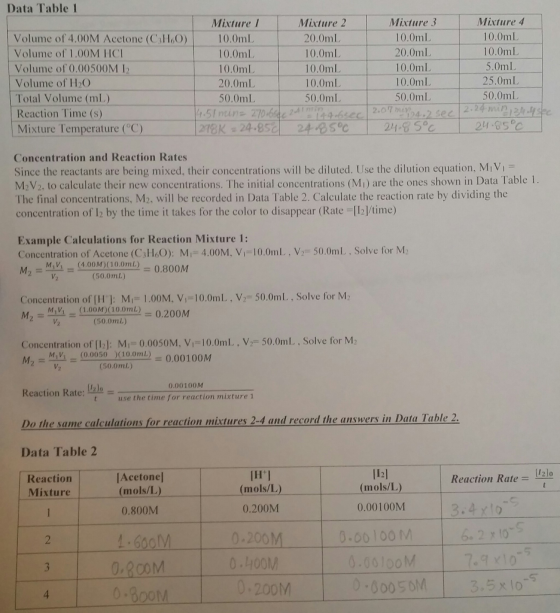
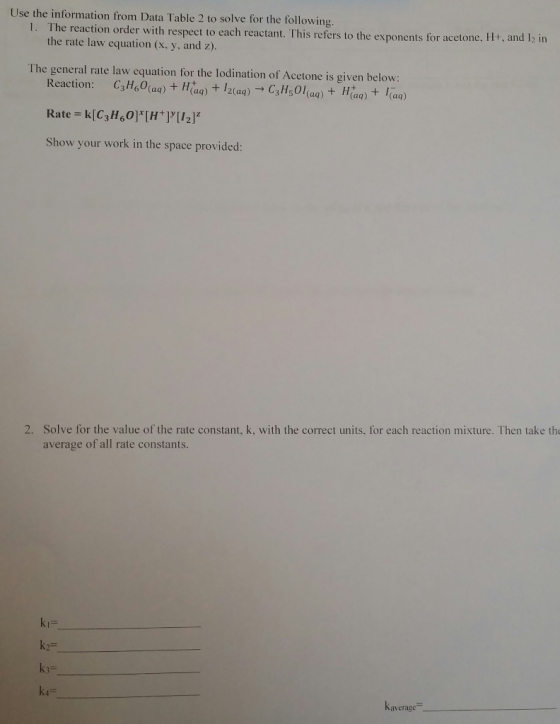
 Please help me solve page 2
and 3
Please help me solve page 2
and 3
Homework Answers
![3.4X10⁻⁵ Ang-I using data & Tond Table let Rate law equution ņS rate= k (acetone] Patron yr for Reaction mixture 1 p 3.0x10r](http://img.homeworklib.com/questions/461914d0-a43f-11ea-9e34-ad74f57b90b8.png?x-oss-process=image/resize,w_560)
Add Answer to:
Please help me solve page 2
and 3
Data Table 1 Mixture 4 Mixture1 Mixture 2...
Can this information be enough to help me get the answers for table 2? I don't...
 Can this information be enough to help me get the answers for
table 2? I don't know within the basic idea on how to do this.
Table 1. Reaction Time Data for Iodination of Acetone Mixture Trial 1, s Trial 2, s Trial 3, s Average Time, s 1 306 297 311 2 185 201 192 3 97 112 116 4 77 63 65 Validated Dry Lab Table 2. Reaction Conditions and Rate of Reaction. Initial Mixture [CH3COCH3], Initial [H*],...
Can this information be enough to help me get the answers for
table 2? I don't know within the basic idea on how to do this.
Table 1. Reaction Time Data for Iodination of Acetone Mixture Trial 1, s Trial 2, s Trial 3, s Average Time, s 1 306 297 311 2 185 201 192 3 97 112 116 4 77 63 65 Validated Dry Lab Table 2. Reaction Conditions and Rate of Reaction. Initial Mixture [CH3COCH3], Initial [H*],...
plz help complete my prelab heres the first page 3. A third reaction mixture was made up in the following way: 5 mL. 4.0 M acetone+ 5 mL 0.0050 M12+ 10 mL 1.0M HCI+5 mL H2O a. What were the initi...
 plz help complete my prelab
heres the first page
3. A third reaction mixture was made up in the following way: 5 mL. 4.0 M acetone+ 5 mL 0.0050 M12+ 10 mL 1.0M HCI+5 mL H2O a. What were the initial concentrations of acetone, 12 and H' ion in the reaction mixture? b. It took 109 seconds for the 12 color to disappear from the reaction mixture when at the same temperature as in question 1. What was the rate...
plz help complete my prelab
heres the first page
3. A third reaction mixture was made up in the following way: 5 mL. 4.0 M acetone+ 5 mL 0.0050 M12+ 10 mL 1.0M HCI+5 mL H2O a. What were the initial concentrations of acetone, 12 and H' ion in the reaction mixture? b. It took 109 seconds for the 12 color to disappear from the reaction mixture when at the same temperature as in question 1. What was the rate...
•Using the data from Table 2, you can now solve for the rate law exponents (m,...
 •Using the data from Table 2, you can now solve for the rate law
exponents (m, n, p).
•To do this, you will compare the data from two experiments,
where the concentration of one reactant changes and all others are
held constant. (Like we did in lecture)
•Your exponents should be a whole number (0,1,2,3)
Rate = k [C3H6O]m [I2]n [H+]p
Found:
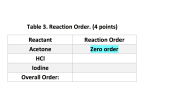
Table 3. Reaction Order. (4 points) Reactant Reaction Order Acetone Zero order НСІ lodine Overall Order: Table 2. Concentration...
•Using the data from Table 2, you can now solve for the rate law
exponents (m, n, p).
•To do this, you will compare the data from two experiments,
where the concentration of one reactant changes and all others are
held constant. (Like we did in lecture)
•Your exponents should be a whole number (0,1,2,3)
Rate = k [C3H6O]m [I2]n [H+]p
Found:
Table 3. Reaction Order. (4 points) Reactant Reaction Order Acetone Zero order НСІ lodine Overall Order: Table 2. Concentration...
please use the tables to solve the questions 2. Write the rate law for the reaction...
 please use the tables to solve the questions
2. Write the rate law for the reaction based on the Part 1 experimentally determined exponents rounded to the nearest integer. Specify the order of the reaction for each of the components and the overall order. 3. Calculate the rate constant, k, with appropriate units for each reaction mixture using the experimental rate law. All work must be shown for Mixture 1 in order to receive complete credit. Complete Table Ri, below....
please use the tables to solve the questions
2. Write the rate law for the reaction based on the Part 1 experimentally determined exponents rounded to the nearest integer. Specify the order of the reaction for each of the components and the overall order. 3. Calculate the rate constant, k, with appropriate units for each reaction mixture using the experimental rate law. All work must be shown for Mixture 1 in order to receive complete credit. Complete Table Ri, below....
how can i get the initial concentration of thiosulfate ion (S2O3) in reaction mixture 1 ?...
 how can i get the initial concentration of thiosulfate ion
(S2O3) in reaction mixture 1 ?
and also how can i determine the initial reaction rate for
mixture 1?
A Chemical Clock Your Report: Part I: Determination of the Rate Law 1. Complete Table 1 below using the volumes of each chemical used and the reaction to the reaction times measured that your team used to determine the rate law. Leave any unused rows D Reaction Mixture: Reaction Time /...
how can i get the initial concentration of thiosulfate ion
(S2O3) in reaction mixture 1 ?
and also how can i determine the initial reaction rate for
mixture 1?
A Chemical Clock Your Report: Part I: Determination of the Rate Law 1. Complete Table 1 below using the volumes of each chemical used and the reaction to the reaction times measured that your team used to determine the rate law. Leave any unused rows D Reaction Mixture: Reaction Time /...
Part 1 Calculations 1. Using the data in Table 2, determine the values of x, y,...
 Part 1 Calculations 1. Using the data in Table 2, determine the values of x, y, and z in the rate law for the iodination of acetone. Indicate the mixtures used for each and show all work. Show both the unrounded value and the value rounded to the nearest integer for the values of the exponents calculated. Rate = k[CH,COCHL_[" Exponent "x" Exponent "y" Exponent "z." Table 2. Reaction Conditions and Rate of Reaction. Initial Mixture Initial [H], Initial [12],...
A) in a reaction involving the iodination of acetone, the following volumes were used to make...
A) in a reaction involving the iodination of acetone, the following volumes were used to make up the reaction mixture: 10 mL 4.0 M acetone + 10 mL 1.0 M HCl + 10 mL 0.0050 M I2 + 20 mL H2O What is the total volume of the sample? V = ___ mL B) In a reaction involving the iodination of acetone, the following volumes were used to make up the reaction mixture: 10 mL 4.0 M acetone + 10...
Rates of Chemical Reaction Lab Iodination of Acetone 1- a student made up a reaction mixture...
 Rates of Chemical Reaction Lab
Iodination of Acetone
1- a student made up a reaction mixture
consisting of 10 mL 4 M acetone, 5 mL 1.0 M HCl 10 mL 0.005 M
I2 and 25 mL H2O.
Why is the concentration of iodine so much lower than the other
reactants?
3. How are time and rate related? How are 1/time and
rate related?
4. What does it mean when someone says a reaction is “first
order”?
5. In a...
Rates of Chemical Reaction Lab
Iodination of Acetone
1- a student made up a reaction mixture
consisting of 10 mL 4 M acetone, 5 mL 1.0 M HCl 10 mL 0.005 M
I2 and 25 mL H2O.
Why is the concentration of iodine so much lower than the other
reactants?
3. How are time and rate related? How are 1/time and
rate related?
4. What does it mean when someone says a reaction is “first
order”?
5. In a...
Table 2. Conditions for Reaction Rate Study. Volume solution, mL Vessel Solution Mixture 1 Mixture 2...
 Table 2. Conditions for Reaction Rate Study. Volume solution, mL Vessel Solution Mixture 1 Mixture 2 Mixture 3 Mixture 4 beaker 5.50 7.50 8.00 5.00 5.50 5.00 5.50 5.00 Water 12, 0.00100 M HCI, 0.500 M Starch indicator Acetone, 4.00 M 2.50 2.50 2.50 2.00 flask 2.00 2.50 5.00 2.00 2.50 2.00 2.50 5.00 Total volume 20.00 20.00 20.00 20.00 Table 2. Reaction Conditions and Rate of Reaction. Initial Mixture Initial [H], Initial [12], [CH3COCH3] Number M M M -A[12],...
please help answer questions for mixture 1 AND mixture 2 thank you! Table 23.1 Test Tube...
 please help answer questions for mixture 1 AND mixture 2 thank
you!
Table 23.1 Test Tube Number 1 2 3 4 5 5,00 1.00 5.00 2.00 Volume Fe(NO), solution (ml.) Volume KSCN solution (ml.) Volume H,O (ml.) 5.00 3.00 2.00 5.00 4.00 5.00 5.00 0.00 4.00 3.00 1.00 Mixture 2 3 4 5 Absorbance 0.079 0.165 0.246 0.311 0.400 In order to convert the absorbance values provided below into equilibrium concentrations of FeSCN?, you will need to know the slope...
please help answer questions for mixture 1 AND mixture 2 thank
you!
Table 23.1 Test Tube Number 1 2 3 4 5 5,00 1.00 5.00 2.00 Volume Fe(NO), solution (ml.) Volume KSCN solution (ml.) Volume H,O (ml.) 5.00 3.00 2.00 5.00 4.00 5.00 5.00 0.00 4.00 3.00 1.00 Mixture 2 3 4 5 Absorbance 0.079 0.165 0.246 0.311 0.400 In order to convert the absorbance values provided below into equilibrium concentrations of FeSCN?, you will need to know the slope...
 Can this information be enough to help me get the answers for
table 2? I don't know within the basic idea on how to do this.
Table 1. Reaction Time Data for Iodination of Acetone Mixture Trial 1, s Trial 2, s Trial 3, s Average Time, s 1 306 297 311 2 185 201 192 3 97 112 116 4 77 63 65 Validated Dry Lab Table 2. Reaction Conditions and Rate of Reaction. Initial Mixture [CH3COCH3], Initial [H*],...
Can this information be enough to help me get the answers for
table 2? I don't know within the basic idea on how to do this.
Table 1. Reaction Time Data for Iodination of Acetone Mixture Trial 1, s Trial 2, s Trial 3, s Average Time, s 1 306 297 311 2 185 201 192 3 97 112 116 4 77 63 65 Validated Dry Lab Table 2. Reaction Conditions and Rate of Reaction. Initial Mixture [CH3COCH3], Initial [H*],...
 plz help complete my prelab
heres the first page
3. A third reaction mixture was made up in the following way: 5 mL. 4.0 M acetone+ 5 mL 0.0050 M12+ 10 mL 1.0M HCI+5 mL H2O a. What were the initial concentrations of acetone, 12 and H' ion in the reaction mixture? b. It took 109 seconds for the 12 color to disappear from the reaction mixture when at the same temperature as in question 1. What was the rate...
plz help complete my prelab
heres the first page
3. A third reaction mixture was made up in the following way: 5 mL. 4.0 M acetone+ 5 mL 0.0050 M12+ 10 mL 1.0M HCI+5 mL H2O a. What were the initial concentrations of acetone, 12 and H' ion in the reaction mixture? b. It took 109 seconds for the 12 color to disappear from the reaction mixture when at the same temperature as in question 1. What was the rate...
 •Using the data from Table 2, you can now solve for the rate law
exponents (m, n, p).
•To do this, you will compare the data from two experiments,
where the concentration of one reactant changes and all others are
held constant. (Like we did in lecture)
•Your exponents should be a whole number (0,1,2,3)
Rate = k [C3H6O]m [I2]n [H+]p
Found:
Table 3. Reaction Order. (4 points) Reactant Reaction Order Acetone Zero order НСІ lodine Overall Order: Table 2. Concentration...
•Using the data from Table 2, you can now solve for the rate law
exponents (m, n, p).
•To do this, you will compare the data from two experiments,
where the concentration of one reactant changes and all others are
held constant. (Like we did in lecture)
•Your exponents should be a whole number (0,1,2,3)
Rate = k [C3H6O]m [I2]n [H+]p
Found:
Table 3. Reaction Order. (4 points) Reactant Reaction Order Acetone Zero order НСІ lodine Overall Order: Table 2. Concentration...
 please use the tables to solve the questions
2. Write the rate law for the reaction based on the Part 1 experimentally determined exponents rounded to the nearest integer. Specify the order of the reaction for each of the components and the overall order. 3. Calculate the rate constant, k, with appropriate units for each reaction mixture using the experimental rate law. All work must be shown for Mixture 1 in order to receive complete credit. Complete Table Ri, below....
please use the tables to solve the questions
2. Write the rate law for the reaction based on the Part 1 experimentally determined exponents rounded to the nearest integer. Specify the order of the reaction for each of the components and the overall order. 3. Calculate the rate constant, k, with appropriate units for each reaction mixture using the experimental rate law. All work must be shown for Mixture 1 in order to receive complete credit. Complete Table Ri, below....
 how can i get the initial concentration of thiosulfate ion
(S2O3) in reaction mixture 1 ?
and also how can i determine the initial reaction rate for
mixture 1?
A Chemical Clock Your Report: Part I: Determination of the Rate Law 1. Complete Table 1 below using the volumes of each chemical used and the reaction to the reaction times measured that your team used to determine the rate law. Leave any unused rows D Reaction Mixture: Reaction Time /...
how can i get the initial concentration of thiosulfate ion
(S2O3) in reaction mixture 1 ?
and also how can i determine the initial reaction rate for
mixture 1?
A Chemical Clock Your Report: Part I: Determination of the Rate Law 1. Complete Table 1 below using the volumes of each chemical used and the reaction to the reaction times measured that your team used to determine the rate law. Leave any unused rows D Reaction Mixture: Reaction Time /...
 Part 1 Calculations 1. Using the data in Table 2, determine the values of x, y, and z in the rate law for the iodination of acetone. Indicate the mixtures used for each and show all work. Show both the unrounded value and the value rounded to the nearest integer for the values of the exponents calculated. Rate = k[CH,COCHL_[" Exponent "x" Exponent "y" Exponent "z." Table 2. Reaction Conditions and Rate of Reaction. Initial Mixture Initial [H], Initial [12],...
 Rates of Chemical Reaction Lab
Iodination of Acetone
1- a student made up a reaction mixture
consisting of 10 mL 4 M acetone, 5 mL 1.0 M HCl 10 mL 0.005 M
I2 and 25 mL H2O.
Why is the concentration of iodine so much lower than the other
reactants?
3. How are time and rate related? How are 1/time and
rate related?
4. What does it mean when someone says a reaction is “first
order”?
5. In a...
Rates of Chemical Reaction Lab
Iodination of Acetone
1- a student made up a reaction mixture
consisting of 10 mL 4 M acetone, 5 mL 1.0 M HCl 10 mL 0.005 M
I2 and 25 mL H2O.
Why is the concentration of iodine so much lower than the other
reactants?
3. How are time and rate related? How are 1/time and
rate related?
4. What does it mean when someone says a reaction is “first
order”?
5. In a...
 Table 2. Conditions for Reaction Rate Study. Volume solution, mL Vessel Solution Mixture 1 Mixture 2 Mixture 3 Mixture 4 beaker 5.50 7.50 8.00 5.00 5.50 5.00 5.50 5.00 Water 12, 0.00100 M HCI, 0.500 M Starch indicator Acetone, 4.00 M 2.50 2.50 2.50 2.00 flask 2.00 2.50 5.00 2.00 2.50 2.00 2.50 5.00 Total volume 20.00 20.00 20.00 20.00 Table 2. Reaction Conditions and Rate of Reaction. Initial Mixture Initial [H], Initial [12], [CH3COCH3] Number M M M -A[12],...
 please help answer questions for mixture 1 AND mixture 2 thank
you!
Table 23.1 Test Tube Number 1 2 3 4 5 5,00 1.00 5.00 2.00 Volume Fe(NO), solution (ml.) Volume KSCN solution (ml.) Volume H,O (ml.) 5.00 3.00 2.00 5.00 4.00 5.00 5.00 0.00 4.00 3.00 1.00 Mixture 2 3 4 5 Absorbance 0.079 0.165 0.246 0.311 0.400 In order to convert the absorbance values provided below into equilibrium concentrations of FeSCN?, you will need to know the slope...
please help answer questions for mixture 1 AND mixture 2 thank
you!
Table 23.1 Test Tube Number 1 2 3 4 5 5,00 1.00 5.00 2.00 Volume Fe(NO), solution (ml.) Volume KSCN solution (ml.) Volume H,O (ml.) 5.00 3.00 2.00 5.00 4.00 5.00 5.00 0.00 4.00 3.00 1.00 Mixture 2 3 4 5 Absorbance 0.079 0.165 0.246 0.311 0.400 In order to convert the absorbance values provided below into equilibrium concentrations of FeSCN?, you will need to know the slope...
Most questions answered within 3 hours.
-
Where is the error in this code sequence?
String s1 = "Hello";
String s2 = "ello";...
asked 10 months ago -
Financial data for Joel de Paris, Inc., for last year
follow:
Joel de Paris, Inc.
Balance...
asked 10 months ago -
Consider this reaction:
Al2(SO4)3 (aq)+ BaCl3
(aq) Al2Cl6 (aq)- +
3BaSO4(s) . What is the...
asked 10 months ago -
Suppose that Savneet is considering increasing her
recent random sample from 20 car rentals to 40...
asked 10 months ago -
Trucks arrive at an unloading terminal at an average rate of 120
per hour.
Trucks arrive...
asked 10 months ago -
Why are methanol and ethanol completely soluble in water while
octanol is not very little soluble....
asked 10 months ago -
A facilities manager at a university reads in a research report
that the mean amount of...
asked 10 months ago -
When the CuSO4 is rehydrated by adding water to the anhydrous
compound, is this an endothermic...
asked 10 months ago -
A ray of sunlight is passing from diamond into crown glass; the
angle of incidence is...
asked 10 months ago -
A block of mass 0.249 kg is placed on top of a light, vertical
spring of...
asked 10 months ago -
how do the kidneys compensate in the presences of acidosis
a) trigger hyperventilate
b) reserve acid...
asked 10 months ago -
Question 501 pts
The rental rate of capital to the firm increases. Which of the
following...
asked 10 months ago