CA= Current Account The CA is equal to: Y - (C - I + G). Y...
CA= Current Account
|
The CA is equal to: Y - (C - I + G). Y + (C + I + G). Y - (C + I + G). Y - (C + I - G). Y + (C - I - G). |
Homework Answers
Request Answer!
We need at least 10 more requests to produce the answer.
0 / 10 have requested this problem solution
The more requests, the faster the answer.
Which of the following is NOT true about this national income equation: S + (T - G) = I + CA A) For the current account,...
Which of the following is NOT true about this national income equation: S + (T - G) = I + CA A) For the current account, CA, to improve, we may have to invest less than otherwise would be the case. B) For the current account, CA, to improve, we may have to save less to maintain the same amount of investment that includes foreign saving. C) For the current account, CA, to improve, the government may have to run...
We have the following model of the economy: (I)Y-C+S+T (2) E-C+I+G (3) Y E (4) C-(YD. CA (5) S-s(...
 1-5
We have the following model of the economy: (I)Y-C+S+T (2) E-C+I+G (3) Y E (4) C-(YD. CA (5) S-s(YD SA) (6) I=IA 7) G-GA (8) T TA (9) YD Y T (10) Deficit =G-T The following data for equilibrium values will help in this problem. G-800 I 30 T=650 Y'=5,000 Calculate 1. the equilibrium value of consumption 2. marginal propensity to consume (AC/AY) 3. the expenditure multiplier 4. The government budget now has an imbalance ofThis is a DEFICIT...
1-5
We have the following model of the economy: (I)Y-C+S+T (2) E-C+I+G (3) Y E (4) C-(YD. CA (5) S-s(YD SA) (6) I=IA 7) G-GA (8) T TA (9) YD Y T (10) Deficit =G-T The following data for equilibrium values will help in this problem. G-800 I 30 T=650 Y'=5,000 Calculate 1. the equilibrium value of consumption 2. marginal propensity to consume (AC/AY) 3. the expenditure multiplier 4. The government budget now has an imbalance ofThis is a DEFICIT...
Can anyone please help me with this question?? Here are the abbreviations... CA: Current Account KA:...
 Can
anyone please help me with this question?? Here are the
abbreviations...
CA: Current Account
KA: Capital Account
NUT: Net Unilateral Transfers
TB: Trade Balance
C: Consumption(personal consumption expenditures)
G: Government Consumption(government expenditures)
GNE: Gross National Expenditure
Question 3) Use the following data on the hypothetical economy to answer the following questions: CA: $5000 million C: $3000 million KA: $100 million G: $1000 million NUT: $50 million GNE: $7000 million TB: $800 million نه ف What is the financial account...
Can
anyone please help me with this question?? Here are the
abbreviations...
CA: Current Account
KA: Capital Account
NUT: Net Unilateral Transfers
TB: Trade Balance
C: Consumption(personal consumption expenditures)
G: Government Consumption(government expenditures)
GNE: Gross National Expenditure
Question 3) Use the following data on the hypothetical economy to answer the following questions: CA: $5000 million C: $3000 million KA: $100 million G: $1000 million NUT: $50 million GNE: $7000 million TB: $800 million نه ف What is the financial account...
Assume C-50+0.6 (Y -T) G = 15 I = 15 T=2 (a) Y at equilibrium is...
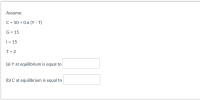 Assume C-50+0.6 (Y -T) G = 15 I = 15 T=2 (a) Y at equilibrium is equal to (b) C at equilibrium is equal to
The options are : National savings = (Y - C - G) or (Y-C) or (G-T)...
 The options are : National savings = (Y - C - G)
or (Y-C) or (G-T)
or (Y-T-G)
for the second blank under National Savings the options are (Y)
or (I) or (C) or
(G)
The options are : Private savings = (Y - C - T)
or (Y - T - I) or (T - G)
or (C -T)
The options are : Public Savungs = (Y - C - T)
or (Y - T - I) or (T...
The options are : National savings = (Y - C - G)
or (Y-C) or (G-T)
or (Y-T-G)
for the second blank under National Savings the options are (Y)
or (I) or (C) or
(G)
The options are : Private savings = (Y - C - T)
or (Y - T - I) or (T - G)
or (C -T)
The options are : Public Savungs = (Y - C - T)
or (Y - T - I) or (T...
The income identity for a closed economy says that Y = C+I+G Assume that in the...
The income identity for a closed economy says that Y = C+I+G Assume that in the Economy of Berkeley GDP (Y) is equal to 6,000 and consumption (C) is given by the equation: C = 600 + 0.6(Y-T) In addition, investment (I) is given by the equation I = 2,000 - 100r where r is the real of interest rate in percent. Taxes (T) are 500 and government spending (G) is also 500. What are the equilibrium values of C,...
Assume the following equations summarize the structure of an economy. C =Ca +0.7(Y-T) Ca = 2,000...
Assume the following equations summarize the structure of an economy. C =Ca +0.7(Y-T) Ca = 2,000 - 5r T = 150 + 0.15Y (M/P)d = 0.3Y - 10r MS/P = 3,000 i = 2,000 -10r G = 4,000- .2y NX = 1,500 - 0.1Y- 5r A. Calculate the equilibrium real output (Y) and (r). B. If government spending increases by 100, compute by how much the fed must increase the money supply if it wants to avoid the crowding out...
C=160+0.6Yd I=150 G=150 T=100 Yd=Y-T (a) Assume that output is equal to 900. Compute total demand....
C=160+0.6Yd I=150 G=150 T=100 Yd=Y-T (a) Assume that output is equal to 900. Compute total demand. Is it equal to output? Explain. (b) Assume that output is equal to 1000. Compute total demand. Is it equal to output? Explain. (c) Assume output is equal to 1000. Compute private saving. Is it equal to investment? Explain.
In a closed economy, private saving, , is equal to I - (G - T). I + (G - T). I + (G + T). I - (G + T). I + (G - T) + C....
In a closed economy, private saving, , is equal to I - (G - T). I + (G - T). I + (G + T). I - (G + T). I + (G - T) + C.
What happens to the current account (CA) if there were a reduction in the budget deficit?...
What happens to the current account (CA) if there were a reduction in the budget deficit? Explain taking into consideration possible changes in investment and private savings.
 1-5
We have the following model of the economy: (I)Y-C+S+T (2) E-C+I+G (3) Y E (4) C-(YD. CA (5) S-s(YD SA) (6) I=IA 7) G-GA (8) T TA (9) YD Y T (10) Deficit =G-T The following data for equilibrium values will help in this problem. G-800 I 30 T=650 Y'=5,000 Calculate 1. the equilibrium value of consumption 2. marginal propensity to consume (AC/AY) 3. the expenditure multiplier 4. The government budget now has an imbalance ofThis is a DEFICIT...
1-5
We have the following model of the economy: (I)Y-C+S+T (2) E-C+I+G (3) Y E (4) C-(YD. CA (5) S-s(YD SA) (6) I=IA 7) G-GA (8) T TA (9) YD Y T (10) Deficit =G-T The following data for equilibrium values will help in this problem. G-800 I 30 T=650 Y'=5,000 Calculate 1. the equilibrium value of consumption 2. marginal propensity to consume (AC/AY) 3. the expenditure multiplier 4. The government budget now has an imbalance ofThis is a DEFICIT...
 Can
anyone please help me with this question?? Here are the
abbreviations...
CA: Current Account
KA: Capital Account
NUT: Net Unilateral Transfers
TB: Trade Balance
C: Consumption(personal consumption expenditures)
G: Government Consumption(government expenditures)
GNE: Gross National Expenditure
Question 3) Use the following data on the hypothetical economy to answer the following questions: CA: $5000 million C: $3000 million KA: $100 million G: $1000 million NUT: $50 million GNE: $7000 million TB: $800 million نه ف What is the financial account...
Can
anyone please help me with this question?? Here are the
abbreviations...
CA: Current Account
KA: Capital Account
NUT: Net Unilateral Transfers
TB: Trade Balance
C: Consumption(personal consumption expenditures)
G: Government Consumption(government expenditures)
GNE: Gross National Expenditure
Question 3) Use the following data on the hypothetical economy to answer the following questions: CA: $5000 million C: $3000 million KA: $100 million G: $1000 million NUT: $50 million GNE: $7000 million TB: $800 million نه ف What is the financial account...
 Assume C-50+0.6 (Y -T) G = 15 I = 15 T=2 (a) Y at equilibrium is equal to (b) C at equilibrium is equal to
 The options are : National savings = (Y - C - G)
or (Y-C) or (G-T)
or (Y-T-G)
for the second blank under National Savings the options are (Y)
or (I) or (C) or
(G)
The options are : Private savings = (Y - C - T)
or (Y - T - I) or (T - G)
or (C -T)
The options are : Public Savungs = (Y - C - T)
or (Y - T - I) or (T...
The options are : National savings = (Y - C - G)
or (Y-C) or (G-T)
or (Y-T-G)
for the second blank under National Savings the options are (Y)
or (I) or (C) or
(G)
The options are : Private savings = (Y - C - T)
or (Y - T - I) or (T - G)
or (C -T)
The options are : Public Savungs = (Y - C - T)
or (Y - T - I) or (T...
Most questions answered within 3 hours.
-
Where is the error in this code sequence?
String s1 = "Hello";
String s2 = "ello";...
asked 10 months ago -
Financial data for Joel de Paris, Inc., for last year
follow:
Joel de Paris, Inc.
Balance...
asked 10 months ago -
Consider this reaction:
Al2(SO4)3 (aq)+ BaCl3
(aq) Al2Cl6 (aq)- +
3BaSO4(s) . What is the...
asked 10 months ago -
Suppose that Savneet is considering increasing her
recent random sample from 20 car rentals to 40...
asked 10 months ago -
Trucks arrive at an unloading terminal at an average rate of 120
per hour.
Trucks arrive...
asked 10 months ago -
Why are methanol and ethanol completely soluble in water while
octanol is not very little soluble....
asked 10 months ago -
A facilities manager at a university reads in a research report
that the mean amount of...
asked 10 months ago -
When the CuSO4 is rehydrated by adding water to the anhydrous
compound, is this an endothermic...
asked 10 months ago -
A ray of sunlight is passing from diamond into crown glass; the
angle of incidence is...
asked 10 months ago -
A block of mass 0.249 kg is placed on top of a light, vertical
spring of...
asked 10 months ago -
how do the kidneys compensate in the presences of acidosis
a) trigger hyperventilate
b) reserve acid...
asked 10 months ago -
Question 501 pts
The rental rate of capital to the firm increases. Which of the
following...
asked 10 months ago