Experiment #6: Saponification of Wintergreen Oil 1.) Draw a reaction mechanism for the conversion of wintergreen...
Experiment #6: Saponification of Wintergreen Oil
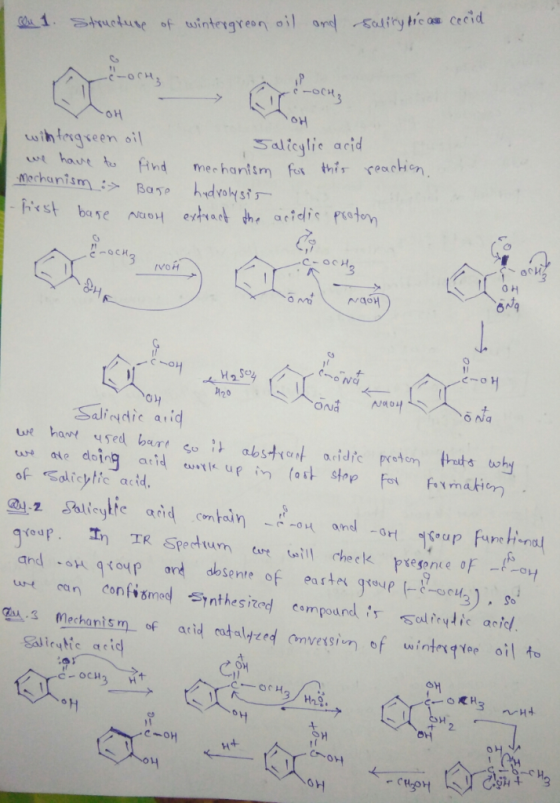
1.) Draw a reaction mechanism for the conversion of wintergreen oil into salicylic acid.
2. ) If you wanted to take an IR spectrum to confirm that the reaction worked, what would you look for in the spectrum?
3.) It is also possible to hydrolyze an ester under acidic conditions. Draw a mechanism for the acid-catalyzed conversion of wintergreen oil to salicylic acid.
Homework Answers
Add Answer to:
Experiment #6: Saponification of Wintergreen
Oil
1.) Draw a reaction mechanism for the conversion of
wintergreen...
CHEM 242L Exp. 4 Report/ Synthesis of Oil of Wintergreen Name Score: 20 1) Assess the effectivene...
 please answer all these questions, thank you.
CHEM 242L Exp. 4 Report/ Synthesis of Oil of Wintergreen Name Score: 20 1) Assess the effectiveness of the experiment and your technique by A) reporting the yield of each step in grams and percent as well as the overall percent yield (What is "overall percent yield?). SHOW ALL CALCULATIONS! B) Give a complete analysis of the identity and purity of your final product and any isolated intermediates 2 What was the purpose...
please answer all these questions, thank you.
CHEM 242L Exp. 4 Report/ Synthesis of Oil of Wintergreen Name Score: 20 1) Assess the effectiveness of the experiment and your technique by A) reporting the yield of each step in grams and percent as well as the overall percent yield (What is "overall percent yield?). SHOW ALL CALCULATIONS! B) Give a complete analysis of the identity and purity of your final product and any isolated intermediates 2 What was the purpose...
4. Conversion of B into C involves hydrolysis of the ester followed by decarboxylation. On the...
 4. Conversion of B into C involves hydrolysis of the ester followed by decarboxylation. On the structures provided below, show the electron flow for the decarboxylation step. CH2Ph 5. The initial product formed on decarboxylation is an enol, which rapidly equilibrates to its keto form under the acidic reaction conditions. Write the complete stepwise mechanism for the acid-catalyzed conversion of the enol into its keto form, Compound C. Ph Ph
Carboxylic Acids and Esters EXPERIMENT 22 OBSERVATIONS AND RESULTS Synthesis and Identification of an Ester: Esterification...
 Carboxylic Acids and Esters EXPERIMENT 22 OBSERVATIONS AND RESULTS Synthesis and Identification of an Ester: Esterification 1. Give the name and structure of the ester which you synthesized. What fruit did you associate with the odor of the ester? to noldsoinogs w to esar bnn eaman sd vio stolpi Look up the ester and its fruit sburce in your textbook. (If it is not in your textbook, ask your instructor.) Did you associate the ester with the right fruit? If...
Hydration of alkenes under aqueous acidic conditions. Draw the detailed stepwise mechanism for this reaction. Be...
 Hydration of alkenes under aqueous acidic conditions. Draw the detailed stepwise mechanism for this reaction. Be sure to show all steps, intermediates, formal charges, and show the movement of electrons with curved arrows. You do not need to draw transition states. H2SO4 H20 ?? The hydration of alkynes can also occur under aqueous acidic conditions however, instead of forming the alcohol, a ketone is formed. Draw the detailed stepwise mechanism for the conversion of the alkyne to the ketone (one...
Fisher Esterification lab. 1. What can happen if the water produced in the reaction is not...
 Fisher Esterification lab.
1. What can happen if the water produced in the reaction is not
removed, and the same conditions of reflux and temperature
continue?
2. Complete the following table by writing the missing
names:
3. Consider the start of the reaction (time 0) when all the
reagents necessary to carry out the esterification have been
mixed.
a. What signals of the corresponding IR spectrum of that
initial reagent mixture should be observed to change significantly
when the reaction...
Fisher Esterification lab.
1. What can happen if the water produced in the reaction is not
removed, and the same conditions of reflux and temperature
continue?
2. Complete the following table by writing the missing
names:
3. Consider the start of the reaction (time 0) when all the
reagents necessary to carry out the esterification have been
mixed.
a. What signals of the corresponding IR spectrum of that
initial reagent mixture should be observed to change significantly
when the reaction...
please help! thank you 47) Draw out the reaction mechanism for a Fischer esterification reaction with...
 please help! thank you
47) Draw out the reaction mechanism for a Fischer esterification reaction with ethanol and benzoic acid in hot acidic conditions. Name the products. 48) Draw out the reaction mechanism for a Fischer esterification reaction when 5-hydroxyhexanoic acid is heated. Name the products if you feel ambitious.
please help! thank you
47) Draw out the reaction mechanism for a Fischer esterification reaction with ethanol and benzoic acid in hot acidic conditions. Name the products. 48) Draw out the reaction mechanism for a Fischer esterification reaction when 5-hydroxyhexanoic acid is heated. Name the products if you feel ambitious.
Fisher Esterification lab. 1. What can happen if the water produced in the reaction is not removed, and the same cond...
 Fisher Esterification lab.
1. What can happen if the water produced in the reaction is
not removed, and the same conditions of reflux and temperature
continue?
2. Complete the following table by writing the missing
names:
3. Consider the start of the reaction (time 0) when all the
reagents necessary to carry out the esterification have been
mixed.
a. What signals of the corresponding IR spectrum of that
initial reagent mixture should be observed to change significantly
when the reaction...
Fisher Esterification lab.
1. What can happen if the water produced in the reaction is
not removed, and the same conditions of reflux and temperature
continue?
2. Complete the following table by writing the missing
names:
3. Consider the start of the reaction (time 0) when all the
reagents necessary to carry out the esterification have been
mixed.
a. What signals of the corresponding IR spectrum of that
initial reagent mixture should be observed to change significantly
when the reaction...
6. "Fun in base" question: Draw a reaction mechanism using the curved-arrow formalism (include lone pair...
 6. "Fun in base" question: Draw a reaction mechanism using the curved-arrow formalism (include lone pair electrons) for the conversion of methyl salicylate into the corresponding conjugate base of salicylic acid and methanol in the presence of excess aqueous hydroxide. Hint: The first step is an acid- base reaction. H20 осни + он o + CH OH (in excess; used as solvent) ОН Be sure you explain acid-base chemistry and use appropriate PK, values in steps 1 and 4. Compound...
1. Draw the mechanism of the reaction you performed in this lab using the same starting...
1. Draw the mechanism of the reaction you performed in this lab using the same starting materials you used. You can start from the diazonium salt (you don’t need to show how the amine is converted into a diazonium). What is the name of the final product? Starting Materials used: metanilic acid (3-aminobenzenesulfonic acid) and salicylic acid
3. Draw a stepwise, detailed mechanism for the acid-catalyzed hydration reaction in question 2 above. Use...
 3. Draw a stepwise, detailed mechanism for the acid-catalyzed hydration reaction in question 2 above. Use curved arrows to indicate the flow of electrons. (Note: use hydronium ion, H307, in your mechanism to indicate "acidic water"). (6 pts) 4. Draw a stepwise, detailed mechanism for the reaction below. Use curved arrows to indicate the flow of electrons. (Hint: think of this reaction as a combination of addition of HX (step 1) and hydration (step 2)]. In the second step, an...
 please answer all these questions, thank you.
CHEM 242L Exp. 4 Report/ Synthesis of Oil of Wintergreen Name Score: 20 1) Assess the effectiveness of the experiment and your technique by A) reporting the yield of each step in grams and percent as well as the overall percent yield (What is "overall percent yield?). SHOW ALL CALCULATIONS! B) Give a complete analysis of the identity and purity of your final product and any isolated intermediates 2 What was the purpose...
please answer all these questions, thank you.
CHEM 242L Exp. 4 Report/ Synthesis of Oil of Wintergreen Name Score: 20 1) Assess the effectiveness of the experiment and your technique by A) reporting the yield of each step in grams and percent as well as the overall percent yield (What is "overall percent yield?). SHOW ALL CALCULATIONS! B) Give a complete analysis of the identity and purity of your final product and any isolated intermediates 2 What was the purpose...
 4. Conversion of B into C involves hydrolysis of the ester followed by decarboxylation. On the structures provided below, show the electron flow for the decarboxylation step. CH2Ph 5. The initial product formed on decarboxylation is an enol, which rapidly equilibrates to its keto form under the acidic reaction conditions. Write the complete stepwise mechanism for the acid-catalyzed conversion of the enol into its keto form, Compound C. Ph Ph
 Carboxylic Acids and Esters EXPERIMENT 22 OBSERVATIONS AND RESULTS Synthesis and Identification of an Ester: Esterification 1. Give the name and structure of the ester which you synthesized. What fruit did you associate with the odor of the ester? to noldsoinogs w to esar bnn eaman sd vio stolpi Look up the ester and its fruit sburce in your textbook. (If it is not in your textbook, ask your instructor.) Did you associate the ester with the right fruit? If...
 Hydration of alkenes under aqueous acidic conditions. Draw the detailed stepwise mechanism for this reaction. Be sure to show all steps, intermediates, formal charges, and show the movement of electrons with curved arrows. You do not need to draw transition states. H2SO4 H20 ?? The hydration of alkynes can also occur under aqueous acidic conditions however, instead of forming the alcohol, a ketone is formed. Draw the detailed stepwise mechanism for the conversion of the alkyne to the ketone (one...
 Fisher Esterification lab.
1. What can happen if the water produced in the reaction is not
removed, and the same conditions of reflux and temperature
continue?
2. Complete the following table by writing the missing
names:
3. Consider the start of the reaction (time 0) when all the
reagents necessary to carry out the esterification have been
mixed.
a. What signals of the corresponding IR spectrum of that
initial reagent mixture should be observed to change significantly
when the reaction...
Fisher Esterification lab.
1. What can happen if the water produced in the reaction is not
removed, and the same conditions of reflux and temperature
continue?
2. Complete the following table by writing the missing
names:
3. Consider the start of the reaction (time 0) when all the
reagents necessary to carry out the esterification have been
mixed.
a. What signals of the corresponding IR spectrum of that
initial reagent mixture should be observed to change significantly
when the reaction...
 please help! thank you
47) Draw out the reaction mechanism for a Fischer esterification reaction with ethanol and benzoic acid in hot acidic conditions. Name the products. 48) Draw out the reaction mechanism for a Fischer esterification reaction when 5-hydroxyhexanoic acid is heated. Name the products if you feel ambitious.
please help! thank you
47) Draw out the reaction mechanism for a Fischer esterification reaction with ethanol and benzoic acid in hot acidic conditions. Name the products. 48) Draw out the reaction mechanism for a Fischer esterification reaction when 5-hydroxyhexanoic acid is heated. Name the products if you feel ambitious.
 Fisher Esterification lab.
1. What can happen if the water produced in the reaction is
not removed, and the same conditions of reflux and temperature
continue?
2. Complete the following table by writing the missing
names:
3. Consider the start of the reaction (time 0) when all the
reagents necessary to carry out the esterification have been
mixed.
a. What signals of the corresponding IR spectrum of that
initial reagent mixture should be observed to change significantly
when the reaction...
Fisher Esterification lab.
1. What can happen if the water produced in the reaction is
not removed, and the same conditions of reflux and temperature
continue?
2. Complete the following table by writing the missing
names:
3. Consider the start of the reaction (time 0) when all the
reagents necessary to carry out the esterification have been
mixed.
a. What signals of the corresponding IR spectrum of that
initial reagent mixture should be observed to change significantly
when the reaction...
 6. "Fun in base" question: Draw a reaction mechanism using the curved-arrow formalism (include lone pair electrons) for the conversion of methyl salicylate into the corresponding conjugate base of salicylic acid and methanol in the presence of excess aqueous hydroxide. Hint: The first step is an acid- base reaction. H20 осни + он o + CH OH (in excess; used as solvent) ОН Be sure you explain acid-base chemistry and use appropriate PK, values in steps 1 and 4. Compound...
 3. Draw a stepwise, detailed mechanism for the acid-catalyzed hydration reaction in question 2 above. Use curved arrows to indicate the flow of electrons. (Note: use hydronium ion, H307, in your mechanism to indicate "acidic water"). (6 pts) 4. Draw a stepwise, detailed mechanism for the reaction below. Use curved arrows to indicate the flow of electrons. (Hint: think of this reaction as a combination of addition of HX (step 1) and hydration (step 2)]. In the second step, an...
Most questions answered within 3 hours.
-
Where is the error in this code sequence?
String s1 = "Hello";
String s2 = "ello";...
asked 11 months ago -
Financial data for Joel de Paris, Inc., for last year
follow:
Joel de Paris, Inc.
Balance...
asked 11 months ago -
Consider this reaction:
Al2(SO4)3 (aq)+ BaCl3
(aq) Al2Cl6 (aq)- +
3BaSO4(s) . What is the...
asked 11 months ago -
Suppose that Savneet is considering increasing her
recent random sample from 20 car rentals to 40...
asked 11 months ago -
Trucks arrive at an unloading terminal at an average rate of 120
per hour.
Trucks arrive...
asked 11 months ago -
Why are methanol and ethanol completely soluble in water while
octanol is not very little soluble....
asked 11 months ago -
A facilities manager at a university reads in a research report
that the mean amount of...
asked 11 months ago -
When the CuSO4 is rehydrated by adding water to the anhydrous
compound, is this an endothermic...
asked 11 months ago -
A ray of sunlight is passing from diamond into crown glass; the
angle of incidence is...
asked 11 months ago -
A block of mass 0.249 kg is placed on top of a light, vertical
spring of...
asked 11 months ago -
how do the kidneys compensate in the presences of acidosis
a) trigger hyperventilate
b) reserve acid...
asked 11 months ago -
Question 501 pts
The rental rate of capital to the firm increases. Which of the
following...
asked 11 months ago