
Homework Answers
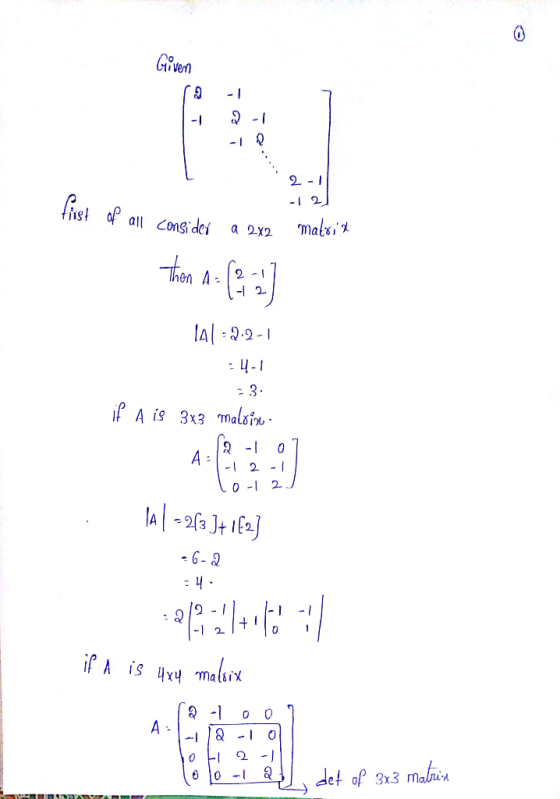
![12 - 0 1 -1 0 JA: 2-1 2-1 Hilo 2-1 O-L-2 Tol 2 Tourettin 42 :2[4]- 1(3) -3 =dx(de l of 3x3 malsief-1 (det of 242 matsire) by](http://img.homeworklib.com/questions/c01b81c0-ad8a-11ea-ba33-71c7cd947401.png?x-oss-process=image/resize,w_560)
Add Answer to:
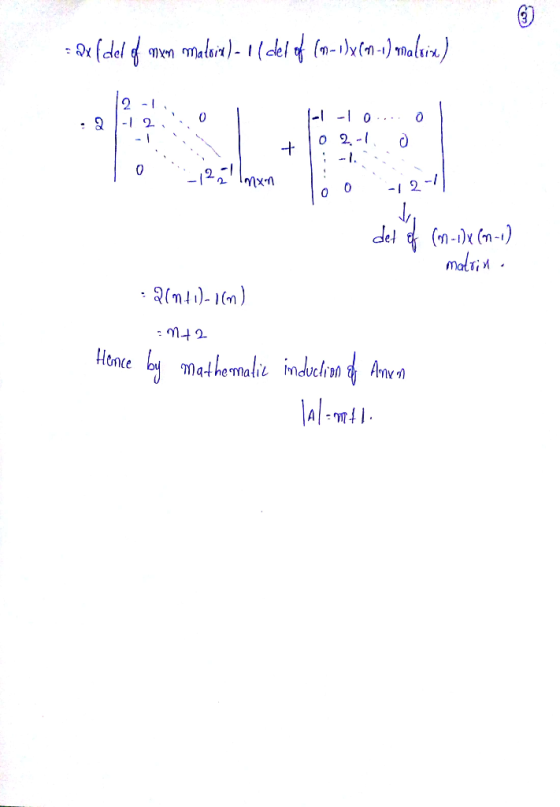
Compute the determinant of the following n x n matrix: [ 2-1 -1 2-1 -1 2...
general order n x n 2.21 Find the determinant and inverse of the nxn matrix 10...
 general order n x n
2.21 Find the determinant and inverse of the nxn matrix 10 1 1 ... 1 0 1 ... 1 1 0 ... 1 1 1 1 1 1 ...
general order n x n
2.21 Find the determinant and inverse of the nxn matrix 10 1 1 ... 1 0 1 ... 1 1 0 ... 1 1 1 1 1 1 ...
Let A be an n×n matrix. Mark each statement as true or false. Justify each answer. a. An n×n determinant is define...
Let A be an n×n matrix. Mark each statement as true or false. Justify each answer. a. An n×n determinant is defined by determinants of (n−1)×(n−1) submatrices. b. The (i,j)-cofactor of a matrix A is the matrix obtained by deleting from A its I’th row and j’th column. a. Choose the correct answer below. A. The statement is false. Although determinants of (n−1)×(n−1)submatrices can be used to find n×n determinants,they are not involved in the definition of n×n determinants. B....
1. To prove the theorem in detail. Theorem: det A for any n X n-matrix A can be computed by a cof...
 1. To prove the theorem in detail. Theorem: det A for any n X n-matrix A can be computed by a cofactor expansion across the ith row of A, that is, det A H-1)adtAj Hint: Use induction on i, For the induction step from i to i+1, flip rows i and i+1 (How does this change the determinant?) and use the induction assumption.
1. To prove the theorem in detail. Theorem: det A for any n X n-matrix A can...
1. To prove the theorem in detail. Theorem: det A for any n X n-matrix A can be computed by a cofactor expansion across the ith row of A, that is, det A H-1)adtAj Hint: Use induction on i, For the induction step from i to i+1, flip rows i and i+1 (How does this change the determinant?) and use the induction assumption.
1. To prove the theorem in detail. Theorem: det A for any n X n-matrix A can...
QUESTION: PROVE THE FOLLOWING 4.3 THEOREM IN THE CASE r=1(no induction required, just use the definition of the determ...
 QUESTION: PROVE THE FOLLOWING 4.3 THEOREM IN THE CASE
r=1(no induction required, just use the definition of the
determinants)
Theorem 4.3. The determinant of an n × n matrix is a linear function of each row when the remaining rows are held fixed. That is, for 1 Sr S n, we have ar-1 ar-1 ar-1 ar+1 ar+1 ar+1 an an rt whenever k is a scalar and u, v, and each a are row vectors in F". Proof. The proof...
QUESTION: PROVE THE FOLLOWING 4.3 THEOREM IN THE CASE
r=1(no induction required, just use the definition of the
determinants)
Theorem 4.3. The determinant of an n × n matrix is a linear function of each row when the remaining rows are held fixed. That is, for 1 Sr S n, we have ar-1 ar-1 ar-1 ar+1 ar+1 ar+1 an an rt whenever k is a scalar and u, v, and each a are row vectors in F". Proof. The proof...
4. Compute 9n for n 0, 1, 2, 3,4, 5. What are the possible values of the units digit of gn for al...
 4. Compute 9n for n 0, 1, 2, 3,4, 5. What are the possible values of the units digit of gn for all integers n 20? 5. Use the Principle of Strong Mathematical Induction to prove your answer in problem 4 is correct.
4. Compute 9n for n 0, 1, 2, 3,4, 5. What are the possible values of the units digit of gn for all integers n 20? 5. Use the Principle of Strong Mathematical Induction to prove your...
4. Compute 9n for n 0, 1, 2, 3,4, 5. What are the possible values of the units digit of gn for all integers n 20? 5. Use the Principle of Strong Mathematical Induction to prove your answer in problem 4 is correct.
4. Compute 9n for n 0, 1, 2, 3,4, 5. What are the possible values of the units digit of gn for all integers n 20? 5. Use the Principle of Strong Mathematical Induction to prove your...
2. Let A be an n x n matrix with AT =-A (a) Prove that A...
 2. Let A be an n x n matrix with AT =-A (a) Prove that A has value 0. (b) Prove that A has determinant 0 if n is odd.
1. Prove the following statement by mathematical induction. For all positive integers n. 2++ n+1) =...
 1. Prove the following statement by mathematical induction. For all positive integers n. 2++ n+1) = 2. Prove the following statement by mathematical induction. For all nonnegative integers n, 3 divides 22n-1. 3. Prove the following statement by mathematical induction. For all integers n 27,3" <n!
Prove by mathematical induction (discrete mathematics) n? - 2*n-1 > 0 n> 3
 Prove by mathematical induction (discrete mathematics)
n? - 2*n-1 > 0 n> 3
Prove by mathematical induction (discrete mathematics)
n? - 2*n-1 > 0 n> 3
Explain all parts of question 1 and question 2 in detail 1. Consider the matrix In...
 Explain all parts of question 1 and question 2 in detail
1. Consider the matrix In + Inn, which has every diagonal entry equal to 2 and every off-diagonal entry equal to 1. (a) Compute det(In + Inn) for each of n = 1,2,3. (b) For n = 4, we have 2 1 1 1 1 2 1 1 1 1 2 1 111 2 2 1 1 1 -1 1 0 0 -1 0 1 0 -1 0 0...
Explain all parts of question 1 and question 2 in detail
1. Consider the matrix In + Inn, which has every diagonal entry equal to 2 and every off-diagonal entry equal to 1. (a) Compute det(In + Inn) for each of n = 1,2,3. (b) For n = 4, we have 2 1 1 1 1 2 1 1 1 1 2 1 111 2 2 1 1 1 -1 1 0 0 -1 0 1 0 -1 0 0...
(16). Determine the determinant of the following n x n matrix: 2 3 II 2 3...
 (16). Determine the determinant of the following n x n matrix: 2 3 II 2 3 0 3 00 9 (17). If A= then A= 9 3 7 2 1 (18). Let A= 1 2 If x= is an eigenvector of A-1, then k = 1 2 (19). Let A € R3x3 and det(A - 1) = det(A + 1) = det(A - 21) = 0. Then det(A) = 1 3 3 2 (20). The rank of matrix A =...
 general order n x n
2.21 Find the determinant and inverse of the nxn matrix 10 1 1 ... 1 0 1 ... 1 1 0 ... 1 1 1 1 1 1 ...
general order n x n
2.21 Find the determinant and inverse of the nxn matrix 10 1 1 ... 1 0 1 ... 1 1 0 ... 1 1 1 1 1 1 ...
 1. To prove the theorem in detail. Theorem: det A for any n X n-matrix A can be computed by a cofactor expansion across the ith row of A, that is, det A H-1)adtAj Hint: Use induction on i, For the induction step from i to i+1, flip rows i and i+1 (How does this change the determinant?) and use the induction assumption.
1. To prove the theorem in detail. Theorem: det A for any n X n-matrix A can...
1. To prove the theorem in detail. Theorem: det A for any n X n-matrix A can be computed by a cofactor expansion across the ith row of A, that is, det A H-1)adtAj Hint: Use induction on i, For the induction step from i to i+1, flip rows i and i+1 (How does this change the determinant?) and use the induction assumption.
1. To prove the theorem in detail. Theorem: det A for any n X n-matrix A can...
 QUESTION: PROVE THE FOLLOWING 4.3 THEOREM IN THE CASE
r=1(no induction required, just use the definition of the
determinants)
Theorem 4.3. The determinant of an n × n matrix is a linear function of each row when the remaining rows are held fixed. That is, for 1 Sr S n, we have ar-1 ar-1 ar-1 ar+1 ar+1 ar+1 an an rt whenever k is a scalar and u, v, and each a are row vectors in F". Proof. The proof...
QUESTION: PROVE THE FOLLOWING 4.3 THEOREM IN THE CASE
r=1(no induction required, just use the definition of the
determinants)
Theorem 4.3. The determinant of an n × n matrix is a linear function of each row when the remaining rows are held fixed. That is, for 1 Sr S n, we have ar-1 ar-1 ar-1 ar+1 ar+1 ar+1 an an rt whenever k is a scalar and u, v, and each a are row vectors in F". Proof. The proof...
 4. Compute 9n for n 0, 1, 2, 3,4, 5. What are the possible values of the units digit of gn for all integers n 20? 5. Use the Principle of Strong Mathematical Induction to prove your answer in problem 4 is correct.
4. Compute 9n for n 0, 1, 2, 3,4, 5. What are the possible values of the units digit of gn for all integers n 20? 5. Use the Principle of Strong Mathematical Induction to prove your...
4. Compute 9n for n 0, 1, 2, 3,4, 5. What are the possible values of the units digit of gn for all integers n 20? 5. Use the Principle of Strong Mathematical Induction to prove your answer in problem 4 is correct.
4. Compute 9n for n 0, 1, 2, 3,4, 5. What are the possible values of the units digit of gn for all integers n 20? 5. Use the Principle of Strong Mathematical Induction to prove your...
 2. Let A be an n x n matrix with AT =-A (a) Prove that A has value 0. (b) Prove that A has determinant 0 if n is odd.
 1. Prove the following statement by mathematical induction. For all positive integers n. 2++ n+1) = 2. Prove the following statement by mathematical induction. For all nonnegative integers n, 3 divides 22n-1. 3. Prove the following statement by mathematical induction. For all integers n 27,3" <n!
 Prove by mathematical induction (discrete mathematics)
n? - 2*n-1 > 0 n> 3
Prove by mathematical induction (discrete mathematics)
n? - 2*n-1 > 0 n> 3
 Explain all parts of question 1 and question 2 in detail
1. Consider the matrix In + Inn, which has every diagonal entry equal to 2 and every off-diagonal entry equal to 1. (a) Compute det(In + Inn) for each of n = 1,2,3. (b) For n = 4, we have 2 1 1 1 1 2 1 1 1 1 2 1 111 2 2 1 1 1 -1 1 0 0 -1 0 1 0 -1 0 0...
Explain all parts of question 1 and question 2 in detail
1. Consider the matrix In + Inn, which has every diagonal entry equal to 2 and every off-diagonal entry equal to 1. (a) Compute det(In + Inn) for each of n = 1,2,3. (b) For n = 4, we have 2 1 1 1 1 2 1 1 1 1 2 1 111 2 2 1 1 1 -1 1 0 0 -1 0 1 0 -1 0 0...
 (16). Determine the determinant of the following n x n matrix: 2 3 II 2 3 0 3 00 9 (17). If A= then A= 9 3 7 2 1 (18). Let A= 1 2 If x= is an eigenvector of A-1, then k = 1 2 (19). Let A € R3x3 and det(A - 1) = det(A + 1) = det(A - 21) = 0. Then det(A) = 1 3 3 2 (20). The rank of matrix A =...
Most questions answered within 3 hours.
-
Where is the error in this code sequence?
String s1 = "Hello";
String s2 = "ello";...
asked 11 months ago -
Financial data for Joel de Paris, Inc., for last year
follow:
Joel de Paris, Inc.
Balance...
asked 11 months ago -
Consider this reaction:
Al2(SO4)3 (aq)+ BaCl3
(aq) Al2Cl6 (aq)- +
3BaSO4(s) . What is the...
asked 11 months ago -
Suppose that Savneet is considering increasing her
recent random sample from 20 car rentals to 40...
asked 11 months ago -
Trucks arrive at an unloading terminal at an average rate of 120
per hour.
Trucks arrive...
asked 11 months ago -
Why are methanol and ethanol completely soluble in water while
octanol is not very little soluble....
asked 11 months ago -
A facilities manager at a university reads in a research report
that the mean amount of...
asked 11 months ago -
When the CuSO4 is rehydrated by adding water to the anhydrous
compound, is this an endothermic...
asked 11 months ago -
A ray of sunlight is passing from diamond into crown glass; the
angle of incidence is...
asked 11 months ago -
A block of mass 0.249 kg is placed on top of a light, vertical
spring of...
asked 11 months ago -
how do the kidneys compensate in the presences of acidosis
a) trigger hyperventilate
b) reserve acid...
asked 11 months ago -
Question 501 pts
The rental rate of capital to the firm increases. Which of the
following...
asked 11 months ago