
Homework Answers
Add Answer to:
Problem 01.015 - Kepler's third law According to Kepler's third law, the orbital period of a...
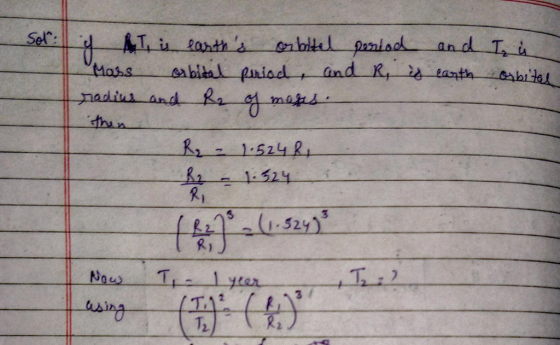
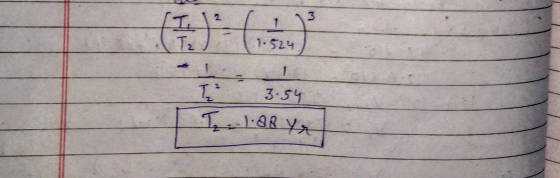
According to Kepler's third law, there is a relation between the period of one revolution for...
 According to Kepler's third law, there is a relation between the period of one revolution for the satellite, the semimajor axis length of the Moon, and its mass. By applying this law, find the Moon's mass, in Kg, while the orbital period of this motion is 50,000 s and the semi-major axis of the Moon is equal to 5 m. (Round your answer to the nearest whole number)
6. Using Nowton's version of Kepler's Third Law (15 points). a) (5pt) Compute the semimajor the...
 6. Using Nowton's version of Kepler's Third Law (15 points). a) (5pt) Compute the semimajor the mass of the Sun from the fact that the Earth's orbital period is 1 year and axis is 1 AU. Assume that the mass of the Earth is much smaller than the mass of the Sun. Is this assumption justified? pt) Compute the orbital period of a cubesat orbiting the Earth at an altitude of 400 km above the Earth's surface. c) (5pt) Estimate...
KEPLER'S THIRD LAW 2 \T2 A satellite orbits the Earth with an altitude of 35870 km....
 KEPLER'S THIRD LAW 2 \T2 A satellite orbits the Earth with an altitude of 35870 km. Use Kepler's third law to find the period of the satellite, using the Moon as your other value. Calculate the speed of the satellite. Mars has a period of 1.88 Earth Years. Earth has an average orbital radius of 149.6 x 100 km. Use Kepler's Third Law to find the average orbital radius of Mars, in 100 km.
Use Kepler's third law to show that the closer a planet is to the Sun, the...
Use Kepler's third law to show that the closer a planet is to the Sun, the shorter its period. Kepler's third law relates a planet's period around the Sun to the length of the (select) (semimajor or semiminor) axis such that T2 = kR3. It is obvious from this expression that as the distance from the Sun (select) (T or k or R) decreases the period (select) (T or k or R) decreases as well. I have to find the...
In Lecture 4, we discussed Kepler’s third law relatingthe orbital period of a planet (p) to...
In Lecture 4, we discussed Kepler’s third law relatingthe orbital period of a planet (p) to the semi-major axis (orbital distance, a) of its orbit(p2= a3). We can apply this law as long the object orbits the Sun or another object of the same mass, and the units of orbital period are in (Earth) years and the orbital distance is in Astronomical Units(AU). [1AU is equal to the distance between the Earth and the Sun]. [Note: Newton extended this law...
1. Kepler's harmonic law of planetary motion (his 3rd law) states that the square of the...
 1. Kepler's harmonic law of planetary motion (his 3rd law) states that the square of the orbital period is proportional to the cube of the characteristic distance of the planet from the sun. Test this by fitting a power law to the data below. Give your answer to 4 decimal places. Data file #period (days), distance (AU) # Data supporting Kepler's third law # distance is measured relative to the earth's mean distance, # which is about 9.26e7 miles and...
1. Why is the orbital period of each planet not exactly proportional to the radius of...
1. Why is the orbital period of each planet not exactly proportional to the radius of its orbit? (Think Kepler's 3rd law). 2. When people say that Venus is the twin of Earth, what is the only characteristic that would validate that statement? 3. If you didn't want to disrupt your sleep cycle, what planet besides earth would you be happy living on? 4. What other terrestrial planet would have seasons similar to earth? 5. Explain the result of Venus'...
Kepler’s third law
Kepler’s third law. According to Kepler’s third law of planetary motion, the ratio t^2/r^3 has the same value for every planet in our solar system. R is the average radius of the orbit of the planet measured in astronomical units (AU), and T is the number of years it takes for one complete orbit of the sun. Jupiter orbits the sun in 11.86 years with an average radius of 5.2 AU, whereas Saturn orbits the sun in 29.46 years If...
Use Kepler's third law to determine how many days it takes a spacecraft to travel i...
 Use Kepler's third law to determine how many days it takes a spacecraft to travel i an elliptical orbit from a point 7 397 km from the Earth's center to the Moon, 385 000 km from the Earth's center 10 Your response differs from the correct answer by more than 10%. Double check your calculations, d
The Mass of the Sun Calculate the mass of the Sun, noting that the period of...
 The Mass of the Sun Calculate the mass of the Sun, noting that the period of the Earth's orbit around the Sun is 3.156 x 10⁷ s and its distance from the Sun is 1.496 x 10¹¹ m. SOLUTION Conceptualize Based on the mathematical representation of Kepler's third law expressed as T2 412 3 Ksa3, we realize that the mass of the central object in a gravitational system is related to the orbital size and ---Select--- of objects in orbit...
 According to Kepler's third law, there is a relation between the period of one revolution for the satellite, the semimajor axis length of the Moon, and its mass. By applying this law, find the Moon's mass, in Kg, while the orbital period of this motion is 50,000 s and the semi-major axis of the Moon is equal to 5 m. (Round your answer to the nearest whole number)
 6. Using Nowton's version of Kepler's Third Law (15 points). a) (5pt) Compute the semimajor the mass of the Sun from the fact that the Earth's orbital period is 1 year and axis is 1 AU. Assume that the mass of the Earth is much smaller than the mass of the Sun. Is this assumption justified? pt) Compute the orbital period of a cubesat orbiting the Earth at an altitude of 400 km above the Earth's surface. c) (5pt) Estimate...
 KEPLER'S THIRD LAW 2 \T2 A satellite orbits the Earth with an altitude of 35870 km. Use Kepler's third law to find the period of the satellite, using the Moon as your other value. Calculate the speed of the satellite. Mars has a period of 1.88 Earth Years. Earth has an average orbital radius of 149.6 x 100 km. Use Kepler's Third Law to find the average orbital radius of Mars, in 100 km.
 1. Kepler's harmonic law of planetary motion (his 3rd law) states that the square of the orbital period is proportional to the cube of the characteristic distance of the planet from the sun. Test this by fitting a power law to the data below. Give your answer to 4 decimal places. Data file #period (days), distance (AU) # Data supporting Kepler's third law # distance is measured relative to the earth's mean distance, # which is about 9.26e7 miles and...
 Use Kepler's third law to determine how many days it takes a spacecraft to travel i an elliptical orbit from a point 7 397 km from the Earth's center to the Moon, 385 000 km from the Earth's center 10 Your response differs from the correct answer by more than 10%. Double check your calculations, d
 The Mass of the Sun Calculate the mass of the Sun, noting that the period of the Earth's orbit around the Sun is 3.156 x 10⁷ s and its distance from the Sun is 1.496 x 10¹¹ m. SOLUTION Conceptualize Based on the mathematical representation of Kepler's third law expressed as T2 412 3 Ksa3, we realize that the mass of the central object in a gravitational system is related to the orbital size and ---Select--- of objects in orbit...
Most questions answered within 3 hours.
-
Where is the error in this code sequence?
String s1 = "Hello";
String s2 = "ello";...
asked 10 months ago -
Financial data for Joel de Paris, Inc., for last year
follow:
Joel de Paris, Inc.
Balance...
asked 10 months ago -
Consider this reaction:
Al2(SO4)3 (aq)+ BaCl3
(aq) Al2Cl6 (aq)- +
3BaSO4(s) . What is the...
asked 10 months ago -
Suppose that Savneet is considering increasing her
recent random sample from 20 car rentals to 40...
asked 10 months ago -
Trucks arrive at an unloading terminal at an average rate of 120
per hour.
Trucks arrive...
asked 10 months ago -
Why are methanol and ethanol completely soluble in water while
octanol is not very little soluble....
asked 10 months ago -
A facilities manager at a university reads in a research report
that the mean amount of...
asked 10 months ago -
When the CuSO4 is rehydrated by adding water to the anhydrous
compound, is this an endothermic...
asked 10 months ago -
A ray of sunlight is passing from diamond into crown glass; the
angle of incidence is...
asked 10 months ago -
A block of mass 0.249 kg is placed on top of a light, vertical
spring of...
asked 10 months ago -
how do the kidneys compensate in the presences of acidosis
a) trigger hyperventilate
b) reserve acid...
asked 10 months ago -
Question 501 pts
The rental rate of capital to the firm increases. Which of the
following...
asked 10 months ago