
Homework Answers
Add Answer to:
please i need steps
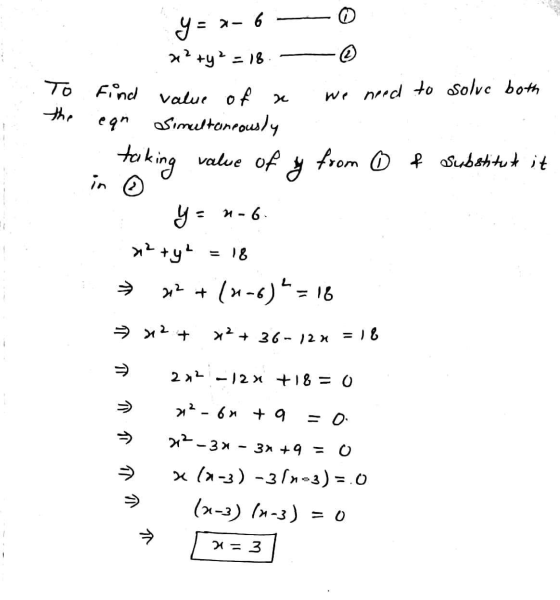
nsider this system of equations 10. Consider y=x-6 2 + y =...
i need help with this differential equations problem 10) Consider the system of DE: x" +...
 i need help with this differential equations problem
10) Consider the system of DE: x" + 10x – 4y = 0, -4x + y" + 4y = 0 subject to initial conditions, x(0) = 0, x'(0) = 1, y(0) = 0,y'(0) = -1. Denote L{x(t)} = X(s) and L{y(t)} = Y(s). By applying the Laplace transform to each equation, we get the following system a) (s? + 10)X(s) – 4Y(s) = 1, (s? + 4)Y(s) – 4X(s) = -1 b)...
i need help with this differential equations problem
10) Consider the system of DE: x" + 10x – 4y = 0, -4x + y" + 4y = 0 subject to initial conditions, x(0) = 0, x'(0) = 1, y(0) = 0,y'(0) = -1. Denote L{x(t)} = X(s) and L{y(t)} = Y(s). By applying the Laplace transform to each equation, we get the following system a) (s? + 10)X(s) – 4Y(s) = 1, (s? + 4)Y(s) – 4X(s) = -1 b)...
I need help with this MATLAB exercise. The given system is y[n] - (3/10)y[n-1] - (1/10)y[n-2]...
 I need help with this MATLAB exercise.
The given system is y[n] - (3/10)y[n-1] - (1/10)y[n-2] =
2x[n]
The input x[n] is 2cos(2*pi*n/6)(u[n] - u[n-10])
Don't have to answer part 2 of the question.
Zero-state response of a system can be found by using convolution of the input signal and unit impulse response: Use conv command from MATLAB to compute the zero-state response of the system defined in part B to the input x[n] in part C. 1. 2. 3....
I need help with this MATLAB exercise.
The given system is y[n] - (3/10)y[n-1] - (1/10)y[n-2] =
2x[n]
The input x[n] is 2cos(2*pi*n/6)(u[n] - u[n-10])
Don't have to answer part 2 of the question.
Zero-state response of a system can be found by using convolution of the input signal and unit impulse response: Use conv command from MATLAB to compute the zero-state response of the system defined in part B to the input x[n] in part C. 1. 2. 3....
Please provide solution with detailed steps and explanations, thanks 6. Consider the system * = -x(x2...
 Please provide solution with detailed steps and explanations,
thanks
6. Consider the system * = -x(x2 + y2 + x - 2) - Y y = -y(x2 + y2 +1 -2) +r. Prove that this system has a periodic orbit. Hint: Convert to polar form.
Please provide solution with detailed steps and explanations,
thanks
6. Consider the system * = -x(x2 + y2 + x - 2) - Y y = -y(x2 + y2 +1 -2) +r. Prove that this system has a periodic orbit. Hint: Convert to polar form.
Please show steps and equations x1(t) -6 42 6 X2(t) 6 4-2 x(t) *x2(t) 6 42...
 Please show steps and equations
x1(t) -6 42 6 X2(t) 6 4-2 x(t) *x2(t) 6 42 6 Let ylt) -xi(t) xlt) a) What is the value of y(-4)? b) What is the value of y(0)? c) What is the value of y(-3)? d) What is the value of y(2)?
Please show steps and equations
x1(t) -6 42 6 X2(t) 6 4-2 x(t) *x2(t) 6 42 6 Let ylt) -xi(t) xlt) a) What is the value of y(-4)? b) What is the value of y(0)? c) What is the value of y(-3)? d) What is the value of y(2)?
Please explain your steps. I really don't understand this. Exercise 2. Consider the continuous-time signal x(t)...
 Please explain your steps. I really don't
understand this.
Exercise 2. Consider the continuous-time signal x(t) = ejwot. Signal x(t) is sent to the input of a first LTI system (System 1) with frequency response Hi(jw) = e-jwA. Let A and wo be constant positive real values. Let y(t) be the output signal of System 1. Signal y(t) is then sent to the input of a second LTI system (System 2) with frequency response H2(jw) = w. Let z(t) be...
Please explain your steps. I really don't
understand this.
Exercise 2. Consider the continuous-time signal x(t) = ejwot. Signal x(t) is sent to the input of a first LTI system (System 1) with frequency response Hi(jw) = e-jwA. Let A and wo be constant positive real values. Let y(t) be the output signal of System 1. Signal y(t) is then sent to the input of a second LTI system (System 2) with frequency response H2(jw) = w. Let z(t) be...
Please do all t Which system of equations is DATE x-y -2 B y-3 6. Whic...
 Please do all
t Which system of equations is DATE x-y -2 B y-3 6. Whic system of inequalities is graphed? S-x+1 2-1 ye-x+1 ys-1 7. Which system of equations is graphed? AxtyS x-2y- 2 Bxty-s x+2y-2 x+2y- 2 8. Which system of inequalities is graphed? x+3y 6 G2x +y22 x-3y <6 x+3ys6 At a university, 1200 students are enrolled in engineering. There are twice as many in electrical engineering as mechanical engineering, and three times as many in chemical...
Please do all
t Which system of equations is DATE x-y -2 B y-3 6. Whic system of inequalities is graphed? S-x+1 2-1 ye-x+1 ys-1 7. Which system of equations is graphed? AxtyS x-2y- 2 Bxty-s x+2y-2 x+2y- 2 8. Which system of inequalities is graphed? x+3y 6 G2x +y22 x-3y <6 x+3ys6 At a university, 1200 students are enrolled in engineering. There are twice as many in electrical engineering as mechanical engineering, and three times as many in chemical...
b) Consider the system of simultaneous equations for x,y and z: ( x + 2y +...
 b) Consider the system of simultaneous equations for x,y and z: ( x + 2y + z = 3 r-3y+z=1 (2x - y +2 = 4 Use Gaussian elimination to find if these equations are consistent. Pro- vide a geometrie interpretation of the result. (18 marks) [Total 35 marks)
Given the system of equations: 2 x + y + z = 2 − x +...
Given the system of equations: 2 x + y + z = 2 − x + y − z = 3 x + 2 y + 3 z = − 10 Write 3 different MATLAB scripts/instructions to solve the above system of equations. Your answer must indicate: Solution 1: <statement(s)> Solution 2: <statement(s)> Solution 3: <statement(s)>
Consider the system of equations dxdt=x(3−x−4y) dydt=y(1−3x), taking (x,y)>0. (1 point) Consider the system of equations...
 Consider the system of equations dxdt=x(3−x−4y) dydt=y(1−3x),
taking (x,y)>0.
(1 point) Consider the system of equations de = 2(3 – 2 – 49) = y(1 - 33), taking (2,y) > 0. (a) Write an equation for the (non-zero) vertical (-)nullcline of this system: (Enter your equation, e.g., y=x.) And for the (non-zero) horizontal (y-)nullcline: (Enter your equation, e.g. y=x.) (Note that there are also nullclines lying along the axes.) (b) What are the equilibrium points for the system? Equilibria =...
Consider the system of equations dxdt=x(3−x−4y) dydt=y(1−3x),
taking (x,y)>0.
(1 point) Consider the system of equations de = 2(3 – 2 – 49) = y(1 - 33), taking (2,y) > 0. (a) Write an equation for the (non-zero) vertical (-)nullcline of this system: (Enter your equation, e.g., y=x.) And for the (non-zero) horizontal (y-)nullcline: (Enter your equation, e.g. y=x.) (Note that there are also nullclines lying along the axes.) (b) What are the equilibrium points for the system? Equilibria =...
QUESTION 2 Consider the system of equations: x + y + z = 3 -y +...
 QUESTION 2 Consider the system of equations: x + y + z = 3 -y + 2x + z = 0 - Z+/- 3x = 1 Choose each of the following that is a true statement about the solution of this system of equations. OAZ= -0.6 m B.V = 1.4 OC. None of the other statements is true. OD.X= 2.2 E. X= -1
 i need help with this differential equations problem
10) Consider the system of DE: x" + 10x – 4y = 0, -4x + y" + 4y = 0 subject to initial conditions, x(0) = 0, x'(0) = 1, y(0) = 0,y'(0) = -1. Denote L{x(t)} = X(s) and L{y(t)} = Y(s). By applying the Laplace transform to each equation, we get the following system a) (s? + 10)X(s) – 4Y(s) = 1, (s? + 4)Y(s) – 4X(s) = -1 b)...
i need help with this differential equations problem
10) Consider the system of DE: x" + 10x – 4y = 0, -4x + y" + 4y = 0 subject to initial conditions, x(0) = 0, x'(0) = 1, y(0) = 0,y'(0) = -1. Denote L{x(t)} = X(s) and L{y(t)} = Y(s). By applying the Laplace transform to each equation, we get the following system a) (s? + 10)X(s) – 4Y(s) = 1, (s? + 4)Y(s) – 4X(s) = -1 b)...
 I need help with this MATLAB exercise.
The given system is y[n] - (3/10)y[n-1] - (1/10)y[n-2] =
2x[n]
The input x[n] is 2cos(2*pi*n/6)(u[n] - u[n-10])
Don't have to answer part 2 of the question.
Zero-state response of a system can be found by using convolution of the input signal and unit impulse response: Use conv command from MATLAB to compute the zero-state response of the system defined in part B to the input x[n] in part C. 1. 2. 3....
I need help with this MATLAB exercise.
The given system is y[n] - (3/10)y[n-1] - (1/10)y[n-2] =
2x[n]
The input x[n] is 2cos(2*pi*n/6)(u[n] - u[n-10])
Don't have to answer part 2 of the question.
Zero-state response of a system can be found by using convolution of the input signal and unit impulse response: Use conv command from MATLAB to compute the zero-state response of the system defined in part B to the input x[n] in part C. 1. 2. 3....
 Please provide solution with detailed steps and explanations,
thanks
6. Consider the system * = -x(x2 + y2 + x - 2) - Y y = -y(x2 + y2 +1 -2) +r. Prove that this system has a periodic orbit. Hint: Convert to polar form.
Please provide solution with detailed steps and explanations,
thanks
6. Consider the system * = -x(x2 + y2 + x - 2) - Y y = -y(x2 + y2 +1 -2) +r. Prove that this system has a periodic orbit. Hint: Convert to polar form.
 Please show steps and equations
x1(t) -6 42 6 X2(t) 6 4-2 x(t) *x2(t) 6 42 6 Let ylt) -xi(t) xlt) a) What is the value of y(-4)? b) What is the value of y(0)? c) What is the value of y(-3)? d) What is the value of y(2)?
Please show steps and equations
x1(t) -6 42 6 X2(t) 6 4-2 x(t) *x2(t) 6 42 6 Let ylt) -xi(t) xlt) a) What is the value of y(-4)? b) What is the value of y(0)? c) What is the value of y(-3)? d) What is the value of y(2)?
 Please explain your steps. I really don't
understand this.
Exercise 2. Consider the continuous-time signal x(t) = ejwot. Signal x(t) is sent to the input of a first LTI system (System 1) with frequency response Hi(jw) = e-jwA. Let A and wo be constant positive real values. Let y(t) be the output signal of System 1. Signal y(t) is then sent to the input of a second LTI system (System 2) with frequency response H2(jw) = w. Let z(t) be...
Please explain your steps. I really don't
understand this.
Exercise 2. Consider the continuous-time signal x(t) = ejwot. Signal x(t) is sent to the input of a first LTI system (System 1) with frequency response Hi(jw) = e-jwA. Let A and wo be constant positive real values. Let y(t) be the output signal of System 1. Signal y(t) is then sent to the input of a second LTI system (System 2) with frequency response H2(jw) = w. Let z(t) be...
 Please do all
t Which system of equations is DATE x-y -2 B y-3 6. Whic system of inequalities is graphed? S-x+1 2-1 ye-x+1 ys-1 7. Which system of equations is graphed? AxtyS x-2y- 2 Bxty-s x+2y-2 x+2y- 2 8. Which system of inequalities is graphed? x+3y 6 G2x +y22 x-3y <6 x+3ys6 At a university, 1200 students are enrolled in engineering. There are twice as many in electrical engineering as mechanical engineering, and three times as many in chemical...
Please do all
t Which system of equations is DATE x-y -2 B y-3 6. Whic system of inequalities is graphed? S-x+1 2-1 ye-x+1 ys-1 7. Which system of equations is graphed? AxtyS x-2y- 2 Bxty-s x+2y-2 x+2y- 2 8. Which system of inequalities is graphed? x+3y 6 G2x +y22 x-3y <6 x+3ys6 At a university, 1200 students are enrolled in engineering. There are twice as many in electrical engineering as mechanical engineering, and three times as many in chemical...
 b) Consider the system of simultaneous equations for x,y and z: ( x + 2y + z = 3 r-3y+z=1 (2x - y +2 = 4 Use Gaussian elimination to find if these equations are consistent. Pro- vide a geometrie interpretation of the result. (18 marks) [Total 35 marks)
 Consider the system of equations dxdt=x(3−x−4y) dydt=y(1−3x),
taking (x,y)>0.
(1 point) Consider the system of equations de = 2(3 – 2 – 49) = y(1 - 33), taking (2,y) > 0. (a) Write an equation for the (non-zero) vertical (-)nullcline of this system: (Enter your equation, e.g., y=x.) And for the (non-zero) horizontal (y-)nullcline: (Enter your equation, e.g. y=x.) (Note that there are also nullclines lying along the axes.) (b) What are the equilibrium points for the system? Equilibria =...
Consider the system of equations dxdt=x(3−x−4y) dydt=y(1−3x),
taking (x,y)>0.
(1 point) Consider the system of equations de = 2(3 – 2 – 49) = y(1 - 33), taking (2,y) > 0. (a) Write an equation for the (non-zero) vertical (-)nullcline of this system: (Enter your equation, e.g., y=x.) And for the (non-zero) horizontal (y-)nullcline: (Enter your equation, e.g. y=x.) (Note that there are also nullclines lying along the axes.) (b) What are the equilibrium points for the system? Equilibria =...
 QUESTION 2 Consider the system of equations: x + y + z = 3 -y + 2x + z = 0 - Z+/- 3x = 1 Choose each of the following that is a true statement about the solution of this system of equations. OAZ= -0.6 m B.V = 1.4 OC. None of the other statements is true. OD.X= 2.2 E. X= -1
Most questions answered within 3 hours.
-
Where is the error in this code sequence?
String s1 = "Hello";
String s2 = "ello";...
asked 10 months ago -
Financial data for Joel de Paris, Inc., for last year
follow:
Joel de Paris, Inc.
Balance...
asked 10 months ago -
Consider this reaction:
Al2(SO4)3 (aq)+ BaCl3
(aq) Al2Cl6 (aq)- +
3BaSO4(s) . What is the...
asked 10 months ago -
Suppose that Savneet is considering increasing her
recent random sample from 20 car rentals to 40...
asked 10 months ago -
Trucks arrive at an unloading terminal at an average rate of 120
per hour.
Trucks arrive...
asked 10 months ago -
Why are methanol and ethanol completely soluble in water while
octanol is not very little soluble....
asked 10 months ago -
A facilities manager at a university reads in a research report
that the mean amount of...
asked 10 months ago -
When the CuSO4 is rehydrated by adding water to the anhydrous
compound, is this an endothermic...
asked 10 months ago -
A ray of sunlight is passing from diamond into crown glass; the
angle of incidence is...
asked 10 months ago -
A block of mass 0.249 kg is placed on top of a light, vertical
spring of...
asked 10 months ago -
how do the kidneys compensate in the presences of acidosis
a) trigger hyperventilate
b) reserve acid...
asked 10 months ago -
Question 501 pts
The rental rate of capital to the firm increases. Which of the
following...
asked 10 months ago