

Homework Answers
Add Answer to:
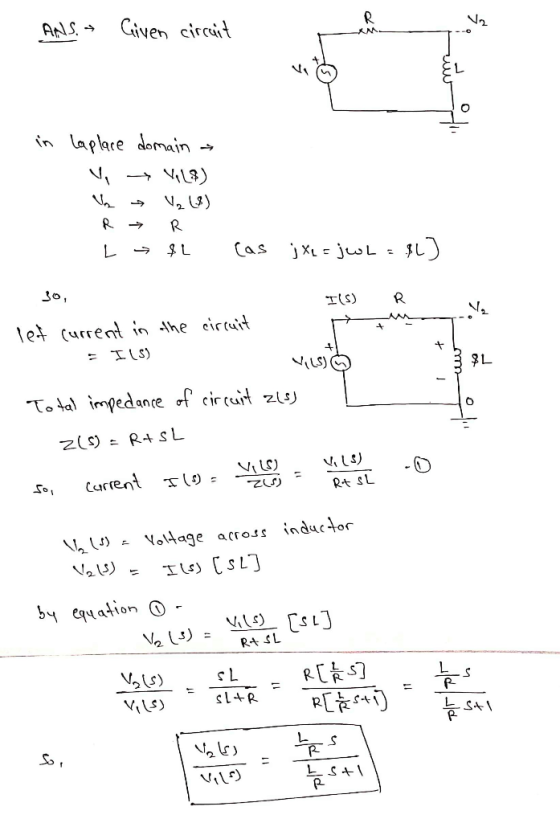
a) Using phasor analysis, show that the complex gain is: v2() R VI Ls+1 UTULIILLILUL Figure...
Fill in the table and show calculations for it. A.1. Phasor Analysis and Complex Power 100...
 Fill in the table and show calculations for it.
A.1. Phasor Analysis and Complex Power 100 R3 220 R2 1k L1 Implement the above circuit. (The above diagram was made in PSpice but you should be able to simulate it in LTSpice). Set the source amplitude to 5V amplitude with a frequency of 795 Hz a. Use phasor analysis to calculate the current through Rs b. Using the first power expression, determine the complex power produced by the source. Recall,...
Fill in the table and show calculations for it.
A.1. Phasor Analysis and Complex Power 100 R3 220 R2 1k L1 Implement the above circuit. (The above diagram was made in PSpice but you should be able to simulate it in LTSpice). Set the source amplitude to 5V amplitude with a frequency of 795 Hz a. Use phasor analysis to calculate the current through Rs b. Using the first power expression, determine the complex power produced by the source. Recall,...
please show solution to 4.7 Calculate the peak value of the voltage across the inductor in...
 please show solution to 4.7
Calculate the peak value of the voltage across the inductor in figure 4.7(a), assuming Vo= 10 V, a 2t x 103 s, R= 1 2, L 25 mH, and C 1 uF. 4.6 Calculate the phase of the voltage across the inductor relative to the source in figure 4.7(a) for the values given in problem 4.6 4.7 90 Sinusoldal Circuits circuit-reducti to linear sinusoidal theorems for dc circuits can be applied cuits if the impedances...
please show solution to 4.7
Calculate the peak value of the voltage across the inductor in figure 4.7(a), assuming Vo= 10 V, a 2t x 103 s, R= 1 2, L 25 mH, and C 1 uF. 4.6 Calculate the phase of the voltage across the inductor relative to the source in figure 4.7(a) for the values given in problem 4.6 4.7 90 Sinusoldal Circuits circuit-reducti to linear sinusoidal theorems for dc circuits can be applied cuits if the impedances...
The single-phase circuit shown in Figure. 1 is operating at steady-state. R;=1000 G=10F L=0.05 H C...
 The single-phase circuit shown in Figure. 1 is operating at steady-state. R;=1000 G=10F L=0.05 H C = 2001F1 ZL.+0.2H R=2002} @va Vs1 V2*10000/10000) M Vs2 V2200Cos(1000+30) M Figure. 1: Single-Phase Circuit 1. Represent the circuit in the phasor domain. Show the impedance value for each passive component of the circuit and the phasor value for each voltage source. 2. Using the circuit in phasor domain calculate the value of each branch current and the complex, apparent, active, and reactive powers...
Please show any equation manipulation. Vi = 8 (V) Problem 1 R1 = 8 (1) V2...
 Please show any equation manipulation.
Vi = 8 (V) Problem 1 R1 = 8 (1) V2 = 26 (V) HH V4 = 28 (V) Using Kirchhoff's rules in the circuit of image, A- Calculate the current in the circuit. B- Show the direction current in the circuit. C- Calculate the voltage across resistor R. D- Calculate the power delivered to R2 E- After 15 minutes of working of circuit, how much energy is delivered to resistor Rı? V3 = 20...
Please show any equation manipulation.
Vi = 8 (V) Problem 1 R1 = 8 (1) V2 = 26 (V) HH V4 = 28 (V) Using Kirchhoff's rules in the circuit of image, A- Calculate the current in the circuit. B- Show the direction current in the circuit. C- Calculate the voltage across resistor R. D- Calculate the power delivered to R2 E- After 15 minutes of working of circuit, how much energy is delivered to resistor Rı? V3 = 20...
help with all of them please h. Referring to vi and V2 in the figure, which...
 help with all of them please
h. Referring to vi and V2 in the figure, which of the following is a true statement? a. v, v",sin(t-4) and V2 lags v1 by ф b. V2 :1 v",sin(t-4) and V2 leads vi by ф C. V2-vmSin(t + ф) and V2 lags vi by ф d. v2 vmsin(t + ф) and V2 leads vi by ф vm /v.5% i) The phasor representation of 120 V house voltage is )120V 260Hz 2) I 20...
help with all of them please
h. Referring to vi and V2 in the figure, which of the following is a true statement? a. v, v",sin(t-4) and V2 lags v1 by ф b. V2 :1 v",sin(t-4) and V2 leads vi by ф C. V2-vmSin(t + ф) and V2 lags vi by ф d. v2 vmsin(t + ф) and V2 leads vi by ф vm /v.5% i) The phasor representation of 120 V house voltage is )120V 260Hz 2) I 20...
Learning Goal: To understand the use of phasor diagrams in calculating the impedance and resonance conditions in a seri...
 Learning Goal: To understand the use of phasor diagrams in calculating the impedance and resonance conditions in a series L-R-C circuit. At resonance, XL = Xc. The voltage across the capacitor exactly cancels that across the i have the same amplitude. Thus, the inductor and capacitor effectively cancel out in the formu not come as a surprise that the resonant frequency equals the natural frequency of the oscilla In this problem, you will consider a series L-R-C circuit, containing a...
4) Consider the MOSFET differential amplifier shown below, with Io-2 mA, and RL- 10 kS2, Rss-100 ...
 4) Consider the MOSFET differential amplifier shown below, with Io-2 mA, and RL- 10 kS2, Rss-100 k2, VDD- +8V and Vss--8V. The NMOS transistors in the circuit are nominally identical, with kn 2 mA/V2, VTn 1.0 V and ro 100 k2. The PMoS transistors in the circuit are nominally identical, with kp 2 mA/V2, [VTpl 1.0 V and ro 100 kΩ M3 M4 0 M1 M2 a) First consider the DC bias point. Assuming that the current mirror requires at...
Please use MATLAB for the specified parts, I appreciate the help! 1. Complex Numbers and phasor...
 Please use MATLAB for the specified parts, I appreciate the
help!
1. Complex Numbers and phasor analysis can be used to solve many problems. For example if we want to determine the currents of each of the voltage sources in the following circuit, VI ov then we can use a technique called mesh analysis to write mesh equations that involve the currents of each source. Let libe the current of the voltage source vl = 2 cos(t), I be the...
Please use MATLAB for the specified parts, I appreciate the
help!
1. Complex Numbers and phasor analysis can be used to solve many problems. For example if we want to determine the currents of each of the voltage sources in the following circuit, VI ov then we can use a technique called mesh analysis to write mesh equations that involve the currents of each source. Let libe the current of the voltage source vl = 2 cos(t), I be the...
Could someone please write worked solutions? Thanks R. Figure 1 Consider the filter circuit that is...
 Could someone please write worked solutions? Thanks
R. Figure 1 Consider the filter circuit that is shown in Figure 1 1. Determine the voltage at node a in terms of the passive component variables. (7 marks) 2. Determine the Laplace transfer function H(s) = Vo/Vi. Subsequently, identify the resulting filter type including its order. (9 marks) 3. If R-1k and C-10HF, determine the gain, cut-off frequency, and the quality factor of this filter. (6 marks) 4. If the input signal...
Could someone please write worked solutions? Thanks
R. Figure 1 Consider the filter circuit that is shown in Figure 1 1. Determine the voltage at node a in terms of the passive component variables. (7 marks) 2. Determine the Laplace transfer function H(s) = Vo/Vi. Subsequently, identify the resulting filter type including its order. (9 marks) 3. If R-1k and C-10HF, determine the gain, cut-off frequency, and the quality factor of this filter. (6 marks) 4. If the input signal...
I'm absolutely stuck on this, please show work and explain. + 1+ Vo R & Vo...
 I'm absolutely stuck on this, please show work and explain.
+ 1+ Vo R & Vo R FIG I: RC CIRCUIT FIG 2: RL CIRCUIT A. View the RC circuit in Fig. 1. 1) Assume an input sinusoidal voltage with frequency f=50kHz, R=4.7kN and C= 0.01°F (#103). Compute the phase difference between Vo and Vi. 2) Plot the amplitude for the voltage ratio vs. frequency. 3) Determine the characteristic frequency (fc). 4) Assume a step function input voltage (Vi) applied...
I'm absolutely stuck on this, please show work and explain.
+ 1+ Vo R & Vo R FIG I: RC CIRCUIT FIG 2: RL CIRCUIT A. View the RC circuit in Fig. 1. 1) Assume an input sinusoidal voltage with frequency f=50kHz, R=4.7kN and C= 0.01°F (#103). Compute the phase difference between Vo and Vi. 2) Plot the amplitude for the voltage ratio vs. frequency. 3) Determine the characteristic frequency (fc). 4) Assume a step function input voltage (Vi) applied...
 Fill in the table and show calculations for it.
A.1. Phasor Analysis and Complex Power 100 R3 220 R2 1k L1 Implement the above circuit. (The above diagram was made in PSpice but you should be able to simulate it in LTSpice). Set the source amplitude to 5V amplitude with a frequency of 795 Hz a. Use phasor analysis to calculate the current through Rs b. Using the first power expression, determine the complex power produced by the source. Recall,...
Fill in the table and show calculations for it.
A.1. Phasor Analysis and Complex Power 100 R3 220 R2 1k L1 Implement the above circuit. (The above diagram was made in PSpice but you should be able to simulate it in LTSpice). Set the source amplitude to 5V amplitude with a frequency of 795 Hz a. Use phasor analysis to calculate the current through Rs b. Using the first power expression, determine the complex power produced by the source. Recall,...
 please show solution to 4.7
Calculate the peak value of the voltage across the inductor in figure 4.7(a), assuming Vo= 10 V, a 2t x 103 s, R= 1 2, L 25 mH, and C 1 uF. 4.6 Calculate the phase of the voltage across the inductor relative to the source in figure 4.7(a) for the values given in problem 4.6 4.7 90 Sinusoldal Circuits circuit-reducti to linear sinusoidal theorems for dc circuits can be applied cuits if the impedances...
please show solution to 4.7
Calculate the peak value of the voltage across the inductor in figure 4.7(a), assuming Vo= 10 V, a 2t x 103 s, R= 1 2, L 25 mH, and C 1 uF. 4.6 Calculate the phase of the voltage across the inductor relative to the source in figure 4.7(a) for the values given in problem 4.6 4.7 90 Sinusoldal Circuits circuit-reducti to linear sinusoidal theorems for dc circuits can be applied cuits if the impedances...
 The single-phase circuit shown in Figure. 1 is operating at steady-state. R;=1000 G=10F L=0.05 H C = 2001F1 ZL.+0.2H R=2002} @va Vs1 V2*10000/10000) M Vs2 V2200Cos(1000+30) M Figure. 1: Single-Phase Circuit 1. Represent the circuit in the phasor domain. Show the impedance value for each passive component of the circuit and the phasor value for each voltage source. 2. Using the circuit in phasor domain calculate the value of each branch current and the complex, apparent, active, and reactive powers...
 Please show any equation manipulation.
Vi = 8 (V) Problem 1 R1 = 8 (1) V2 = 26 (V) HH V4 = 28 (V) Using Kirchhoff's rules in the circuit of image, A- Calculate the current in the circuit. B- Show the direction current in the circuit. C- Calculate the voltage across resistor R. D- Calculate the power delivered to R2 E- After 15 minutes of working of circuit, how much energy is delivered to resistor Rı? V3 = 20...
Please show any equation manipulation.
Vi = 8 (V) Problem 1 R1 = 8 (1) V2 = 26 (V) HH V4 = 28 (V) Using Kirchhoff's rules in the circuit of image, A- Calculate the current in the circuit. B- Show the direction current in the circuit. C- Calculate the voltage across resistor R. D- Calculate the power delivered to R2 E- After 15 minutes of working of circuit, how much energy is delivered to resistor Rı? V3 = 20...
 help with all of them please
h. Referring to vi and V2 in the figure, which of the following is a true statement? a. v, v",sin(t-4) and V2 lags v1 by ф b. V2 :1 v",sin(t-4) and V2 leads vi by ф C. V2-vmSin(t + ф) and V2 lags vi by ф d. v2 vmsin(t + ф) and V2 leads vi by ф vm /v.5% i) The phasor representation of 120 V house voltage is )120V 260Hz 2) I 20...
help with all of them please
h. Referring to vi and V2 in the figure, which of the following is a true statement? a. v, v",sin(t-4) and V2 lags v1 by ф b. V2 :1 v",sin(t-4) and V2 leads vi by ф C. V2-vmSin(t + ф) and V2 lags vi by ф d. v2 vmsin(t + ф) and V2 leads vi by ф vm /v.5% i) The phasor representation of 120 V house voltage is )120V 260Hz 2) I 20...
 Learning Goal: To understand the use of phasor diagrams in calculating the impedance and resonance conditions in a series L-R-C circuit. At resonance, XL = Xc. The voltage across the capacitor exactly cancels that across the i have the same amplitude. Thus, the inductor and capacitor effectively cancel out in the formu not come as a surprise that the resonant frequency equals the natural frequency of the oscilla In this problem, you will consider a series L-R-C circuit, containing a...
 4) Consider the MOSFET differential amplifier shown below, with Io-2 mA, and RL- 10 kS2, Rss-100 k2, VDD- +8V and Vss--8V. The NMOS transistors in the circuit are nominally identical, with kn 2 mA/V2, VTn 1.0 V and ro 100 k2. The PMoS transistors in the circuit are nominally identical, with kp 2 mA/V2, [VTpl 1.0 V and ro 100 kΩ M3 M4 0 M1 M2 a) First consider the DC bias point. Assuming that the current mirror requires at...
 Please use MATLAB for the specified parts, I appreciate the
help!
1. Complex Numbers and phasor analysis can be used to solve many problems. For example if we want to determine the currents of each of the voltage sources in the following circuit, VI ov then we can use a technique called mesh analysis to write mesh equations that involve the currents of each source. Let libe the current of the voltage source vl = 2 cos(t), I be the...
Please use MATLAB for the specified parts, I appreciate the
help!
1. Complex Numbers and phasor analysis can be used to solve many problems. For example if we want to determine the currents of each of the voltage sources in the following circuit, VI ov then we can use a technique called mesh analysis to write mesh equations that involve the currents of each source. Let libe the current of the voltage source vl = 2 cos(t), I be the...
 Could someone please write worked solutions? Thanks
R. Figure 1 Consider the filter circuit that is shown in Figure 1 1. Determine the voltage at node a in terms of the passive component variables. (7 marks) 2. Determine the Laplace transfer function H(s) = Vo/Vi. Subsequently, identify the resulting filter type including its order. (9 marks) 3. If R-1k and C-10HF, determine the gain, cut-off frequency, and the quality factor of this filter. (6 marks) 4. If the input signal...
Could someone please write worked solutions? Thanks
R. Figure 1 Consider the filter circuit that is shown in Figure 1 1. Determine the voltage at node a in terms of the passive component variables. (7 marks) 2. Determine the Laplace transfer function H(s) = Vo/Vi. Subsequently, identify the resulting filter type including its order. (9 marks) 3. If R-1k and C-10HF, determine the gain, cut-off frequency, and the quality factor of this filter. (6 marks) 4. If the input signal...
 I'm absolutely stuck on this, please show work and explain.
+ 1+ Vo R & Vo R FIG I: RC CIRCUIT FIG 2: RL CIRCUIT A. View the RC circuit in Fig. 1. 1) Assume an input sinusoidal voltage with frequency f=50kHz, R=4.7kN and C= 0.01°F (#103). Compute the phase difference between Vo and Vi. 2) Plot the amplitude for the voltage ratio vs. frequency. 3) Determine the characteristic frequency (fc). 4) Assume a step function input voltage (Vi) applied...
I'm absolutely stuck on this, please show work and explain.
+ 1+ Vo R & Vo R FIG I: RC CIRCUIT FIG 2: RL CIRCUIT A. View the RC circuit in Fig. 1. 1) Assume an input sinusoidal voltage with frequency f=50kHz, R=4.7kN and C= 0.01°F (#103). Compute the phase difference between Vo and Vi. 2) Plot the amplitude for the voltage ratio vs. frequency. 3) Determine the characteristic frequency (fc). 4) Assume a step function input voltage (Vi) applied...
Most questions answered within 3 hours.
-
Where is the error in this code sequence?
String s1 = "Hello";
String s2 = "ello";...
asked 10 months ago -
Financial data for Joel de Paris, Inc., for last year
follow:
Joel de Paris, Inc.
Balance...
asked 10 months ago -
Consider this reaction:
Al2(SO4)3 (aq)+ BaCl3
(aq) Al2Cl6 (aq)- +
3BaSO4(s) . What is the...
asked 10 months ago -
Suppose that Savneet is considering increasing her
recent random sample from 20 car rentals to 40...
asked 10 months ago -
Trucks arrive at an unloading terminal at an average rate of 120
per hour.
Trucks arrive...
asked 10 months ago -
Why are methanol and ethanol completely soluble in water while
octanol is not very little soluble....
asked 10 months ago -
A facilities manager at a university reads in a research report
that the mean amount of...
asked 10 months ago -
When the CuSO4 is rehydrated by adding water to the anhydrous
compound, is this an endothermic...
asked 10 months ago -
A ray of sunlight is passing from diamond into crown glass; the
angle of incidence is...
asked 10 months ago -
A block of mass 0.249 kg is placed on top of a light, vertical
spring of...
asked 10 months ago -
how do the kidneys compensate in the presences of acidosis
a) trigger hyperventilate
b) reserve acid...
asked 10 months ago -
Question 501 pts
The rental rate of capital to the firm increases. Which of the
following...
asked 10 months ago