
Homework Answers
Explanation:- The above statement can not be proved,Because,any deterministic comparison-based sorting algorithm must perform Ω(n log n) comparisons to sort n elements in the worst case. Specifically, for any deterministic comparison-based sorting algorithm A, for all n ≥ 2 there exists an input I of size n such that A makes at least log2 (n!) = Ω(n log n) comparisons to sort I.
For half of the n! inputs:- h ≥ log(n!/2) = logn! - log2 ≥ n*logn - n*loge – 1 = Ω(nlogn)
For Fraction of 1/n inputs:- log(n!/n) = logn! - logn ≥ n*logn - n*loge – logn = Ω(nlogn)
Similarly,
For Fraction of 1/2n inputs:-
log(n!/2n) = logn! – log2n
= logn! – n ≥ n*logn - n*loge – n = Ω(nlogn)
From all the above statements ,we can conclude that there exists comparison based algorithm whose running time is Ω(nlogn) but not linear for at least .a fraction of 1/2n of the n! possible input instances of length n.
Proof of Comparison based sorting algorithm:-
let S be the set of these inputs that are consistent with the answers to all comparisons made so far (so, initially, |S| = n!). We can think of a new comparison as splitting S into two groups: those inputs for which the answer would be YES and those for which the answer would be NO. Now, suppose an adversary always gives the answer to each comparison corresponding to the larger group. Then, each comparison will cut down the size of S by at most a factor of 2. Since S initially has size n!, and by construction, the algorithm at the end must have reduced |S| down to 1 in order to know which output to produce, the algorithm must make at least log2 (n!) comparisons before it can halt. We can then solve:
log2 (n!) = log2 (n) + log2 (n − 1) + ... + log2 (2) = Ω(n log n).
Add Answer to:
(30 points) Prove or disprove the following statement: There exists a comparison-based sorting algorithm whose running...
Suppose we have an algorithm A that does comparison-based sorting. Answer true or false for each...
 Suppose we have an algorithm A that does comparison-based sorting. Answer true or false for each of the following. Assume our input size is n, and that each of the n inputs is distinct. 1. There can be an input ordering for which algorithm A executes no more than n comparisons to determine the sorted order. 2. There can be an input ordering for which algorithm A executes no more than 2n comparisons to determine the sorted order. 3. There...
9-2. For each of the following problems: design a reduction algorithm a hash table or sorting algorithm that solves the problem; describe your algorithm with clear pseudocode; and prove the time effi...
 9-2. For each of the following problems: design a reduction algorithm a hash table or sorting algorithm that solves the problem; describe your algorithm with clear pseudocode; and prove the time efficiency class of your algorithm. duplicate search problem input: a vector V of comparable objects output: an element of V that appears more than once in V, or None if no such element exists
9-2. For each of the following problems: design a reduction algorithm a hash table or...
9-2. For each of the following problems: design a reduction algorithm a hash table or sorting algorithm that solves the problem; describe your algorithm with clear pseudocode; and prove the time efficiency class of your algorithm. duplicate search problem input: a vector V of comparable objects output: an element of V that appears more than once in V, or None if no such element exists
9-2. For each of the following problems: design a reduction algorithm a hash table or...
3. Prove that any comparison-based algorithm for constructing a binary search tree from an arbitrary list...
3. Prove that any comparison-based algorithm for constructing a binary search tree from an arbitrary list of n elements takes Ω(n log n) time in the worst case. Hint: Think about reducing the problem of sorting to performing a set of operations on a binary search tree.
3. (20 points) Prove the best case performance of comparison-based sortings is S2(nlgn) by using the...
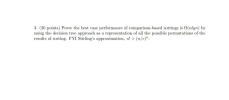 3. (20 points) Prove the best case performance of comparison-based sortings is S2(nlgn) by using the decision tree approach as a representation of all the possible permutations of the results of sorting. FYI Stirling's approximation, n!> (n/e)".
Algorithm Analysis: Study the following sorting algorithm. SORT( A[1...n]) bound <- Length(A) -1 for i...
Algorithm Analysis: Study the following sorting algorithm. SORT( A[1...n]) bound <- Length(A) -1 for i <- 1 to Length(A) newbound <- 0 for j <- 0 to bound if A[j] > A[j + 1] swap( A[j], A[j + 1] ) newbound = j -1 bound <- newbound (a) Use the longer approach described in lecture 3 week 1 that we used in analyzing Insertion-Sort to compute the running time T(n) of the above SORT algorithm. You may...
a) Prove that running time T(n)=n3+30n+1 is O(n3) [1 mark] b) Prove that running time T(n)=(n+30)(n+5)...
a) Prove that running time T(n)=n3+30n+1 is O(n3) [1 mark] b) Prove that running time T(n)=(n+30)(n+5) is O(n2) [1 mark] c) Count the number of primitive operation of algorithm unique1 on page 174 of textbook, give a big-Oh of this algorithm and prove it. [2 mark] d) Order the following function by asymptotic growth rate [2 mark] a. 4nlogn+2n b. 210 c. 3n+100logn d. n2+10n e. n3 f. nlogn
1. (10 points) Write an efficient iterative (i.e., loop-based) function Fibonnaci(n) that returns the nth Fibonnaci...
 1. (10 points) Write an efficient iterative (i.e., loop-based) function Fibonnaci(n) that returns the nth Fibonnaci number. By definition Fibonnaci(0) is 1, Fibonnaci(1) is 1, Fibonnaci(2) is 2, Fibonnaci(3) is 3, Fibonnaci(4) is 5, and so on. Your function may only use a constant amount of memory (i.e. no auxiliary array). Argue that the running time of the function is Θ(n), i.e. the function is linear in n. 2. (10 points) Order the following functions by growth rate: N, \N,...
5. [30 pts.] Sorting: Fundamentals (a) [10 pts.] llustrate the performance of the merge-sort algorithm by...
 5. [30 pts.] Sorting: Fundamentals (a) [10 pts.] llustrate the performance of the merge-sort algorithm by providing the merge- sort tree T corresponding to (1) the input sequence processed and (2) the output sequence generated based on the following input sequence: (20, 17,5,9, 19,40, 60, 11) i. Phase 1: input sequences processed at each node of T ii. Phase 2: output sequences generated at each node of T We were unable to transcribe this image(c) [10 pts.] Illustrate the performance...
2. Here is a sorting algorithm that I like to use. Given an unsorted list of...
 2. Here is a sorting algorithm that I like to use. Given an unsorted list of size n, let Xx represent the data in location k of the unsorted list. Compare xi to X2 and switch if necessary so that they are in sorted order, smallest first. Compare Xn-1 and Xn and switch if necessary so that they are in sorted order, smallest first. • Compare x3 with its left neighbors, switching if necessary so that the 3 first entries...
1. Consider the following well-known sorting algorithm, which is studied later in the book, with a...
1. Consider the following well-known sorting algorithm, which is studied later in the book, with a counter inserted to count the number of key comparisons. ALGORITHM SortAnalysis(A[0..n − 1]) //Input: An array A[0..n − 1] of n orderable elements //Output: The total number of key comparisons made count ←0 for i ←1 to n − 1 do v ←A[i] j ←i − 1 while j ≥ 0 and A[j ]> v do count ←count + 1 A[j + 1]←A[j ]...
 Suppose we have an algorithm A that does comparison-based sorting. Answer true or false for each of the following. Assume our input size is n, and that each of the n inputs is distinct. 1. There can be an input ordering for which algorithm A executes no more than n comparisons to determine the sorted order. 2. There can be an input ordering for which algorithm A executes no more than 2n comparisons to determine the sorted order. 3. There...
 9-2. For each of the following problems: design a reduction algorithm a hash table or sorting algorithm that solves the problem; describe your algorithm with clear pseudocode; and prove the time efficiency class of your algorithm. duplicate search problem input: a vector V of comparable objects output: an element of V that appears more than once in V, or None if no such element exists
9-2. For each of the following problems: design a reduction algorithm a hash table or...
9-2. For each of the following problems: design a reduction algorithm a hash table or sorting algorithm that solves the problem; describe your algorithm with clear pseudocode; and prove the time efficiency class of your algorithm. duplicate search problem input: a vector V of comparable objects output: an element of V that appears more than once in V, or None if no such element exists
9-2. For each of the following problems: design a reduction algorithm a hash table or...
 3. (20 points) Prove the best case performance of comparison-based sortings is S2(nlgn) by using the decision tree approach as a representation of all the possible permutations of the results of sorting. FYI Stirling's approximation, n!> (n/e)".
 1. (10 points) Write an efficient iterative (i.e., loop-based) function Fibonnaci(n) that returns the nth Fibonnaci number. By definition Fibonnaci(0) is 1, Fibonnaci(1) is 1, Fibonnaci(2) is 2, Fibonnaci(3) is 3, Fibonnaci(4) is 5, and so on. Your function may only use a constant amount of memory (i.e. no auxiliary array). Argue that the running time of the function is Θ(n), i.e. the function is linear in n. 2. (10 points) Order the following functions by growth rate: N, \N,...
 5. [30 pts.] Sorting: Fundamentals (a) [10 pts.] llustrate the performance of the merge-sort algorithm by providing the merge- sort tree T corresponding to (1) the input sequence processed and (2) the output sequence generated based on the following input sequence: (20, 17,5,9, 19,40, 60, 11) i. Phase 1: input sequences processed at each node of T ii. Phase 2: output sequences generated at each node of T We were unable to transcribe this image(c) [10 pts.] Illustrate the performance...
 2. Here is a sorting algorithm that I like to use. Given an unsorted list of size n, let Xx represent the data in location k of the unsorted list. Compare xi to X2 and switch if necessary so that they are in sorted order, smallest first. Compare Xn-1 and Xn and switch if necessary so that they are in sorted order, smallest first. • Compare x3 with its left neighbors, switching if necessary so that the 3 first entries...
Most questions answered within 3 hours.
-
Where is the error in this code sequence?
String s1 = "Hello";
String s2 = "ello";...
asked 10 months ago -
Financial data for Joel de Paris, Inc., for last year
follow:
Joel de Paris, Inc.
Balance...
asked 10 months ago -
Consider this reaction:
Al2(SO4)3 (aq)+ BaCl3
(aq) Al2Cl6 (aq)- +
3BaSO4(s) . What is the...
asked 10 months ago -
Suppose that Savneet is considering increasing her
recent random sample from 20 car rentals to 40...
asked 10 months ago -
Trucks arrive at an unloading terminal at an average rate of 120
per hour.
Trucks arrive...
asked 10 months ago -
Why are methanol and ethanol completely soluble in water while
octanol is not very little soluble....
asked 10 months ago -
A facilities manager at a university reads in a research report
that the mean amount of...
asked 10 months ago -
When the CuSO4 is rehydrated by adding water to the anhydrous
compound, is this an endothermic...
asked 10 months ago -
A ray of sunlight is passing from diamond into crown glass; the
angle of incidence is...
asked 10 months ago -
A block of mass 0.249 kg is placed on top of a light, vertical
spring of...
asked 10 months ago -
how do the kidneys compensate in the presences of acidosis
a) trigger hyperventilate
b) reserve acid...
asked 10 months ago -
Question 501 pts
The rental rate of capital to the firm increases. Which of the
following...
asked 10 months ago