What are the oxidation states for every atom of each of the following molecules? --> [Co(NH3)6]Cl3...
What are the oxidation states for every atom of each of the following molecules?
--> [Co(NH3)6]Cl3
--> (Et4N)2[CoCl4]
Homework Answers
[Co(NH3)6]Cl3
The oxidation state of chlorine is -1.
The oxidation state of hydrogen is +1.
The oxidation state of Nitrogen is -3.
The oxidation state of cobalt is suppose x.
Since the molecule is a neutral species,
so, x + 6*[(-3) + 3*(+1)] + 3*(-1) = 0
=> x = +3.
The oxidation state of Cobalt is +3.
(Et4N)2[CoCl4]
The oxidation state of N is +3.
The charge carried on Et is -1.
The oxidation state of Cl is -1.
The oxidation state of cobalt is suppose x.
Since the molecule is a neutral species,
2*[(-1) * 4 + (+3)] + x + 4* (-1) = 0
=>. x = +6
The oxidation state of cobalt is +6.
Add Answer to:
What are the oxidation states for every atom of each of the
following molecules?
--> [Co(NH3)6]Cl3...
2. For each of the complexes: [Co(H2O)6]Cl3 and [Co(NH3)6]Cl3 Give the oxidation state and the electron...
2. For each of the complexes: [Co(H2O)6]Cl3 and [Co(NH3)6]Cl3 Give the oxidation state and the electron configuration of the transition element as it is in the complex. Say whether the complex is low - spin or high - spin giving a reason for your choice. Draw the d level splitting diagram including the electrons.
What is the oxidation number of ruthenium in the complex [Ru(NH3)6]Cl3?
What is the oxidation number of ruthenium in the complex [Ru(NH3)6]Cl3?
For [ Co(NH3)6]Cl3, [Co(NH3)5Cl1]Cl2, and [Co(NH3)4Cl2]Cl. 1) Determine the point group for each...
For [ Co(NH3)6]Cl3, [Co(NH3)5Cl1]Cl2, and [Co(NH3)4Cl2]Cl. 1) Determine the point group for each species 2) Assuming each species completely dissolves in water, determine the number of ions that would be present in solution for each. 3) Determine the total percent chlorine in each of the three compounds I need help understanding these aspects a bit more (like determining the number of ions and determining percent chlorine without an experimental mass) . I have an idea for the point groups but...
What is the oxidation states of cobalt in each of the following and include dn electronic...
What is the oxidation states of cobalt in each of the following and include dn electronic configuration for these compouds: 1) [Co(H2O)6]2+ 2) [Co(NH3)6]2+ 3) CoCl3.5NH3 4) CoCl2.6H2O
What is the theoretical electrolyte type for: and how did you calculate it? [(CH3CH2)4N]2CoCl4 What type of reactions are each of these metal complexes and what are their initial oxidation and...
What is the theoretical electrolyte type for: and how did you calculate it? [(CH3CH2)4N]2CoCl4 What type of reactions are each of these metal complexes and what are their initial oxidation and final oxidation? [(CH3CH2)4N]2CoCl4 [Co(NH3)5Cl]Cl2 [Co(NH3)6]Cl3 [Ni(NH3)6]Cl2
Assign oxidation states to each atom in each of the following species. Express your answer as...
Assign oxidation states to each atom in each of the following species. Express your answer as a signed integer and use commas to separate them for compounds. O2 Li+ CuCl2 CO Cr2O72 HSO4 CuCl2
Describe the chemistry involved in the conversion of the -NO2 groups in [Co((NO2)2sar)]Cl3 into -NH3+ groups...
Describe the chemistry involved in the conversion of the -NO2 groups in [Co((NO2)2sar)]Cl3 into -NH3+ groups in [Co((NH3)2sar)]Cl5. Hint: The conversion of R–NO2 to R–NH3+ requires 6 e– and 6 H+ and probably involves R–NO and RNHOH intermediates.
8) Write the oxidation states for each atom in the following: (4 pts) (a) Al203 (b)...
 8) Write the oxidation states for each atom in the following: (4 pts) (a) Al203 (b) SnF2 (c) CO (d) CO2 (e) N2 (f) H2S (g) NO (h) Cr202
Assign oxidation states to the central atom in each of the following structures, where the red...
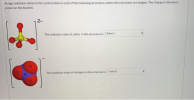 Assign oxidation states to the central atom in each of the following structures, where the red atoms are oxygen. The charge on the ion is shown on the bracket The oxidation state of sulfur in this structure is [Select The oxidation state of nitrogen in this structure is Select
QUESTION 25 What is the oxidation number for the chromium atom in the following molecules? K2Cr204:...
 QUESTION 25 What is the oxidation number for the chromium atom in the following molecules? K2Cr204: Cro32
 8) Write the oxidation states for each atom in the following: (4 pts) (a) Al203 (b) SnF2 (c) CO (d) CO2 (e) N2 (f) H2S (g) NO (h) Cr202
 Assign oxidation states to the central atom in each of the following structures, where the red atoms are oxygen. The charge on the ion is shown on the bracket The oxidation state of sulfur in this structure is [Select The oxidation state of nitrogen in this structure is Select
 QUESTION 25 What is the oxidation number for the chromium atom in the following molecules? K2Cr204: Cro32
Most questions answered within 3 hours.
-
Where is the error in this code sequence?
String s1 = "Hello";
String s2 = "ello";...
asked 10 months ago -
Financial data for Joel de Paris, Inc., for last year
follow:
Joel de Paris, Inc.
Balance...
asked 10 months ago -
Consider this reaction:
Al2(SO4)3 (aq)+ BaCl3
(aq) Al2Cl6 (aq)- +
3BaSO4(s) . What is the...
asked 10 months ago -
Suppose that Savneet is considering increasing her
recent random sample from 20 car rentals to 40...
asked 10 months ago -
Trucks arrive at an unloading terminal at an average rate of 120
per hour.
Trucks arrive...
asked 10 months ago -
Why are methanol and ethanol completely soluble in water while
octanol is not very little soluble....
asked 10 months ago -
A facilities manager at a university reads in a research report
that the mean amount of...
asked 10 months ago -
When the CuSO4 is rehydrated by adding water to the anhydrous
compound, is this an endothermic...
asked 10 months ago -
A ray of sunlight is passing from diamond into crown glass; the
angle of incidence is...
asked 10 months ago -
A block of mass 0.249 kg is placed on top of a light, vertical
spring of...
asked 10 months ago -
how do the kidneys compensate in the presences of acidosis
a) trigger hyperventilate
b) reserve acid...
asked 10 months ago -
Question 501 pts
The rental rate of capital to the firm increases. Which of the
following...
asked 10 months ago