
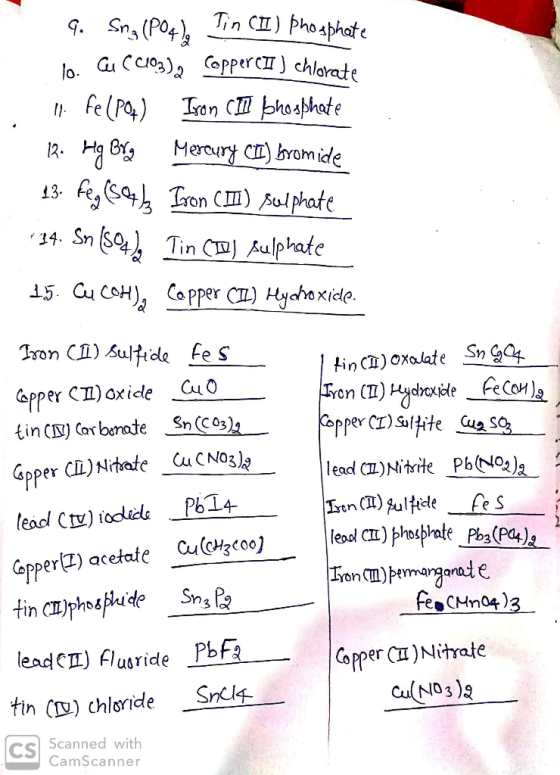
Homework Answers
Nomenclature done by metal(oxidation no. Of metal)anion.for
example PbO2 nomenclature metal is lead and anion is
oxide ion metal present in +4 oxidation state so nomenclature of
PbO2 is Lead (|V)oxide.For any query please comment
below.
Add Answer to:
Worksheet. ll: Stock Nomenclature 1. Cu,P2 2. Pb,(PO)2 3. Fez(SO) 4. Pbo, 5. PbSO. 6. Cul...
Please answer the following questions (naming compounds) - will thumbs up upon completion =) Thank you!...
 Please answer the following questions (naming compounds)
- will thumbs up upon completion =) Thank you!
Part III: Stock Nomenclature 1. Cu3Pi 3. Pb: PO4)2 4. Cu ClO3)2 5. Fe2(SO4)s 6. Cu OH)2 7. PbO2 8. HgBr2 9. PbSO4 10. Fe(SO4)s 11· iron(II)sulfide 12. tin(I)oxalate 13 copper(T)oxide 14. iron(II)hydroxide 15. copperI)sulfite 16. tin(IV)carbonate 17. lead(II)nitrite 18. lead(IDphosphate 19. iron(II)sulfate 20. iron IIpermanganate
Please answer the following questions (naming compounds)
- will thumbs up upon completion =) Thank you!
Part III: Stock Nomenclature 1. Cu3Pi 3. Pb: PO4)2 4. Cu ClO3)2 5. Fe2(SO4)s 6. Cu OH)2 7. PbO2 8. HgBr2 9. PbSO4 10. Fe(SO4)s 11· iron(II)sulfide 12. tin(I)oxalate 13 copper(T)oxide 14. iron(II)hydroxide 15. copperI)sulfite 16. tin(IV)carbonate 17. lead(II)nitrite 18. lead(IDphosphate 19. iron(II)sulfate 20. iron IIpermanganate
Chemical Nomenclature: Worksheet Name B. Write the formulas for the following compounds: manganese(ll) chlorite chlorine monoxide...
 Chemical Nomenclature: Worksheet Name B. Write the formulas for the following compounds: manganese(ll) chlorite chlorine monoxide potassium nitride mercury(II) sulfate cobalt(III) sulfite calcium chlorite nickel() carbonate silicon monoxide diphosphorus pentoxide carbonic acid cobalt(W) permanganate lead(IV) nitrate barium sulfite hypochlorous acid lead(ul) sulfide iron(III) chloride zinc permanganate manganese(II) bromide nitrous acid xenon pentoxide silver nitrate phosphorous pentchloride potassium cyanide
Directions: Write the formula or name of the following compounds in the space provided. (Please note...
Directions: Write the formula or name of the following compounds in the space provided. (Please note that some of these compounds do not exist as a stable substance in nature, however the following should serve as a practice exercise in nomenclature.) If provided the name, then you must write the formula. If provided the formula, then you must write the correct name. Indicate IUPAC names only. NOTE: IF EVEN ONE PROBLEM IS LEFT UNANSWERED, YOU WILL RECEIVE ZERO (0) POINTS...
need help, convert them like below pic S. OH- t. 10 w. CIO2 2- X. CO24...
 need help, convert them like below pic
S. OH- t. 10 w. CIO2 2- X. CO24 y. HSO3 z. CIO, u. HCO3- v. 104 5. Ionic Compounds with Polyatomic lons & Constant Charge lons a. CaCO3 i. potassium hydroxide b. KCIO j. beryllium hydroxide C. CASO k. strontium acetate d. Li2SO3 I. ammonium oxide e. Ag3PO4 m. silver cyanide f. NH,F n. zinc carbonate g. Al(NO2)3 0. aluminum bicarbonate h. Ba(HCO3)2- p. magnesium phosphate b. NiP04 6. Tonic Compounds with...
need help, convert them like below pic
S. OH- t. 10 w. CIO2 2- X. CO24 y. HSO3 z. CIO, u. HCO3- v. 104 5. Ionic Compounds with Polyatomic lons & Constant Charge lons a. CaCO3 i. potassium hydroxide b. KCIO j. beryllium hydroxide C. CASO k. strontium acetate d. Li2SO3 I. ammonium oxide e. Ag3PO4 m. silver cyanide f. NH,F n. zinc carbonate g. Al(NO2)3 0. aluminum bicarbonate h. Ba(HCO3)2- p. magnesium phosphate b. NiP04 6. Tonic Compounds with...
double check answers to see if they're all right hydroiodic acid 26 HI (aq) calcium hydroxide...
 double check answers to see if they're all right
hydroiodic acid 26 HI (aq) calcium hydroxide Ca(OH) rubidium arsenate RbjAsO 27 silver phosphate 2 AgsPO beryllium nitride Be N2 28 hydrogen chloride НСТ hydrosulfuric acid H2S (aq) 29 hydrochloric acid 4 HCl (aq) antimony(II) nitrate 30 Sb(NO) ammonium sulfate 5 (NHa) SO lead(II) bromide РЬВг2 31 zinc sulfide 6 ZnS sulfuric acid 32 HSO. (aq) cadmium dichromate CdCr2O 7 cobalt(II) chloride 33 CoCl barium chlorate Ba(CIO) hydrogen selenide 34 HSe...
double check answers to see if they're all right
hydroiodic acid 26 HI (aq) calcium hydroxide Ca(OH) rubidium arsenate RbjAsO 27 silver phosphate 2 AgsPO beryllium nitride Be N2 28 hydrogen chloride НСТ hydrosulfuric acid H2S (aq) 29 hydrochloric acid 4 HCl (aq) antimony(II) nitrate 30 Sb(NO) ammonium sulfate 5 (NHa) SO lead(II) bromide РЬВг2 31 zinc sulfide 6 ZnS sulfuric acid 32 HSO. (aq) cadmium dichromate CdCr2O 7 cobalt(II) chloride 33 CoCl barium chlorate Ba(CIO) hydrogen selenide 34 HSe...
1. Study these 27 compounds and try to group them based on their similarities. There are...
 1. Study these 27 compounds and try to group them based on their similarities. There are nine main types with three examples in each group. Organize these 27 into the following groups: Acid (binary or ternary): organic; molecular, hydrated salts: Ionic (binary and ternary). Group One Na,PO12H0 Сас, PCI, Fe(OH), CuSO-SHO Her, NO, What do these three compounds have in common that led you to put them in the same group? AICI-6H,0 NH CHO HI Group Two LiH Sn(Cr.0.), н.com...
Experiment 5: Nomenclature of Chemical Compounds and Formula Writing Experiment NOMENCLATURE OF CHEMICAL COMPOUNDS AND FORMULA...
 Experiment 5: Nomenclature of Chemical Compounds and Formula
Writing
Experiment NOMENCLATURE OF CHEMICAL COMPOUNDS AND FORMULA WRITING The After Thought 1. Consider the elements in period or row 3 of the Periodic Table. Each element is expected to form a simple ion as atoms of that element gain or lose electrons. Write the charge expected for each of these elements in the corresponding box below. Group 1 III IV V VI VII NU 2. Circle either ionic (l) or molecular...
Experiment 5: Nomenclature of Chemical Compounds and Formula
Writing
Experiment NOMENCLATURE OF CHEMICAL COMPOUNDS AND FORMULA WRITING The After Thought 1. Consider the elements in period or row 3 of the Periodic Table. Each element is expected to form a simple ion as atoms of that element gain or lose electrons. Write the charge expected for each of these elements in the corresponding box below. Group 1 III IV V VI VII NU 2. Circle either ionic (l) or molecular...
Give the formulas of the following substances: 1. Ammonium hydrogen carbonate 2. Hydrogen sulfide si 3....
 Give the formulas of the following substances: 1. Ammonium hydrogen carbonate 2. Hydrogen sulfide si 3. Barium hydroxide 4. Carbon tetrachloride 5. Nickel(IT) perchlorate 6. Lead(II) nitrate 7. Sulfur dioxide 8. Carbonic acid 9. Copper(I) carbonate 10. Calcium cyanide 11. Arsenic(II)oxide 12. Silver dichromate 13. Nitrous acid 14. Copper(II) bromide es com 15Ammonia 16. Chlorine 17. Chromium(III) sulfite o 18. Chloric acid 19. Barium arsenate 20. Manganese(IV) chloride 21. Carbon disulfide 22. Aluminum fluoride Text Give the names of the...
STUDENT NAME CHEM 121 POST LAB WORKSHEET NOMENCLATURE and FORMULAS of BINARY INORGANIC COMPOUNDS Do not...
 STUDENT NAME CHEM 121 POST LAB WORKSHEET NOMENCLATURE and FORMULAS of BINARY INORGANIC COMPOUNDS Do not attempt to write your answers on this sheet. There is not enough room and your writing will be too small to read. Attach separate sheets with your answers. 1-43) WRITE THE IUPAC NAME FOR THE FOLLOWING COMPOUNDS ANSWERS ON A SEPARATE SHEET PLEASE 1) H20 2) Mgo 3) AIS 4) KN 5) CaCl2 6) AuCl3 7) CO 8) Cu20 9) FeCl2 10) P.0 11)...
Please help with solving Question 1 (A-C) Thank you! Unless otherwise specified in the problem, you...
 Please help with solving Question 1 (A-C) Thank you!
Unless otherwise specified in the problem, you may assume that all solutions are at 25°C. 1. 50.0 mL of a pH 6.00 carbonic acid buffer is titrated with 0.2857 M NaOH, requiring 17.47 mL to reach the second equivalence point. a. Calculate the molarity of carbonic acid and bicarbonate in the original buffer. Carbonic acid: Bicarbonate: b. Calculate the pH of the solution after a total of 100.0 mL of 0.2857...
Please help with solving Question 1 (A-C) Thank you!
Unless otherwise specified in the problem, you may assume that all solutions are at 25°C. 1. 50.0 mL of a pH 6.00 carbonic acid buffer is titrated with 0.2857 M NaOH, requiring 17.47 mL to reach the second equivalence point. a. Calculate the molarity of carbonic acid and bicarbonate in the original buffer. Carbonic acid: Bicarbonate: b. Calculate the pH of the solution after a total of 100.0 mL of 0.2857...
 Please answer the following questions (naming compounds)
- will thumbs up upon completion =) Thank you!
Part III: Stock Nomenclature 1. Cu3Pi 3. Pb: PO4)2 4. Cu ClO3)2 5. Fe2(SO4)s 6. Cu OH)2 7. PbO2 8. HgBr2 9. PbSO4 10. Fe(SO4)s 11· iron(II)sulfide 12. tin(I)oxalate 13 copper(T)oxide 14. iron(II)hydroxide 15. copperI)sulfite 16. tin(IV)carbonate 17. lead(II)nitrite 18. lead(IDphosphate 19. iron(II)sulfate 20. iron IIpermanganate
Please answer the following questions (naming compounds)
- will thumbs up upon completion =) Thank you!
Part III: Stock Nomenclature 1. Cu3Pi 3. Pb: PO4)2 4. Cu ClO3)2 5. Fe2(SO4)s 6. Cu OH)2 7. PbO2 8. HgBr2 9. PbSO4 10. Fe(SO4)s 11· iron(II)sulfide 12. tin(I)oxalate 13 copper(T)oxide 14. iron(II)hydroxide 15. copperI)sulfite 16. tin(IV)carbonate 17. lead(II)nitrite 18. lead(IDphosphate 19. iron(II)sulfate 20. iron IIpermanganate
 Chemical Nomenclature: Worksheet Name B. Write the formulas for the following compounds: manganese(ll) chlorite chlorine monoxide potassium nitride mercury(II) sulfate cobalt(III) sulfite calcium chlorite nickel() carbonate silicon monoxide diphosphorus pentoxide carbonic acid cobalt(W) permanganate lead(IV) nitrate barium sulfite hypochlorous acid lead(ul) sulfide iron(III) chloride zinc permanganate manganese(II) bromide nitrous acid xenon pentoxide silver nitrate phosphorous pentchloride potassium cyanide
 need help, convert them like below pic
S. OH- t. 10 w. CIO2 2- X. CO24 y. HSO3 z. CIO, u. HCO3- v. 104 5. Ionic Compounds with Polyatomic lons & Constant Charge lons a. CaCO3 i. potassium hydroxide b. KCIO j. beryllium hydroxide C. CASO k. strontium acetate d. Li2SO3 I. ammonium oxide e. Ag3PO4 m. silver cyanide f. NH,F n. zinc carbonate g. Al(NO2)3 0. aluminum bicarbonate h. Ba(HCO3)2- p. magnesium phosphate b. NiP04 6. Tonic Compounds with...
need help, convert them like below pic
S. OH- t. 10 w. CIO2 2- X. CO24 y. HSO3 z. CIO, u. HCO3- v. 104 5. Ionic Compounds with Polyatomic lons & Constant Charge lons a. CaCO3 i. potassium hydroxide b. KCIO j. beryllium hydroxide C. CASO k. strontium acetate d. Li2SO3 I. ammonium oxide e. Ag3PO4 m. silver cyanide f. NH,F n. zinc carbonate g. Al(NO2)3 0. aluminum bicarbonate h. Ba(HCO3)2- p. magnesium phosphate b. NiP04 6. Tonic Compounds with...
 double check answers to see if they're all right
hydroiodic acid 26 HI (aq) calcium hydroxide Ca(OH) rubidium arsenate RbjAsO 27 silver phosphate 2 AgsPO beryllium nitride Be N2 28 hydrogen chloride НСТ hydrosulfuric acid H2S (aq) 29 hydrochloric acid 4 HCl (aq) antimony(II) nitrate 30 Sb(NO) ammonium sulfate 5 (NHa) SO lead(II) bromide РЬВг2 31 zinc sulfide 6 ZnS sulfuric acid 32 HSO. (aq) cadmium dichromate CdCr2O 7 cobalt(II) chloride 33 CoCl barium chlorate Ba(CIO) hydrogen selenide 34 HSe...
double check answers to see if they're all right
hydroiodic acid 26 HI (aq) calcium hydroxide Ca(OH) rubidium arsenate RbjAsO 27 silver phosphate 2 AgsPO beryllium nitride Be N2 28 hydrogen chloride НСТ hydrosulfuric acid H2S (aq) 29 hydrochloric acid 4 HCl (aq) antimony(II) nitrate 30 Sb(NO) ammonium sulfate 5 (NHa) SO lead(II) bromide РЬВг2 31 zinc sulfide 6 ZnS sulfuric acid 32 HSO. (aq) cadmium dichromate CdCr2O 7 cobalt(II) chloride 33 CoCl barium chlorate Ba(CIO) hydrogen selenide 34 HSe...
 1. Study these 27 compounds and try to group them based on their similarities. There are nine main types with three examples in each group. Organize these 27 into the following groups: Acid (binary or ternary): organic; molecular, hydrated salts: Ionic (binary and ternary). Group One Na,PO12H0 Сас, PCI, Fe(OH), CuSO-SHO Her, NO, What do these three compounds have in common that led you to put them in the same group? AICI-6H,0 NH CHO HI Group Two LiH Sn(Cr.0.), н.com...
 Experiment 5: Nomenclature of Chemical Compounds and Formula
Writing
Experiment NOMENCLATURE OF CHEMICAL COMPOUNDS AND FORMULA WRITING The After Thought 1. Consider the elements in period or row 3 of the Periodic Table. Each element is expected to form a simple ion as atoms of that element gain or lose electrons. Write the charge expected for each of these elements in the corresponding box below. Group 1 III IV V VI VII NU 2. Circle either ionic (l) or molecular...
Experiment 5: Nomenclature of Chemical Compounds and Formula
Writing
Experiment NOMENCLATURE OF CHEMICAL COMPOUNDS AND FORMULA WRITING The After Thought 1. Consider the elements in period or row 3 of the Periodic Table. Each element is expected to form a simple ion as atoms of that element gain or lose electrons. Write the charge expected for each of these elements in the corresponding box below. Group 1 III IV V VI VII NU 2. Circle either ionic (l) or molecular...
 Give the formulas of the following substances: 1. Ammonium hydrogen carbonate 2. Hydrogen sulfide si 3. Barium hydroxide 4. Carbon tetrachloride 5. Nickel(IT) perchlorate 6. Lead(II) nitrate 7. Sulfur dioxide 8. Carbonic acid 9. Copper(I) carbonate 10. Calcium cyanide 11. Arsenic(II)oxide 12. Silver dichromate 13. Nitrous acid 14. Copper(II) bromide es com 15Ammonia 16. Chlorine 17. Chromium(III) sulfite o 18. Chloric acid 19. Barium arsenate 20. Manganese(IV) chloride 21. Carbon disulfide 22. Aluminum fluoride Text Give the names of the...
 STUDENT NAME CHEM 121 POST LAB WORKSHEET NOMENCLATURE and FORMULAS of BINARY INORGANIC COMPOUNDS Do not attempt to write your answers on this sheet. There is not enough room and your writing will be too small to read. Attach separate sheets with your answers. 1-43) WRITE THE IUPAC NAME FOR THE FOLLOWING COMPOUNDS ANSWERS ON A SEPARATE SHEET PLEASE 1) H20 2) Mgo 3) AIS 4) KN 5) CaCl2 6) AuCl3 7) CO 8) Cu20 9) FeCl2 10) P.0 11)...
 Please help with solving Question 1 (A-C) Thank you!
Unless otherwise specified in the problem, you may assume that all solutions are at 25°C. 1. 50.0 mL of a pH 6.00 carbonic acid buffer is titrated with 0.2857 M NaOH, requiring 17.47 mL to reach the second equivalence point. a. Calculate the molarity of carbonic acid and bicarbonate in the original buffer. Carbonic acid: Bicarbonate: b. Calculate the pH of the solution after a total of 100.0 mL of 0.2857...
Please help with solving Question 1 (A-C) Thank you!
Unless otherwise specified in the problem, you may assume that all solutions are at 25°C. 1. 50.0 mL of a pH 6.00 carbonic acid buffer is titrated with 0.2857 M NaOH, requiring 17.47 mL to reach the second equivalence point. a. Calculate the molarity of carbonic acid and bicarbonate in the original buffer. Carbonic acid: Bicarbonate: b. Calculate the pH of the solution after a total of 100.0 mL of 0.2857...
Most questions answered within 3 hours.
-
Where is the error in this code sequence?
String s1 = "Hello";
String s2 = "ello";...
asked 11 months ago -
Financial data for Joel de Paris, Inc., for last year
follow:
Joel de Paris, Inc.
Balance...
asked 11 months ago -
Consider this reaction:
Al2(SO4)3 (aq)+ BaCl3
(aq) Al2Cl6 (aq)- +
3BaSO4(s) . What is the...
asked 11 months ago -
Suppose that Savneet is considering increasing her
recent random sample from 20 car rentals to 40...
asked 11 months ago -
Trucks arrive at an unloading terminal at an average rate of 120
per hour.
Trucks arrive...
asked 11 months ago -
Why are methanol and ethanol completely soluble in water while
octanol is not very little soluble....
asked 11 months ago -
A facilities manager at a university reads in a research report
that the mean amount of...
asked 11 months ago -
When the CuSO4 is rehydrated by adding water to the anhydrous
compound, is this an endothermic...
asked 11 months ago -
A ray of sunlight is passing from diamond into crown glass; the
angle of incidence is...
asked 11 months ago -
A block of mass 0.249 kg is placed on top of a light, vertical
spring of...
asked 11 months ago -
how do the kidneys compensate in the presences of acidosis
a) trigger hyperventilate
b) reserve acid...
asked 11 months ago -
Question 501 pts
The rental rate of capital to the firm increases. Which of the
following...
asked 11 months ago