LANGUAGE: PYTHON
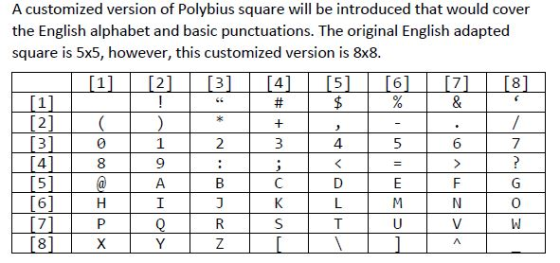
Write a function called: d_polybius(). The function applies the decryption scheme for the polybius cipher scheme above. The start of the function call the get_polybius_square function to get the square as a string.

The second scenario when the number of characters is not even, excluding ‘\n’. For instance: “71\n5” is an invalid cipher because there is no way that the last number correspond to a character (we need two numbers).
Homework Answers
# if this editor loses indentation please check attached images.
def d_polybius(ciphertext,key=None):
i = 0
plaintext = ''
while(i<len(ciphertext)):
if ciphertext[i] != '\n':
rc = ciphertext[i:i+2]
if rc.isdigit():
rc = int(rc) #row col value
if rc<11 or rc >88:
print("Error")
return ''
else: # out of bonds of matrix
rc = str(rc)
r = int(rc[0]) #getting r and c from rc
c = int(rc[1])
pos = (r-1)*8+c
ascii_val = pos+31 # in asci_val space( ) starts at 32 our
plaintext = plaintext+chr(ascii_val)# index start at 1 so adding 31
gives ascii value
i = i+2
else: # not a digit
print("Error")
return ''
else: #char is '\n'
plaintext=plaintext+ciphertext[i]
i = i+1
return plaintext
print(d_polybius("675258\n6552"))
![10 9 def d_polybius(ciphertext,key=None): i = 0 plaintext = while(i<len(ciphertext)): if ciphertext[i] != \n: rc = cipher](http://img.homeworklib.com/questions/465754f0-a5e0-11ea-9d74-09ac53d20452.png?x-oss-process=image/resize,w_560)
![c = int(rc[1]) pos = (r-1)*8+c ascii_val = pos+31 # in asci_val space() st plaintext = plaintext+chr(ascii_val)# index start](http://img.homeworklib.com/questions/46b3e460-a5e0-11ea-8983-9526355dbf8e.png?x-oss-process=image/resize,w_560)
Add Answer to:
LANGUAGE: PYTHON
Write a function called: d_polybius(). The
function applies the decryption scheme for the polybius...
Question) Write a decryption function decryp_scytale(ctext, key) in PYTHON that would decrypt any ciphertext produced through...
Question) Write a decryption function decryp_scytale(ctext, key) in PYTHON that would decrypt any ciphertext produced through the scytale cipher scheme using a given key. Note: the key refers to the diameter of the rod. It represents the number of characters which can be written in the one of the rounds around the rod (think of number of rows in a table). Also, remember that it is assumed that the rod can have an infinite length, i.e. there is no limit...
Computer Science C++ Help, here's the question that needs to be answered (TASK D): Task D....
Computer Science C++ Help, here's the question that needs to be answered (TASK D): Task D. Decryption Implement two decryption functions corresponding to the above ciphers. When decrypting ciphertext, ensure that the produced decrypted string is equal to the original plaintext: decryptCaesar(ciphertext, rshift) == plaintext decryptVigenere(ciphertext, keyword) == plaintext Write a program decryption.cpp that uses the above functions to demonstrate encryption and decryption for both ciphers. It should first ask the user to input plaintext, then ask for a right...
Write a Python program which implements the following two classical cryptosystem which we covered n class:...
 Write a Python program which implements the following two classical cryptosystem which we covered n class: a) Affine Cipher b) Vigenere Cipher Your program should consist of at least five functions: a) Two functions named encrypt, one for each of the two algorithms which accepts a lowercase alphabetical plaintext string and key as input and outputs a corresponding cipher text string. b) Two functions named decrypt, one for each of the two algorithms which accepts a lowercase alphabetical ciphertext string...
Using Python; Caesar part of the homework: Write c_encrypt() and c_decrypt(), both of which take two...
Using Python; Caesar part of the homework: Write c_encrypt() and c_decrypt(), both of which take two arguments, the first one a string and the second one an integer key. Both should return a string. Vigenère part of the homework: Write vig_encrypt() and vig_decrypt() functions. Each takes two strings as inputs, with the first being the plaintext/ciphertext, and the second being the key. Both should be calling functions you wrote earlier to help make the work easier. The key will be...
Decrypting the APCO cipher without the key. Decryption without the key is obviously a much more...
 Decrypting the APCO cipher without the key.
Decryption without the key is obviously a much more difficult
process. Indeed, the purpose of encryption is to make it as
difficult as possible for anyone who does not know the key to read
the plain text. We will be using an unsophisticated password
cracking technique called a brute force attack. A brute
force attack on the APCO cipher works by trying every possible four
digit key (from 0000 to 9999) and keeping...
Decrypting the APCO cipher without the key.
Decryption without the key is obviously a much more difficult
process. Indeed, the purpose of encryption is to make it as
difficult as possible for anyone who does not know the key to read
the plain text. We will be using an unsophisticated password
cracking technique called a brute force attack. A brute
force attack on the APCO cipher works by trying every possible four
digit key (from 0000 to 9999) and keeping...
WE ARE USING PYTHON TO COMPLETE THIS ASSIGNMENT :) THANK YOU! In this programming assignment, you...
WE ARE USING PYTHON TO COMPLETE THIS ASSIGNMENT :) THANK YOU! In this programming assignment, you will write functions to encrypt and decrypt messages using simple substitution ciphers. Your solution MUST include: a function called encode that takes two parameters: key, a 26-character long string that identifies the ciphertext mapping for each letter of the alphabet, in order; plaintext, a string of unspecified length that represents the message to be encoded. encode will return a string representing the ciphertext. a...
Python3 : Write the function longestRun(s, chars) that takes a possibly-empty string s and a second...
Python3 : Write the function longestRun(s, chars) that takes a possibly-empty string s and a second possibly-empty string of chars. We will say that a character is "good" if it is in the chars string (case insensitively, so "A" and "a" would match). The function should return the length of the longest consecutive run of good characters in the given string s. For example, consider: longestRun("abbcazBbcababb","bz"). This returns 3 (look for "zBb"). Restrictions: for loop, slicing cannot be used, if...
I need Help to Write a function in C that will Decrypt at least one word with a substitution cipher given cipher text an...
 I need Help to Write a function in C that will Decrypt at least
one word with a substitution cipher given cipher text and key
My Current Code is:
void SubDecrypt(char *message, char *encryptKey) {
int iteration;
int iteration_Num_Two = 0;
int letter;
printf("Enter Encryption Key: \n");
//Display the message to enter encryption
key
scanf("%s", encryptKey);
//Input
the Encryption key
for (iteration = 0; message[iteration] != '0';
iteration++)
//loop will continue till
message reaches to end
{
letter = message[iteration];
...
I need Help to Write a function in C that will Decrypt at least
one word with a substitution cipher given cipher text and key
My Current Code is:
void SubDecrypt(char *message, char *encryptKey) {
int iteration;
int iteration_Num_Two = 0;
int letter;
printf("Enter Encryption Key: \n");
//Display the message to enter encryption
key
scanf("%s", encryptKey);
//Input
the Encryption key
for (iteration = 0; message[iteration] != '0';
iteration++)
//loop will continue till
message reaches to end
{
letter = message[iteration];
...
Part 3: Transposition Ciphers #can't use ord or chr functions You must implement three transposition ciphers...
Part 3: Transposition Ciphers #can't use ord or chr functions You must implement three transposition ciphers (the "backwards" cipher, the Rail Fence cipher, and the Column Transposition cipher) where the ciphertext is created via an altered presentation of the plaintext. The algorithm for each is detailed in the function descriptions in this section. (13 points) def backwards_cipher(plaintext, key): • Parameter(s): plaintext ----- a string; the message to be encrypted key ----- an integer; the number to control this cipher •...
PLEASE CODE IN PYTHON Run-length encoding is a simple compression scheme best used when a data-set...
PLEASE CODE IN PYTHON Run-length encoding is a simple compression scheme best used when a data-set consists primarily of numerous, long runs of repeated characters. For example, AAAAAAAAAA is a run of 10 A’s. We could encode this run using a notation like *A10, where the * is a special flag character that indicates a run, A is the symbol in the run, and 10 is the length of the run. As another example, the string KKKKKKKKKKKKKBCCDDDDDDDDDDDDDDDKKKKKMNUUUGGGGG would be encoded...
 Write a Python program which implements the following two classical cryptosystem which we covered n class: a) Affine Cipher b) Vigenere Cipher Your program should consist of at least five functions: a) Two functions named encrypt, one for each of the two algorithms which accepts a lowercase alphabetical plaintext string and key as input and outputs a corresponding cipher text string. b) Two functions named decrypt, one for each of the two algorithms which accepts a lowercase alphabetical ciphertext string...
 Decrypting the APCO cipher without the key.
Decryption without the key is obviously a much more difficult
process. Indeed, the purpose of encryption is to make it as
difficult as possible for anyone who does not know the key to read
the plain text. We will be using an unsophisticated password
cracking technique called a brute force attack. A brute
force attack on the APCO cipher works by trying every possible four
digit key (from 0000 to 9999) and keeping...
Decrypting the APCO cipher without the key.
Decryption without the key is obviously a much more difficult
process. Indeed, the purpose of encryption is to make it as
difficult as possible for anyone who does not know the key to read
the plain text. We will be using an unsophisticated password
cracking technique called a brute force attack. A brute
force attack on the APCO cipher works by trying every possible four
digit key (from 0000 to 9999) and keeping...
 I need Help to Write a function in C that will Decrypt at least
one word with a substitution cipher given cipher text and key
My Current Code is:
void SubDecrypt(char *message, char *encryptKey) {
int iteration;
int iteration_Num_Two = 0;
int letter;
printf("Enter Encryption Key: \n");
//Display the message to enter encryption
key
scanf("%s", encryptKey);
//Input
the Encryption key
for (iteration = 0; message[iteration] != '0';
iteration++)
//loop will continue till
message reaches to end
{
letter = message[iteration];
...
I need Help to Write a function in C that will Decrypt at least
one word with a substitution cipher given cipher text and key
My Current Code is:
void SubDecrypt(char *message, char *encryptKey) {
int iteration;
int iteration_Num_Two = 0;
int letter;
printf("Enter Encryption Key: \n");
//Display the message to enter encryption
key
scanf("%s", encryptKey);
//Input
the Encryption key
for (iteration = 0; message[iteration] != '0';
iteration++)
//loop will continue till
message reaches to end
{
letter = message[iteration];
...
Most questions answered within 3 hours.
-
Where is the error in this code sequence?
String s1 = "Hello";
String s2 = "ello";...
asked 11 months ago -
Financial data for Joel de Paris, Inc., for last year
follow:
Joel de Paris, Inc.
Balance...
asked 11 months ago -
Consider this reaction:
Al2(SO4)3 (aq)+ BaCl3
(aq) Al2Cl6 (aq)- +
3BaSO4(s) . What is the...
asked 11 months ago -
Suppose that Savneet is considering increasing her
recent random sample from 20 car rentals to 40...
asked 11 months ago -
Trucks arrive at an unloading terminal at an average rate of 120
per hour.
Trucks arrive...
asked 11 months ago -
Why are methanol and ethanol completely soluble in water while
octanol is not very little soluble....
asked 11 months ago -
A facilities manager at a university reads in a research report
that the mean amount of...
asked 11 months ago -
When the CuSO4 is rehydrated by adding water to the anhydrous
compound, is this an endothermic...
asked 11 months ago -
A ray of sunlight is passing from diamond into crown glass; the
angle of incidence is...
asked 11 months ago -
A block of mass 0.249 kg is placed on top of a light, vertical
spring of...
asked 11 months ago -
how do the kidneys compensate in the presences of acidosis
a) trigger hyperventilate
b) reserve acid...
asked 11 months ago -
Question 501 pts
The rental rate of capital to the firm increases. Which of the
following...
asked 11 months ago