Below are shown two reaction pathways in which optically active (R) -1-phenylethanol (F) is converted to ethyl 1-phenylethyl ether (TsCl = p-toluenesulfonyl chloride, DMF = N, N-dimethylformamide). Explain why the optical rotation of the product has the opposite sign from the two reaction paths.
![CH3 CH3 CH-ONa CH3CH2OTs DMF CH-OCH2CH3 NaHr [a]= +19,9 CH3 -CH-OH TSCI [a]o = +33,0 pyridin ou un - CH2 CH3 CH-OTS CH3CH2ONa](http://img.homeworklib.com/questions/3e9b01d0-a5e1-11ea-af0b-cb099cc28887.png?x-oss-process=image/resize,w_560)
Homework Answers
Solution:
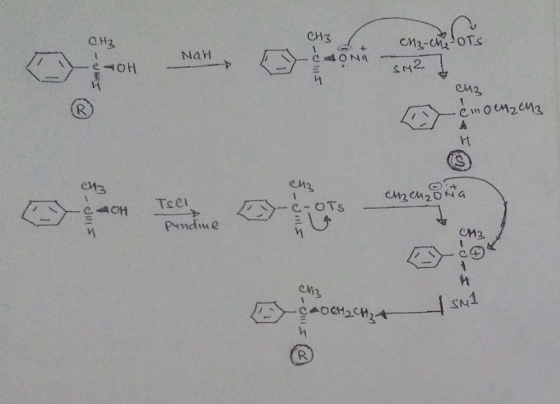
The conversion of (R)-1-phenylethanol to ethyl-1-phenylether by two pathways (NaH, CH3CH2OTs) and (TsCl and CH3CH2ONa), the products formed are enantiomers to each other. Enantiomers have identical physical properties but they rotate plane-polarized light in equal and opposite directions.
A) Conversion by NaH and CH3CH2OTs follow SN2 mechanism, hence formed product has opposite (S) configuration.
B) Conversion by TsCl/pyridine and CH3CH2ONa follow SN1 mechanism in which retention (R) product is more favours, giving rise form a product having R configuration.
The formed products in A and B are enantiomers, hence they posses equal but opposite rotation.
Add Answer to:
Below are shown two reaction pathways in which optically active
(R) -1-phenylethanol (F) is converted to...
Most questions answered within 3 hours.
-
Where is the error in this code sequence?
String s1 = "Hello";
String s2 = "ello";...
asked 10 months ago -
Financial data for Joel de Paris, Inc., for last year
follow:
Joel de Paris, Inc.
Balance...
asked 10 months ago -
Consider this reaction:
Al2(SO4)3 (aq)+ BaCl3
(aq) Al2Cl6 (aq)- +
3BaSO4(s) . What is the...
asked 10 months ago -
Suppose that Savneet is considering increasing her
recent random sample from 20 car rentals to 40...
asked 10 months ago -
Trucks arrive at an unloading terminal at an average rate of 120
per hour.
Trucks arrive...
asked 10 months ago -
Why are methanol and ethanol completely soluble in water while
octanol is not very little soluble....
asked 10 months ago -
A facilities manager at a university reads in a research report
that the mean amount of...
asked 10 months ago -
When the CuSO4 is rehydrated by adding water to the anhydrous
compound, is this an endothermic...
asked 10 months ago -
A ray of sunlight is passing from diamond into crown glass; the
angle of incidence is...
asked 10 months ago -
A block of mass 0.249 kg is placed on top of a light, vertical
spring of...
asked 10 months ago -
how do the kidneys compensate in the presences of acidosis
a) trigger hyperventilate
b) reserve acid...
asked 10 months ago -
Question 501 pts
The rental rate of capital to the firm increases. Which of the
following...
asked 10 months ago