
Homework Answers
SOLUTION:
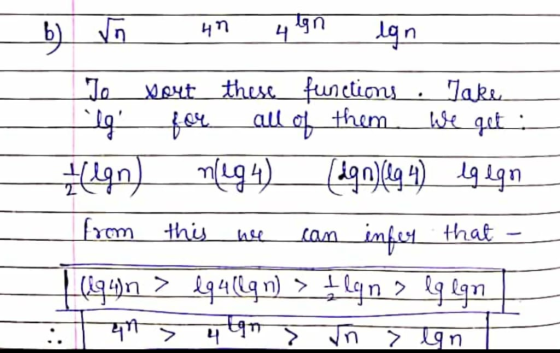
NOTE:
If you are satisfied with my answer please do up vote
and if you have any kind of doubts please post in comment section.
i'll surely help you there.
Thank You:)
Add Answer to:
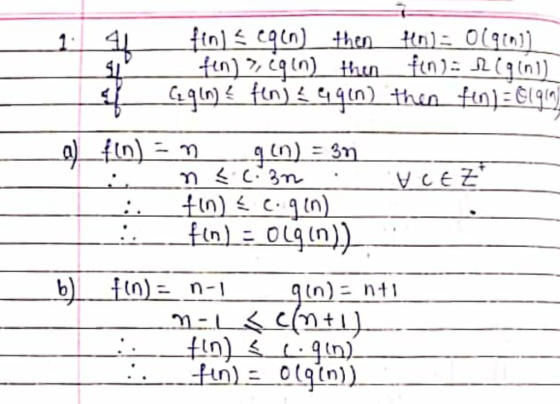
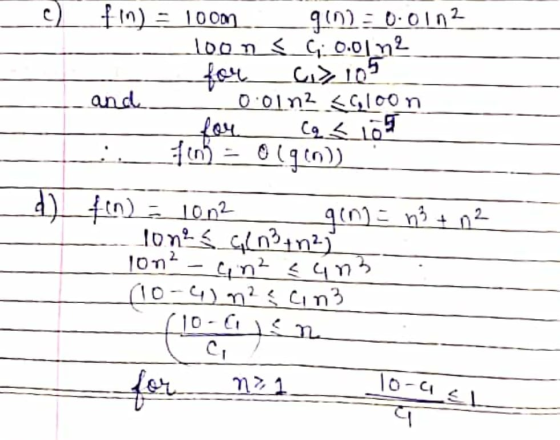
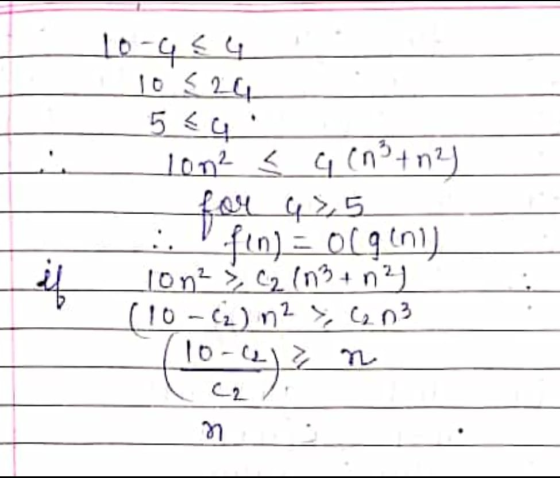
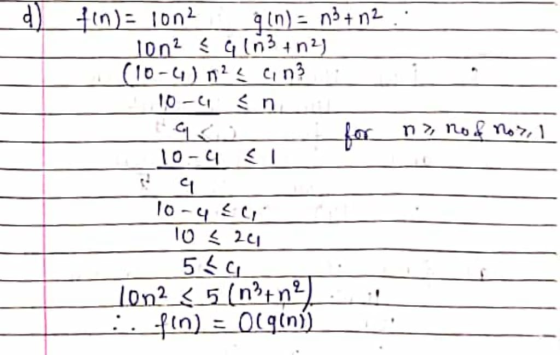
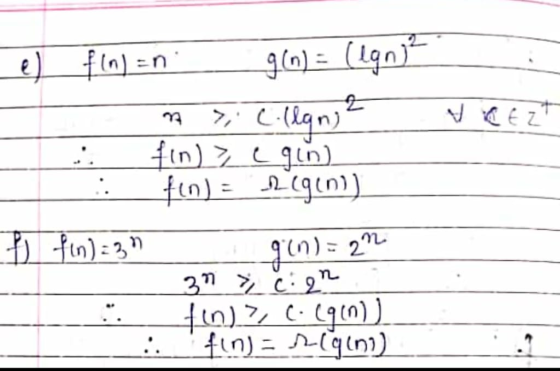
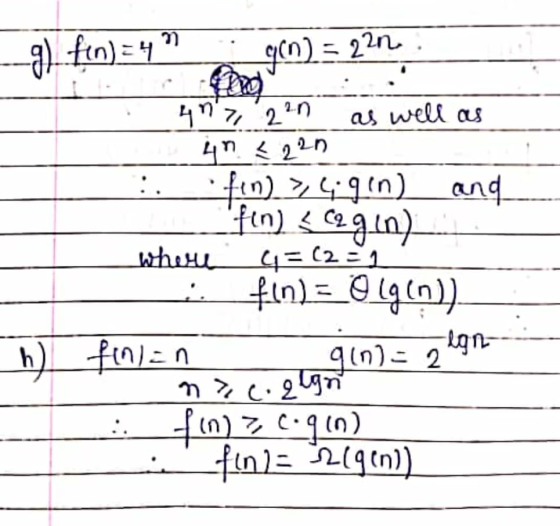
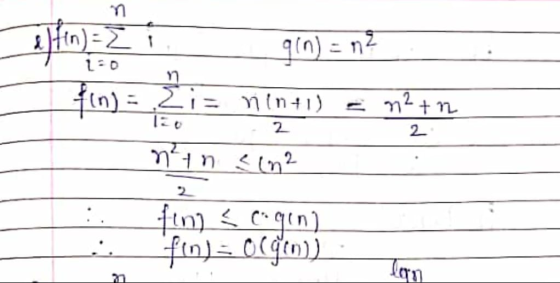
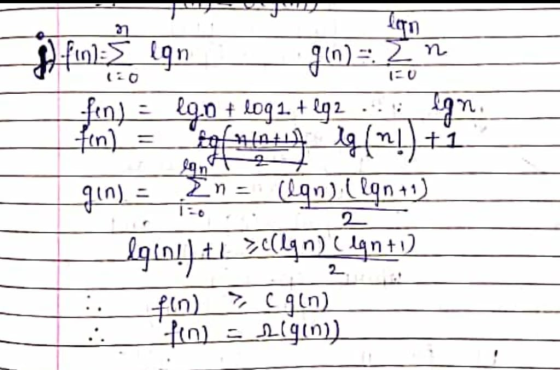
1. (10 pts) For each of the following pairs of functions, indicate whether f = 0(g),...
For each of the following functions, indicate the class Θ(g(n)) the function belongs to. ( Use...
For each of the following functions, indicate the class Θ(g(n)) the function belongs to. ( Use the simplest g(n) possible in your answers). Prove your assertions. a. ( n2 + 1)10 b. 2n+1 + 3n-1 c. [ log2 n ] d. 2n lg(n+2)2 + ( n+2)2 lg n/2 e. ( 10n2 + 7n + 3)1/2
Compare the following pairs of functions f, g. In each case, say whether f- o(g) f-w(g), or f = Θ...
 Compare the following pairs of functions f, g. In each case, say whether f- o(g) f-w(g), or f = Θ(g), and prove your claim. 157. f(n) -100n+logn, gn) (logn)2. 158,介f(n) = logn, g(n) = log log(n2). 159. . f(n)-n2/log n, g(n) = n(log n)2. 160·介介f(n)-(log n)106.9(n)-n10-6 . 161. (n)logn, g(n) (log nlog n 162. f(n) n2, gn) 3.
Compare the following pairs of functions f, g. In each case, say whether f- o(g) f-w(g), or f = Θ(g), and prove...
Compare the following pairs of functions f, g. In each case, say whether f- o(g) f-w(g), or f = Θ(g), and prove your claim. 157. f(n) -100n+logn, gn) (logn)2. 158,介f(n) = logn, g(n) = log log(n2). 159. . f(n)-n2/log n, g(n) = n(log n)2. 160·介介f(n)-(log n)106.9(n)-n10-6 . 161. (n)logn, g(n) (log nlog n 162. f(n) n2, gn) 3.
Compare the following pairs of functions f, g. In each case, say whether f- o(g) f-w(g), or f = Θ(g), and prove...
3. (10 pts) For each of the following functions f(n), prove the stated claim by providing...
 3. (10 pts) For each of the following functions f(n), prove the stated claim by providing constants no C1, and c2 such that for all n2 no, cig(n) S f(n) or f(n) c2g(n), and provide a calculation that shows that this inequality does indeed hold (a) f(n) 2n2 3n3-50nlgn10 0(n3) O(g(n)) (b) f(n)-2n log n + 3n2-10n-10-Ω ( 2)-0(g(n))
1. For each of the following pairs of functions, prove that f(n)-O(g(n)), and / or that...
 1. For each of the following pairs of functions, prove that f(n)-O(g(n)), and / or that g(n) O(f(n)), or explain why one or the other is not true. (a) 2"+1 vs 2 (b) 22n vs 2" VS (c) 4" vs 22n (d) 2" vs 4" (e) loga n vs log, n - where a and b are constants greater than 1. Show that you understand why this restriction on a and b was given. f) log(0(1) n) vs log n....
Part I. (30 pts) (10 pts) Let fin) and g(n) be asymptotically positive functions. Prove or...
 Part I. (30 pts) (10 pts) Let fin) and g(n) be asymptotically positive functions. Prove or disprove each of the following statements T a、 f(n) + g(n)=0(max(f(n), g(n))) 1. b. f(n) = 0(g(n)) implies g(n) = Ω(f(n)) T rc. f(n)- o F d. f(n) o(f(n)) 0(f (n)) f(n)=6((f(n))2)
For each pair of functions f(n) and g(n), indicate whether f(n) = O(g(n)), f(n) = Ω(g(n)), and/or...
For each pair of functions f(n) and g(n), indicate whether f(n) = O(g(n)), f(n) = Ω(g(n)), and/or f(n) = Θ(g(n)), and provide a brief explanation of your reasoning. (Your explanation can be the same for all three; for example, “the two functions differ by only a multiplicative constant” could justify why f(n) = n, g(n) = 2n are related by big-O, big-Omega, and big-Theta.) i. f(n) = n^2 log n, g(n) = 100n^2 ii. f(n) = 100, g(n) = log(log(log...
*9. For each of the following pairs of functions, determine the highest order of contact between the two functions at the indicated point xo: (e) f,g : R-R given by f(x)and g(x) 1+2r ro0 (f) f, g : (...
 *9. For each of the following pairs of functions, determine the highest order of contact between the two functions at the indicated point xo: (e) f,g : R-R given by f(x)and g(x) 1+2r ro0 (f) f, g : (0, oo) → R given by f(r) = In(2) and g(z) = (z-1)3 + In(z): zo = 1. (g) f.g: (0, oo) -R given by f(x)-In(x) and g(x)-(x 1)200 +ln(x); ro 1 x-1)200
*9. For each of the following pairs of functions,...
*9. For each of the following pairs of functions, determine the highest order of contact between the two functions at the indicated point xo: (e) f,g : R-R given by f(x)and g(x) 1+2r ro0 (f) f, g : (0, oo) → R given by f(r) = In(2) and g(z) = (z-1)3 + In(z): zo = 1. (g) f.g: (0, oo) -R given by f(x)-In(x) and g(x)-(x 1)200 +ln(x); ro 1 x-1)200
*9. For each of the following pairs of functions,...
3-3 Ordering by asymptotic growth rates a. Rank the following functions by order of growth; that...
 3-3 Ordering by asymptotic growth rates a. Rank the following functions by order of growth; that is, find an arrangement 81,82, 830 of the functions satisfying gi = Ω(82), g2 Ω(83), , g29 = Ω(g30). Partition your list into equivalence classes such that functions f(n) and g(n) are in the same class if and only if f(n) = Θ(g(n)) Chaptr3 Growth of Functions 1n In Inn lg* g nn-2" n'ln Ig nIn n 2" nlgn 22+1 b. Give an example...
a) Suppose that computer A executes 1 billion instructions per second, and computer B executes 10...
a) Suppose that computer A executes 1 billion instructions per second, and computer B executes 10 million instructions per second, i.e, Computer A is 100 times faster than computer B in raw computing power. Suppose an expert programmer implements insertion sort in machine language for computer A, and the resulting code requires 2 * n2 instructions to sort n numbers. Suppose an average programmer implements merge sort, using a high-level language on computer B, with the resulting code taking 5...
(g(n)), g(n) is (f(n)), or both. 1. For each of the following pairs of functions determine...
 (g(n)), g(n) is (f(n)), or both. 1. For each of the following pairs of functions determine if f(n) is f(n) = (na – n)/2, g(n) = 3n · f(n) = n log n, g(n) = n/n/2
 Compare the following pairs of functions f, g. In each case, say whether f- o(g) f-w(g), or f = Θ(g), and prove your claim. 157. f(n) -100n+logn, gn) (logn)2. 158,介f(n) = logn, g(n) = log log(n2). 159. . f(n)-n2/log n, g(n) = n(log n)2. 160·介介f(n)-(log n)106.9(n)-n10-6 . 161. (n)logn, g(n) (log nlog n 162. f(n) n2, gn) 3.
Compare the following pairs of functions f, g. In each case, say whether f- o(g) f-w(g), or f = Θ(g), and prove...
Compare the following pairs of functions f, g. In each case, say whether f- o(g) f-w(g), or f = Θ(g), and prove your claim. 157. f(n) -100n+logn, gn) (logn)2. 158,介f(n) = logn, g(n) = log log(n2). 159. . f(n)-n2/log n, g(n) = n(log n)2. 160·介介f(n)-(log n)106.9(n)-n10-6 . 161. (n)logn, g(n) (log nlog n 162. f(n) n2, gn) 3.
Compare the following pairs of functions f, g. In each case, say whether f- o(g) f-w(g), or f = Θ(g), and prove...
 3. (10 pts) For each of the following functions f(n), prove the stated claim by providing constants no C1, and c2 such that for all n2 no, cig(n) S f(n) or f(n) c2g(n), and provide a calculation that shows that this inequality does indeed hold (a) f(n) 2n2 3n3-50nlgn10 0(n3) O(g(n)) (b) f(n)-2n log n + 3n2-10n-10-Ω ( 2)-0(g(n))
 1. For each of the following pairs of functions, prove that f(n)-O(g(n)), and / or that g(n) O(f(n)), or explain why one or the other is not true. (a) 2"+1 vs 2 (b) 22n vs 2" VS (c) 4" vs 22n (d) 2" vs 4" (e) loga n vs log, n - where a and b are constants greater than 1. Show that you understand why this restriction on a and b was given. f) log(0(1) n) vs log n....
 Part I. (30 pts) (10 pts) Let fin) and g(n) be asymptotically positive functions. Prove or disprove each of the following statements T a、 f(n) + g(n)=0(max(f(n), g(n))) 1. b. f(n) = 0(g(n)) implies g(n) = Ω(f(n)) T rc. f(n)- o F d. f(n) o(f(n)) 0(f (n)) f(n)=6((f(n))2)
 *9. For each of the following pairs of functions, determine the highest order of contact between the two functions at the indicated point xo: (e) f,g : R-R given by f(x)and g(x) 1+2r ro0 (f) f, g : (0, oo) → R given by f(r) = In(2) and g(z) = (z-1)3 + In(z): zo = 1. (g) f.g: (0, oo) -R given by f(x)-In(x) and g(x)-(x 1)200 +ln(x); ro 1 x-1)200
*9. For each of the following pairs of functions,...
*9. For each of the following pairs of functions, determine the highest order of contact between the two functions at the indicated point xo: (e) f,g : R-R given by f(x)and g(x) 1+2r ro0 (f) f, g : (0, oo) → R given by f(r) = In(2) and g(z) = (z-1)3 + In(z): zo = 1. (g) f.g: (0, oo) -R given by f(x)-In(x) and g(x)-(x 1)200 +ln(x); ro 1 x-1)200
*9. For each of the following pairs of functions,...
 3-3 Ordering by asymptotic growth rates a. Rank the following functions by order of growth; that is, find an arrangement 81,82, 830 of the functions satisfying gi = Ω(82), g2 Ω(83), , g29 = Ω(g30). Partition your list into equivalence classes such that functions f(n) and g(n) are in the same class if and only if f(n) = Θ(g(n)) Chaptr3 Growth of Functions 1n In Inn lg* g nn-2" n'ln Ig nIn n 2" nlgn 22+1 b. Give an example...
 (g(n)), g(n) is (f(n)), or both. 1. For each of the following pairs of functions determine if f(n) is f(n) = (na – n)/2, g(n) = 3n · f(n) = n log n, g(n) = n/n/2
Most questions answered within 3 hours.
-
Where is the error in this code sequence?
String s1 = "Hello";
String s2 = "ello";...
asked 11 months ago -
Financial data for Joel de Paris, Inc., for last year
follow:
Joel de Paris, Inc.
Balance...
asked 11 months ago -
Consider this reaction:
Al2(SO4)3 (aq)+ BaCl3
(aq) Al2Cl6 (aq)- +
3BaSO4(s) . What is the...
asked 11 months ago -
Suppose that Savneet is considering increasing her
recent random sample from 20 car rentals to 40...
asked 11 months ago -
Trucks arrive at an unloading terminal at an average rate of 120
per hour.
Trucks arrive...
asked 11 months ago -
Why are methanol and ethanol completely soluble in water while
octanol is not very little soluble....
asked 11 months ago -
A facilities manager at a university reads in a research report
that the mean amount of...
asked 11 months ago -
When the CuSO4 is rehydrated by adding water to the anhydrous
compound, is this an endothermic...
asked 11 months ago -
A ray of sunlight is passing from diamond into crown glass; the
angle of incidence is...
asked 11 months ago -
A block of mass 0.249 kg is placed on top of a light, vertical
spring of...
asked 11 months ago -
how do the kidneys compensate in the presences of acidosis
a) trigger hyperventilate
b) reserve acid...
asked 11 months ago -
Question 501 pts
The rental rate of capital to the firm increases. Which of the
following...
asked 11 months ago