Choose one that is least likely to help reduce overfitting in neural network: A. Dropout B....
Choose one that is least likely to help reduce overfitting in neural network:
A. Dropout
B. Batch Normalization
C. Momentum
D. L2 Regularization
Homework Answers
Answer: C. Momentum
Explanation:
Batch normalization regularizes the model and Regularization
reduces Overfitting
L2 Regularization and Dropout help us reduce Overfitting
Thanks, PLEASE COMMENT if there is any
concern.
Add Answer to:
Choose one that is least likely to help reduce overfitting in
neural network:
A. Dropout
B....
Which of the following techniques does NOT prevent a model from overfitting? A) Dropout B) Early...
Which of the following techniques does NOT prevent a model from overfitting? A) Dropout B) Early stopping C) Data augmentation D) None of the above
Which of the following classification techniques may suffer from the overfitting issue? Choose all that apply....
Which of the following classification techniques may suffer from the overfitting issue? Choose all that apply. A. Decision Tree B. Logistic Regression c. Neural Network d. Naive Bayes
ARTIFICIAL NEURAL NETWORK HELP PLEASE Compute the output value for the neural network shown below. The artificial neural...
 ARTIFICIAL NEURAL NETWORK HELP PLEASE
Compute the output value for the neural network shown below. The
artificial neural network has two inputs, two neurons in the hidden
layer 1, one neuron in the output layer and one output.
Suppose that the artificial neural network is using the logsig
function
A). manually and B). using neural lab code in
C
Answer should be z = 0.641199
Please answer BOTH A and B AND show FULL
work
LAYER 1 LAYER 2 Neo...
ARTIFICIAL NEURAL NETWORK HELP PLEASE
Compute the output value for the neural network shown below. The
artificial neural network has two inputs, two neurons in the hidden
layer 1, one neuron in the output layer and one output.
Suppose that the artificial neural network is using the logsig
function
A). manually and B). using neural lab code in
C
Answer should be z = 0.641199
Please answer BOTH A and B AND show FULL
work
LAYER 1 LAYER 2 Neo...
Exercise Optimization in neural network Consider a very simple neural network with two input values, one...
 Exercise Optimization in neural network Consider a very simple neural network with two input values, one output value, and a single neuron with sigmoid activation. Each input to the neuron has an associated weight, and the neuron has a bias. So the network represents functions of the form o(W1X1 + W222 + b). We train the neural network using least squares loss on a single piece of training data ((1, -1),0). Initially all weights and biases are set to 1....
Part 1 (1 point) In which two of these examples are network externalities important? Choose one or...
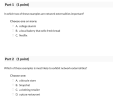 Part 1 (1 point) In which two of these examples are network externalities important? Choose one or more: A. college alumni B. a local bakery that sells fresh bread C. Netflix Part 2 (1 point) Which of these examples is most likely to exhibit network externalities? Choose one: A. a bicycle store B. Snapchat C. a clothing retailer D. a pizza restaurant
Identify at least one likely source of random errors and at least one likely source of...
 Identify at least one likely source of random errors and at least one likely source of systematic errors. How would you reduce these errors? a. You need to measure 10 meters. You don't have a tape measure, so 2. you use a meter stick to measure the distance You need to measure the weight of a penny, but you only have a postage scale b.
1. Consider a neural network, which contains one hidden layer and an output layer with one...
 1. Consider a neural network, which contains one hidden layer and an output layer with one output unit. Let the hidden units have negative sigmoid as the activation function, which is formulated as 1 n(v) 1 + exp(-1) and the output unit has a linear activation function in which the output is equal to the activation input). (a) Show that the derivative of the negative sigmoid obeys the following relation dn(v) dv = n(v)(1 + n(v)) (b) Let the cost...
Which of the following would help reduce the amount of frictional unemployment? Choose one or more:...
Which of the following would help reduce the amount of frictional unemployment? Choose one or more: A. interviewing a wide variety of candidates to ensure a diverse workforce B. government policies to help promote a stagnant economy C. providing tax breaks to firms that engage in technological innovations D. Websites that advertise job openings across the country E. government policies to limit outsourcing of jobs
Se Which of the following would help reduce the amount of frictional unemployment? Choose one or...
 Se Which of the following would help reduce the amount of frictional unemployment? Choose one or more: A. Websites that advertise job openings across the country B. government policies to help promote a stagnant economy C. providing tax breaks to firms that engage in technological innovations D. government policies to limit outsourcing of jobs O E. interviewing a wide variety of candidates to ensure a diverse workforce
2. (20) Design an artificial neural network with two hidden layers. First hidden layer has s...
 2. (20) Design an artificial neural network with two hidden layers. First hidden layer has s neurons, second hidden layer has 3 neurons. Input parameters are 3, output parameter i s (20) What is the fundemental philosophy in backpropagation training algorithm, Explain detail. 4 (30) Define the following terms and their effects on the performance of ANN. a) Learning factor b) Momentum factor. c) Number of hidden neuron d) Training data e) Initial Weights Target Output
 ARTIFICIAL NEURAL NETWORK HELP PLEASE
Compute the output value for the neural network shown below. The
artificial neural network has two inputs, two neurons in the hidden
layer 1, one neuron in the output layer and one output.
Suppose that the artificial neural network is using the logsig
function
A). manually and B). using neural lab code in
C
Answer should be z = 0.641199
Please answer BOTH A and B AND show FULL
work
LAYER 1 LAYER 2 Neo...
ARTIFICIAL NEURAL NETWORK HELP PLEASE
Compute the output value for the neural network shown below. The
artificial neural network has two inputs, two neurons in the hidden
layer 1, one neuron in the output layer and one output.
Suppose that the artificial neural network is using the logsig
function
A). manually and B). using neural lab code in
C
Answer should be z = 0.641199
Please answer BOTH A and B AND show FULL
work
LAYER 1 LAYER 2 Neo...
 Exercise Optimization in neural network Consider a very simple neural network with two input values, one output value, and a single neuron with sigmoid activation. Each input to the neuron has an associated weight, and the neuron has a bias. So the network represents functions of the form o(W1X1 + W222 + b). We train the neural network using least squares loss on a single piece of training data ((1, -1),0). Initially all weights and biases are set to 1....
 Part 1 (1 point) In which two of these examples are network externalities important? Choose one or more: A. college alumni B. a local bakery that sells fresh bread C. Netflix Part 2 (1 point) Which of these examples is most likely to exhibit network externalities? Choose one: A. a bicycle store B. Snapchat C. a clothing retailer D. a pizza restaurant
 Identify at least one likely source of random errors and at least one likely source of systematic errors. How would you reduce these errors? a. You need to measure 10 meters. You don't have a tape measure, so 2. you use a meter stick to measure the distance You need to measure the weight of a penny, but you only have a postage scale b.
 1. Consider a neural network, which contains one hidden layer and an output layer with one output unit. Let the hidden units have negative sigmoid as the activation function, which is formulated as 1 n(v) 1 + exp(-1) and the output unit has a linear activation function in which the output is equal to the activation input). (a) Show that the derivative of the negative sigmoid obeys the following relation dn(v) dv = n(v)(1 + n(v)) (b) Let the cost...
 Se Which of the following would help reduce the amount of frictional unemployment? Choose one or more: A. Websites that advertise job openings across the country B. government policies to help promote a stagnant economy C. providing tax breaks to firms that engage in technological innovations D. government policies to limit outsourcing of jobs O E. interviewing a wide variety of candidates to ensure a diverse workforce
 2. (20) Design an artificial neural network with two hidden layers. First hidden layer has s neurons, second hidden layer has 3 neurons. Input parameters are 3, output parameter i s (20) What is the fundemental philosophy in backpropagation training algorithm, Explain detail. 4 (30) Define the following terms and their effects on the performance of ANN. a) Learning factor b) Momentum factor. c) Number of hidden neuron d) Training data e) Initial Weights Target Output
Most questions answered within 3 hours.
-
Where is the error in this code sequence?
String s1 = "Hello";
String s2 = "ello";...
asked 10 months ago -
Financial data for Joel de Paris, Inc., for last year
follow:
Joel de Paris, Inc.
Balance...
asked 10 months ago -
Consider this reaction:
Al2(SO4)3 (aq)+ BaCl3
(aq) Al2Cl6 (aq)- +
3BaSO4(s) . What is the...
asked 10 months ago -
Suppose that Savneet is considering increasing her
recent random sample from 20 car rentals to 40...
asked 10 months ago -
Trucks arrive at an unloading terminal at an average rate of 120
per hour.
Trucks arrive...
asked 10 months ago -
Why are methanol and ethanol completely soluble in water while
octanol is not very little soluble....
asked 10 months ago -
A facilities manager at a university reads in a research report
that the mean amount of...
asked 10 months ago -
When the CuSO4 is rehydrated by adding water to the anhydrous
compound, is this an endothermic...
asked 10 months ago -
A ray of sunlight is passing from diamond into crown glass; the
angle of incidence is...
asked 10 months ago -
A block of mass 0.249 kg is placed on top of a light, vertical
spring of...
asked 10 months ago -
how do the kidneys compensate in the presences of acidosis
a) trigger hyperventilate
b) reserve acid...
asked 10 months ago -
Question 501 pts
The rental rate of capital to the firm increases. Which of the
following...
asked 10 months ago