
Homework Answers
Add Answer to:
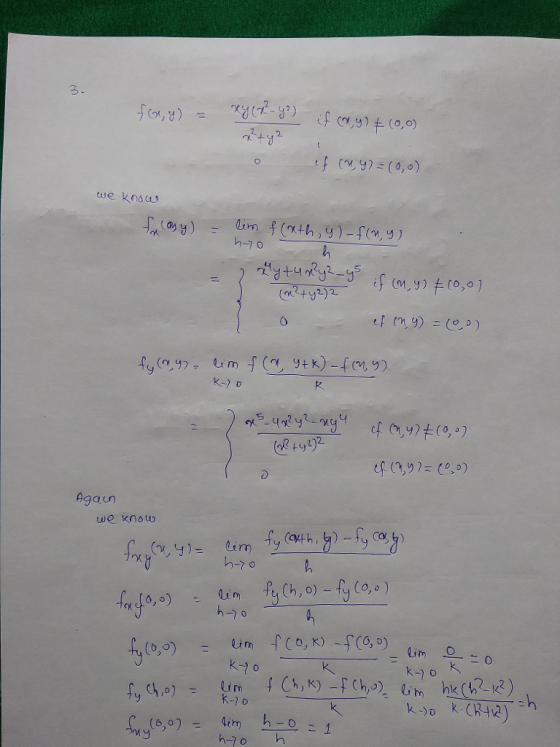
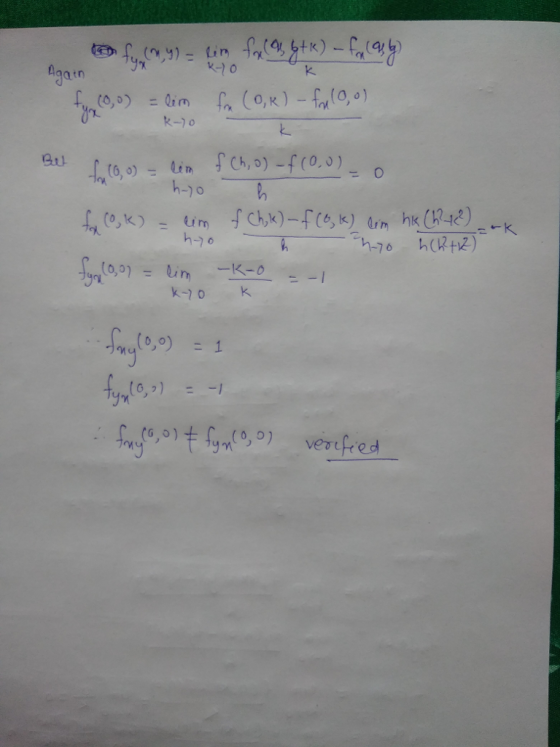
Iff(z,y)-lth' if (z.v) * (0,0), cal late fy(0,0) andふ(0,0), and verify that are different. (This doesn't...
Problem 3. Define the function: 2+_ 0 if (z,y)#10.0) if (a,y)-(0,0) f(x, v)= (a) Graph the...
 Problem 3. Define the function: 2+_ 0 if (z,y)#10.0) if (a,y)-(0,0) f(x, v)= (a) Graph the top portion of the function using Geogebra. Does the function appear to be continuus at 0? (b) Find fz(z, y) and fy(z, y) when (z, y) #10.0) (c) Find f(0,0) and s,(0,0) using the limit definitions of partial derivatives and f,(0,0)-lim rah) - f(O,0) d) Use these limit definitions to show that fay(0,0)--1, while x(0,0)-1 (e) Can we conclude from Clairaut's theorem that()-yr(x,y) for...
GROUP WORK 1, SECTION 14.3 Clarifying Clairaut's Theorem Consider f (x, y, z) = x?cos (y...
 GROUP WORK 1, SECTION 14.3 Clarifying Clairaut's Theorem Consider f (x, y, z) = x?cos (y + 2). 1. Why do we know that fyyxxx=0 without doing any computation? 2. Do we also know, without doing any computation, that Sxyz = 0? Why or why not? 3. Suppose that a = 3x + ay". Jy = bxy + 2y. S,(1, 1) = 3, and has continuous mixed second partial derivatives xy and fyx. (a) Find values for a and b...
(1) Let F denote the inverse square vector field (axr, y, z) F= (Note that ||F...
 (1) Let F denote the inverse square vector field (axr, y, z) F= (Note that ||F 1/r2.) The domain of F is R3\{(0, 0, 0)} where r = the chain rule (a) Verify that Hint: first show that then use (b) Show that div(F 0. (c) Suppose that S is a closed surface in R3 that does not enclose the origin. Show that the flux of F through S is zero. Hint: since the interior of S does not contain...
part (c) 7.23. Let y(x) = n²x e-nx. (a) Show that lim, - fn(x)=0 for all...
 part (c)
7.23. Let y(x) = n²x e-nx. (a) Show that lim, - fn(x)=0 for all x > 0. (Hint: Treat x = 0 as for x > 0 you can use L'Hospital's rule (Theorem A.11) - but remember that n is the variable, not x.) (b) Find lim - So fn(x)dx. (Hint: The answer is not 0.) (c) Why doesn't your answer to part (b) violate Proposition 7.27 Proposition 7.27. Suppose f. : G C is continuous, for n...
part (c)
7.23. Let y(x) = n²x e-nx. (a) Show that lim, - fn(x)=0 for all x > 0. (Hint: Treat x = 0 as for x > 0 you can use L'Hospital's rule (Theorem A.11) - but remember that n is the variable, not x.) (b) Find lim - So fn(x)dx. (Hint: The answer is not 0.) (c) Why doesn't your answer to part (b) violate Proposition 7.27 Proposition 7.27. Suppose f. : G C is continuous, for n...
 Problem 3. Define the function: 2+_ 0 if (z,y)#10.0) if (a,y)-(0,0) f(x, v)= (a) Graph the top portion of the function using Geogebra. Does the function appear to be continuus at 0? (b) Find fz(z, y) and fy(z, y) when (z, y) #10.0) (c) Find f(0,0) and s,(0,0) using the limit definitions of partial derivatives and f,(0,0)-lim rah) - f(O,0) d) Use these limit definitions to show that fay(0,0)--1, while x(0,0)-1 (e) Can we conclude from Clairaut's theorem that()-yr(x,y) for...
 GROUP WORK 1, SECTION 14.3 Clarifying Clairaut's Theorem Consider f (x, y, z) = x?cos (y + 2). 1. Why do we know that fyyxxx=0 without doing any computation? 2. Do we also know, without doing any computation, that Sxyz = 0? Why or why not? 3. Suppose that a = 3x + ay". Jy = bxy + 2y. S,(1, 1) = 3, and has continuous mixed second partial derivatives xy and fyx. (a) Find values for a and b...
 (1) Let F denote the inverse square vector field (axr, y, z) F= (Note that ||F 1/r2.) The domain of F is R3\{(0, 0, 0)} where r = the chain rule (a) Verify that Hint: first show that then use (b) Show that div(F 0. (c) Suppose that S is a closed surface in R3 that does not enclose the origin. Show that the flux of F through S is zero. Hint: since the interior of S does not contain...
 part (c)
7.23. Let y(x) = n²x e-nx. (a) Show that lim, - fn(x)=0 for all x > 0. (Hint: Treat x = 0 as for x > 0 you can use L'Hospital's rule (Theorem A.11) - but remember that n is the variable, not x.) (b) Find lim - So fn(x)dx. (Hint: The answer is not 0.) (c) Why doesn't your answer to part (b) violate Proposition 7.27 Proposition 7.27. Suppose f. : G C is continuous, for n...
part (c)
7.23. Let y(x) = n²x e-nx. (a) Show that lim, - fn(x)=0 for all x > 0. (Hint: Treat x = 0 as for x > 0 you can use L'Hospital's rule (Theorem A.11) - but remember that n is the variable, not x.) (b) Find lim - So fn(x)dx. (Hint: The answer is not 0.) (c) Why doesn't your answer to part (b) violate Proposition 7.27 Proposition 7.27. Suppose f. : G C is continuous, for n...
Most questions answered within 3 hours.
-
Where is the error in this code sequence?
String s1 = "Hello";
String s2 = "ello";...
asked 11 months ago -
Financial data for Joel de Paris, Inc., for last year
follow:
Joel de Paris, Inc.
Balance...
asked 11 months ago -
Consider this reaction:
Al2(SO4)3 (aq)+ BaCl3
(aq) Al2Cl6 (aq)- +
3BaSO4(s) . What is the...
asked 11 months ago -
Suppose that Savneet is considering increasing her
recent random sample from 20 car rentals to 40...
asked 11 months ago -
Trucks arrive at an unloading terminal at an average rate of 120
per hour.
Trucks arrive...
asked 11 months ago -
Why are methanol and ethanol completely soluble in water while
octanol is not very little soluble....
asked 11 months ago -
A facilities manager at a university reads in a research report
that the mean amount of...
asked 11 months ago -
When the CuSO4 is rehydrated by adding water to the anhydrous
compound, is this an endothermic...
asked 11 months ago -
A ray of sunlight is passing from diamond into crown glass; the
angle of incidence is...
asked 11 months ago -
A block of mass 0.249 kg is placed on top of a light, vertical
spring of...
asked 11 months ago -
how do the kidneys compensate in the presences of acidosis
a) trigger hyperventilate
b) reserve acid...
asked 11 months ago -
Question 501 pts
The rental rate of capital to the firm increases. Which of the
following...
asked 11 months ago