
Homework Answers

Add Answer to:
How many grams of a slightly soluble salt having the formula AX3, with a molecular 1....
1-4 please help 7 points possible Last Name First Name 1 x 1031. It dissociates in water The slightly soluble salt...
 1-4 please help
7 points possible Last Name First Name 1 x 1031. It dissociates in water The slightly soluble salt fluorapatite, Cas(POa)3F, has a Ksp according to the following equation: Cas(PO4)3Fi 5Ca2 3PO F 1. Write the Ksp equation for this process: Ksp Calculate the equilibrium concentrations of Ca, PO, and F. 2. a. [Ca2]= b. [PO]= c. [F]= How many grams of fluorapatite will dissolve in 1L of water? 3. 4. The solubility of the related salt hydroxyapatite,...
1-4 please help
7 points possible Last Name First Name 1 x 1031. It dissociates in water The slightly soluble salt fluorapatite, Cas(POa)3F, has a Ksp according to the following equation: Cas(PO4)3Fi 5Ca2 3PO F 1. Write the Ksp equation for this process: Ksp Calculate the equilibrium concentrations of Ca, PO, and F. 2. a. [Ca2]= b. [PO]= c. [F]= How many grams of fluorapatite will dissolve in 1L of water? 3. 4. The solubility of the related salt hydroxyapatite,...
EXPERIMENT 7: DETERMINATION OF KS FOR A SLIGHTLY SOLUBLE SALT QUESTIONS Average Ksp = 3.17x10⁻¹² 1. Based on the va...
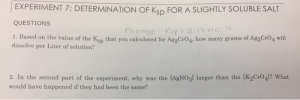 EXPERIMENT 7: DETERMINATION OF KS FOR A SLIGHTLY SOLUBLE SALT QUESTIONS Average Ksp = 3.17x10⁻¹² 1. Based on the value of the Key that you calculated for AgeCrO4, how many grams of Ag2 CrO 4 will dissolve per Liter of solution? 2. In the second part of the experiment, why was the [AgNO3l larger than the (K,CrO4l? What would have happened if they had been the same?
1. How is the molar solubility of a slightly soluble salt affected by the addition of an ion common to the salt equili...
 1. How is the molar solubility of a slightly soluble salt affected by the addition of an ion common to the salt equilibrium? 2. A 3.11 mL volume of a standardized 0.0025 M HCl solution titrated 25.0 mL of a saturated Mg(OH)2 solution to the methyl orange endpoint. Calculate the Ksp of Mg(OH)2. 3. If the endpoint in the titration of a saturated Ca(OH)2 solution with a standardized HCI solution is surpassed, will the reported Kap of Ca(OH)2 be reported...
how many constitutional isomers are there for a molecule having the molecular formula c3h8o
how many constitutional isomers are there for a molecule having the molecular formula c3h8o
1) According to the following reaction, how many grams of hydrogen gas are necessary to form...
1) According to the following reaction, how many grams of hydrogen gas are necessary to form 0.603 moles ammonia? nitrogen (g) + hydrogen (g) ammonia (g) 2) For the following reaction, 6.52 grams of methane (CH4) are allowed to react with 29.8 grams of carbon tetrachloride. methane (CH4) (g) + carbon tetrachloride (g) dichloromethane (CH2Cl2) (g) What is the maximum amount of dichloromethane (CH2Cl2) that can be formed? grams What is the FORMULA for the limiting reagent? What amount of...
Consider the following data for questions A-F: two solutions of an unknown slightly soluble salt, A(OH)2,...
 Consider the following data for questions A-F: two solutions
of an unknown slightly soluble salt, A(OH)2, we're allowed to
equalibrate – one at 25°C and the other at 80°C. A 15 mL aliquot of
each solution is titrated with 0.240 M hydrochloric acid. 8.30 mL
of the acid is required to reach the endpoint of a titration at
25°C, while 75.07 mL are required for the 80°C solution. What is
the Ksp at 80° C?
Exp 10 Solubility and Thermodynamics)...
Consider the following data for questions A-F: two solutions
of an unknown slightly soluble salt, A(OH)2, we're allowed to
equalibrate – one at 25°C and the other at 80°C. A 15 mL aliquot of
each solution is titrated with 0.240 M hydrochloric acid. 8.30 mL
of the acid is required to reach the endpoint of a titration at
25°C, while 75.07 mL are required for the 80°C solution. What is
the Ksp at 80° C?
Exp 10 Solubility and Thermodynamics)...
Consider the following data for questions A-F: two solutions of an unknown slightly soluble salt, A(OH)2,...
 Consider the following data for questions A-F: two solutions
of an unknown slightly soluble salt, A(OH)2, were allowed to
equilibrate- one at 25°C and the other at 80°C. A 15 mL aliquot of
each solution is titrated with 0.240 M in HCl. 8.30 mL of the acid
is required to reach the end point of the titration at 25°C, while
75.07 mL are required for the 80°C solution.
Review Contas Periodic Tate Consider the following data for questions A-F: Two...
Consider the following data for questions A-F: two solutions
of an unknown slightly soluble salt, A(OH)2, were allowed to
equilibrate- one at 25°C and the other at 80°C. A 15 mL aliquot of
each solution is titrated with 0.240 M in HCl. 8.30 mL of the acid
is required to reach the end point of the titration at 25°C, while
75.07 mL are required for the 80°C solution.
Review Contas Periodic Tate Consider the following data for questions A-F: Two...
The nonvolatile, nonelectrolyte sucrose , C12H22O11 (342.3 g/mol), is soluble in water H2O. How many grams...
The nonvolatile, nonelectrolyte sucrose , C12H22O11 (342.3 g/mol), is soluble in water H2O. How many grams of sucrose are needed to generate an osmotic pressure of 3.56 atm when dissolved in 227 ml of a water solution at 298 K. grams sucrose
Consider the following data for question 1-6: Two solutions of an unknown slightly soluble salt, A(OH)2,...
Consider the following data for question 1-6: Two solutions of an unknown slightly soluble salt, A(OH)2, were allowed to equilibrate -- one at 25oC and the other at 80 oC. A 15.00 mL aliquot of each solution is titrated with 0.200 M HCl. 9.00 mL of the acid is required to reach the endpoint of the titration at 25 oC, while 74.35 mL are required for the 80 oC solution. Calculate the Ksp at 25 oC.
1. “Salt” (NaCl) is known to be readily soluble in water, however there is a limit...
1. “Salt” (NaCl) is known to be readily soluble in water, however there is a limit to its solubility. The solubility of salt in water at 25° C is 35.9 g/100 mL a. Explain what the value 35.9 g/100 mL means. . b. Write this value as two conversion factors. c. What minimum volume of water would be necessary to dissolve 2.2 kg of salt? 2. A pair of students forgets to precipitate the carbonate ions in their leaf compost...
 1-4 please help
7 points possible Last Name First Name 1 x 1031. It dissociates in water The slightly soluble salt fluorapatite, Cas(POa)3F, has a Ksp according to the following equation: Cas(PO4)3Fi 5Ca2 3PO F 1. Write the Ksp equation for this process: Ksp Calculate the equilibrium concentrations of Ca, PO, and F. 2. a. [Ca2]= b. [PO]= c. [F]= How many grams of fluorapatite will dissolve in 1L of water? 3. 4. The solubility of the related salt hydroxyapatite,...
1-4 please help
7 points possible Last Name First Name 1 x 1031. It dissociates in water The slightly soluble salt fluorapatite, Cas(POa)3F, has a Ksp according to the following equation: Cas(PO4)3Fi 5Ca2 3PO F 1. Write the Ksp equation for this process: Ksp Calculate the equilibrium concentrations of Ca, PO, and F. 2. a. [Ca2]= b. [PO]= c. [F]= How many grams of fluorapatite will dissolve in 1L of water? 3. 4. The solubility of the related salt hydroxyapatite,...
 EXPERIMENT 7: DETERMINATION OF KS FOR A SLIGHTLY SOLUBLE SALT QUESTIONS Average Ksp = 3.17x10⁻¹² 1. Based on the value of the Key that you calculated for AgeCrO4, how many grams of Ag2 CrO 4 will dissolve per Liter of solution? 2. In the second part of the experiment, why was the [AgNO3l larger than the (K,CrO4l? What would have happened if they had been the same?
 1. How is the molar solubility of a slightly soluble salt affected by the addition of an ion common to the salt equilibrium? 2. A 3.11 mL volume of a standardized 0.0025 M HCl solution titrated 25.0 mL of a saturated Mg(OH)2 solution to the methyl orange endpoint. Calculate the Ksp of Mg(OH)2. 3. If the endpoint in the titration of a saturated Ca(OH)2 solution with a standardized HCI solution is surpassed, will the reported Kap of Ca(OH)2 be reported...
 Consider the following data for questions A-F: two solutions
of an unknown slightly soluble salt, A(OH)2, we're allowed to
equalibrate – one at 25°C and the other at 80°C. A 15 mL aliquot of
each solution is titrated with 0.240 M hydrochloric acid. 8.30 mL
of the acid is required to reach the endpoint of a titration at
25°C, while 75.07 mL are required for the 80°C solution. What is
the Ksp at 80° C?
Exp 10 Solubility and Thermodynamics)...
Consider the following data for questions A-F: two solutions
of an unknown slightly soluble salt, A(OH)2, we're allowed to
equalibrate – one at 25°C and the other at 80°C. A 15 mL aliquot of
each solution is titrated with 0.240 M hydrochloric acid. 8.30 mL
of the acid is required to reach the endpoint of a titration at
25°C, while 75.07 mL are required for the 80°C solution. What is
the Ksp at 80° C?
Exp 10 Solubility and Thermodynamics)...
 Consider the following data for questions A-F: two solutions
of an unknown slightly soluble salt, A(OH)2, were allowed to
equilibrate- one at 25°C and the other at 80°C. A 15 mL aliquot of
each solution is titrated with 0.240 M in HCl. 8.30 mL of the acid
is required to reach the end point of the titration at 25°C, while
75.07 mL are required for the 80°C solution.
Review Contas Periodic Tate Consider the following data for questions A-F: Two...
Consider the following data for questions A-F: two solutions
of an unknown slightly soluble salt, A(OH)2, were allowed to
equilibrate- one at 25°C and the other at 80°C. A 15 mL aliquot of
each solution is titrated with 0.240 M in HCl. 8.30 mL of the acid
is required to reach the end point of the titration at 25°C, while
75.07 mL are required for the 80°C solution.
Review Contas Periodic Tate Consider the following data for questions A-F: Two...
Most questions answered within 3 hours.
-
Where is the error in this code sequence?
String s1 = "Hello";
String s2 = "ello";...
asked 11 months ago -
Financial data for Joel de Paris, Inc., for last year
follow:
Joel de Paris, Inc.
Balance...
asked 11 months ago -
Consider this reaction:
Al2(SO4)3 (aq)+ BaCl3
(aq) Al2Cl6 (aq)- +
3BaSO4(s) . What is the...
asked 11 months ago -
Suppose that Savneet is considering increasing her
recent random sample from 20 car rentals to 40...
asked 11 months ago -
Trucks arrive at an unloading terminal at an average rate of 120
per hour.
Trucks arrive...
asked 11 months ago -
Why are methanol and ethanol completely soluble in water while
octanol is not very little soluble....
asked 11 months ago -
A facilities manager at a university reads in a research report
that the mean amount of...
asked 11 months ago -
When the CuSO4 is rehydrated by adding water to the anhydrous
compound, is this an endothermic...
asked 11 months ago -
A ray of sunlight is passing from diamond into crown glass; the
angle of incidence is...
asked 11 months ago -
A block of mass 0.249 kg is placed on top of a light, vertical
spring of...
asked 11 months ago -
how do the kidneys compensate in the presences of acidosis
a) trigger hyperventilate
b) reserve acid...
asked 11 months ago -
Question 501 pts
The rental rate of capital to the firm increases. Which of the
following...
asked 11 months ago