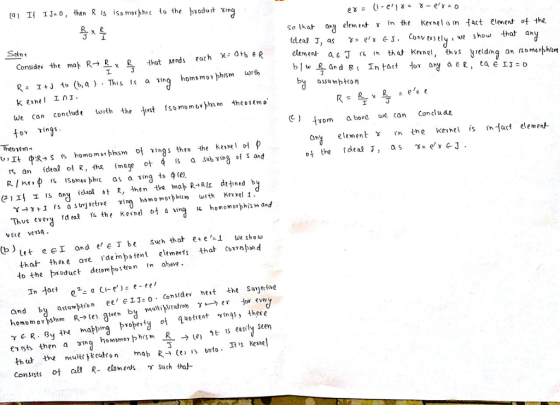
Let and be ideals of a ring such that (a) Prove that if , then is...
Let
and
be
ideals of a ring
such that
(a) Prove that if , then
is isomorphic to
the product ring
(b) Describe the idempotents corresponding to the product decomposition in (a) above.
(c) Show the ideals generated by each idempotent, and quotient that they correspond to in (b) above.
Please show all details so I may understand the process and compare the steps to my work. Thank you.
Homework Answers
Add Answer to:
Let
and be
ideals of a ring such that
(a) Prove that if , then is...
8. let salle &]: xy, 2 e R} a). Prove that (5, +,-) is a ring,...
 8. let salle &]: xy, 2 e R} a). Prove that (5, +,-) is a ring, where t' and are the usual addition and multiplication of matrices. (You may assume standard properities of matrix Operations ) b). Let T be the set of matrices in 5 of the form { x so]. Prove that I is an ideal in the ring s. c). Let & be the function f: 5-71R, given by f[ 8 ] = 2 i prove that...
9) Let R and S be commutative rings. Show that the cartesian product is a ring with addition and ...
 just 10 thank you
9) Let R and S be commutative rings. Show that the cartesian product is a ring with addition and multiplication s') := (r , rrs-s' ) . 10) Let T be a commutative ring containing elements e, f, both 07-such that e+f=h,e=e,f2 = f , and e-f=0T . Show that the ideals R: T e and S T.f are rings but not subrings of T, and that the ring T is isomorphic to the ring R...
just 10 thank you
9) Let R and S be commutative rings. Show that the cartesian product is a ring with addition and multiplication s') := (r , rrs-s' ) . 10) Let T be a commutative ring containing elements e, f, both 07-such that e+f=h,e=e,f2 = f , and e-f=0T . Show that the ideals R: T e and S T.f are rings but not subrings of T, and that the ring T is isomorphic to the ring R...
3. [10] Let L and M be left ideals of a ring R. Prove that L...
 3. [10] Let L and M be left ideals of a ring R. Prove that L + M 2EL,Y EM} is a left ideal of R. = (x+y
6. Let R be a ring, and let 11 and 12 be ideals of R. We...
 6. Let R be a ring, and let 11 and 12 be ideals of R. We define the product of 11 and 12 to be 1112 = {TER:r => aibi, with k > 1, Q1, ..., ak € 11, b1,..., bk € 12 In other words, an element of the product 1.12 is a finite sum of products a;bi, where a, comes from I and bi comes from 12. (a) Prove that 11 12 is an ideal of R, contained...
11. a) Let R1, R2 be isomorphic rings with groups of units U1, U2 respectively. Prove that U1 and...
 11. a) Let R1, R2 be isomorphic rings with groups of units U1, U2 respectively. Prove that U1 and U2 are isomorphic groups. b) For 1 si k let Ri be a ring with group of units U,. Show that the group × Rk is just Ui × of units in the cartesian product R, × × Uk.
11. a) Let R1, R2 be isomorphic rings with groups of units U1, U2 respectively. Prove that U1 and U2 are isomorphic...
11. a) Let R1, R2 be isomorphic rings with groups of units U1, U2 respectively. Prove that U1 and U2 are isomorphic groups. b) For 1 si k let Ri be a ring with group of units U,. Show that the group × Rk is just Ui × of units in the cartesian product R, × × Uk.
11. a) Let R1, R2 be isomorphic rings with groups of units U1, U2 respectively. Prove that U1 and U2 are isomorphic...
Solve problem 2 using the priblem 1 . Question is taken from Ring theory dealing with ideals and ...
 Solve problem 2 using the priblem 1 . Question is taken from
Ring theory dealing with ideals and generating sets for
ideals.
Problem 1. Suppose that R (R,+ Jis a commutative ring with unity, and suppose F- (a,,. , a } is a finite nonempty subset of R. Modify your proof for Problem 5 above to show that 7n j-1 Problem 2. Consider the set Zo of integer sequences introduced in Homework Problem 6 of Investigation 16. You showed that...
Solve problem 2 using the priblem 1 . Question is taken from
Ring theory dealing with ideals and generating sets for
ideals.
Problem 1. Suppose that R (R,+ Jis a commutative ring with unity, and suppose F- (a,,. , a } is a finite nonempty subset of R. Modify your proof for Problem 5 above to show that 7n j-1 Problem 2. Consider the set Zo of integer sequences introduced in Homework Problem 6 of Investigation 16. You showed that...
Please show the solutions for all 4 parts! Problem 1 Let m E Z that is...
 Please show the solutions for all 4 parts!
Problem 1 Let m E Z that is not the square of an integer (ie. mメ0, 1.4.9, ). Let α-Vm (so you have a失Q as mentioned above) (i) Prove the following:Qla aba: a,b Q is a subring of C, Za]a +ba: a, b E Z is a subring of Qla], and the fraction field of Z[a] is Q[a]. (3pts) (ii) Prove that Z[x]/(X2-m) Z[a] and Qx/(x2 mQ[a]. (3pts) i Let n be...
Please show the solutions for all 4 parts!
Problem 1 Let m E Z that is not the square of an integer (ie. mメ0, 1.4.9, ). Let α-Vm (so you have a失Q as mentioned above) (i) Prove the following:Qla aba: a,b Q is a subring of C, Za]a +ba: a, b E Z is a subring of Qla], and the fraction field of Z[a] is Q[a]. (3pts) (ii) Prove that Z[x]/(X2-m) Z[a] and Qx/(x2 mQ[a]. (3pts) i Let n be...
7.1.2. Let R be a commutative ring and a, b E R, and define The goal of this problem is to prove ...
 Part 1
Part 2
7.1.2. Let R be a commutative ring and a, b E R, and define The goal of this problem is to prove that (a, b) is an ideal of R (a) Explain how you know that 0 E (a, b b) What do two random elements of (a, b) look like? Explain why their sum must be in (c) For s E R and z E (a,b), explain why sz E (a, b). 7.2.1. In the...
Part 1
Part 2
7.1.2. Let R be a commutative ring and a, b E R, and define The goal of this problem is to prove that (a, b) is an ideal of R (a) Explain how you know that 0 E (a, b b) What do two random elements of (a, b) look like? Explain why their sum must be in (c) For s E R and z E (a,b), explain why sz E (a, b). 7.2.1. In the...
Thanks 6. Let R be a ring and a € R. Prove that (i) {x E...
 Thanks
6. Let R be a ring and a € R. Prove that (i) {x E R | ax = 0} is a right ideal of R (ii) {Y E R | ya=0} is a left ideal of R (iii) if L is a left ideal of R, then {z E R za = 0 Vae L} is a two-sided ideal of R NB: first show that each set in 6.(i), (ii), (iii) above is a subring T ool of...
Thanks
6. Let R be a ring and a € R. Prove that (i) {x E R | ax = 0} is a right ideal of R (ii) {Y E R | ya=0} is a left ideal of R (iii) if L is a left ideal of R, then {z E R za = 0 Vae L} is a two-sided ideal of R NB: first show that each set in 6.(i), (ii), (iii) above is a subring T ool of...
(a) Let R be a commutative ring. Given a finite subset {ai, a2, , an} of R, con- sider the set {rial + r202 + . . . + rnan I ri, r2, . . . , rn є R), which we denote by 〈a1, a2 , . . . , Prove that...
 (a) Let R be a commutative ring. Given a finite subset {ai, a2, , an} of R, con- sider the set {rial + r202 + . . . + rnan I ri, r2, . . . , rn є R), which we denote by 〈a1, a2 , . . . , Prove that 〈a1, a2, . . . , an〉 įs an ideal of R. (If an ideal 1 = 〈a1, аг, . . . , an) for some a,...
 8. let salle &]: xy, 2 e R} a). Prove that (5, +,-) is a ring, where t' and are the usual addition and multiplication of matrices. (You may assume standard properities of matrix Operations ) b). Let T be the set of matrices in 5 of the form { x so]. Prove that I is an ideal in the ring s. c). Let & be the function f: 5-71R, given by f[ 8 ] = 2 i prove that...
 just 10 thank you
9) Let R and S be commutative rings. Show that the cartesian product is a ring with addition and multiplication s') := (r , rrs-s' ) . 10) Let T be a commutative ring containing elements e, f, both 07-such that e+f=h,e=e,f2 = f , and e-f=0T . Show that the ideals R: T e and S T.f are rings but not subrings of T, and that the ring T is isomorphic to the ring R...
just 10 thank you
9) Let R and S be commutative rings. Show that the cartesian product is a ring with addition and multiplication s') := (r , rrs-s' ) . 10) Let T be a commutative ring containing elements e, f, both 07-such that e+f=h,e=e,f2 = f , and e-f=0T . Show that the ideals R: T e and S T.f are rings but not subrings of T, and that the ring T is isomorphic to the ring R...
 3. [10] Let L and M be left ideals of a ring R. Prove that L + M 2EL,Y EM} is a left ideal of R. = (x+y
 6. Let R be a ring, and let 11 and 12 be ideals of R. We define the product of 11 and 12 to be 1112 = {TER:r => aibi, with k > 1, Q1, ..., ak € 11, b1,..., bk € 12 In other words, an element of the product 1.12 is a finite sum of products a;bi, where a, comes from I and bi comes from 12. (a) Prove that 11 12 is an ideal of R, contained...
 11. a) Let R1, R2 be isomorphic rings with groups of units U1, U2 respectively. Prove that U1 and U2 are isomorphic groups. b) For 1 si k let Ri be a ring with group of units U,. Show that the group × Rk is just Ui × of units in the cartesian product R, × × Uk.
11. a) Let R1, R2 be isomorphic rings with groups of units U1, U2 respectively. Prove that U1 and U2 are isomorphic...
11. a) Let R1, R2 be isomorphic rings with groups of units U1, U2 respectively. Prove that U1 and U2 are isomorphic groups. b) For 1 si k let Ri be a ring with group of units U,. Show that the group × Rk is just Ui × of units in the cartesian product R, × × Uk.
11. a) Let R1, R2 be isomorphic rings with groups of units U1, U2 respectively. Prove that U1 and U2 are isomorphic...
 Solve problem 2 using the priblem 1 . Question is taken from
Ring theory dealing with ideals and generating sets for
ideals.
Problem 1. Suppose that R (R,+ Jis a commutative ring with unity, and suppose F- (a,,. , a } is a finite nonempty subset of R. Modify your proof for Problem 5 above to show that 7n j-1 Problem 2. Consider the set Zo of integer sequences introduced in Homework Problem 6 of Investigation 16. You showed that...
Solve problem 2 using the priblem 1 . Question is taken from
Ring theory dealing with ideals and generating sets for
ideals.
Problem 1. Suppose that R (R,+ Jis a commutative ring with unity, and suppose F- (a,,. , a } is a finite nonempty subset of R. Modify your proof for Problem 5 above to show that 7n j-1 Problem 2. Consider the set Zo of integer sequences introduced in Homework Problem 6 of Investigation 16. You showed that...
 Please show the solutions for all 4 parts!
Problem 1 Let m E Z that is not the square of an integer (ie. mメ0, 1.4.9, ). Let α-Vm (so you have a失Q as mentioned above) (i) Prove the following:Qla aba: a,b Q is a subring of C, Za]a +ba: a, b E Z is a subring of Qla], and the fraction field of Z[a] is Q[a]. (3pts) (ii) Prove that Z[x]/(X2-m) Z[a] and Qx/(x2 mQ[a]. (3pts) i Let n be...
Please show the solutions for all 4 parts!
Problem 1 Let m E Z that is not the square of an integer (ie. mメ0, 1.4.9, ). Let α-Vm (so you have a失Q as mentioned above) (i) Prove the following:Qla aba: a,b Q is a subring of C, Za]a +ba: a, b E Z is a subring of Qla], and the fraction field of Z[a] is Q[a]. (3pts) (ii) Prove that Z[x]/(X2-m) Z[a] and Qx/(x2 mQ[a]. (3pts) i Let n be...
 Part 1
Part 2
7.1.2. Let R be a commutative ring and a, b E R, and define The goal of this problem is to prove that (a, b) is an ideal of R (a) Explain how you know that 0 E (a, b b) What do two random elements of (a, b) look like? Explain why their sum must be in (c) For s E R and z E (a,b), explain why sz E (a, b). 7.2.1. In the...
Part 1
Part 2
7.1.2. Let R be a commutative ring and a, b E R, and define The goal of this problem is to prove that (a, b) is an ideal of R (a) Explain how you know that 0 E (a, b b) What do two random elements of (a, b) look like? Explain why their sum must be in (c) For s E R and z E (a,b), explain why sz E (a, b). 7.2.1. In the...
 Thanks
6. Let R be a ring and a € R. Prove that (i) {x E R | ax = 0} is a right ideal of R (ii) {Y E R | ya=0} is a left ideal of R (iii) if L is a left ideal of R, then {z E R za = 0 Vae L} is a two-sided ideal of R NB: first show that each set in 6.(i), (ii), (iii) above is a subring T ool of...
Thanks
6. Let R be a ring and a € R. Prove that (i) {x E R | ax = 0} is a right ideal of R (ii) {Y E R | ya=0} is a left ideal of R (iii) if L is a left ideal of R, then {z E R za = 0 Vae L} is a two-sided ideal of R NB: first show that each set in 6.(i), (ii), (iii) above is a subring T ool of...
 (a) Let R be a commutative ring. Given a finite subset {ai, a2, , an} of R, con- sider the set {rial + r202 + . . . + rnan I ri, r2, . . . , rn є R), which we denote by 〈a1, a2 , . . . , Prove that 〈a1, a2, . . . , an〉 įs an ideal of R. (If an ideal 1 = 〈a1, аг, . . . , an) for some a,...
Most questions answered within 3 hours.
-
Where is the error in this code sequence?
String s1 = "Hello";
String s2 = "ello";...
asked 11 months ago -
Financial data for Joel de Paris, Inc., for last year
follow:
Joel de Paris, Inc.
Balance...
asked 11 months ago -
Consider this reaction:
Al2(SO4)3 (aq)+ BaCl3
(aq) Al2Cl6 (aq)- +
3BaSO4(s) . What is the...
asked 11 months ago -
Suppose that Savneet is considering increasing her
recent random sample from 20 car rentals to 40...
asked 11 months ago -
Trucks arrive at an unloading terminal at an average rate of 120
per hour.
Trucks arrive...
asked 11 months ago -
Why are methanol and ethanol completely soluble in water while
octanol is not very little soluble....
asked 11 months ago -
A facilities manager at a university reads in a research report
that the mean amount of...
asked 11 months ago -
When the CuSO4 is rehydrated by adding water to the anhydrous
compound, is this an endothermic...
asked 11 months ago -
A ray of sunlight is passing from diamond into crown glass; the
angle of incidence is...
asked 11 months ago -
A block of mass 0.249 kg is placed on top of a light, vertical
spring of...
asked 11 months ago -
how do the kidneys compensate in the presences of acidosis
a) trigger hyperventilate
b) reserve acid...
asked 11 months ago -
Question 501 pts
The rental rate of capital to the firm increases. Which of the
following...
asked 11 months ago