
Homework Answers
Request Answer!
We need at least 10 more requests to produce the answer.
0 / 10 have requested this problem solution
The more requests, the faster the answer.
Add Answer to:
QUESTION 5 Estimate the Nyquist rate of sin(4t)u(t) (in rad/s) 7. 4 0 8 O 16...
- A vector tangent to the parametric curve given by r (t) = <cos (4t); sin...
- A vector tangent to the parametric curve given by r (t) = <cos (4t); sin (4t); e^(t^2)> at the point (0; 1; e^((pi/8)^2)) is a) (0; 1; e^((pi/8)^2)) b) (0; 4; e^((pi/8)^2)) c) (4; 0; e^((pi/8)^2)) d) (4; 4; e^((pi/8)^2)) e) None of the above - The curve c (t) = (cost, sint ,t) lies on which of the following surfaces: (a) cone (b) cylinder (c) sphere (d) plane (e) none of the above
Question 8 A continuous signal x(t) is given as Not yet answered X(t) 4 sin(21t13t) +...
 Question 8 A continuous signal x(t) is given as Not yet answered X(t) 4 sin(21t13t) + 3 cos(21732t) – sin(2nT95t) What is the minimum sampling frequency (Nyquist Rate) that can be used to sample this continuous signal? Marked out of 1.50 P Flag question Select one: a. 190 Hz O b. 95 Hz c. 285 Hz d. 32 Hz e. 13 Hz
Incorrect Question 3 0/0.5 pts Find c{teāt cos(4t)} (s - 5)2 - 16 (8 - 5)2...
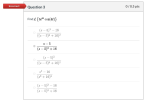 Incorrect Question 3 0/0.5 pts Find c{teāt cos(4t)} (s - 5)2 - 16 (8 - 5)2 + 16) 3-5 (8-5)2 +16 (s - 5) ((: - 5)2 + 16) $2-16 (82 +16) (s - 5)2 - 16 (s - 5)2 +16
Select the correct statement. 3e-8 52 + 9 *} sin(3t) *e! O N {}={2- t <3...
 Select the correct statement. 3e-8 52 + 9 *} sin(3t) *e! O N {}={2- t <3 3 t > 3 O None of the other options о {*} = 6(e – 2)51 OL-{L {** f(t)}} = f(") (t) Select the correct statement. of{e * sin(2) +e*t} - 2+2+5 8 (-3) None of the other options O L {eztult - 3)} = e-3 L {e2(t-"}} w O (t + 1)2 5 (t-1) 5 x{05e-1) + at -1)}- di (-4e")+eos ${sin(t –...
Find the Nyquist rates for these signals: (a) X(t) = sinc (20) (b)x(t) = 4 sinca...
 Find the Nyquist rates for these signals: (a) X(t) = sinc (20) (b)x(t) = 4 sinca (100t) (C) x(t) = 8 sin(50TTT) (d) x(t) = 4 sin(30TTt) + 3 cos(70nt) (e) X(t) = rect(300t) (f) X(t) = -10 sin(40nt) cos(300Tt) (g) X(t) = sinc(t/2)*710(t) (h) x(t) = sinc(t/2) 70.1() (i) X(t) = 8tri((t - 4)/12) (1) X(t) = 13e-201 cos(70TTt)u(t) (k) x(t) = u(t)-u(t-5)
8. Solve V?u=0, 2<r<4,0<O<21, (u(2,0) = sin 0, u(4,0) = cos 0,0 5 0 5 21.
 8. Solve V?u=0, 2<r<4,0<O<21, (u(2,0) = sin 0, u(4,0) = cos 0,0 5 0 5 21.
(1 point) Let -13 Solve the differential equation using Laplace transforms ft S 4r t/16-sin(4t)/64+3/4sin(4t)+4cos(4t)...
 (1 point) Let -13 Solve the differential equation using Laplace transforms ft S 4r t/16-sin(4t)/64+3/4sin(4t)+4cos(4t) y(t) = 3/4sin(4t)+4cos(4t)-pi/4cos(4t)+pi/4 Note: You can earn partial credit on this problem. Preview My Answers Submit Answers Your score was recorded. You have attempted this problem 8 times. You received a score of 50% for this attempt. Your overall recorded score is 50%.
(1 point) Let -13 Solve the differential equation using Laplace transforms ft S 4r t/16-sin(4t)/64+3/4sin(4t)+4cos(4t) y(t) = 3/4sin(4t)+4cos(4t)-pi/4cos(4t)+pi/4 Note: You can earn...
(1 point) Let -13 Solve the differential equation using Laplace transforms ft S 4r t/16-sin(4t)/64+3/4sin(4t)+4cos(4t) y(t) = 3/4sin(4t)+4cos(4t)-pi/4cos(4t)+pi/4 Note: You can earn partial credit on this problem. Preview My Answers Submit Answers Your score was recorded. You have attempted this problem 8 times. You received a score of 50% for this attempt. Your overall recorded score is 50%.
(1 point) Let -13 Solve the differential equation using Laplace transforms ft S 4r t/16-sin(4t)/64+3/4sin(4t)+4cos(4t) y(t) = 3/4sin(4t)+4cos(4t)-pi/4cos(4t)+pi/4 Note: You can earn...
U Question 15 "C 7 pts "С If S is the surface of the cylinder E=...
 U Question 15 "C 7 pts "С If S is the surface of the cylinder E= {(x,y,z) : 32 + y < 4,1523}, oriented outwards, which of the following (after applying the Divergence Theorem) will compute zyz) - dS? 40 O (1 + y2 cos & sin 6)r dr de dz REC O 1988 6%" /*(1 + == sin ®)r dr do dz %%% %%% %%% (r cos 0 + 32 + y2 z cos ( sin 0), dr do...
(4) (a) Compute the Fourier series for the function f(s)-- interval [-T, on the (b) Compute the solution u(t,a) for the partial differential equation on the interval [o, ) luWith u(t, 0) u(t,1)-0...
 (4) (a) Compute the Fourier series for the function f(s)-- interval [-T, on the (b) Compute the solution u(t,a) for the partial differential equation on the interval [o, ) luWith u(t, 0) u(t,1)-0 for t>0 (boundary conditions) u(o,z)-3 sin(2x)-5 sin(5z) + sin(6z), for O < < 1 (initial conditions) (20 points)
(4) (a) Compute the Fourier series for the function f(s)-- interval [-T, on the (b) Compute the solution u(t,a) for the partial differential equation on the interval [o, )...
(4) (a) Compute the Fourier series for the function f(s)-- interval [-T, on the (b) Compute the solution u(t,a) for the partial differential equation on the interval [o, ) luWith u(t, 0) u(t,1)-0 for t>0 (boundary conditions) u(o,z)-3 sin(2x)-5 sin(5z) + sin(6z), for O < < 1 (initial conditions) (20 points)
(4) (a) Compute the Fourier series for the function f(s)-- interval [-T, on the (b) Compute the solution u(t,a) for the partial differential equation on the interval [o, )...
An unstable LTI system has the impulse response h(t)=sin (4t)u(t). Show that proportional feedback (G(s) =...
 An unstable LTI system has the impulse response h(t)=sin (4t)u(t). Show that proportional feedback (G(s) = K) cannot BIBO-stabilize the system. Show that derivative control feedback (G(s) = Ks) can stabilize the system. Using derivative control, choose K so that the closed loop system is critically damped. 7. (a) (b) (c) %3D E(s) System но) X(s) (E +Y(s) Feedback G(s) Y(s) Y(s) system G(s) Feedback loop Figure 4. o of
 Question 8 A continuous signal x(t) is given as Not yet answered X(t) 4 sin(21t13t) + 3 cos(21732t) – sin(2nT95t) What is the minimum sampling frequency (Nyquist Rate) that can be used to sample this continuous signal? Marked out of 1.50 P Flag question Select one: a. 190 Hz O b. 95 Hz c. 285 Hz d. 32 Hz e. 13 Hz
 Incorrect Question 3 0/0.5 pts Find c{teāt cos(4t)} (s - 5)2 - 16 (8 - 5)2 + 16) 3-5 (8-5)2 +16 (s - 5) ((: - 5)2 + 16) $2-16 (82 +16) (s - 5)2 - 16 (s - 5)2 +16
 Select the correct statement. 3e-8 52 + 9 *} sin(3t) *e! O N {}={2- t <3 3 t > 3 O None of the other options о {*} = 6(e – 2)51 OL-{L {** f(t)}} = f(") (t) Select the correct statement. of{e * sin(2) +e*t} - 2+2+5 8 (-3) None of the other options O L {eztult - 3)} = e-3 L {e2(t-"}} w O (t + 1)2 5 (t-1) 5 x{05e-1) + at -1)}- di (-4e")+eos ${sin(t –...
 Find the Nyquist rates for these signals: (a) X(t) = sinc (20) (b)x(t) = 4 sinca (100t) (C) x(t) = 8 sin(50TTT) (d) x(t) = 4 sin(30TTt) + 3 cos(70nt) (e) X(t) = rect(300t) (f) X(t) = -10 sin(40nt) cos(300Tt) (g) X(t) = sinc(t/2)*710(t) (h) x(t) = sinc(t/2) 70.1() (i) X(t) = 8tri((t - 4)/12) (1) X(t) = 13e-201 cos(70TTt)u(t) (k) x(t) = u(t)-u(t-5)
 8. Solve V?u=0, 2<r<4,0<O<21, (u(2,0) = sin 0, u(4,0) = cos 0,0 5 0 5 21.
 (1 point) Let -13 Solve the differential equation using Laplace transforms ft S 4r t/16-sin(4t)/64+3/4sin(4t)+4cos(4t) y(t) = 3/4sin(4t)+4cos(4t)-pi/4cos(4t)+pi/4 Note: You can earn partial credit on this problem. Preview My Answers Submit Answers Your score was recorded. You have attempted this problem 8 times. You received a score of 50% for this attempt. Your overall recorded score is 50%.
(1 point) Let -13 Solve the differential equation using Laplace transforms ft S 4r t/16-sin(4t)/64+3/4sin(4t)+4cos(4t) y(t) = 3/4sin(4t)+4cos(4t)-pi/4cos(4t)+pi/4 Note: You can earn...
(1 point) Let -13 Solve the differential equation using Laplace transforms ft S 4r t/16-sin(4t)/64+3/4sin(4t)+4cos(4t) y(t) = 3/4sin(4t)+4cos(4t)-pi/4cos(4t)+pi/4 Note: You can earn partial credit on this problem. Preview My Answers Submit Answers Your score was recorded. You have attempted this problem 8 times. You received a score of 50% for this attempt. Your overall recorded score is 50%.
(1 point) Let -13 Solve the differential equation using Laplace transforms ft S 4r t/16-sin(4t)/64+3/4sin(4t)+4cos(4t) y(t) = 3/4sin(4t)+4cos(4t)-pi/4cos(4t)+pi/4 Note: You can earn...
 U Question 15 "C 7 pts "С If S is the surface of the cylinder E= {(x,y,z) : 32 + y < 4,1523}, oriented outwards, which of the following (after applying the Divergence Theorem) will compute zyz) - dS? 40 O (1 + y2 cos & sin 6)r dr de dz REC O 1988 6%" /*(1 + == sin ®)r dr do dz %%% %%% %%% (r cos 0 + 32 + y2 z cos ( sin 0), dr do...
 (4) (a) Compute the Fourier series for the function f(s)-- interval [-T, on the (b) Compute the solution u(t,a) for the partial differential equation on the interval [o, ) luWith u(t, 0) u(t,1)-0 for t>0 (boundary conditions) u(o,z)-3 sin(2x)-5 sin(5z) + sin(6z), for O < < 1 (initial conditions) (20 points)
(4) (a) Compute the Fourier series for the function f(s)-- interval [-T, on the (b) Compute the solution u(t,a) for the partial differential equation on the interval [o, )...
(4) (a) Compute the Fourier series for the function f(s)-- interval [-T, on the (b) Compute the solution u(t,a) for the partial differential equation on the interval [o, ) luWith u(t, 0) u(t,1)-0 for t>0 (boundary conditions) u(o,z)-3 sin(2x)-5 sin(5z) + sin(6z), for O < < 1 (initial conditions) (20 points)
(4) (a) Compute the Fourier series for the function f(s)-- interval [-T, on the (b) Compute the solution u(t,a) for the partial differential equation on the interval [o, )...
 An unstable LTI system has the impulse response h(t)=sin (4t)u(t). Show that proportional feedback (G(s) = K) cannot BIBO-stabilize the system. Show that derivative control feedback (G(s) = Ks) can stabilize the system. Using derivative control, choose K so that the closed loop system is critically damped. 7. (a) (b) (c) %3D E(s) System но) X(s) (E +Y(s) Feedback G(s) Y(s) Y(s) system G(s) Feedback loop Figure 4. o of
Most questions answered within 3 hours.
-
Where is the error in this code sequence?
String s1 = "Hello";
String s2 = "ello";...
asked 11 months ago -
Financial data for Joel de Paris, Inc., for last year
follow:
Joel de Paris, Inc.
Balance...
asked 11 months ago -
Consider this reaction:
Al2(SO4)3 (aq)+ BaCl3
(aq) Al2Cl6 (aq)- +
3BaSO4(s) . What is the...
asked 11 months ago -
Suppose that Savneet is considering increasing her
recent random sample from 20 car rentals to 40...
asked 11 months ago -
Trucks arrive at an unloading terminal at an average rate of 120
per hour.
Trucks arrive...
asked 11 months ago -
Why are methanol and ethanol completely soluble in water while
octanol is not very little soluble....
asked 11 months ago -
A facilities manager at a university reads in a research report
that the mean amount of...
asked 11 months ago -
When the CuSO4 is rehydrated by adding water to the anhydrous
compound, is this an endothermic...
asked 11 months ago -
A ray of sunlight is passing from diamond into crown glass; the
angle of incidence is...
asked 11 months ago -
A block of mass 0.249 kg is placed on top of a light, vertical
spring of...
asked 11 months ago -
how do the kidneys compensate in the presences of acidosis
a) trigger hyperventilate
b) reserve acid...
asked 11 months ago -
Question 501 pts
The rental rate of capital to the firm increases. Which of the
following...
asked 11 months ago