
Homework Answers

Add Answer to:
Draw the ac equivalent circuit of Figure Q2. Determine gm Z, Zo and AvNL VGS (Hint:...
ster PageS of Q3:(a) oC Anahrals: For an ampifier shown in figure DC analysis and calculate thev b) Draw ac-equivalent circuit and calculate the gain.(4+3-7 Ra (Hint: Use approximation and neglec...
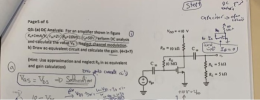 ster PageS of Q3:(a) oC Anahrals: For an ampifier shown in figure DC analysis and calculate thev b) Draw ac-equivalent circuit and calculate the gain.(4+3-7 Ra (Hint: Use approximation and neglect Rg in ac equivalent and gain calculation) zo s cy
ster PageS of Q3:(a) oC Anahrals: For an ampifier shown in figure DC analysis and calculate thev b) Draw ac-equivalent circuit and calculate the gain.(4+3-7 Ra (Hint: Use approximation and neglect Rg in ac equivalent and gain calculation) zo...
ster PageS of Q3:(a) oC Anahrals: For an ampifier shown in figure DC analysis and calculate thev b) Draw ac-equivalent circuit and calculate the gain.(4+3-7 Ra (Hint: Use approximation and neglect Rg in ac equivalent and gain calculation) zo s cy
ster PageS of Q3:(a) oC Anahrals: For an ampifier shown in figure DC analysis and calculate thev b) Draw ac-equivalent circuit and calculate the gain.(4+3-7 Ra (Hint: Use approximation and neglect Rg in ac equivalent and gain calculation) zo...
Circuit Analysis For the circuit shown in Figure Q2: (a) (b) Determine the amplifier type and...
 Circuit Analysis
For the circuit shown in Figure Q2: (a) (b) Determine the amplifier type and feedback topology Derive the input impedance with feedback, Zif and state whether it is increased or decreased from the circuit without feedback. If Ar 10, Zi 500k2, Zo = 2kQ, and Zof- 25k2, calculate Zi, Ax and B. (c) I IG Vo V Ax V Zd Zof Figure Q2
For the circuit shown in Figure Q2: (a) (b) Determine the amplifier type and feedback...
Circuit Analysis
For the circuit shown in Figure Q2: (a) (b) Determine the amplifier type and feedback topology Derive the input impedance with feedback, Zif and state whether it is increased or decreased from the circuit without feedback. If Ar 10, Zi 500k2, Zo = 2kQ, and Zof- 25k2, calculate Zi, Ax and B. (c) I IG Vo V Ax V Zd Zof Figure Q2
For the circuit shown in Figure Q2: (a) (b) Determine the amplifier type and feedback...
For the cascade amplifier of Figure Q1(a), determine the (1) transconductance factor, gm. a.c. diode resistance.,...
 For the cascade amplifier of Figure Q1(a), determine the (1) transconductance factor, gm. a.c. diode resistance., re. (iii) ac equivalent circuit (iv) input impedance, Z (v) output impedance, Z. (vi) voltage gain, Avi (vii) voltage gain, Av2. (viii) total cascade voltage gain, Avr. Given gm = 21 pss lvpl + 15 V Ipss - 10 mA Vp.4V Vase -- 1.5 V βος = 50 μs Γ. 40 ΚΩ RO 3.3 ΚΩ R81 22 ΚΩ Rc 10 ΚΩ O V. β...
Given a RL circuit as in Figure Q2 (a) with input for the circuit is vi(t)...
 Given a RL circuit as in Figure Q2 (a) with input for the circuit is vi(t) and output is vo(t). L1 il(t) R1 il(t) + + vi(t) L2 R2 v.(t) Figure Q2 (a) Show that the RL circuit in Figure Q2 (a) can be represented by the following state-space representation: di,, (t) -(R+R) L dt di,, (t) dt R₂ R L, 1.t -R, L. (1) L2 8-6 L, V. (t) L v.(t)=[R, R)
1-Clear handwriting 2-Correct answer 3-Organized 4-answer all the questions Please Problem 2 On the circuit on...
 1-Clear handwriting
2-Correct answer
3-Organized
4-answer all the questions
Please
Problem 2 On the circuit on Figure P2, transi stor Q1 has a threshold voltage of Vt = 2 V and a transconductance parameter of k = 100 mA/V2. Note that Vcc = -Vee = 4.5 V. Moreover, capacitors C1, C2, and C3 can be assumed to be very large VDD 4.5.0 R3 25kQ R1 300kn C2 Vout C1 Rsig Q1 1k0 R2 200kn Vsig (R4 2kQ C3 -4.5V VSS...
1-Clear handwriting
2-Correct answer
3-Organized
4-answer all the questions
Please
Problem 2 On the circuit on Figure P2, transi stor Q1 has a threshold voltage of Vt = 2 V and a transconductance parameter of k = 100 mA/V2. Note that Vcc = -Vee = 4.5 V. Moreover, capacitors C1, C2, and C3 can be assumed to be very large VDD 4.5.0 R3 25kQ R1 300kn C2 Vout C1 Rsig Q1 1k0 R2 200kn Vsig (R4 2kQ C3 -4.5V VSS...
f) Figure Qlf) shows the ac equivalent circuit of a common-source amplifier where have a low-frequeney rol-off C assume that Rs is much greater than the impedance of Cs at the frequency of 100 Re is...
 f) Figure Qlf) shows the ac equivalent circuit of a common-source amplifier where have a low-frequeney rol-off C assume that Rs is much greater than the impedance of Cs at the frequency of 100 Re is the ac load. The low-frequency roll-off is to be set by the capacitor Cs. Design the amplifier to have a low-frequency roll-off, 100 Hz. You may Rt gs gm Vgs V. Rs Cs Figure QiD
f) Figure Qlf) shows the ac equivalent circuit of...
f) Figure Qlf) shows the ac equivalent circuit of a common-source amplifier where have a low-frequeney rol-off C assume that Rs is much greater than the impedance of Cs at the frequency of 100 Re is the ac load. The low-frequency roll-off is to be set by the capacitor Cs. Design the amplifier to have a low-frequency roll-off, 100 Hz. You may Rt gs gm Vgs V. Rs Cs Figure QiD
f) Figure Qlf) shows the ac equivalent circuit of...
Problem 2: In the circuit on Figure P2, BJT NPN Q1 and Q2 emulate a Darlington...
 Problem 2: In the circuit on Figure P2, BJT NPN Q1 and Q2 emulate a Darlington Pair (DP). It should be noted that Q1 and Q2 are such that their current gains are B1 B2 = B = 99. Moreover, capacitors C1 and C2 can be assumed to be very large. Note: The DC analysis of the DP circuit below can be done in a similar fashion as what you do when only dealing with one transistor. Express the current...
1 } 470 k 2 2.2 k 2 10 uF 16 C2 Z B = 120....
 1 } 470 k 2 2.2 k 2 10 uF 16 C2 Z B = 120. ro = 40 k22 10 uF OB Z 0.56 k 2 CE 10 μF 1 Figure Q2 (b) c) Draw the small signal AC circuit for the emitter bias network in Figure Q2 (b). (3 Marks) Determine the following for the small signal AC circuit drawn in Question 2 (c): d) i) Z (1 Mark) ii) Zo without ro (1 Mark) iii) Z, with...
5. (20 points) For the amplifier in the following figure: +Vcc Rout Rc C3 R2 Rin Ri 1 k R3 Vo Vi R1 RE -VEE a) Draw the de equivalent circuit and find the Q-point. Assume B -75 b) Draw the equiv...
 5. (20 points) For the amplifier in the following figure: +Vcc Rout Rc C3 R2 Rin Ri 1 k R3 Vo Vi R1 RE -VEE a) Draw the de equivalent circuit and find the Q-point. Assume B -75 b) Draw the equivalent circuit used for ac analysis. Find the values in Thevenin equivalent representation for the amplifiers between C, and C as shown below. What is the maximum value of v, that satisfies the small- signal assumption? Rout Ri vi...
F LOpoint For the circuit shown in Figure 3 3. 1. Draw the DC equivalent circuit...
 F LOpoint For the circuit shown in Figure 3 3. 1. Draw the DC equivalent circuit by opening caps and shorting inductors 2. Analyze the DC equivalent circuit as we have in previous labs (assume a region, analyze and check assumptions). Check your DC operating point using LT Spice. 3. Calculate the small signal parameters (transconductance, output resistance, input resistance) 4. Draw the AC equivalent circuit by shorting de voltage sources, opening dc current sources, shorting caps and opening inductors....
 ster PageS of Q3:(a) oC Anahrals: For an ampifier shown in figure DC analysis and calculate thev b) Draw ac-equivalent circuit and calculate the gain.(4+3-7 Ra (Hint: Use approximation and neglect Rg in ac equivalent and gain calculation) zo s cy
ster PageS of Q3:(a) oC Anahrals: For an ampifier shown in figure DC analysis and calculate thev b) Draw ac-equivalent circuit and calculate the gain.(4+3-7 Ra (Hint: Use approximation and neglect Rg in ac equivalent and gain calculation) zo...
ster PageS of Q3:(a) oC Anahrals: For an ampifier shown in figure DC analysis and calculate thev b) Draw ac-equivalent circuit and calculate the gain.(4+3-7 Ra (Hint: Use approximation and neglect Rg in ac equivalent and gain calculation) zo s cy
ster PageS of Q3:(a) oC Anahrals: For an ampifier shown in figure DC analysis and calculate thev b) Draw ac-equivalent circuit and calculate the gain.(4+3-7 Ra (Hint: Use approximation and neglect Rg in ac equivalent and gain calculation) zo...
 Circuit Analysis
For the circuit shown in Figure Q2: (a) (b) Determine the amplifier type and feedback topology Derive the input impedance with feedback, Zif and state whether it is increased or decreased from the circuit without feedback. If Ar 10, Zi 500k2, Zo = 2kQ, and Zof- 25k2, calculate Zi, Ax and B. (c) I IG Vo V Ax V Zd Zof Figure Q2
For the circuit shown in Figure Q2: (a) (b) Determine the amplifier type and feedback...
Circuit Analysis
For the circuit shown in Figure Q2: (a) (b) Determine the amplifier type and feedback topology Derive the input impedance with feedback, Zif and state whether it is increased or decreased from the circuit without feedback. If Ar 10, Zi 500k2, Zo = 2kQ, and Zof- 25k2, calculate Zi, Ax and B. (c) I IG Vo V Ax V Zd Zof Figure Q2
For the circuit shown in Figure Q2: (a) (b) Determine the amplifier type and feedback...
 For the cascade amplifier of Figure Q1(a), determine the (1) transconductance factor, gm. a.c. diode resistance., re. (iii) ac equivalent circuit (iv) input impedance, Z (v) output impedance, Z. (vi) voltage gain, Avi (vii) voltage gain, Av2. (viii) total cascade voltage gain, Avr. Given gm = 21 pss lvpl + 15 V Ipss - 10 mA Vp.4V Vase -- 1.5 V βος = 50 μs Γ. 40 ΚΩ RO 3.3 ΚΩ R81 22 ΚΩ Rc 10 ΚΩ O V. β...
 Given a RL circuit as in Figure Q2 (a) with input for the circuit is vi(t) and output is vo(t). L1 il(t) R1 il(t) + + vi(t) L2 R2 v.(t) Figure Q2 (a) Show that the RL circuit in Figure Q2 (a) can be represented by the following state-space representation: di,, (t) -(R+R) L dt di,, (t) dt R₂ R L, 1.t -R, L. (1) L2 8-6 L, V. (t) L v.(t)=[R, R)
 1-Clear handwriting
2-Correct answer
3-Organized
4-answer all the questions
Please
Problem 2 On the circuit on Figure P2, transi stor Q1 has a threshold voltage of Vt = 2 V and a transconductance parameter of k = 100 mA/V2. Note that Vcc = -Vee = 4.5 V. Moreover, capacitors C1, C2, and C3 can be assumed to be very large VDD 4.5.0 R3 25kQ R1 300kn C2 Vout C1 Rsig Q1 1k0 R2 200kn Vsig (R4 2kQ C3 -4.5V VSS...
1-Clear handwriting
2-Correct answer
3-Organized
4-answer all the questions
Please
Problem 2 On the circuit on Figure P2, transi stor Q1 has a threshold voltage of Vt = 2 V and a transconductance parameter of k = 100 mA/V2. Note that Vcc = -Vee = 4.5 V. Moreover, capacitors C1, C2, and C3 can be assumed to be very large VDD 4.5.0 R3 25kQ R1 300kn C2 Vout C1 Rsig Q1 1k0 R2 200kn Vsig (R4 2kQ C3 -4.5V VSS...
 f) Figure Qlf) shows the ac equivalent circuit of a common-source amplifier where have a low-frequeney rol-off C assume that Rs is much greater than the impedance of Cs at the frequency of 100 Re is the ac load. The low-frequency roll-off is to be set by the capacitor Cs. Design the amplifier to have a low-frequency roll-off, 100 Hz. You may Rt gs gm Vgs V. Rs Cs Figure QiD
f) Figure Qlf) shows the ac equivalent circuit of...
f) Figure Qlf) shows the ac equivalent circuit of a common-source amplifier where have a low-frequeney rol-off C assume that Rs is much greater than the impedance of Cs at the frequency of 100 Re is the ac load. The low-frequency roll-off is to be set by the capacitor Cs. Design the amplifier to have a low-frequency roll-off, 100 Hz. You may Rt gs gm Vgs V. Rs Cs Figure QiD
f) Figure Qlf) shows the ac equivalent circuit of...
 Problem 2: In the circuit on Figure P2, BJT NPN Q1 and Q2 emulate a Darlington Pair (DP). It should be noted that Q1 and Q2 are such that their current gains are B1 B2 = B = 99. Moreover, capacitors C1 and C2 can be assumed to be very large. Note: The DC analysis of the DP circuit below can be done in a similar fashion as what you do when only dealing with one transistor. Express the current...
 1 } 470 k 2 2.2 k 2 10 uF 16 C2 Z B = 120. ro = 40 k22 10 uF OB Z 0.56 k 2 CE 10 μF 1 Figure Q2 (b) c) Draw the small signal AC circuit for the emitter bias network in Figure Q2 (b). (3 Marks) Determine the following for the small signal AC circuit drawn in Question 2 (c): d) i) Z (1 Mark) ii) Zo without ro (1 Mark) iii) Z, with...
 5. (20 points) For the amplifier in the following figure: +Vcc Rout Rc C3 R2 Rin Ri 1 k R3 Vo Vi R1 RE -VEE a) Draw the de equivalent circuit and find the Q-point. Assume B -75 b) Draw the equivalent circuit used for ac analysis. Find the values in Thevenin equivalent representation for the amplifiers between C, and C as shown below. What is the maximum value of v, that satisfies the small- signal assumption? Rout Ri vi...
 F LOpoint For the circuit shown in Figure 3 3. 1. Draw the DC equivalent circuit by opening caps and shorting inductors 2. Analyze the DC equivalent circuit as we have in previous labs (assume a region, analyze and check assumptions). Check your DC operating point using LT Spice. 3. Calculate the small signal parameters (transconductance, output resistance, input resistance) 4. Draw the AC equivalent circuit by shorting de voltage sources, opening dc current sources, shorting caps and opening inductors....
Most questions answered within 3 hours.
-
Where is the error in this code sequence?
String s1 = "Hello";
String s2 = "ello";...
asked 11 months ago -
Financial data for Joel de Paris, Inc., for last year
follow:
Joel de Paris, Inc.
Balance...
asked 11 months ago -
Consider this reaction:
Al2(SO4)3 (aq)+ BaCl3
(aq) Al2Cl6 (aq)- +
3BaSO4(s) . What is the...
asked 11 months ago -
Suppose that Savneet is considering increasing her
recent random sample from 20 car rentals to 40...
asked 11 months ago -
Trucks arrive at an unloading terminal at an average rate of 120
per hour.
Trucks arrive...
asked 11 months ago -
Why are methanol and ethanol completely soluble in water while
octanol is not very little soluble....
asked 11 months ago -
A facilities manager at a university reads in a research report
that the mean amount of...
asked 11 months ago -
When the CuSO4 is rehydrated by adding water to the anhydrous
compound, is this an endothermic...
asked 11 months ago -
A ray of sunlight is passing from diamond into crown glass; the
angle of incidence is...
asked 11 months ago -
A block of mass 0.249 kg is placed on top of a light, vertical
spring of...
asked 11 months ago -
how do the kidneys compensate in the presences of acidosis
a) trigger hyperventilate
b) reserve acid...
asked 11 months ago -
Question 501 pts
The rental rate of capital to the firm increases. Which of the
following...
asked 11 months ago