![Page ot 9 2. Stacks/Queues: Write a method splitStack that takes a stack of integers as a parameter and splits it into negatives and non-negatives. The numbers in the stack should be rearranged so that all the negatives appear on the bottom of the stack and all the non-negatives appear on the top. In other words, if after this method is called you were to pop numbers off the stack, you would first get all the nonnegative numbers and then get all the negative numbers. It does not matter what order the numbers appear in as long as all the negatives appear lower in the stack than all the non-negatives. You may use a single queue as auxiliary storage. For example, if the stack stores [3, -5, 1, 2,-4], an acceptable result would be [-5, -4, 3, 1, 2](http://img.homeworklib.com/questions/7e82dca0-a7a3-11ea-a9d9-6b1e218566ae.png?x-oss-process=image/resize,w_560)
Homework Answers
Here is the completed code for this method. Assuming the language is Java. Please don’t forget to mention the language while you post a question in future. Comments are included, go through it, learn how things work and let me know if you have any doubts or if you need anything to change. If you are satisfied with the solution, please rate the answer. Thanks
//required method, using Stack & Queue from java.util library
static void splitStack(Stack<Integer> stk) {
// creating a queue as auxiliary storage
Queue<Integer> auxQueue = new LinkedList<Integer>();
// moving each value from stk to the queue
while (!stk.isEmpty()) {
auxQueue.add(stk.pop());
}
// finding the size of the queue
int size = auxQueue.size();
// looping for size number of times
for (int i = 0; i < size; i++) {
// removing front element from queue
int number = auxQueue.remove();
// if number is negative, pushing to stack
if (number < 0) {
stk.push(number);
} else {
// otherwise adding to the end of queue
auxQueue.add(number);
}
}
// at this point, the stack will only contain negative values, all
// positive values are left on the queue, so we just simply add them to
// the stack, so that positive values will be at the top
// looping and removing each value remaining on the queue into the stack
while (!auxQueue.isEmpty()) {
stk.push(auxQueue.remove());
}
}
Add Answer to:
Page ot 9 2. Stacks/Queues: Write a method splitStack that takes a stack of integers as...
PLEASE DONT COPY PASTE EXISTING SOLUTIONS Practice problem on stacks and queues. Thanks :) Write a...
PLEASE DONT COPY PASTE EXISTING SOLUTIONS Practice problem on stacks and queues. Thanks :) Write a method called divideStack that takes a stack of integers as a parameter and divides it into negatives and positives.The numbers in the stack must be arranged so that all negatives appear on the bottom of the stack and all positives appear on the top. The order of the numbers does not matter as long as all negatives appear lower in the stack than all...
Queues and Stacks Purpose: To review queues and stacks in Java, and to use the built-in...
Queues and Stacks Purpose: To review queues and stacks in Java, and to use the built-in Stack class and Queue interface. The Stack class is a generic class containing these methods: public void push(E value) - pushes a new value onto the Stack public E pop() - pops the next value off of the stack and returns it; throws EmptyStackExceptionl if stack is empty public E peek() - returns the next value on the Stack but does not pop it...
In java please: Write a method that accepts as a parameter a queue of integers that...
In java please: Write a method that accepts as a parameter a queue of integers that are already sorted by absolute value, and modifies it so that the integers are sorted normally. Only use a single stack as auxiliary storage. For example, if a queue variable named q stores the following elements: front {1, -2, 4, 5, -7, -9, -12, 28, -34} back Then the call of reorder(q); should modify it to store the following values: front {-34, -12, -9,...
Java Program Write a method called reverseBottomHalf that accepts a Stack of integers as a parameter...
Java Program Write a method called reverseBottomHalf that accepts a Stack of integers as a parameter and reverses only the values in the bottom half of the Stack. For example, if a Stack containing the values [1, 2, 3, 4, 5] were passed in (with 1 at the bottom and 5 at the top), the Stack would be changed to [2, 1, 3, 4, 5] (with 2 at the bottom and 5 at the top) after this method was called...
Data Structures and Algorithm (Stacks and Queues) Imagine you have a Queue of integers, Q1 and...
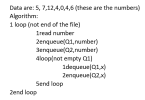 Data Structures and Algorithm (Stacks and Queues)
Imagine you have a Queue of integers, Q1 and Q2. Draw a picture
of Q1 and Q2 after the following operations:
**Note: make sure that ALL variables are
simulated.**
Data are: 5,7,12,4,0,4,6 (these are the numbers) Algorithm: 1 loop (not end of the file) 1read number 2enqueue(Q1,number) 3enqueue(Q2,number) 4loop(not empty Q1) 1dequeue(Q1,x) 2enqueue(Q2,x) Send loop 2end loop
Data Structures and Algorithm (Stacks and Queues)
Imagine you have a Queue of integers, Q1 and Q2. Draw a picture
of Q1 and Q2 after the following operations:
**Note: make sure that ALL variables are
simulated.**
Data are: 5,7,12,4,0,4,6 (these are the numbers) Algorithm: 1 loop (not end of the file) 1read number 2enqueue(Q1,number) 3enqueue(Q2,number) 4loop(not empty Q1) 1dequeue(Q1,x) 2enqueue(Q2,x) Send loop 2end loop
Write a method called reverseFirstK that accepts an integer k and a queue of integers as...
 Write a method called reverseFirstK that accepts an integer k and a queue of integers as parameters and reverses the order of the first k elements of the queue, leaving the other elements in the same relative order. For example, if a queue named q stores [10, 20 30, 40, 50, 60, 70, 80, 90], the call of reverseFirstK (4, q):should change the queue to store [40, 30 20, 10, 50, 60, 70, 80, 90]. If k is 0 or...
help me answer the following questions please 1. Stack (LIFO) & its application 1. Stack overflow...
help me answer the following questions please 1. Stack (LIFO) & its application 1. Stack overflow & underflow 2. Implementation: partially filled array & linked list 3. Applications: reverse string, backtracking Exercises: 1) Which of the following applications may use a stack? A. parentheses balancing program. B. Keeping track of local variables at run time. C. Syntax analyzer for a compiler. D. All of the above. 2) Consider the usual algorithm for determining whether a sequence of parentheses is balanced....
in java Write a class named Palindrome.java and Write a method isPalindrome that takes an IntQueue...
in java Write a class named Palindrome.java and Write a method isPalindrome that takes an IntQueue as a parameter and that returns whether or not the numbers in the queue represent a palindrome (true if they do, false otherwise). A sequence of numbers is considered a palindrome if it is the same in reverse order. For example, suppose a Queue called q stores this sequence of values: front [3, 8, 17, 9, 17, 8, 3] back Then the following call:...
In c++ Section 1. Stack ADT – Overview Data Items The data items in a stack...
In c++ Section 1. Stack ADT – Overview Data Items The data items in a stack are of generic DataType. This means use should use templating and your Node class. Structure The stack data items are linearly ordered from the most recently added (the top) to the least recently added (the bottom). This is a LIFO scheme. Data items are inserted onto (pushed) and removed from (popped) the top of the stack. Operations Constructor. Creates an empty stack. Copy constructor....
Write a method called removeDuplicates that accepts a PriorityQueue of integers as a parameter and modifies...
Write a method called removeDuplicates that accepts a PriorityQueue of integers as a parameter and modifies the queue’s state so that any element that is equal to another element in the queue is removed. For example, if the queue stores [7, 7, 8, 8, 8, 10, 45, 45], your method should modify the queue to store [7, 8, 10, 45]. You may use one stack or queue as auxiliary storage. Please also create a Main Program to test the code....
 Data Structures and Algorithm (Stacks and Queues)
Imagine you have a Queue of integers, Q1 and Q2. Draw a picture
of Q1 and Q2 after the following operations:
**Note: make sure that ALL variables are
simulated.**
Data are: 5,7,12,4,0,4,6 (these are the numbers) Algorithm: 1 loop (not end of the file) 1read number 2enqueue(Q1,number) 3enqueue(Q2,number) 4loop(not empty Q1) 1dequeue(Q1,x) 2enqueue(Q2,x) Send loop 2end loop
Data Structures and Algorithm (Stacks and Queues)
Imagine you have a Queue of integers, Q1 and Q2. Draw a picture
of Q1 and Q2 after the following operations:
**Note: make sure that ALL variables are
simulated.**
Data are: 5,7,12,4,0,4,6 (these are the numbers) Algorithm: 1 loop (not end of the file) 1read number 2enqueue(Q1,number) 3enqueue(Q2,number) 4loop(not empty Q1) 1dequeue(Q1,x) 2enqueue(Q2,x) Send loop 2end loop
 Write a method called reverseFirstK that accepts an integer k and a queue of integers as parameters and reverses the order of the first k elements of the queue, leaving the other elements in the same relative order. For example, if a queue named q stores [10, 20 30, 40, 50, 60, 70, 80, 90], the call of reverseFirstK (4, q):should change the queue to store [40, 30 20, 10, 50, 60, 70, 80, 90]. If k is 0 or...
Most questions answered within 3 hours.
-
Where is the error in this code sequence?
String s1 = "Hello";
String s2 = "ello";...
asked 11 months ago -
Financial data for Joel de Paris, Inc., for last year
follow:
Joel de Paris, Inc.
Balance...
asked 11 months ago -
Consider this reaction:
Al2(SO4)3 (aq)+ BaCl3
(aq) Al2Cl6 (aq)- +
3BaSO4(s) . What is the...
asked 11 months ago -
Suppose that Savneet is considering increasing her
recent random sample from 20 car rentals to 40...
asked 11 months ago -
Trucks arrive at an unloading terminal at an average rate of 120
per hour.
Trucks arrive...
asked 11 months ago -
Why are methanol and ethanol completely soluble in water while
octanol is not very little soluble....
asked 11 months ago -
A facilities manager at a university reads in a research report
that the mean amount of...
asked 11 months ago -
When the CuSO4 is rehydrated by adding water to the anhydrous
compound, is this an endothermic...
asked 11 months ago -
A ray of sunlight is passing from diamond into crown glass; the
angle of incidence is...
asked 11 months ago -
A block of mass 0.249 kg is placed on top of a light, vertical
spring of...
asked 11 months ago -
how do the kidneys compensate in the presences of acidosis
a) trigger hyperventilate
b) reserve acid...
asked 11 months ago -
Question 501 pts
The rental rate of capital to the firm increases. Which of the
following...
asked 11 months ago