
Homework Answers
![limiting current current diffusion current ヲvoltage half wave potential voltage (E) half wave potential logl(id-i)/i] ->](http://img.homeworklib.com/questions/c9cfd490-af5c-11ea-9b70-992e545b12d2.png?x-oss-process=image/resize,w_560)
Here A-B is the residual current.
B-C is the diffusion current
C-D is the limiting current.
Id is diffusion current.
at B, the concentration of reductant is greater in bulk as compared to in region C. At region C, there will be a relatively higher concentration of analyte ions( reductant) near the electrode.
residual current is something where the reaction starts happening and at B the movement of ions start taking place. residual current is basically the sum of faradaic current which is due to impurities and the non-faradaic current which is generated due to the formation of an electrical double layer around the dropping mercury electrode.
half wave potential is characteristic of that species and independent of the concentration of the analyte. half wave potential is the point at which the diffusion current is half of its maximum value.
limiting current is dependent on the concentration of the analyte.
In polarography, there are two types of current generated in the medium. one is due to the concentration gradient of analyte (diffusion current) and another is due to the difference in the potential applied across the solution (migration current). To stop the movement of analyte ions via migration current, we use a supporting electrolyte which forms a layer around the electrode so analyte ions cannot approach the electrode (so no migration current). So analyte ions approach the electrode via diffusion current to get reduced. so as the potential increases, the flow of analyte ions increases, diffusion current increases till point C.
point C gives the concentration of reducing species (analyte ions) in the medium which is mathematically given by IIKOVICH equation.
Id= 607nFD1/2M2/3t1/6
where the n= number of electrons exchanged
D is the diffusion coefficient, M is the mass flow rate of Hg from the capillary, and t is the drop lifetime in seconds.
Add Answer to:
Draw a linear scan polargraphic wave. Label the axes and indicate the half-wave potential and limiting...
Q1. Based upon the figure wirh 10mM concentration, what is the limiting currebt in units of...
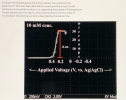 Q1. Based upon the figure wirh 10mM concentration, what is the
limiting currebt in units of microamps? The limiting current is
described by the red bar line.
Q.2 Based upon the figure with 5 mM concebtration, what is the
limiting current in units of microamps? The limiting current is
labeled by the red bar line.
Q.3 This Question refers back to the previous two questions.
If a blank sample (conc. = 0 mM) yielded 0.0 microamps of current
duribg the...
Q1. Based upon the figure wirh 10mM concentration, what is the
limiting currebt in units of microamps? The limiting current is
described by the red bar line.
Q.2 Based upon the figure with 5 mM concebtration, what is the
limiting current in units of microamps? The limiting current is
labeled by the red bar line.
Q.3 This Question refers back to the previous two questions.
If a blank sample (conc. = 0 mM) yielded 0.0 microamps of current
duribg the...
Draw out a cell for Al in Al(NO3)3 and Ag in AgNO3. Label the anode and...
Draw out a cell for Al in Al(NO3)3 and Ag in AgNO3. Label the anode and cathode sides, including charge on each electrode. (hint: use a table of standard reduction potentials). Indicate direction of electron flow. Write the net reaction, and the half reactions. What is the standard cell potential? Indicate for both electrodes whether they are dissolving, growing, or staying the same size. Assuming the salt bridge contains KNO3, indicate flow of ions into and out of salt bridge....
1) Indicate Pka values and PI of arginine 2) Draw all the different ionic forms of...
1) Indicate Pka values and PI of arginine 2) Draw all the different ionic forms of Arginine going from low pH to high pH and circle the dominant form of Arginine at its isoelectric point. 3) Calculate the pI for this amino acid. 4) Sketch an accurate titration curve for a titration of Arginine with NaOH. Label the equivalence points, the half-equivalence points and the pI. 5) Indicate which species of Arginine is present at different points in your titration...
Q4: 2+2-4 Marks a) Draw the interatomic potential curve of the metal Tungsten. Clearly label all...
 Q4: 2+2-4 Marks a) Draw the interatomic potential curve of the metal Tungsten. Clearly label all axes. b) On the sa point than Tungsten. ne axes draw the interatomic potential curve of Metal A which has a lower melting MATERIAL SECTION Materials Formulae Equations Constants h4.125x 10"eV 3 x 10 m/s Co(W)-o.140 kJAkg K) ρ(W)-20 x 10. Ohn1cm Density of W-19.25 gen Violet light, λ-04-0 425 μm Blue light, λ-0424-0 49 Green light, λ-O 49-055 μm Yellow light, λ-0.55-0 56...
Problem 1. (concept question) 1) What is the Nernst equation and how to define for the...
 Problem 1. (concept question) 1) What is the Nernst equation and how to define for the electrochemical reaction (aA bBcC dD)? 2) What is Formal potential and why it is useful? 3) What is the Faraday's law and how it is defined (i.e. its relation)? 4) What is the reference electrode and what is it used for? What is the desired characteristic of reference electrode? Show three examples of reference electrode 5) What is the electrochemical double layer and how...
3. Draw the structure of Serine. (a) label all functional groups (b) identify the stereogenic center and provide al...
 3. Draw the structure of Serine. (a) label all functional groups (b) identify the stereogenic center and provide all possible configurations - use the appropriate nomenclature (c) graph the concentrations of fully protonated, zwitterionic and fully deprotonated forms with respect to increasing pH (d) show the titration curve of serine using 2 equivalents of OH. Make sure to label significant points and regions on the graph and indicate the relative concentrations of the various species. (e) calculate the isoelectric point...
Draw and carefully describe a graph that utilizes theAggregate Demand/Aggregate Supply model that would illustrate...
 Draw and carefully describe a graph that utilizes the
Aggregate Demand/Aggregate Supply model that would illustrate the
current state of the aggregate economy in the United States. The
Aggregate Demand/Aggregate Supply Model is first explained in
Chapter 11of your text. Carefully explain your graph.You should draw your own AD/AS graph which you can then scan
and paste into your post. Your graph needs to be clearly labeled
and explained carefully. Make sure that your graph includes an
aggregate demand (AD)...
Draw and carefully describe a graph that utilizes the
Aggregate Demand/Aggregate Supply model that would illustrate the
current state of the aggregate economy in the United States. The
Aggregate Demand/Aggregate Supply Model is first explained in
Chapter 11of your text. Carefully explain your graph.You should draw your own AD/AS graph which you can then scan
and paste into your post. Your graph needs to be clearly labeled
and explained carefully. Make sure that your graph includes an
aggregate demand (AD)...
*This is from the most recent quarter of 2019* Draw and carefully describe a graph that utilizes the Aggregate Demand/Ag...
*This is from the most recent quarter of 2019* Draw and carefully describe a graph that utilizes the Aggregate Demand/Aggregate Supply model that would illustrate the current state of the aggregate economy in the United States. Your graph needs to be clearly labeled and explained in some detail. Make sure that your graph includes an aggregate demand (AD) curve, a short run aggregate supply (SRAS) curve, and a long run aggregate supply curve (LRAS, Potential GDP) curve. You should clearly...
NAME (PRINT For each question, first draw a demand curve. label it D1. This is the...
 NAME (PRINT For each question, first draw a demand curve. label it D1. This is the initial condition. Then, in response to the situation posed, show how (if it does) the demand curve shifts on the same chart. Label the new demand curve D2. You must properly label the axes to get all points possible. Each question is worth 2 points. 1. The government announces that oranges are full of cancer-causing chemicals. Show what happens to the demand curve for...
Pls draw the rough graph out, and show the calculation of Initial PH, PH at half-equivalence...
 Pls draw the rough graph out, and show the calculation of
Initial PH, PH at half-equivalence point and equivalence point!!!
pls draw the graph out and how the number, any answer give no graph
will receive thumb down!!!
Prepare two sketches based on the complete titration of a 10.00 mL aliquot of 0.02000 F neutral ethylenediamine (H2NCH2CH2NH2) with 0.0500 F titrant: Plot 1) pH vs mL titrant added Plot 2) fractional composition (a) vs. pH (0-14) for all ethylenediamine-derived species...
Pls draw the rough graph out, and show the calculation of
Initial PH, PH at half-equivalence point and equivalence point!!!
pls draw the graph out and how the number, any answer give no graph
will receive thumb down!!!
Prepare two sketches based on the complete titration of a 10.00 mL aliquot of 0.02000 F neutral ethylenediamine (H2NCH2CH2NH2) with 0.0500 F titrant: Plot 1) pH vs mL titrant added Plot 2) fractional composition (a) vs. pH (0-14) for all ethylenediamine-derived species...
 Q1. Based upon the figure wirh 10mM concentration, what is the
limiting currebt in units of microamps? The limiting current is
described by the red bar line.
Q.2 Based upon the figure with 5 mM concebtration, what is the
limiting current in units of microamps? The limiting current is
labeled by the red bar line.
Q.3 This Question refers back to the previous two questions.
If a blank sample (conc. = 0 mM) yielded 0.0 microamps of current
duribg the...
Q1. Based upon the figure wirh 10mM concentration, what is the
limiting currebt in units of microamps? The limiting current is
described by the red bar line.
Q.2 Based upon the figure with 5 mM concebtration, what is the
limiting current in units of microamps? The limiting current is
labeled by the red bar line.
Q.3 This Question refers back to the previous two questions.
If a blank sample (conc. = 0 mM) yielded 0.0 microamps of current
duribg the...
 Q4: 2+2-4 Marks a) Draw the interatomic potential curve of the metal Tungsten. Clearly label all axes. b) On the sa point than Tungsten. ne axes draw the interatomic potential curve of Metal A which has a lower melting MATERIAL SECTION Materials Formulae Equations Constants h4.125x 10"eV 3 x 10 m/s Co(W)-o.140 kJAkg K) ρ(W)-20 x 10. Ohn1cm Density of W-19.25 gen Violet light, λ-04-0 425 μm Blue light, λ-0424-0 49 Green light, λ-O 49-055 μm Yellow light, λ-0.55-0 56...
 Problem 1. (concept question) 1) What is the Nernst equation and how to define for the electrochemical reaction (aA bBcC dD)? 2) What is Formal potential and why it is useful? 3) What is the Faraday's law and how it is defined (i.e. its relation)? 4) What is the reference electrode and what is it used for? What is the desired characteristic of reference electrode? Show three examples of reference electrode 5) What is the electrochemical double layer and how...
 3. Draw the structure of Serine. (a) label all functional groups (b) identify the stereogenic center and provide all possible configurations - use the appropriate nomenclature (c) graph the concentrations of fully protonated, zwitterionic and fully deprotonated forms with respect to increasing pH (d) show the titration curve of serine using 2 equivalents of OH. Make sure to label significant points and regions on the graph and indicate the relative concentrations of the various species. (e) calculate the isoelectric point...
 Draw and carefully describe a graph that utilizes the
Aggregate Demand/Aggregate Supply model that would illustrate the
current state of the aggregate economy in the United States. The
Aggregate Demand/Aggregate Supply Model is first explained in
Chapter 11of your text. Carefully explain your graph.You should draw your own AD/AS graph which you can then scan
and paste into your post. Your graph needs to be clearly labeled
and explained carefully. Make sure that your graph includes an
aggregate demand (AD)...
Draw and carefully describe a graph that utilizes the
Aggregate Demand/Aggregate Supply model that would illustrate the
current state of the aggregate economy in the United States. The
Aggregate Demand/Aggregate Supply Model is first explained in
Chapter 11of your text. Carefully explain your graph.You should draw your own AD/AS graph which you can then scan
and paste into your post. Your graph needs to be clearly labeled
and explained carefully. Make sure that your graph includes an
aggregate demand (AD)...
 NAME (PRINT For each question, first draw a demand curve. label it D1. This is the initial condition. Then, in response to the situation posed, show how (if it does) the demand curve shifts on the same chart. Label the new demand curve D2. You must properly label the axes to get all points possible. Each question is worth 2 points. 1. The government announces that oranges are full of cancer-causing chemicals. Show what happens to the demand curve for...
 Pls draw the rough graph out, and show the calculation of
Initial PH, PH at half-equivalence point and equivalence point!!!
pls draw the graph out and how the number, any answer give no graph
will receive thumb down!!!
Prepare two sketches based on the complete titration of a 10.00 mL aliquot of 0.02000 F neutral ethylenediamine (H2NCH2CH2NH2) with 0.0500 F titrant: Plot 1) pH vs mL titrant added Plot 2) fractional composition (a) vs. pH (0-14) for all ethylenediamine-derived species...
Pls draw the rough graph out, and show the calculation of
Initial PH, PH at half-equivalence point and equivalence point!!!
pls draw the graph out and how the number, any answer give no graph
will receive thumb down!!!
Prepare two sketches based on the complete titration of a 10.00 mL aliquot of 0.02000 F neutral ethylenediamine (H2NCH2CH2NH2) with 0.0500 F titrant: Plot 1) pH vs mL titrant added Plot 2) fractional composition (a) vs. pH (0-14) for all ethylenediamine-derived species...
Most questions answered within 3 hours.
-
Where is the error in this code sequence?
String s1 = "Hello";
String s2 = "ello";...
asked 10 months ago -
Financial data for Joel de Paris, Inc., for last year
follow:
Joel de Paris, Inc.
Balance...
asked 10 months ago -
Consider this reaction:
Al2(SO4)3 (aq)+ BaCl3
(aq) Al2Cl6 (aq)- +
3BaSO4(s) . What is the...
asked 10 months ago -
Suppose that Savneet is considering increasing her
recent random sample from 20 car rentals to 40...
asked 10 months ago -
Trucks arrive at an unloading terminal at an average rate of 120
per hour.
Trucks arrive...
asked 10 months ago -
Why are methanol and ethanol completely soluble in water while
octanol is not very little soluble....
asked 10 months ago -
A facilities manager at a university reads in a research report
that the mean amount of...
asked 10 months ago -
When the CuSO4 is rehydrated by adding water to the anhydrous
compound, is this an endothermic...
asked 10 months ago -
A ray of sunlight is passing from diamond into crown glass; the
angle of incidence is...
asked 10 months ago -
A block of mass 0.249 kg is placed on top of a light, vertical
spring of...
asked 10 months ago -
how do the kidneys compensate in the presences of acidosis
a) trigger hyperventilate
b) reserve acid...
asked 10 months ago -
Question 501 pts
The rental rate of capital to the firm increases. Which of the
following...
asked 10 months ago