Discuss the problems of monopoly and how to control monopoly firms with taxation. Show how a...
Discuss the problems of monopoly and how to control monopoly firms with taxation. Show how a monopolist discriminates two different markets with price
Homework Answers
Problems of Monopoly can be defined as follows :
- Diseconomies of scale
- Allocative inefficiency.
- Lack of choice
- cost Inefficiency.
- Supernormal Profit. lead to an unequal distribution of income in society.
- Higher prices to suppliers
- Lack of incentives.
- Productive inefficiency
- Higher prices.
monopoly can be controlled through taxation that is implemented by government by
Imposition of a Specific Tax:
Specific taxes are taxes like excise duty and sales tax. Excise duty are levied on production and sale tax on sales. it usually becomes the part of variable cost as increase in marginal cost lead to increase in variable cost and finally have effect on average cost due to reason output generated by monopolist reduce and prices increase another effect also leads to fall in the profit level and monopolist has to transfer the burden of tax to the customer in this case of imposition of specific tax.
Imposition of Lump Sum Tax:
the government levies a lump sum tax on monopolists this tax
might be profit
tax or license fee are imposed on a firm regardless of its level of
output. we consider it as fixed cost and does not become the part
of variable cost so it does not affect variable cost so in
this case of lump sum tax output level remain the same, price is
also same but profit reduced due to average cost rise and supplier
only bear the burdun of tax.
we start our discussion regarding discriminates two different markets with price, as we know monopolist is the single seller who control over all supply and market share . monopolist produces homogeneous product but charging differnt prices for different market is based on elasticity of demand when demand elasticity for one market is inelastic then he can charge high price for that market (woolen dresses at cold places) but in case of other market where demand is elastic according he will charge less price for the same goods. woolen dresses at warm places.
Add Answer to:
Discuss the problems of monopoly and how to control
monopoly firms with taxation. Show how a...
Question 3 Monopoly a) Discuss how monopoly markets discriminate prices by using the concept of market...
 Question 3 Monopoly a) Discuss how monopoly markets discriminate prices by using the concept of market segmentation. b) The market demand curve for a monopoly firm is given as P = 200 – 20. Furthermore, the marginal cost is represented by the equation MC = 20 + 20. The firm's TC can be expressed as TC = 200 + Q2 + 100. Use this information to answer the questions and calculate the following: i) Profit maximizing quantity and price. ii)...
Monopoly Assignment 1. A way in maintaining control over a market in order to insure the...
 Monopoly Assignment 1. A way in maintaining control over a market in order to insure the firm is the sole provider of a product, is to keep potential rivals out of the market. List three elements in preserving a monopoly, briefly discuss each. 2. Monopoly breeds inefficiency in resource allocation by producing too little and charging too high a price. Do you agree or disagree. Discuss your argument. 3. Assume a firm buys a perfectly competitive market and turns it...
answer 14.1, extra detail for c depends on its ability to prevent buyers. pertectly competitive firms....
 answer 14.1, extra detail for c
depends on its ability to prevent buyers. pertectly competitive firms. Durable goods s may be constrained by markets for used may opt for different levels of quality than olies (firms with diminishing avate naturs broad range of output levels). The mechanisms adopted can affect the regulated firm. . Governments often choose t average costs goods type A monopoly may be able to increase its profits further discrimination- that is, charging differ of buyers. The...
answer 14.1, extra detail for c
depends on its ability to prevent buyers. pertectly competitive firms. Durable goods s may be constrained by markets for used may opt for different levels of quality than olies (firms with diminishing avate naturs broad range of output levels). The mechanisms adopted can affect the regulated firm. . Governments often choose t average costs goods type A monopoly may be able to increase its profits further discrimination- that is, charging differ of buyers. The...
Question 17 (1 point) Price discrimination is more common for firms selling services than for manufacturing...
 Question 17 (1 point) Price discrimination is more common for firms selling services than for manufacturing firms because monopoly is more common in producing services than in producing manufactured goods. O price elasticities differ among consumers of services more than among customers of manufactured goods. it is easier to prevent resale of a service than of a manufactured product. firms selling services are more likely to have constant marginal cost curves. Question 18 (1 point) Assume that a monopolist produces...
Suppose the conglomerate Enn, Golf & Devour takes monopoly control of the nano-widget market by acquiring...
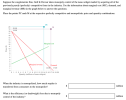 Suppose the conglomerate Enn, Golf & Devour takes monopoly control of the nano-widget market by acquiring all of the previously purely (perfectly) competitive firms in the industry. Use the information about marginal cost (MC), demand, and marginal revenue (MR) in the graph below to answer the questions. Place the points PC ands M at the respective perfectly competitive and monopolistic price and quantity combinations. PC 20.00 19.00 Price ($) Marginal revenue Demand 14.00 17.00 0 1 2 3 4 5...
a) Discuss how monopoly markets discriminate prices by using the concept of market segmentation
a) Discuss how monopoly markets discriminate prices by using the concept of market segmentation
5. Problems and Applications Q5 Consider the relationship between monopoly pricing and the price elasticity of...
 5. Problems and Applications Q5 Consider the relationship between monopoly pricing and the price elasticity of demand If demand is inelastic and a monopolist raises its price, total revenue would and total cost would .Therefore, a monopolist will produce a quantity at which the demand curve is inelastic Use the purple segment (diamond symbols) to indicate the portion of the demand curve that is inelastic. (Hint: The answer is related to the marginal- revenue (MR) curve.) Then use the black...
PART VI. Problems. Solve the following problems. Please show your work, especially how you calculate a)...
 PART VI. Problems. Solve the following problems. Please show your work, especially how you calculate a) marginal revenue, the b) profit maximizing quantity and price, c) the Cournot reaction function [best response functions) and the Stackelberg model. (3 points for each problem.) 33. A regulated monopoly faces the following demand for its product, P = 68 - 4Q, and has a marginal cost of MC = 20. Q is the quantity sold and P is the price. a. Under regulation,...
7. How is monopoly different from perfect competition? 8. What is a barrier to entry? Give...
7. How is monopoly different from perfect competition? 8. What is a barrier to entry? Give some examples. 9. What is a natural monopoly? 11. What is predatory pricing? 14. In what sense is a natural monopoly “natural”? 15. How is the demand curve perceived by a perfectly competitive firm different from the demand curve perceived by a monopolist? 16. How does the demand curve perceived by a monopolist compare with the market demand curve? 17. Is a monopolist a...
A bilateral monopoly situation is one where a Multiple Choice single firm is a monopolist in...
A bilateral monopoly situation is one where a Multiple Choice single firm is a monopolist in two different markets. market is effectively split between two exclusive monopolies. monopolistic seller faces a monopsonistic buyer. firm is a monopoly in the product market and a monopsony in the labor market.
 Question 3 Monopoly a) Discuss how monopoly markets discriminate prices by using the concept of market segmentation. b) The market demand curve for a monopoly firm is given as P = 200 – 20. Furthermore, the marginal cost is represented by the equation MC = 20 + 20. The firm's TC can be expressed as TC = 200 + Q2 + 100. Use this information to answer the questions and calculate the following: i) Profit maximizing quantity and price. ii)...
 Monopoly Assignment 1. A way in maintaining control over a market in order to insure the firm is the sole provider of a product, is to keep potential rivals out of the market. List three elements in preserving a monopoly, briefly discuss each. 2. Monopoly breeds inefficiency in resource allocation by producing too little and charging too high a price. Do you agree or disagree. Discuss your argument. 3. Assume a firm buys a perfectly competitive market and turns it...
 answer 14.1, extra detail for c
depends on its ability to prevent buyers. pertectly competitive firms. Durable goods s may be constrained by markets for used may opt for different levels of quality than olies (firms with diminishing avate naturs broad range of output levels). The mechanisms adopted can affect the regulated firm. . Governments often choose t average costs goods type A monopoly may be able to increase its profits further discrimination- that is, charging differ of buyers. The...
answer 14.1, extra detail for c
depends on its ability to prevent buyers. pertectly competitive firms. Durable goods s may be constrained by markets for used may opt for different levels of quality than olies (firms with diminishing avate naturs broad range of output levels). The mechanisms adopted can affect the regulated firm. . Governments often choose t average costs goods type A monopoly may be able to increase its profits further discrimination- that is, charging differ of buyers. The...
 Question 17 (1 point) Price discrimination is more common for firms selling services than for manufacturing firms because monopoly is more common in producing services than in producing manufactured goods. O price elasticities differ among consumers of services more than among customers of manufactured goods. it is easier to prevent resale of a service than of a manufactured product. firms selling services are more likely to have constant marginal cost curves. Question 18 (1 point) Assume that a monopolist produces...
 Suppose the conglomerate Enn, Golf & Devour takes monopoly control of the nano-widget market by acquiring all of the previously purely (perfectly) competitive firms in the industry. Use the information about marginal cost (MC), demand, and marginal revenue (MR) in the graph below to answer the questions. Place the points PC ands M at the respective perfectly competitive and monopolistic price and quantity combinations. PC 20.00 19.00 Price ($) Marginal revenue Demand 14.00 17.00 0 1 2 3 4 5...
 5. Problems and Applications Q5 Consider the relationship between monopoly pricing and the price elasticity of demand If demand is inelastic and a monopolist raises its price, total revenue would and total cost would .Therefore, a monopolist will produce a quantity at which the demand curve is inelastic Use the purple segment (diamond symbols) to indicate the portion of the demand curve that is inelastic. (Hint: The answer is related to the marginal- revenue (MR) curve.) Then use the black...
 PART VI. Problems. Solve the following problems. Please show your work, especially how you calculate a) marginal revenue, the b) profit maximizing quantity and price, c) the Cournot reaction function [best response functions) and the Stackelberg model. (3 points for each problem.) 33. A regulated monopoly faces the following demand for its product, P = 68 - 4Q, and has a marginal cost of MC = 20. Q is the quantity sold and P is the price. a. Under regulation,...
Most questions answered within 3 hours.
-
Where is the error in this code sequence?
String s1 = "Hello";
String s2 = "ello";...
asked 11 months ago -
Financial data for Joel de Paris, Inc., for last year
follow:
Joel de Paris, Inc.
Balance...
asked 11 months ago -
Consider this reaction:
Al2(SO4)3 (aq)+ BaCl3
(aq) Al2Cl6 (aq)- +
3BaSO4(s) . What is the...
asked 11 months ago -
Suppose that Savneet is considering increasing her
recent random sample from 20 car rentals to 40...
asked 11 months ago -
Trucks arrive at an unloading terminal at an average rate of 120
per hour.
Trucks arrive...
asked 11 months ago -
Why are methanol and ethanol completely soluble in water while
octanol is not very little soluble....
asked 11 months ago -
A facilities manager at a university reads in a research report
that the mean amount of...
asked 11 months ago -
When the CuSO4 is rehydrated by adding water to the anhydrous
compound, is this an endothermic...
asked 11 months ago -
A ray of sunlight is passing from diamond into crown glass; the
angle of incidence is...
asked 11 months ago -
A block of mass 0.249 kg is placed on top of a light, vertical
spring of...
asked 11 months ago -
how do the kidneys compensate in the presences of acidosis
a) trigger hyperventilate
b) reserve acid...
asked 11 months ago -
Question 501 pts
The rental rate of capital to the firm increases. Which of the
following...
asked 11 months ago