
Homework Answers


Add Answer to:
34. Given the values of AHor and So listed below, what is the AGoxn for the...
1 attempts left Check my work Enter your answer in the provided box. Find AGⓇ for...
 1 attempts left Check my work Enter your answer in the provided box. Find AGⓇ for the following reaction, at 25°C, using AHand S values. NH,Cs) – NHỊg) + Hg) -55 kJ Substance or Ion HCl(g) HCl(aq) NH3) NH3(aq) NH,Cl(s) Standard Thermodynamic Values at 298 K AH KkJ/mol) -92.3 -167.46 -45.9 -S0.83 -314.4 sº (J/mol K) 186.79 55.06 193 110 94.6
7 Consider the following reaction at 298 K: NH3(g) +HCI(g)NH4CI(s) Using the thermochemical data at 298 K given below (a) Determine the AH for the reaction. (2 marks) (b) Determine the AG for the...
 7 Consider the following reaction at 298 K: NH3(g) +HCI(g)NH4CI(s) Using the thermochemical data at 298 K given below (a) Determine the AH for the reaction. (2 marks) (b) Determine the AG for the reaction and comment on its value. (3 marks) (c) Determine the maximum work done available in the reaction. (3 marks) An equilibrium mixture, consisting of 0.5 atm of NHy(), 0.5 atm of HCKg) and excessive of NH Cl(s), is enclosed in a container at 298 K...
please show work and maybe explanations ? Practice Problem 1 Calculate AH and AS for the...
 please show work and maybe explanations ?
Practice Problem 1 Calculate AH and AS for the following reaction (the Haber process for the manufacture of ammonia) and calculate if the reaction is favorable at STP. N2(g) + 3 H2(g) 2 NH3(g) (The following information may also be obtained from Appendix C in the Jespersen text.) Compound Enthalpy (kJ/mol) Entropy (J/mol-K) N2(9) H2(g) NH3(g) 0 191.61 130.68 192.45 -46.11 Practice Problem 2 Use the values of AH and AS calculated in...
please show work and maybe explanations ?
Practice Problem 1 Calculate AH and AS for the following reaction (the Haber process for the manufacture of ammonia) and calculate if the reaction is favorable at STP. N2(g) + 3 H2(g) 2 NH3(g) (The following information may also be obtained from Appendix C in the Jespersen text.) Compound Enthalpy (kJ/mol) Entropy (J/mol-K) N2(9) H2(g) NH3(g) 0 191.61 130.68 192.45 -46.11 Practice Problem 2 Use the values of AH and AS calculated in...
Gibbs Free Energy Change Homework – Unanswered Use the data to determine the Gibbs Free Energy...
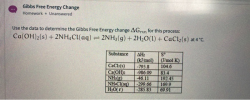 Gibbs Free Energy Change Homework – Unanswered Use the data to determine the Gibbs Free Energy change AGrxn for this process: Ca(OH)2(s) + 2NH4Cl(aq) = 2NH3(g) + 2H2O(1) + CaCl2(s) at 4°C. Substance CaCla(s) Ca(OH)2 NH3) NHCl(aq) HjO(0) ΔΗ: (kJ/mol -795.8 -986.09 -46.11 -299.66 -285.83 S (J/mol K) 104.6 83.4 192.45 169.9 69.91
Consider the reaction, NH3 (8) H HC ENH1G(s) Given the following table of thermodynamic data at...
 Consider the reaction, NH3 (8) H HC ENH1G(s) Given the following table of thermodynamic data at 298 K: Substana | AH¢{kj/mol | Sº C/K-mol) NH3 (5) 16:19 192.5 HCl (8) 92150 186,69 NHCl (s) 13144 94.6 The value of K for the reaction at 25°C is
10. (10 points) Use standard enthalpies of formation listed in the attached table to find AH°...
 10. (10 points) Use standard enthalpies of formation listed in the attached table to find AH° values for the following reaction at 25°C. NH3(g) + HCl(g) + NH4Cl (s) Substance NH3(g) HCl(g) NHACI (s) AH f (kJ/mol) -45.9 -92.31 -314.43 Is the reaction endothermic or exothermic?
Q1 Q2 Q3 Is a reaction with the following values of AH and AS spontaneous at...
 Q1
Q2
Q3
Is a reaction with the following values of AH and AS spontaneous at 350 K?. AH 107 kJ AS = - 285 J/K A. The reaction is not spontaneous. B. The reaction is spontaneous. C. The reaction is at equilibrium. D. Cannot be determined Which of the following reactions represent AG°f? A. Na (s) + 1/2 F2 (g) → NaF (s) B. 2 H2 (g) + O2 (g) + 2 H20 (1) C. H30+ (aq) + OH-...
Q1
Q2
Q3
Is a reaction with the following values of AH and AS spontaneous at 350 K?. AH 107 kJ AS = - 285 J/K A. The reaction is not spontaneous. B. The reaction is spontaneous. C. The reaction is at equilibrium. D. Cannot be determined Which of the following reactions represent AG°f? A. Na (s) + 1/2 F2 (g) → NaF (s) B. 2 H2 (g) + O2 (g) + 2 H20 (1) C. H30+ (aq) + OH-...
a) Complete the table below using data given in the Appendix of your textbook. 2 CH18...
 a) Complete the table below using data given in the Appendix of your textbook. 2 CH18 (1) + 25 O2 (g) → 16 CO2 (g) +18 H20 (1) O2(g) CO2 (g) H20 (1) C4H8 (1) -208.4 kJ/mol AH® (kJ/mol) sº (J/molK) 463.7 JK 'mol b) Calculate AG° combustion at 25°C for octane, CsH18 (1). Give your answer in kJ/mol of CH18 (1). c) Consider the reaction, 3 Fe203 (s) + 3 C(s) + 4 Fe (s) + 3 CO2 (g)...
Consider the reaction: NH3 (g) + HCl (g) → NH4Cl (s) Given the following table of...
 Consider the reaction: NH3 (g) + HCl (g) → NH4Cl (s) Given the following table of thermodynamic data at 298 K: Substance! AH/M/mol) I s。(J/K-mol) NH3 g) HCI (g) NHCI)-3144 -46.19 -92.30 192.5 186.69 94.6 The value of K for the reaction at 25 °c is
14- Calculate AH-m for the following reaction: 4 NHs (g) 솨,e,s ? + 5 (g) → 4 NO (g) + 6 H2O (g) Given the following ΔΗ7 values: NHs (g)-45.9 kJ/mol NO (g) +91.3 kJ/mol H20 (g)-241.8 kJ/mol A) 16...
 14- Calculate AH-m for the following reaction: 4 NHs (g) 솨,e,s ? + 5 (g) → 4 NO (g) + 6 H2O (g) Given the following ΔΗ7 values: NHs (g)-45.9 kJ/mol NO (g) +91.3 kJ/mol H20 (g)-241.8 kJ/mol A) 1632 kJ B) 1632 kJ C) 1269 kJ D) 902 kJ E) Δ1p value for O2 is needed 15- Which electron configuration does not represent the Pauli exclusion A) B) s 2 C) 1s 2 2 D) 1s 2s E) 1s...
 1 attempts left Check my work Enter your answer in the provided box. Find AGⓇ for the following reaction, at 25°C, using AHand S values. NH,Cs) – NHỊg) + Hg) -55 kJ Substance or Ion HCl(g) HCl(aq) NH3) NH3(aq) NH,Cl(s) Standard Thermodynamic Values at 298 K AH KkJ/mol) -92.3 -167.46 -45.9 -S0.83 -314.4 sº (J/mol K) 186.79 55.06 193 110 94.6
 7 Consider the following reaction at 298 K: NH3(g) +HCI(g)NH4CI(s) Using the thermochemical data at 298 K given below (a) Determine the AH for the reaction. (2 marks) (b) Determine the AG for the reaction and comment on its value. (3 marks) (c) Determine the maximum work done available in the reaction. (3 marks) An equilibrium mixture, consisting of 0.5 atm of NHy(), 0.5 atm of HCKg) and excessive of NH Cl(s), is enclosed in a container at 298 K...
 please show work and maybe explanations ?
Practice Problem 1 Calculate AH and AS for the following reaction (the Haber process for the manufacture of ammonia) and calculate if the reaction is favorable at STP. N2(g) + 3 H2(g) 2 NH3(g) (The following information may also be obtained from Appendix C in the Jespersen text.) Compound Enthalpy (kJ/mol) Entropy (J/mol-K) N2(9) H2(g) NH3(g) 0 191.61 130.68 192.45 -46.11 Practice Problem 2 Use the values of AH and AS calculated in...
please show work and maybe explanations ?
Practice Problem 1 Calculate AH and AS for the following reaction (the Haber process for the manufacture of ammonia) and calculate if the reaction is favorable at STP. N2(g) + 3 H2(g) 2 NH3(g) (The following information may also be obtained from Appendix C in the Jespersen text.) Compound Enthalpy (kJ/mol) Entropy (J/mol-K) N2(9) H2(g) NH3(g) 0 191.61 130.68 192.45 -46.11 Practice Problem 2 Use the values of AH and AS calculated in...
 Gibbs Free Energy Change Homework – Unanswered Use the data to determine the Gibbs Free Energy change AGrxn for this process: Ca(OH)2(s) + 2NH4Cl(aq) = 2NH3(g) + 2H2O(1) + CaCl2(s) at 4°C. Substance CaCla(s) Ca(OH)2 NH3) NHCl(aq) HjO(0) ΔΗ: (kJ/mol -795.8 -986.09 -46.11 -299.66 -285.83 S (J/mol K) 104.6 83.4 192.45 169.9 69.91
 Consider the reaction, NH3 (8) H HC ENH1G(s) Given the following table of thermodynamic data at 298 K: Substana | AH¢{kj/mol | Sº C/K-mol) NH3 (5) 16:19 192.5 HCl (8) 92150 186,69 NHCl (s) 13144 94.6 The value of K for the reaction at 25°C is
 10. (10 points) Use standard enthalpies of formation listed in the attached table to find AH° values for the following reaction at 25°C. NH3(g) + HCl(g) + NH4Cl (s) Substance NH3(g) HCl(g) NHACI (s) AH f (kJ/mol) -45.9 -92.31 -314.43 Is the reaction endothermic or exothermic?
 Q1
Q2
Q3
Is a reaction with the following values of AH and AS spontaneous at 350 K?. AH 107 kJ AS = - 285 J/K A. The reaction is not spontaneous. B. The reaction is spontaneous. C. The reaction is at equilibrium. D. Cannot be determined Which of the following reactions represent AG°f? A. Na (s) + 1/2 F2 (g) → NaF (s) B. 2 H2 (g) + O2 (g) + 2 H20 (1) C. H30+ (aq) + OH-...
Q1
Q2
Q3
Is a reaction with the following values of AH and AS spontaneous at 350 K?. AH 107 kJ AS = - 285 J/K A. The reaction is not spontaneous. B. The reaction is spontaneous. C. The reaction is at equilibrium. D. Cannot be determined Which of the following reactions represent AG°f? A. Na (s) + 1/2 F2 (g) → NaF (s) B. 2 H2 (g) + O2 (g) + 2 H20 (1) C. H30+ (aq) + OH-...
 a) Complete the table below using data given in the Appendix of your textbook. 2 CH18 (1) + 25 O2 (g) → 16 CO2 (g) +18 H20 (1) O2(g) CO2 (g) H20 (1) C4H8 (1) -208.4 kJ/mol AH® (kJ/mol) sº (J/molK) 463.7 JK 'mol b) Calculate AG° combustion at 25°C for octane, CsH18 (1). Give your answer in kJ/mol of CH18 (1). c) Consider the reaction, 3 Fe203 (s) + 3 C(s) + 4 Fe (s) + 3 CO2 (g)...
 Consider the reaction: NH3 (g) + HCl (g) → NH4Cl (s) Given the following table of thermodynamic data at 298 K: Substance! AH/M/mol) I s。(J/K-mol) NH3 g) HCI (g) NHCI)-3144 -46.19 -92.30 192.5 186.69 94.6 The value of K for the reaction at 25 °c is
 14- Calculate AH-m for the following reaction: 4 NHs (g) 솨,e,s ? + 5 (g) → 4 NO (g) + 6 H2O (g) Given the following ΔΗ7 values: NHs (g)-45.9 kJ/mol NO (g) +91.3 kJ/mol H20 (g)-241.8 kJ/mol A) 1632 kJ B) 1632 kJ C) 1269 kJ D) 902 kJ E) Δ1p value for O2 is needed 15- Which electron configuration does not represent the Pauli exclusion A) B) s 2 C) 1s 2 2 D) 1s 2s E) 1s...
Most questions answered within 3 hours.
-
Where is the error in this code sequence?
String s1 = "Hello";
String s2 = "ello";...
asked 10 months ago -
Financial data for Joel de Paris, Inc., for last year
follow:
Joel de Paris, Inc.
Balance...
asked 10 months ago -
Consider this reaction:
Al2(SO4)3 (aq)+ BaCl3
(aq) Al2Cl6 (aq)- +
3BaSO4(s) . What is the...
asked 10 months ago -
Suppose that Savneet is considering increasing her
recent random sample from 20 car rentals to 40...
asked 10 months ago -
Trucks arrive at an unloading terminal at an average rate of 120
per hour.
Trucks arrive...
asked 10 months ago -
Why are methanol and ethanol completely soluble in water while
octanol is not very little soluble....
asked 10 months ago -
A facilities manager at a university reads in a research report
that the mean amount of...
asked 10 months ago -
When the CuSO4 is rehydrated by adding water to the anhydrous
compound, is this an endothermic...
asked 10 months ago -
A ray of sunlight is passing from diamond into crown glass; the
angle of incidence is...
asked 10 months ago -
A block of mass 0.249 kg is placed on top of a light, vertical
spring of...
asked 10 months ago -
how do the kidneys compensate in the presences of acidosis
a) trigger hyperventilate
b) reserve acid...
asked 10 months ago -
Question 501 pts
The rental rate of capital to the firm increases. Which of the
following...
asked 10 months ago