
Homework Answers
Add Answer to:
could someone please do part 5 to part 10
Problem 1 (50pts). Consider an infinitely long...
Can you please help with answering all parts? (11%) Problem 5: An electron beam is shot...
 Can you please help with answering all parts?
(11%) Problem 5: An electron beam is shot into a region where there is both an electric field pointing upward of magnitude E = 1.6 N/C, and a magnetic field, B, as shown in the figure. While moving through the region the electron beam stays in a straight line with speed v 130 m/s Randomized Variables E 1.6 N/C V 130 m/s Otheexpertta.com 13% Part (a) In which direction does the electric...
Can you please help with answering all parts?
(11%) Problem 5: An electron beam is shot into a region where there is both an electric field pointing upward of magnitude E = 1.6 N/C, and a magnetic field, B, as shown in the figure. While moving through the region the electron beam stays in a straight line with speed v 130 m/s Randomized Variables E 1.6 N/C V 130 m/s Otheexpertta.com 13% Part (a) In which direction does the electric...
Question: Consider one infinitely long straight wire with a uniform charge density of 1C/m. Sketch the...
Question: Consider one infinitely long straight wire with a uniform charge density of 1C/m. Sketch the electric field around the wire Question: In the above problem, calculate the magnitude of the electric field at a distance R from the wire. How is it different (if any)from the field of a point charge? Question: Consider two infinite wires 1 m apart with a uniform charge density per unit length 1 C/m. Calculate the force per unit length between the wires. To...
The relationship between the electric force F (e) and the gravitational force F (g) (or 1. weight) between two electron...
 The relationship between the electric force F (e) and the gravitational force F (g) (or 1. weight) between two electrons. Two equal and equally charged spheres of 0.1 g of mass each are suspended from the same point by threads of 13 cm in length. Due to the repulsion between both, the spheres are separated 10 cm as seen in the graphic representation. Find the load of 2. each of them. Calculate the number of electrons that add an electric...
Problem 1 In this problem, we will analyze the method used by J.J. Thomson in 1897...
 Problem 1 In this problem, we will analyze the method used by J.J. Thomson in 1897 to measure the charge/mass ratio of the electron. A beam of electrons with charge q and mass m and velocity V vi enters a region that has a uniform electric field E Ei and a uniform magnetic field B- Bi. Thus the magnetic and electric fields are at right angles to each other and to the beam (a) Suppose that E is adjusted so...
(Figure 1)An infinitely long conducting cylindrical rod with a positive charge, per unit length is surrounded...
 (Figure 1)An infinitely long conducting cylindrical rod with a positive charge, per unit length is surrounded by a conducting cylindrical shell (which is also infinitely long) with a charge per unit length of -21 and radius , as shown in the figure. Part A What is E (r), the radial component of the electric field between the rod and cylindrical shell as a function of the distance from the axis of the cylindrical rod? Express your answer in terms of...
PART A: An electron moves at 3.00×10⁶ m/s through a region in which there is a...
PART A: An electron moves at 3.00×10⁶ m/s through a region in which there is a magnetic field of unspecified direction and magnitude 7.50×10⁻² T . A1: An electron moves at 3.00×10⁶ m/s through a region in which there is a magnetic field of unspecified direction and magnitude 7.50×10⁻² T . A2: What is the smallest possible magnitude of the force on the electron due to the magnetic field? Express your answer in newtons to the nearest integer. A3: If...
In the late 19th century, great interest was directed toward the study of electrical discharges in...
In the late 19th century, great interest was directed toward the study of electrical discharges in gases and the nature of so-called cathode rays. One remarkable series of experiments with cathode rays, conducted by J. J. Thomson around 1897, led to the discovery of the electron. With the idea that cathode rays were charged particles, Thomson used a cathode-ray tube to measure the ratio of charge to mass, q/m, of these particles, repeating the measurements with different cathode materials and...
Finding the charge to mass (e/m) ratio of the electron Often in physics, we look for ways to find fundamental physical...
 Finding the charge to mass (e/m) ratio of the electron Often in physics, we look for ways to find fundamental physical constants. From the set-up demonstrated in class, we are able to find a monumental combination of two physical constants-the charge of an electron (e) and the mass of an electron (m). Since the charge of an electron (e) is well known through other experiments, we will use the ratio of charge to mass to find the mass of an...
Finding the charge to mass (e/m) ratio of the electron Often in physics, we look for ways to find fundamental physical...
 Finding the charge to mass (e/m) ratio of the electron Often in physics, we look for ways to find fundamental physical constants. From the set-up demonstrated in class, we are able to find a monumental combination of two physical constants-the charge of an electron (e) and the mass of an electron (m). Since the charge of an electron (e) is well known through other experiments, we will use the ratio of charge to mass to find the mass of an...
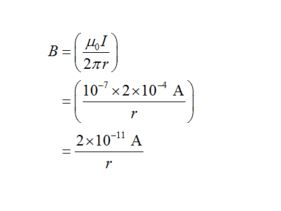
2. Briefly discuss the Biot Savart Law and give its mathematical expression. (5 Marks) a. b. An infinitely long str...
 2. Briefly discuss the Biot Savart Law and give its mathematical expression. (5 Marks) a. b. An infinitely long straight conductor is present in a magnetic field B. The conductor carrying a current of I = 10 A, is placed in a sheath (M- 202 ). At what distance from the conductor will the magnetic field be 1T/m? Find the magnetic moment of a square loop of 500 turns in a field of uniform flux density 2.5mT. The loop carries...
 Can you please help with answering all parts?
(11%) Problem 5: An electron beam is shot into a region where there is both an electric field pointing upward of magnitude E = 1.6 N/C, and a magnetic field, B, as shown in the figure. While moving through the region the electron beam stays in a straight line with speed v 130 m/s Randomized Variables E 1.6 N/C V 130 m/s Otheexpertta.com 13% Part (a) In which direction does the electric...
Can you please help with answering all parts?
(11%) Problem 5: An electron beam is shot into a region where there is both an electric field pointing upward of magnitude E = 1.6 N/C, and a magnetic field, B, as shown in the figure. While moving through the region the electron beam stays in a straight line with speed v 130 m/s Randomized Variables E 1.6 N/C V 130 m/s Otheexpertta.com 13% Part (a) In which direction does the electric...
 The relationship between the electric force F (e) and the gravitational force F (g) (or 1. weight) between two electrons. Two equal and equally charged spheres of 0.1 g of mass each are suspended from the same point by threads of 13 cm in length. Due to the repulsion between both, the spheres are separated 10 cm as seen in the graphic representation. Find the load of 2. each of them. Calculate the number of electrons that add an electric...
 Problem 1 In this problem, we will analyze the method used by J.J. Thomson in 1897 to measure the charge/mass ratio of the electron. A beam of electrons with charge q and mass m and velocity V vi enters a region that has a uniform electric field E Ei and a uniform magnetic field B- Bi. Thus the magnetic and electric fields are at right angles to each other and to the beam (a) Suppose that E is adjusted so...
 (Figure 1)An infinitely long conducting cylindrical rod with a positive charge, per unit length is surrounded by a conducting cylindrical shell (which is also infinitely long) with a charge per unit length of -21 and radius , as shown in the figure. Part A What is E (r), the radial component of the electric field between the rod and cylindrical shell as a function of the distance from the axis of the cylindrical rod? Express your answer in terms of...
 Finding the charge to mass (e/m) ratio of the electron Often in physics, we look for ways to find fundamental physical constants. From the set-up demonstrated in class, we are able to find a monumental combination of two physical constants-the charge of an electron (e) and the mass of an electron (m). Since the charge of an electron (e) is well known through other experiments, we will use the ratio of charge to mass to find the mass of an...
 Finding the charge to mass (e/m) ratio of the electron Often in physics, we look for ways to find fundamental physical constants. From the set-up demonstrated in class, we are able to find a monumental combination of two physical constants-the charge of an electron (e) and the mass of an electron (m). Since the charge of an electron (e) is well known through other experiments, we will use the ratio of charge to mass to find the mass of an...
 2. Briefly discuss the Biot Savart Law and give its mathematical expression. (5 Marks) a. b. An infinitely long straight conductor is present in a magnetic field B. The conductor carrying a current of I = 10 A, is placed in a sheath (M- 202 ). At what distance from the conductor will the magnetic field be 1T/m? Find the magnetic moment of a square loop of 500 turns in a field of uniform flux density 2.5mT. The loop carries...
Most questions answered within 3 hours.
-
Where is the error in this code sequence?
String s1 = "Hello";
String s2 = "ello";...
asked 10 months ago -
Financial data for Joel de Paris, Inc., for last year
follow:
Joel de Paris, Inc.
Balance...
asked 10 months ago -
Consider this reaction:
Al2(SO4)3 (aq)+ BaCl3
(aq) Al2Cl6 (aq)- +
3BaSO4(s) . What is the...
asked 10 months ago -
Suppose that Savneet is considering increasing her
recent random sample from 20 car rentals to 40...
asked 10 months ago -
Trucks arrive at an unloading terminal at an average rate of 120
per hour.
Trucks arrive...
asked 10 months ago -
Why are methanol and ethanol completely soluble in water while
octanol is not very little soluble....
asked 10 months ago -
A facilities manager at a university reads in a research report
that the mean amount of...
asked 10 months ago -
When the CuSO4 is rehydrated by adding water to the anhydrous
compound, is this an endothermic...
asked 10 months ago -
A ray of sunlight is passing from diamond into crown glass; the
angle of incidence is...
asked 10 months ago -
A block of mass 0.249 kg is placed on top of a light, vertical
spring of...
asked 10 months ago -
how do the kidneys compensate in the presences of acidosis
a) trigger hyperventilate
b) reserve acid...
asked 10 months ago -
Question 501 pts
The rental rate of capital to the firm increases. Which of the
following...
asked 10 months ago