
Homework Answers
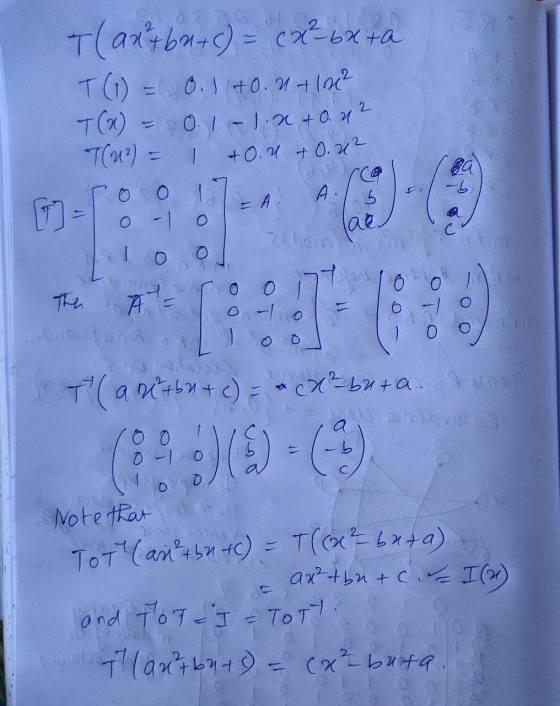
Compute the characteristic polynomial cT(x) of the operator T: P2 →P2 given by T(a + bx...
Compute the characteristic polynomial cT(x) of the operator T: P2 →P2 given by T(a + bx + cx2) = (b + c) + (a + c)x + (a + b)x2.
2. Let T: P2 + R2 be the linear transformation given by (a-6) T(a + bx...
 2. Let T: P2 + R2 be the linear transformation given by (a-6) T(a + bx + cx?) = | 16+c) Find ker T and im T.
5. Consider the linear transformation T : P2(R) + Pl(R) defined by T(ax? + bx +...
 5. Consider the linear transformation T : P2(R) + Pl(R) defined by T(ax? + bx + c) = (a + b) + (b – c)x. Determine Ker(T), Rng(T), and their dimensions.
Let T: P1 → P2 be a linear transformation defined by T(a + bx) = 3a...
 Let T: P1 → P2 be a linear transformation defined by T(a + bx) = 3a – 2bx + (a + b)x². (a) Find range(T) and give a basis for range(T). (b) Find ker(T) and give a basis for ker(T). (c) By justifying your answer determine whether T is onto. (d) By justifying your answer determine whether T is one-to-one. (e) Find [T(7 + x)]], where B = {-1, -2x, 4x2}.
Let T:P1→P2T:P1→P2 be a linear transformation defined by T(a+bx)=3a−2bx+(a+b)x2.T(a+bx)=3a−2bx+(a+b)x2. (a) Find range(T)range(T) and give a basis...
Let T:P1→P2T:P1→P2 be a linear transformation defined by T(a+bx)=3a−2bx+(a+b)x2.T(a+bx)=3a−2bx+(a+b)x2. (a) Find range(T)range(T) and give a basis for range(T)range(T). (b) Find ker(T)ker(T) and give a basis for ker(T)ker(T). (c) By justifying your answer determine whether TT is onto. (d) By justifying your answer determine whether TT is one-to-one. (e) Find [T(7+x)]B[T(7+x)]B, where B={−1,−2x,4x2}B={−1,−2x,4x2}.
Background: 1. 2. Consider the linear map D: P2(R) + P1(R) defined by D(a + bx...
 Background:
1.
2.
Consider the linear map D: P2(R) + P1(R) defined by D(a + bx + cx?) = (a + bx + cx?) = 6+2cx, dr and the linear map T : P1(R) + P2(R) defined by T(a + bx) = (a + bt)dt = ax + 3x2. Let a = {1,x}, B = {1, x, x?} be the standard bases for P1(R), P2 (R), respectively. We know from Calculus (a+bt)dt = a+bx. Compute [D] [T]& and verify this....
Background:
1.
2.
Consider the linear map D: P2(R) + P1(R) defined by D(a + bx + cx?) = (a + bx + cx?) = 6+2cx, dr and the linear map T : P1(R) + P2(R) defined by T(a + bx) = (a + bt)dt = ax + 3x2. Let a = {1,x}, B = {1, x, x?} be the standard bases for P1(R), P2 (R), respectively. We know from Calculus (a+bt)dt = a+bx. Compute [D] [T]& and verify this....
(2) Let T: P2 + R2 be given by T(p) = [pc] (e.g. if p= a...
 (2) Let T: P2 + R2 be given by T(p) = [pc] (e.g. if p= a + bx, then p(4) = a + b(4) = a + 4b.) (a) Find the matrix of T relative to the standard bases B = {1, 2,2} of P2, and C = {ej,ez} of R (b) Find the matrix of T relative to the basis A = {1, 1+,1+x+x?} of P2 and D= {(1, 1), (1, -1)} of R2 (c) Find a basis for...
Given ln (P2/P1) = -Delta HVAP/R (1/T2-1/T1). Find the Delta H Vap for C6H6 if the...
Given ln (P2/P1) = -Delta HVAP/R (1/T2-1/T1). Find the Delta H Vap for C6H6 if the boiling point is 80.5*C and P2=1.5 at 95*C
Let T:P1→P2 be a linear transformation defined by T(a+bx)=3a−2bx+(a+b)x2. (a) Find range(T) and give a basis...
Let T:P1→P2 be a linear transformation defined by T(a+bx)=3a−2bx+(a+b)x2. (a) Find range(T) and give a basis for range(T). (b) Find ker(T) and give a basis for ker(T) (c) By justifying your answer determine whether T is onto. (d) By justifying your answer determine whether T is one-to-one. (e) Find [T(7+x)]B, where B={−1,−2x,4x2} Please solve it in very detail, and make sure it is correct.
Find the laplace transformation for the given function. 1. (t1)u (t1) е 2и (t - 1)...
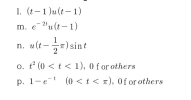 Find the laplace transformation for the given function.
1. (t1)u (t1) е 2и (t - 1) m. e 1 n. u (t - т) sint TT 2 о. t? (0 < t < 1), 0 forothers р. 1—е (о <i<т), 0for others
1. (t1)u (t1) е 2и (t - 1) m. e 1 n. u (t - т) sint TT 2 о. t? (0
Find the laplace transformation for the given function.
1. (t1)u (t1) е 2и (t - 1) m. e 1 n. u (t - т) sint TT 2 о. t? (0 < t < 1), 0 forothers р. 1—е (о <i<т), 0for others
1. (t1)u (t1) е 2и (t - 1) m. e 1 n. u (t - т) sint TT 2 о. t? (0
 2. Let T: P2 + R2 be the linear transformation given by (a-6) T(a + bx + cx?) = | 16+c) Find ker T and im T.
 5. Consider the linear transformation T : P2(R) + Pl(R) defined by T(ax? + bx + c) = (a + b) + (b – c)x. Determine Ker(T), Rng(T), and their dimensions.
 Let T: P1 → P2 be a linear transformation defined by T(a + bx) = 3a – 2bx + (a + b)x². (a) Find range(T) and give a basis for range(T). (b) Find ker(T) and give a basis for ker(T). (c) By justifying your answer determine whether T is onto. (d) By justifying your answer determine whether T is one-to-one. (e) Find [T(7 + x)]], where B = {-1, -2x, 4x2}.
 Background:
1.
2.
Consider the linear map D: P2(R) + P1(R) defined by D(a + bx + cx?) = (a + bx + cx?) = 6+2cx, dr and the linear map T : P1(R) + P2(R) defined by T(a + bx) = (a + bt)dt = ax + 3x2. Let a = {1,x}, B = {1, x, x?} be the standard bases for P1(R), P2 (R), respectively. We know from Calculus (a+bt)dt = a+bx. Compute [D] [T]& and verify this....
Background:
1.
2.
Consider the linear map D: P2(R) + P1(R) defined by D(a + bx + cx?) = (a + bx + cx?) = 6+2cx, dr and the linear map T : P1(R) + P2(R) defined by T(a + bx) = (a + bt)dt = ax + 3x2. Let a = {1,x}, B = {1, x, x?} be the standard bases for P1(R), P2 (R), respectively. We know from Calculus (a+bt)dt = a+bx. Compute [D] [T]& and verify this....
 (2) Let T: P2 + R2 be given by T(p) = [pc] (e.g. if p= a + bx, then p(4) = a + b(4) = a + 4b.) (a) Find the matrix of T relative to the standard bases B = {1, 2,2} of P2, and C = {ej,ez} of R (b) Find the matrix of T relative to the basis A = {1, 1+,1+x+x?} of P2 and D= {(1, 1), (1, -1)} of R2 (c) Find a basis for...
 Find the laplace transformation for the given function.
1. (t1)u (t1) е 2и (t - 1) m. e 1 n. u (t - т) sint TT 2 о. t? (0 < t < 1), 0 forothers р. 1—е (о <i<т), 0for others
1. (t1)u (t1) е 2и (t - 1) m. e 1 n. u (t - т) sint TT 2 о. t? (0
Find the laplace transformation for the given function.
1. (t1)u (t1) е 2и (t - 1) m. e 1 n. u (t - т) sint TT 2 о. t? (0 < t < 1), 0 forothers р. 1—е (о <i<т), 0for others
1. (t1)u (t1) е 2и (t - 1) m. e 1 n. u (t - т) sint TT 2 о. t? (0
Most questions answered within 3 hours.
-
Where is the error in this code sequence?
String s1 = "Hello";
String s2 = "ello";...
asked 10 months ago -
Financial data for Joel de Paris, Inc., for last year
follow:
Joel de Paris, Inc.
Balance...
asked 10 months ago -
Consider this reaction:
Al2(SO4)3 (aq)+ BaCl3
(aq) Al2Cl6 (aq)- +
3BaSO4(s) . What is the...
asked 10 months ago -
Suppose that Savneet is considering increasing her
recent random sample from 20 car rentals to 40...
asked 10 months ago -
Trucks arrive at an unloading terminal at an average rate of 120
per hour.
Trucks arrive...
asked 10 months ago -
Why are methanol and ethanol completely soluble in water while
octanol is not very little soluble....
asked 10 months ago -
A facilities manager at a university reads in a research report
that the mean amount of...
asked 10 months ago -
When the CuSO4 is rehydrated by adding water to the anhydrous
compound, is this an endothermic...
asked 10 months ago -
A ray of sunlight is passing from diamond into crown glass; the
angle of incidence is...
asked 10 months ago -
A block of mass 0.249 kg is placed on top of a light, vertical
spring of...
asked 10 months ago -
how do the kidneys compensate in the presences of acidosis
a) trigger hyperventilate
b) reserve acid...
asked 10 months ago -
Question 501 pts
The rental rate of capital to the firm increases. Which of the
following...
asked 10 months ago