
Homework Answers

Add Answer to:
Problem 1 (25 Points Total): Deposits of $100 per week are made into an investment account...
It is now January 1. You plan to make a total of 5 deposits of $100...
It is now January 1. You plan to make a total of 5 deposits of $100 each, one every 6 months, with the first payment being made today. The bank pays a nominal interest rate of 14% but uses semiannual compounding. You plan to leave the money in the bank for 10 years. How much will be in your account after 10 years? Round your answer to the nearest cent. $ You must make a payment of $1,343.93 in 10...
It is now January 1. You plan to make a total of 5 deposits of $400...
It is now January 1. You plan to make a total of 5 deposits of $400 each, one every 6 months, with the first payment being made today. The bank pays a nominal interest rate of 14% but uses semiannual compounding. You plan to leave the money in the bank for 10 years. How much will be in your account after 10 years? Round your answer to the nearest cent. $ You must make a payment of $1,642.68 in 10...
It is now January 1. You plan to make a total of 5 deposits of $200...
It is now January 1. You plan to make a total of 5 deposits of $200 each, one every 6 months, with the first payment being made today. The bank pays a nominal interest rate of 8% but uses semiannual compounding. You plan to leave the money in the bank for 10 years. How much will be in your account after 10 years? Round your answer to the nearest cent. $ You must make a payment of $1,261.90 in 10...
It is now January 1. You plan to make a total of 5 deposits of $400...
 It is now January 1. You plan to make a total of 5 deposits of $400 each, one every 6 months, with the first payment being made today. The bank pays a nominal interest rate of 8% but uses semiannual compounding. You plan to leave the money in the bank for 10 years. Do not round intermediate calculations. Round your answers to the nearest cent. a. How much will be in your account after 10 years? b. You must make...
3. Nonannual compounding period The number of compounding periods in one year is called compoundi...
 3. Nonannual compounding period The number of compounding periods in one year is called compounding frequency. The compounding frequency affects both the present and future values of cash flows An investor can invest money with a particular bank and earn a stated interest rate of 13.20%; however, interest will be compounded quarterly. What are the nominal, periodic, and effective interest rates for this investment opportunity? Interest Rates Nominal rate Periodic rate Effective annual rate You want to invest $19,000 and...
3. Value 1.00 points If regular month-end deposits of $200 in an Investment account amounted to...
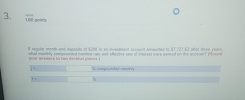 3. Value 1.00 points If regular month-end deposits of $200 in an Investment account amounted to $7,727 62 after three years, what monthly compounded nominal rate and effective rate of interest were earned on the account? (Round 9% compounded monthly
Question 1 (5 Points) 1. The following table shows examples of interest statements. Interpret those statements...
 Question 1 (5 Points) 1. The following table shows examples of interest statements. Interpret those statements by filing the table. Nominal or Effective Interest | Compounding Period Interest Rate Statement 15% per year compounded monthly 15% per year Effective 15% per year compounded monthly 20% per year compounded quarterly Nominal 2% per month compounded weekly 2% per month 2% per month compounded monthly Effective 6% per quarter Effective 2% per month compounded daily 1% per week compounded continuously
Nonannual Compounding It is now January 1. You plan to make a total of 5 deposits...
Nonannual Compounding It is now January 1. You plan to make a total of 5 deposits of $500 each, one every 6 months, with the first payment being made today. The bank pays a nominal interest rate of 8% but uses semiannual compounding. You plan to leave the money in the bank for 10 years. Do not round intermediate calculations. Round your answers to the nearest cent. How much will be in your account after 10 years? $ You must...
please answer all of the following questions 25. You currently owe $26,000 on a car loan...
 please answer all of the following questions
25. You currently owe $26,000 on a car loan at 4.25 percent interest. If you make monthly payments of $596.59 per month, how long i.e., number of months rounded to one decimal place) will it take you to fully repay the loan? 26. It is now January 1. You plan to make 5 deposits of $300 each, one every 6 months, with the first payment being made exactly six months from today. If...
please answer all of the following questions
25. You currently owe $26,000 on a car loan at 4.25 percent interest. If you make monthly payments of $596.59 per month, how long i.e., number of months rounded to one decimal place) will it take you to fully repay the loan? 26. It is now January 1. You plan to make 5 deposits of $300 each, one every 6 months, with the first payment being made exactly six months from today. If...
Attention: Due to a bug in Google Chrome, this page may not function correctly. Click here to learn more. 18. Nonannual...
 Attention: Due to a bug in Google Chrome, this page may not function correctly. Click here to learn more. 18. Nonannual compounding period Aa Aa E The number of compounding periods in one year is called compounding frequency. The compounding frequency affects both the present and future values of cash flows. An investor can invest money with a particular bank and earn a stated interest rate of 6.60%; however, interest will be compounded quarterly. What are the nominal, periodic, and...
 It is now January 1. You plan to make a total of 5 deposits of $400 each, one every 6 months, with the first payment being made today. The bank pays a nominal interest rate of 8% but uses semiannual compounding. You plan to leave the money in the bank for 10 years. Do not round intermediate calculations. Round your answers to the nearest cent. a. How much will be in your account after 10 years? b. You must make...
 3. Nonannual compounding period The number of compounding periods in one year is called compounding frequency. The compounding frequency affects both the present and future values of cash flows An investor can invest money with a particular bank and earn a stated interest rate of 13.20%; however, interest will be compounded quarterly. What are the nominal, periodic, and effective interest rates for this investment opportunity? Interest Rates Nominal rate Periodic rate Effective annual rate You want to invest $19,000 and...
 3. Value 1.00 points If regular month-end deposits of $200 in an Investment account amounted to $7,727 62 after three years, what monthly compounded nominal rate and effective rate of interest were earned on the account? (Round 9% compounded monthly
 Question 1 (5 Points) 1. The following table shows examples of interest statements. Interpret those statements by filing the table. Nominal or Effective Interest | Compounding Period Interest Rate Statement 15% per year compounded monthly 15% per year Effective 15% per year compounded monthly 20% per year compounded quarterly Nominal 2% per month compounded weekly 2% per month 2% per month compounded monthly Effective 6% per quarter Effective 2% per month compounded daily 1% per week compounded continuously
 please answer all of the following questions
25. You currently owe $26,000 on a car loan at 4.25 percent interest. If you make monthly payments of $596.59 per month, how long i.e., number of months rounded to one decimal place) will it take you to fully repay the loan? 26. It is now January 1. You plan to make 5 deposits of $300 each, one every 6 months, with the first payment being made exactly six months from today. If...
please answer all of the following questions
25. You currently owe $26,000 on a car loan at 4.25 percent interest. If you make monthly payments of $596.59 per month, how long i.e., number of months rounded to one decimal place) will it take you to fully repay the loan? 26. It is now January 1. You plan to make 5 deposits of $300 each, one every 6 months, with the first payment being made exactly six months from today. If...
 Attention: Due to a bug in Google Chrome, this page may not function correctly. Click here to learn more. 18. Nonannual compounding period Aa Aa E The number of compounding periods in one year is called compounding frequency. The compounding frequency affects both the present and future values of cash flows. An investor can invest money with a particular bank and earn a stated interest rate of 6.60%; however, interest will be compounded quarterly. What are the nominal, periodic, and...
Most questions answered within 3 hours.
-
Where is the error in this code sequence?
String s1 = "Hello";
String s2 = "ello";...
asked 10 months ago -
Financial data for Joel de Paris, Inc., for last year
follow:
Joel de Paris, Inc.
Balance...
asked 10 months ago -
Consider this reaction:
Al2(SO4)3 (aq)+ BaCl3
(aq) Al2Cl6 (aq)- +
3BaSO4(s) . What is the...
asked 10 months ago -
Suppose that Savneet is considering increasing her
recent random sample from 20 car rentals to 40...
asked 10 months ago -
Trucks arrive at an unloading terminal at an average rate of 120
per hour.
Trucks arrive...
asked 10 months ago -
Why are methanol and ethanol completely soluble in water while
octanol is not very little soluble....
asked 10 months ago -
A facilities manager at a university reads in a research report
that the mean amount of...
asked 10 months ago -
When the CuSO4 is rehydrated by adding water to the anhydrous
compound, is this an endothermic...
asked 10 months ago -
A ray of sunlight is passing from diamond into crown glass; the
angle of incidence is...
asked 10 months ago -
A block of mass 0.249 kg is placed on top of a light, vertical
spring of...
asked 10 months ago -
how do the kidneys compensate in the presences of acidosis
a) trigger hyperventilate
b) reserve acid...
asked 10 months ago -
Question 501 pts
The rental rate of capital to the firm increases. Which of the
following...
asked 10 months ago