
Homework Answers
Add Answer to:
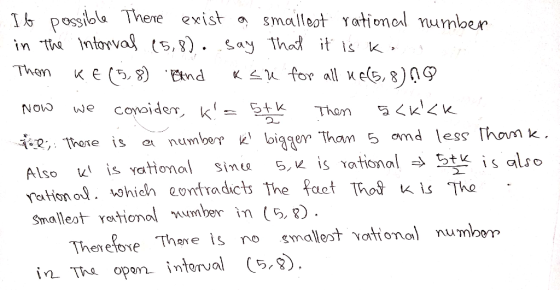
for every positive integer 1. 6. Give a proof by contradiction that there is no smallest...
give a proof by contradiction. there does not exist any rational number x such that x...
give a proof by contradiction. there does not exist any rational number x such that x * sqrt(2) = sqrt(3)
please answer questions #7-13 7. Use a direct proof to show every odd integer is the...
 please answer questions #7-13
7. Use a direct proof to show every odd integer is the difference of two squares. [Hint: Find the difference of squares ofk+1 and k where k is a positive integer. Prove or disprove that the products of two irrational numbers is irrational. Use proof by contraposition to show that ifx ty 22 where x and y are real numbers then x 21ory 21 8. 9. 10. Prove that if n is an integer and 3n...
please answer questions #7-13
7. Use a direct proof to show every odd integer is the difference of two squares. [Hint: Find the difference of squares ofk+1 and k where k is a positive integer. Prove or disprove that the products of two irrational numbers is irrational. Use proof by contraposition to show that ifx ty 22 where x and y are real numbers then x 21ory 21 8. 9. 10. Prove that if n is an integer and 3n...
Explain the difference between proof by contradiction and proof by contraposition. Give an example of a...
Explain the difference between proof by contradiction and proof by contraposition. Give an example of a theorem that would lend itself to proof by contradiction. Explain why that proof technique would be a good choice in this case.
What is wrong with the following proof that every positive integer equals the nex larger positive...
 What is wrong with the following proof that every positive integer equals the nex larger positive integer? "Proof," Let P(n) be the proposition that n = n + 1, Assume that P(k) is true, so that k = k + 1 . Add 1 to both sides of this equation to obtain k + 1-k + 2 . Since this is the statement P(k 1), It follows that P(n) is true for all positive integers n.
Q3.a) Show that every planar graph has at least one vertex whose degree is s 5. Use a proof by contradiction b) Using the above fact, give an induction proof that every planar graph can be colored...
 Q3.a) Show that every planar graph has at least one vertex whose degree is s 5. Use a proof by contradiction b) Using the above fact, give an induction proof that every planar graph can be colored using at most six colors. c) Explain what a tree is. Assuming that every tree is a planar graph, show that in a tree, e v-1. Hint: Use Euler's formula
Q3.a) Show that every planar graph has at least one vertex whose degree...
Q3.a) Show that every planar graph has at least one vertex whose degree is s 5. Use a proof by contradiction b) Using the above fact, give an induction proof that every planar graph can be colored using at most six colors. c) Explain what a tree is. Assuming that every tree is a planar graph, show that in a tree, e v-1. Hint: Use Euler's formula
Q3.a) Show that every planar graph has at least one vertex whose degree...
Proof by contradiction that the product of any nonzero rational number and any irrational number is...
 Proof by contradiction that the product of any nonzero rational number and any irrational number is irrational (Must use the method of contradiction). Which of the following options shows an accurate start of the proof. Proof. Let X+0 and y be two real numbers such that their product xy=- is a rational number where c, d are integers with d 0. Proof. Let x0 and y be two real numbers such that their product xy is an irrational number (that...
25. (2 points) Below is a proof presented as a proof by contradiction. Restate the proof,...
 25. (2 points) Below is a proof presented as a proof by contradiction. Restate the proof, using the same ideas, as a proof of the contrapositive of the proposition. Proposition: The sum of a rational number and an irrational number is irrational. Proof: Suppose BWOC that there existr e Q and neR-Q such that run e Q. Sincer is rational, r = for some p, q E Z. Sincer+ne Q, also r+n= for some a, b e Z. Now: r...
1 a). Give a counter example to the proposition: Every positive integer which ends in 31...
1 a). Give a counter example to the proposition: Every positive integer which ends in 31 is a prime. b). Give a proof by cases that min{s, t} + max{s, t} = s + t for any real numbers s and t. Hint: One of the cases you might use is s ≤ t or s < t. Depending on your choice, what would be the other case(s)? c). Give an indirect proof that if 2n 3 + 3n +...
50. What is wrong with this "proof? "Theorem For every positive integer n = (n +...
 50. What is wrong with this "proof? "Theorem For every positive integer n = (n + /2. Basis Step: The formula is true for n = 1. Inductive Step: Suppose that +Y/2. Then -(+972 +*+- +*+1)/2 + + + /- + 1). By the inductive hypothesis, we have + /2-[(++P/2, completing the + inductive step.
5) [2 marks] Give a proof by contradiction that if n+2 is even then n is...
5) [2 marks] Give a proof by contradiction that if n+2 is even then n is even
 please answer questions #7-13
7. Use a direct proof to show every odd integer is the difference of two squares. [Hint: Find the difference of squares ofk+1 and k where k is a positive integer. Prove or disprove that the products of two irrational numbers is irrational. Use proof by contraposition to show that ifx ty 22 where x and y are real numbers then x 21ory 21 8. 9. 10. Prove that if n is an integer and 3n...
please answer questions #7-13
7. Use a direct proof to show every odd integer is the difference of two squares. [Hint: Find the difference of squares ofk+1 and k where k is a positive integer. Prove or disprove that the products of two irrational numbers is irrational. Use proof by contraposition to show that ifx ty 22 where x and y are real numbers then x 21ory 21 8. 9. 10. Prove that if n is an integer and 3n...
 What is wrong with the following proof that every positive integer equals the nex larger positive integer? "Proof," Let P(n) be the proposition that n = n + 1, Assume that P(k) is true, so that k = k + 1 . Add 1 to both sides of this equation to obtain k + 1-k + 2 . Since this is the statement P(k 1), It follows that P(n) is true for all positive integers n.
 Q3.a) Show that every planar graph has at least one vertex whose degree is s 5. Use a proof by contradiction b) Using the above fact, give an induction proof that every planar graph can be colored using at most six colors. c) Explain what a tree is. Assuming that every tree is a planar graph, show that in a tree, e v-1. Hint: Use Euler's formula
Q3.a) Show that every planar graph has at least one vertex whose degree...
Q3.a) Show that every planar graph has at least one vertex whose degree is s 5. Use a proof by contradiction b) Using the above fact, give an induction proof that every planar graph can be colored using at most six colors. c) Explain what a tree is. Assuming that every tree is a planar graph, show that in a tree, e v-1. Hint: Use Euler's formula
Q3.a) Show that every planar graph has at least one vertex whose degree...
 Proof by contradiction that the product of any nonzero rational number and any irrational number is irrational (Must use the method of contradiction). Which of the following options shows an accurate start of the proof. Proof. Let X+0 and y be two real numbers such that their product xy=- is a rational number where c, d are integers with d 0. Proof. Let x0 and y be two real numbers such that their product xy is an irrational number (that...
 25. (2 points) Below is a proof presented as a proof by contradiction. Restate the proof, using the same ideas, as a proof of the contrapositive of the proposition. Proposition: The sum of a rational number and an irrational number is irrational. Proof: Suppose BWOC that there existr e Q and neR-Q such that run e Q. Sincer is rational, r = for some p, q E Z. Sincer+ne Q, also r+n= for some a, b e Z. Now: r...
 50. What is wrong with this "proof? "Theorem For every positive integer n = (n + /2. Basis Step: The formula is true for n = 1. Inductive Step: Suppose that +Y/2. Then -(+972 +*+- +*+1)/2 + + + /- + 1). By the inductive hypothesis, we have + /2-[(++P/2, completing the + inductive step.
Most questions answered within 3 hours.
-
Where is the error in this code sequence?
String s1 = "Hello";
String s2 = "ello";...
asked 10 months ago -
Financial data for Joel de Paris, Inc., for last year
follow:
Joel de Paris, Inc.
Balance...
asked 10 months ago -
Consider this reaction:
Al2(SO4)3 (aq)+ BaCl3
(aq) Al2Cl6 (aq)- +
3BaSO4(s) . What is the...
asked 10 months ago -
Suppose that Savneet is considering increasing her
recent random sample from 20 car rentals to 40...
asked 10 months ago -
Trucks arrive at an unloading terminal at an average rate of 120
per hour.
Trucks arrive...
asked 10 months ago -
Why are methanol and ethanol completely soluble in water while
octanol is not very little soluble....
asked 10 months ago -
A facilities manager at a university reads in a research report
that the mean amount of...
asked 10 months ago -
When the CuSO4 is rehydrated by adding water to the anhydrous
compound, is this an endothermic...
asked 10 months ago -
A ray of sunlight is passing from diamond into crown glass; the
angle of incidence is...
asked 10 months ago -
A block of mass 0.249 kg is placed on top of a light, vertical
spring of...
asked 10 months ago -
how do the kidneys compensate in the presences of acidosis
a) trigger hyperventilate
b) reserve acid...
asked 10 months ago -
Question 501 pts
The rental rate of capital to the firm increases. Which of the
following...
asked 10 months ago