
Homework Answers
Request Answer!
We need at least 10 more requests to produce the answer.
0 / 10 have requested this problem solution
The more requests, the faster the answer.
Add Answer to:
4 The following reaction is a variation of an aldol condensation (it is actually called a...
Please answer all questions please answer thoroughly The following reaction is a variation of an aldol...
 Please answer all questions
please answer thoroughly
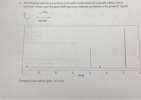
The following reaction is a variation of an aldol condensation (it is actually called a Henry reaction). Based upon the given NMR spectrum, what do you believe is the product? (6 pts) 4. ﹀NOg NaOMe 4 PPM integrals from left to right-1:3:1:6)
Please answer all questions
please answer thoroughly
The following reaction is a variation of an aldol condensation (it is actually called a Henry reaction). Based upon the given NMR spectrum, what do you believe is the product? (6 pts) 4. ﹀NOg NaOMe 4 PPM integrals from left to right-1:3:1:6)
Aldol Condensation Reaction
Why is the major product between p-anisaldehyde and acetophenone the crossed aldol product rather than the Cannizzaro reaction or the self-condensation ofacetophenone?Please actually explain instead of showing a mechanism. I do know the mechanism but am having a hard time understanding why these two other reactions are not favored.
Lab : Aldol Condensation Purpose. In this lab you will conduct the Aldol condensation reaction under solid-state...
Lab : Aldol Condensation Purpose. In this lab you will conduct the Aldol condensation reaction under solid-state reaction conditions that will involve grinding reactants in the solid phase. You must read ahead and learn about this reaction and the chemical mechanism for the Aldol condensation. There are two possible products which are the initial Aldol or subsequent elimination product. You will need to isolate and purify your reaction product. You will use your melting point, IR, 1H and 13C NMR spectra to...
2. (6 points) When 2-bromoacetophenone and benzaldehyde are treated with the same condition as Aldol condensation...
 2. (6 points) When 2-bromoacetophenone and benzaldehyde are treated with the same condition as Aldol condensation (shown below), an interesting product is formed. Br NaOEt 2-bromoacetophenone 1) Deduce the structure of the product based on its data. Molecular formula: C18H12O2, IR: a peak at 1710 cm-1, 'H NMR: 4.08 ppm (doublet, 1H), 4.30 (doublet, 1H), 7.48-8.02 (multiplet, 10H). 2) Provide a mechanism for this reaction.
2. (6 points) When 2-bromoacetophenone and benzaldehyde are treated with the same condition as Aldol condensation...
 2. (6 points) When 2-bromoacetophenone and benzaldehyde are treated with the same condition as Aldol condensation (shown below), an interesting product is formed Br NaOEt H 2-bromoacetophenone 1) Deduce the structure of the product based on its data. Molecular formula: CisH12O2, IR: a peak at 1710 cm-1, 'H NMR: 4.08 ppm (doublet, 1H), 4.30 (doublet, 1H), 7.48-8.02 (multiplet, 10H) 2) Provide a mechanism for this reaction
#4 which of the following represent the final product of the below aldol condensation reaction ?...
 #4 which of the following represent the final product of the
below aldol condensation reaction ? the IR of the product does not
have a broad peak around 3300 wavenumbers
Which intermediates are formed during the mechanism of the below reaction? Select all that apply. 2 й — ДА . с . CH_CH3 \ 2. То No ті о он g / H,с сну Нас сн, о - — -- H₃C CH₂ Question 2 2 pts In the above reaction,...
#4 which of the following represent the final product of the
below aldol condensation reaction ? the IR of the product does not
have a broad peak around 3300 wavenumbers
Which intermediates are formed during the mechanism of the below reaction? Select all that apply. 2 й — ДА . с . CH_CH3 \ 2. То No ті о он g / H,с сну Нас сн, о - — -- H₃C CH₂ Question 2 2 pts In the above reaction,...
Draw the starting materials for the compound given below via directed aldol condensation reaction. Show the...
 Draw the starting materials for the compound given below via directed aldol condensation reaction. Show the resonance structure for the following, α,β-unsaturated ketone. 1. Propose reagents or products as needed (you will need sets of reagents for arrows pointing left and 1 product for the right facing arrow). 2. H3C-SH HO
Draw the organic product(s) of this intramolecular aldol condensation reaction. Consider only the formation of 5-...
 Draw the organic product(s) of this intramolecular aldol
condensation reaction. Consider only the formation of 5- and
6-membered rings.
base Draw the organic product(s) of this intramolecular aldol condensation reaction. Consider only the formation of 5-and 6 membered rings. You do not have to consider stereochemistry. You do not have to explicitly draw H atoms. Do not include lone pairs in your answer. They will not be considered in the grading . Draw one structure per sketcher. Add additional sketchers...
Draw the organic product(s) of this intramolecular aldol
condensation reaction. Consider only the formation of 5- and
6-membered rings.
base Draw the organic product(s) of this intramolecular aldol condensation reaction. Consider only the formation of 5-and 6 membered rings. You do not have to consider stereochemistry. You do not have to explicitly draw H atoms. Do not include lone pairs in your answer. They will not be considered in the grading . Draw one structure per sketcher. Add additional sketchers...
5. Draw a stepwise mechanism for the following variation of the aldol reaction, often called a...
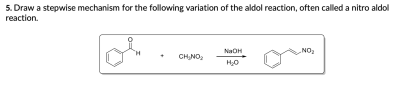 5. Draw a stepwise mechanism for the following variation of the aldol reaction, often called a nitro aldol reaction. NaOH CH3NO2 H2O
what is the product of the aldol condensation between cyclohexanone and 4-methylbenzaldehyde? show the mechanism for...
what is the product of the aldol condensation between cyclohexanone and 4-methylbenzaldehyde? show the mechanism for this condensation. is it possible for this reaction to form alternative products? how do you know whether it can or not?
 Please answer all questions
please answer thoroughly
The following reaction is a variation of an aldol condensation (it is actually called a Henry reaction). Based upon the given NMR spectrum, what do you believe is the product? (6 pts) 4. ﹀NOg NaOMe 4 PPM integrals from left to right-1:3:1:6)
Please answer all questions
please answer thoroughly
The following reaction is a variation of an aldol condensation (it is actually called a Henry reaction). Based upon the given NMR spectrum, what do you believe is the product? (6 pts) 4. ﹀NOg NaOMe 4 PPM integrals from left to right-1:3:1:6)
 2. (6 points) When 2-bromoacetophenone and benzaldehyde are treated with the same condition as Aldol condensation (shown below), an interesting product is formed. Br NaOEt 2-bromoacetophenone 1) Deduce the structure of the product based on its data. Molecular formula: C18H12O2, IR: a peak at 1710 cm-1, 'H NMR: 4.08 ppm (doublet, 1H), 4.30 (doublet, 1H), 7.48-8.02 (multiplet, 10H). 2) Provide a mechanism for this reaction.
 2. (6 points) When 2-bromoacetophenone and benzaldehyde are treated with the same condition as Aldol condensation (shown below), an interesting product is formed Br NaOEt H 2-bromoacetophenone 1) Deduce the structure of the product based on its data. Molecular formula: CisH12O2, IR: a peak at 1710 cm-1, 'H NMR: 4.08 ppm (doublet, 1H), 4.30 (doublet, 1H), 7.48-8.02 (multiplet, 10H) 2) Provide a mechanism for this reaction
 #4 which of the following represent the final product of the
below aldol condensation reaction ? the IR of the product does not
have a broad peak around 3300 wavenumbers
Which intermediates are formed during the mechanism of the below reaction? Select all that apply. 2 й — ДА . с . CH_CH3 \ 2. То No ті о он g / H,с сну Нас сн, о - — -- H₃C CH₂ Question 2 2 pts In the above reaction,...
#4 which of the following represent the final product of the
below aldol condensation reaction ? the IR of the product does not
have a broad peak around 3300 wavenumbers
Which intermediates are formed during the mechanism of the below reaction? Select all that apply. 2 й — ДА . с . CH_CH3 \ 2. То No ті о он g / H,с сну Нас сн, о - — -- H₃C CH₂ Question 2 2 pts In the above reaction,...
 Draw the starting materials for the compound given below via directed aldol condensation reaction. Show the resonance structure for the following, α,β-unsaturated ketone. 1. Propose reagents or products as needed (you will need sets of reagents for arrows pointing left and 1 product for the right facing arrow). 2. H3C-SH HO
 Draw the organic product(s) of this intramolecular aldol
condensation reaction. Consider only the formation of 5- and
6-membered rings.
base Draw the organic product(s) of this intramolecular aldol condensation reaction. Consider only the formation of 5-and 6 membered rings. You do not have to consider stereochemistry. You do not have to explicitly draw H atoms. Do not include lone pairs in your answer. They will not be considered in the grading . Draw one structure per sketcher. Add additional sketchers...
Draw the organic product(s) of this intramolecular aldol
condensation reaction. Consider only the formation of 5- and
6-membered rings.
base Draw the organic product(s) of this intramolecular aldol condensation reaction. Consider only the formation of 5-and 6 membered rings. You do not have to consider stereochemistry. You do not have to explicitly draw H atoms. Do not include lone pairs in your answer. They will not be considered in the grading . Draw one structure per sketcher. Add additional sketchers...
 5. Draw a stepwise mechanism for the following variation of the aldol reaction, often called a nitro aldol reaction. NaOH CH3NO2 H2O
Most questions answered within 3 hours.
-
Where is the error in this code sequence?
String s1 = "Hello";
String s2 = "ello";...
asked 11 months ago -
Financial data for Joel de Paris, Inc., for last year
follow:
Joel de Paris, Inc.
Balance...
asked 11 months ago -
Consider this reaction:
Al2(SO4)3 (aq)+ BaCl3
(aq) Al2Cl6 (aq)- +
3BaSO4(s) . What is the...
asked 11 months ago -
Suppose that Savneet is considering increasing her
recent random sample from 20 car rentals to 40...
asked 11 months ago -
Trucks arrive at an unloading terminal at an average rate of 120
per hour.
Trucks arrive...
asked 11 months ago -
Why are methanol and ethanol completely soluble in water while
octanol is not very little soluble....
asked 11 months ago -
A facilities manager at a university reads in a research report
that the mean amount of...
asked 11 months ago -
When the CuSO4 is rehydrated by adding water to the anhydrous
compound, is this an endothermic...
asked 11 months ago -
A ray of sunlight is passing from diamond into crown glass; the
angle of incidence is...
asked 11 months ago -
A block of mass 0.249 kg is placed on top of a light, vertical
spring of...
asked 11 months ago -
how do the kidneys compensate in the presences of acidosis
a) trigger hyperventilate
b) reserve acid...
asked 11 months ago -
Question 501 pts
The rental rate of capital to the firm increases. Which of the
following...
asked 11 months ago