
Homework Answers
Add Answer to:
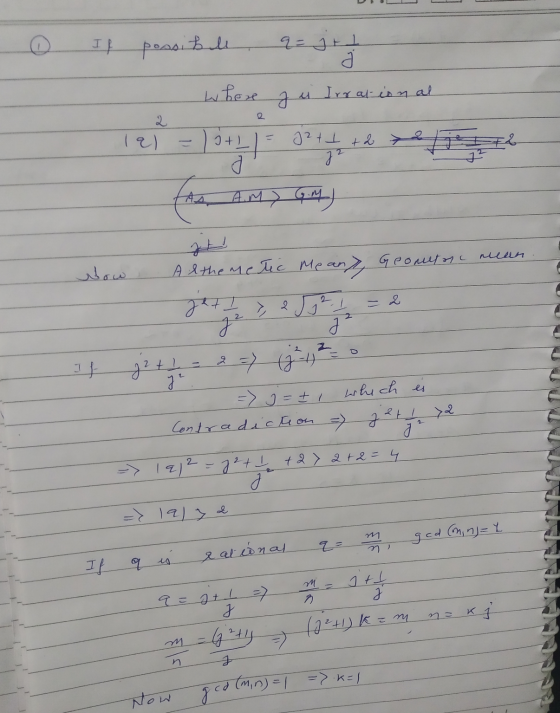
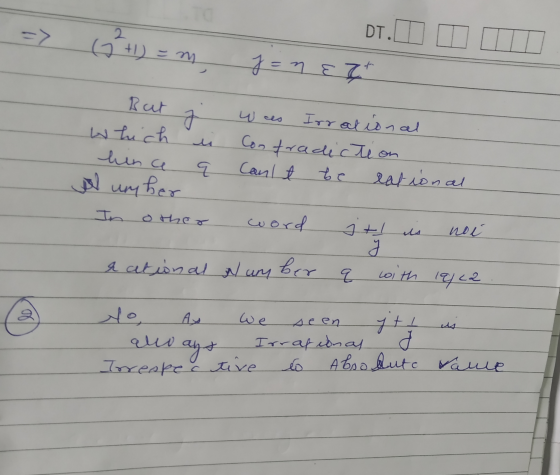
Problem VI.(15 pts.) Suppose that is an irrational number. 1. Prove that j + cannot be...
4. [5 Pts] Prove that the product of a non-zero rational number and an irrational number...
4. [5 Pts] Prove that the product of a non-zero rational number and an irrational number is irrational. Can you use a direct proof? Why or why not?
2) Prove that 1 + 3n < 4n for all n > 1. /5 Marks/
 2) Prove that 1 + 3n < 4n for all n > 1. /5 Marks/
Prove each problem, prove by induction 3) Statementn-1 5 25(2m-1) forn2 1 4 Statement Suppose: bo1...
 Prove each problem, prove by induction
3) Statementn-1 5 25(2m-1) forn2 1 4 Statement Suppose: bo1 . b,-2b-1 + 1 for t 1 en fort >
Prove each problem, prove by induction
3) Statementn-1 5 25(2m-1) forn2 1 4 Statement Suppose: bo1 . b,-2b-1 + 1 for t 1 en fort >
Prove X, Y, Z, JER. XKY Prove Z <# X AND Y<j, if and only if...
 Prove
X, Y, Z, JER. XKY Prove Z <# X AND Y<j, if and only if (x,y) [z,j]
Prove
X, Y, Z, JER. XKY Prove Z <# X AND Y<j, if and only if (x,y) [z,j]
Problem 7.12. Suppose that f is a bounded function on (a, b) and P is a...
 Problem 7.12. Suppose that f is a bounded function on (a, b) and P is a partition of [a,b]. Show that Lp(f) < Up(f).
Please no abusing 11. Prove that the number of positive irreducible fractions < 1 with denominator...
 Please no abusing
11. Prove that the number of positive irreducible fractions < 1 with denominator n is ф(1) + ф(2) + ф(3) + . . . + ф(n).
Please no abusing
11. Prove that the number of positive irreducible fractions < 1 with denominator n is ф(1) + ф(2) + ф(3) + . . . + ф(n).
3. (15 pts) Let D be an infinite set with cardinal d. Let A = {X...
 3. (15 pts) Let D be an infinite set with cardinal d. Let A = {X C D | 0(X) <3}. Prove that o(A) = d.
(3) 5. Suppose that f : D[0, 1] → D[0, 1] is holomorphic, prove that f'(2)...
 (3) 5. Suppose that f : D[0, 1] → D[0, 1] is holomorphic, prove that f'(2) < 1/(1 - 121) for all z e D[0,1].
Problem 3. (Number Theory) 3 and q = 7 and (7 pts) (i) What are the...
 Problem 3. (Number Theory) 3 and q = 7 and (7 pts) (i) What are the public and private keys for RSA cryptosystem with p 3 <e< 11. (Show all necessary computation) Answer:
Problem 6* (Optional). Suppose ej,..., en is an orthonormal basis of V and v, ...,Vn are...
 Problem 6* (Optional). Suppose ej,..., en is an orthonormal basis of V and v, ...,Vn are vectors in V such that lle; - v, 1 < 1 h for each j. Prove that V1, ..., Vn is a basis of V. In other words, if you perturb an orthonormal basis slightly, you still have a basis.
 2) Prove that 1 + 3n < 4n for all n > 1. /5 Marks/
 Prove each problem, prove by induction
3) Statementn-1 5 25(2m-1) forn2 1 4 Statement Suppose: bo1 . b,-2b-1 + 1 for t 1 en fort >
Prove each problem, prove by induction
3) Statementn-1 5 25(2m-1) forn2 1 4 Statement Suppose: bo1 . b,-2b-1 + 1 for t 1 en fort >
 Prove
X, Y, Z, JER. XKY Prove Z <# X AND Y<j, if and only if (x,y) [z,j]
Prove
X, Y, Z, JER. XKY Prove Z <# X AND Y<j, if and only if (x,y) [z,j]
 Problem 7.12. Suppose that f is a bounded function on (a, b) and P is a partition of [a,b]. Show that Lp(f) < Up(f).
 Please no abusing
11. Prove that the number of positive irreducible fractions < 1 with denominator n is ф(1) + ф(2) + ф(3) + . . . + ф(n).
Please no abusing
11. Prove that the number of positive irreducible fractions < 1 with denominator n is ф(1) + ф(2) + ф(3) + . . . + ф(n).
 3. (15 pts) Let D be an infinite set with cardinal d. Let A = {X C D | 0(X) <3}. Prove that o(A) = d.
 (3) 5. Suppose that f : D[0, 1] → D[0, 1] is holomorphic, prove that f'(2) < 1/(1 - 121) for all z e D[0,1].
 Problem 3. (Number Theory) 3 and q = 7 and (7 pts) (i) What are the public and private keys for RSA cryptosystem with p 3 <e< 11. (Show all necessary computation) Answer:
 Problem 6* (Optional). Suppose ej,..., en is an orthonormal basis of V and v, ...,Vn are vectors in V such that lle; - v, 1 < 1 h for each j. Prove that V1, ..., Vn is a basis of V. In other words, if you perturb an orthonormal basis slightly, you still have a basis.
Most questions answered within 3 hours.
-
Where is the error in this code sequence?
String s1 = "Hello";
String s2 = "ello";...
asked 10 months ago -
Financial data for Joel de Paris, Inc., for last year
follow:
Joel de Paris, Inc.
Balance...
asked 10 months ago -
Consider this reaction:
Al2(SO4)3 (aq)+ BaCl3
(aq) Al2Cl6 (aq)- +
3BaSO4(s) . What is the...
asked 10 months ago -
Suppose that Savneet is considering increasing her
recent random sample from 20 car rentals to 40...
asked 10 months ago -
Trucks arrive at an unloading terminal at an average rate of 120
per hour.
Trucks arrive...
asked 10 months ago -
Why are methanol and ethanol completely soluble in water while
octanol is not very little soluble....
asked 10 months ago -
A facilities manager at a university reads in a research report
that the mean amount of...
asked 10 months ago -
When the CuSO4 is rehydrated by adding water to the anhydrous
compound, is this an endothermic...
asked 10 months ago -
A ray of sunlight is passing from diamond into crown glass; the
angle of incidence is...
asked 10 months ago -
A block of mass 0.249 kg is placed on top of a light, vertical
spring of...
asked 10 months ago -
how do the kidneys compensate in the presences of acidosis
a) trigger hyperventilate
b) reserve acid...
asked 10 months ago -
Question 501 pts
The rental rate of capital to the firm increases. Which of the
following...
asked 10 months ago