Dinitrogen pentaoxide rapidly decomposes in the atmosphere according to the reaction 2 N2O5(g)-->2 N2O4(g)+ O2(g). At...
Dinitrogen pentaoxide rapidly decomposes in the atmosphere according to the reaction 2 N2O5(g)-->2 N2O4(g)+ O2(g). At a particular temperature, the slope of a plot of ln[N2O5] versus time is -0.00693. How long will it take N2O5 to reach 0.100% of its original concentration if [N2O5]0= 0.0250M?
Homework Answers

Add Answer to:
Dinitrogen pentaoxide rapidly decomposes in the atmosphere
according to the reaction 2 N2O5(g)-->2 N2O4(g)+ O2(g). At...
Dinitrogen pentoxide rapidly decomposes in the atmosphere according to the reaction 2 N,0, ()2 N,O, ()+...
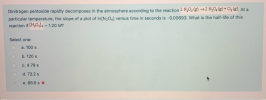 Dinitrogen pentoxide rapidly decomposes in the atmosphere according to the reaction 2 N,0, ()2 N,O, ()+ 02(), At a particular temperature, the slope of a plot of In[N2Os] versus time in seconds is -0.00693. What is the half-life of this reaction if (N,Osl = 1.20 M? Select one: a. 100 s b. 120 s c. 4.79 s d. 72.2 s e. 86.6 s x
Be sure to answer all parts. For the decomposition of gaseous dinitrogen pentaoxide, 2 N2O5(g)→4 NO2(g)...
Be sure to answer all parts. For the decomposition of gaseous dinitrogen pentaoxide, 2 N2O5(g)→4 NO2(g) + O2(g) the rate constant is k = 2.8 × 10⁻³ s−1 at 60°C. The initial concentration of N2O5 is 2.32 mol/L. (a) What is [N2O5] after 5.00 min? mol L (b) What fraction of the N2O5 has decomposed after 5.00 min?
Dinitrogen tetroxide partially decomposes according to the following equilibrium: N2O4(g) 2NO2(g) A 1.000 L flask is charged...
Dinitrogen tetroxide partially decomposes according to the following equilibrium: N2O4(g) 2NO2(g) A 1.000 L flask is charged with 6.00 × 10⁻² mol of N2O4. At equilibrium, 3.21 × 10⁻² mol of N2O4 remains. Kc for this reaction is ________. Group of answer choices 0.465 2.42 × 10⁻² 1.74 10.3 9.70 × 10⁻²
The gas phase decomposition of dinitrogen pentoxide at 335 K N2O5(g) 2 NO2(g) + ½ O2(g)...
The gas phase decomposition of dinitrogen pentoxide at 335 K N2O5(g) 2 NO2(g) + ½ O2(g) is first order in N2O5 with a rate constant of 4.70×10⁻³ s-1. If the initial concentration of N2O5 is 4.50×10⁻² M, the concentration of N2O5 will be ______ M after 259 s have passed.
When heated, colorless dinitrogen tetraoxide, N2O4(g), decomposes into red-brown nitrogen dioxide, NO2(g), according to the following...
 When heated, colorless dinitrogen tetraoxide, N2O4(g), decomposes into red-brown nitrogen dioxide, NO2(g), according to the following reaction: N204 (g) + 2 NO2 (g) Suppose that 2.00 mol of N204(g) was placed into an empty 5.00-L flask and heated to 407 K. When equilibrium was attained, the concentration of red-brown NO2(g) was found to be 0.525 M. Calculate the equilibrium constant, K, for this reaction at 407 K. 3.80 2.00 0.500 0.263 0.525
A student determined the value of K for the reaction 2 H2 (g) + O2 (g)...
A student determined the value of K for the reaction 2 H2 (g) + O2 (g) → 2 H2O (g) at several different temperatures. The value for ∆S can be determined from: the slope of the curve at 25ºC from a plot of ln K versus T. the y-intercept of the line resulting from a plot of ln K versus T. the y-intercept of the line resulting from a plot of ln K versus (1/T). the slope of the line...
A student determined the value of K for the reaction 2 H2 (g) + O2 (g)...
A student determined the value of K for the reaction 2 H2 (g) + O2 (g) → 2 H2O (g) at several different temperatures. The value for ∆S can be determined from: the slope of the curve at 25ºC from a plot of ln K versus T. the y-intercept of the line resulting from a plot of ln K versus T. the y-intercept of the line resulting from a plot of ln K versus (1/T). the slope of the line...
Part A Dinitrogen tetroxide decomposes to form nitrogen dioxide according to the following reaction: N2O4(g)⇌2NO2(g), Kp=6.7N2O4(g)⇌2NO2(g),...
Part A Dinitrogen tetroxide decomposes to form nitrogen dioxide according to the following reaction: N2O4(g)⇌2NO2(g), Kp=6.7N2O4(g)⇌2NO2(g), Kp=6.7 at 298K298K A reaction vessel contains 0.45 atmatm of N2O4N2O4 and 2.0 atm NO2atm NO2. Which statement is true of the reaction system? A) The reaction system is at equilibrium. B)The reaction system proceeds to the left (forming more reactant). C)The reaction system proceeds to the right (forming more product). D)It is impossible to determine the future progress of the reaction based on...
N2O3(g) decomposes to NO2 (g) and O2(g) according to the following balanced equation: N20 (2) $...
 N2O3(g) decomposes to NO2 (g) and O2(g) according to the following balanced equation: N20 (2) $ NO2(g) + O2(g) The decomposition of N2O(g) was found to be first order at 30 °C. The half-life for the reaction was found to be 3000 s. A rigid reactor was initially filled with N2O5 to a pressure of 400 psi at 30°C. What is the total pressure (in psi) in the reactor at 30 °C after 6000 s? ANS: 850 psi
The decomposition of N2O5 in the gas phase was studied at constant temperature. 2 N 2O5(g)...
The decomposition of N2O5 in the gas phase was studied at constant temperature. 2 N 2O5(g) → 4 NO2(g) + O2(g) The following results were collected: [N 2O5] Time (s) 0.1000 0 0.0707 50 0.0500 100 0.0250 200 0.0125 300 0.00625 400 (a) Determine the rate law and calculate the value of k. (b) Determine the concentration of N2O5(g) at 250 s. Does your calculated answer make sense? Justify your answer. (c) Determine the concentration of N2O5(g) at 600...
 Dinitrogen pentoxide rapidly decomposes in the atmosphere according to the reaction 2 N,0, ()2 N,O, ()+ 02(), At a particular temperature, the slope of a plot of In[N2Os] versus time in seconds is -0.00693. What is the half-life of this reaction if (N,Osl = 1.20 M? Select one: a. 100 s b. 120 s c. 4.79 s d. 72.2 s e. 86.6 s x
 When heated, colorless dinitrogen tetraoxide, N2O4(g), decomposes into red-brown nitrogen dioxide, NO2(g), according to the following reaction: N204 (g) + 2 NO2 (g) Suppose that 2.00 mol of N204(g) was placed into an empty 5.00-L flask and heated to 407 K. When equilibrium was attained, the concentration of red-brown NO2(g) was found to be 0.525 M. Calculate the equilibrium constant, K, for this reaction at 407 K. 3.80 2.00 0.500 0.263 0.525
 N2O3(g) decomposes to NO2 (g) and O2(g) according to the following balanced equation: N20 (2) $ NO2(g) + O2(g) The decomposition of N2O(g) was found to be first order at 30 °C. The half-life for the reaction was found to be 3000 s. A rigid reactor was initially filled with N2O5 to a pressure of 400 psi at 30°C. What is the total pressure (in psi) in the reactor at 30 °C after 6000 s? ANS: 850 psi
Most questions answered within 3 hours.
-
Where is the error in this code sequence?
String s1 = "Hello";
String s2 = "ello";...
asked 10 months ago -
Financial data for Joel de Paris, Inc., for last year
follow:
Joel de Paris, Inc.
Balance...
asked 10 months ago -
Consider this reaction:
Al2(SO4)3 (aq)+ BaCl3
(aq) Al2Cl6 (aq)- +
3BaSO4(s) . What is the...
asked 10 months ago -
Suppose that Savneet is considering increasing her
recent random sample from 20 car rentals to 40...
asked 10 months ago -
Trucks arrive at an unloading terminal at an average rate of 120
per hour.
Trucks arrive...
asked 10 months ago -
Why are methanol and ethanol completely soluble in water while
octanol is not very little soluble....
asked 10 months ago -
A facilities manager at a university reads in a research report
that the mean amount of...
asked 10 months ago -
When the CuSO4 is rehydrated by adding water to the anhydrous
compound, is this an endothermic...
asked 10 months ago -
A ray of sunlight is passing from diamond into crown glass; the
angle of incidence is...
asked 10 months ago -
A block of mass 0.249 kg is placed on top of a light, vertical
spring of...
asked 10 months ago -
how do the kidneys compensate in the presences of acidosis
a) trigger hyperventilate
b) reserve acid...
asked 10 months ago -
Question 501 pts
The rental rate of capital to the firm increases. Which of the
following...
asked 10 months ago