please answer all questions with working out! will
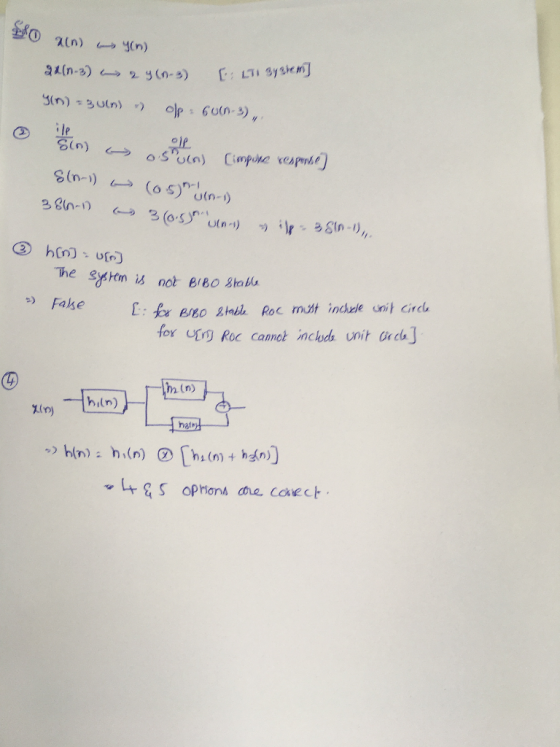
rate high![A signal :[7] = cos( /4)0.8 [rel is applied to an LTI systern and produces an output 3u[1]. What output is produced by an in](http://img.homeworklib.com/questions/d07f8c80-ac0c-11ea-8ad5-97c42af911c5.png?x-oss-process=image/resize,w_560)
Homework Answers
Add Answer to:
please answer all questions with working out! will
rate high
A signal :[7] = cos( /4)0.8"...
Use MATLAB to compute the convolution as a sum ofechoes of the input signal x[n] = cos () with th...
 Use MATLAB to compute the convolution as a sum ofechoes of the input signal x[n] = cos () with the impulse response h[n]1.5un un - 6]) of an LTI system S. Is the output periodic? Why or why not? Please explain.
Use MATLAB to compute the convolution as a sum ofechoes of the input signal x[n] = cos () with the impulse response h[n]1.5un un - 6]) of an LTI system S. Is the output periodic? Why or why not?...
Use MATLAB to compute the convolution as a sum ofechoes of the input signal x[n] = cos () with the impulse response h[n]1.5un un - 6]) of an LTI system S. Is the output periodic? Why or why not? Please explain.
Use MATLAB to compute the convolution as a sum ofechoes of the input signal x[n] = cos () with the impulse response h[n]1.5un un - 6]) of an LTI system S. Is the output periodic? Why or why not?...
CONVOLUTION - Questions 4 and 5 4. Consider an LTI system with an impulse response h(n)...
 CONVOLUTION - Questions 4 and 5 4. Consider an LTI system with an impulse response h(n) = [1 2 1] for 0 <n<2. If the input to the system is x(n) = u(n)-un-2) where u(n) is the unit-step, calculate the output of the system y(n) analytically. Check your answer using the "conv" function in MATLAB. 5. Consider an LTI system with an impulse response h(n) = u(n) where u(n) is the unit-step. (a) If the input to the system is...
Discrete-time convolution. Use of shift invariance for LTI systems. A discrete-time LTI system is described the...
 Discrete-time convolution. Use of shift invariance for LTI systems. A discrete-time LTI system is described the its impulse response h[n]. h[n] = (5)"u[n]. n-3 1 An input x[n] = u[n – 4) is applied. The output of the system y[n] is given by: x[r] – 54 G)" ()") un 14 The correct answer is not provided gắn] = [16(5)” – 54(5) ] n] y[n] = [16()" – 54(+)"] uſn – 4
please matlab code result is important 5. Consider a system with a cascade connection of two...
 please matlab code result is important
5. Consider a system with a cascade connection of two causal LTI systems: • Frequency response of the first system is H, (e) 1-2 and The impulse response of the second system is h, [n] = 5()'u[n] The input to the system is x[n], the output of the first system is w[n) and the output of the overall (complete) system is yn). a. Find the difference equation relating i. The input x[n) to the...
please matlab code result is important
5. Consider a system with a cascade connection of two causal LTI systems: • Frequency response of the first system is H, (e) 1-2 and The impulse response of the second system is h, [n] = 5()'u[n] The input to the system is x[n], the output of the first system is w[n) and the output of the overall (complete) system is yn). a. Find the difference equation relating i. The input x[n) to the...
pls show all work thanks 4. If the signal X(t) = cos(0) + cos(26) + cos...
 pls show all work thanks
4. If the signal X(t) = cos(0) + cos(26) + cos (46) is the input to an LTI system whose impulse response is n(t) sinc(30) sincet), what will be the output signal y() in response to this input?
pls show all work thanks
4. If the signal X(t) = cos(0) + cos(26) + cos (46) is the input to an LTI system whose impulse response is n(t) sinc(30) sincet), what will be the output signal y() in response to this input?
QUESTION 2 (20 MARKS) (a) A continuous time signal x(t) = 3e2tu(-t) is an input to...
 QUESTION 2 (20 MARKS) (a) A continuous time signal x(t) = 3e2tu(-t) is an input to a Linear Time Invariant system of which the impulse response h(t) is shown as h(t) = { .. 12, -osts-2 elsewhere Compute the output y(t) of the system above using convolution in time domain for all values of time t. [8 marks) (b) The impulse response h[n] of an LTI system is given as a[n] = 4(0.6)”u[n] Determine if the system is stable. [3...
Consider the discrete-time periodic signal n- 2 (a) Determine the Discrete-Time Fourier Series (DTFS) coefficients ak...
 Consider the discrete-time periodic signal n- 2 (a) Determine the Discrete-Time Fourier Series (DTFS) coefficients ak of X[n]. (b) Suppose that x[n] is the input to a discrete-time LTI system with impulse response hnuln - ]. Determine the Fourier series coefficients of the output yn. Hint: Recall that ejIn s an eigenfunction of an LTI system and that the response of the system to it is H(Q)ejfhn, where H(Q)-? h[n]e-jin
Will thumbs up if completed. Please show all work and have clear images, thank you. 4....
 Will thumbs up if completed. Please show all work and have clear
images, thank you.
4. Find the output of an LTI system whose impulse response is h[n] = u[n – 1], if the input signal x[n] = (1/3)-nu[-n – 1] is applied to it. (15 points)
Will thumbs up if completed. Please show all work and have clear
images, thank you.
4. Find the output of an LTI system whose impulse response is h[n] = u[n – 1], if the input signal x[n] = (1/3)-nu[-n – 1] is applied to it. (15 points)
2. (30 pts) A signal 7: n İs applied lo an ll.l system I (hi [n) outputting y1,,,and il is also a...
 2. (30 pts) A signal 7: n İs applied lo an ll.l system I (hi [n) outputting y1,,,and il is also applied to an LTI system 2 (h2n) outputng Then te sum of nnl and s applied to an LTI systcm 3 (hsln) oulputting n The relationships are given in the following cquations. Assume thaforn < 0 (a) (15 pts) Find the valo e impulse respsofte system 3 (b) (15 pts) Find the valucof the impulse response of the t...
PROBLEM 7.3*: The diagram in Fig. 2 depicts a cascade connection of two linear time-invariant (LTI)...
 PROBLEM 7.3*: The diagram in Fig. 2 depicts a cascade connection of two linear time-invariant (LTI) systems; i.e., the output of the first system is the input to the second system, and the overall output is the output of the second system. [n] yi[n] y[n] LTI System #1 hin] LTI System #2 h2[1] Figure 2: Cascade connection of two LTI systems. (a) Suppose that System #1 is a "blurring" filter described by the following equation y1 [n] =arn-k] k=0 and...
 Use MATLAB to compute the convolution as a sum ofechoes of the input signal x[n] = cos () with the impulse response h[n]1.5un un - 6]) of an LTI system S. Is the output periodic? Why or why not? Please explain.
Use MATLAB to compute the convolution as a sum ofechoes of the input signal x[n] = cos () with the impulse response h[n]1.5un un - 6]) of an LTI system S. Is the output periodic? Why or why not?...
Use MATLAB to compute the convolution as a sum ofechoes of the input signal x[n] = cos () with the impulse response h[n]1.5un un - 6]) of an LTI system S. Is the output periodic? Why or why not? Please explain.
Use MATLAB to compute the convolution as a sum ofechoes of the input signal x[n] = cos () with the impulse response h[n]1.5un un - 6]) of an LTI system S. Is the output periodic? Why or why not?...
 CONVOLUTION - Questions 4 and 5 4. Consider an LTI system with an impulse response h(n) = [1 2 1] for 0 <n<2. If the input to the system is x(n) = u(n)-un-2) where u(n) is the unit-step, calculate the output of the system y(n) analytically. Check your answer using the "conv" function in MATLAB. 5. Consider an LTI system with an impulse response h(n) = u(n) where u(n) is the unit-step. (a) If the input to the system is...
 Discrete-time convolution. Use of shift invariance for LTI systems. A discrete-time LTI system is described the its impulse response h[n]. h[n] = (5)"u[n]. n-3 1 An input x[n] = u[n – 4) is applied. The output of the system y[n] is given by: x[r] – 54 G)" ()") un 14 The correct answer is not provided gắn] = [16(5)” – 54(5) ] n] y[n] = [16()" – 54(+)"] uſn – 4
 please matlab code result is important
5. Consider a system with a cascade connection of two causal LTI systems: • Frequency response of the first system is H, (e) 1-2 and The impulse response of the second system is h, [n] = 5()'u[n] The input to the system is x[n], the output of the first system is w[n) and the output of the overall (complete) system is yn). a. Find the difference equation relating i. The input x[n) to the...
please matlab code result is important
5. Consider a system with a cascade connection of two causal LTI systems: • Frequency response of the first system is H, (e) 1-2 and The impulse response of the second system is h, [n] = 5()'u[n] The input to the system is x[n], the output of the first system is w[n) and the output of the overall (complete) system is yn). a. Find the difference equation relating i. The input x[n) to the...
 pls show all work thanks
4. If the signal X(t) = cos(0) + cos(26) + cos (46) is the input to an LTI system whose impulse response is n(t) sinc(30) sincet), what will be the output signal y() in response to this input?
pls show all work thanks
4. If the signal X(t) = cos(0) + cos(26) + cos (46) is the input to an LTI system whose impulse response is n(t) sinc(30) sincet), what will be the output signal y() in response to this input?
 QUESTION 2 (20 MARKS) (a) A continuous time signal x(t) = 3e2tu(-t) is an input to a Linear Time Invariant system of which the impulse response h(t) is shown as h(t) = { .. 12, -osts-2 elsewhere Compute the output y(t) of the system above using convolution in time domain for all values of time t. [8 marks) (b) The impulse response h[n] of an LTI system is given as a[n] = 4(0.6)”u[n] Determine if the system is stable. [3...
 Consider the discrete-time periodic signal n- 2 (a) Determine the Discrete-Time Fourier Series (DTFS) coefficients ak of X[n]. (b) Suppose that x[n] is the input to a discrete-time LTI system with impulse response hnuln - ]. Determine the Fourier series coefficients of the output yn. Hint: Recall that ejIn s an eigenfunction of an LTI system and that the response of the system to it is H(Q)ejfhn, where H(Q)-? h[n]e-jin
 Will thumbs up if completed. Please show all work and have clear
images, thank you.
4. Find the output of an LTI system whose impulse response is h[n] = u[n – 1], if the input signal x[n] = (1/3)-nu[-n – 1] is applied to it. (15 points)
Will thumbs up if completed. Please show all work and have clear
images, thank you.
4. Find the output of an LTI system whose impulse response is h[n] = u[n – 1], if the input signal x[n] = (1/3)-nu[-n – 1] is applied to it. (15 points)
 2. (30 pts) A signal 7: n İs applied lo an ll.l system I (hi [n) outputting y1,,,and il is also applied to an LTI system 2 (h2n) outputng Then te sum of nnl and s applied to an LTI systcm 3 (hsln) oulputting n The relationships are given in the following cquations. Assume thaforn < 0 (a) (15 pts) Find the valo e impulse respsofte system 3 (b) (15 pts) Find the valucof the impulse response of the t...
 PROBLEM 7.3*: The diagram in Fig. 2 depicts a cascade connection of two linear time-invariant (LTI) systems; i.e., the output of the first system is the input to the second system, and the overall output is the output of the second system. [n] yi[n] y[n] LTI System #1 hin] LTI System #2 h2[1] Figure 2: Cascade connection of two LTI systems. (a) Suppose that System #1 is a "blurring" filter described by the following equation y1 [n] =arn-k] k=0 and...
Most questions answered within 3 hours.
-
Where is the error in this code sequence?
String s1 = "Hello";
String s2 = "ello";...
asked 11 months ago -
Financial data for Joel de Paris, Inc., for last year
follow:
Joel de Paris, Inc.
Balance...
asked 11 months ago -
Consider this reaction:
Al2(SO4)3 (aq)+ BaCl3
(aq) Al2Cl6 (aq)- +
3BaSO4(s) . What is the...
asked 11 months ago -
Suppose that Savneet is considering increasing her
recent random sample from 20 car rentals to 40...
asked 11 months ago -
Trucks arrive at an unloading terminal at an average rate of 120
per hour.
Trucks arrive...
asked 11 months ago -
Why are methanol and ethanol completely soluble in water while
octanol is not very little soluble....
asked 11 months ago -
A facilities manager at a university reads in a research report
that the mean amount of...
asked 11 months ago -
When the CuSO4 is rehydrated by adding water to the anhydrous
compound, is this an endothermic...
asked 11 months ago -
A ray of sunlight is passing from diamond into crown glass; the
angle of incidence is...
asked 11 months ago -
A block of mass 0.249 kg is placed on top of a light, vertical
spring of...
asked 11 months ago -
how do the kidneys compensate in the presences of acidosis
a) trigger hyperventilate
b) reserve acid...
asked 11 months ago -
Question 501 pts
The rental rate of capital to the firm increases. Which of the
following...
asked 11 months ago