
Homework Answers
Request Answer!
We need at least 10 more requests to produce the answer.
0 / 10 have requested this problem solution
The more requests, the faster the answer.
9. 0 -17.14ints SerPSE 103 AP 041 A veater is given by R = 1.70 i...
 9. 0 -17.14ints SerPSE 103 AP 041 A veater is given by R = 1.70 i + 0.600 i + 3.07 (a) Find the magnitudes of the x, y, and a components. X (b) Find the magnitude of R. (C) Find the angle between R and the x axis, Find the angle between R and they axis. Find the angle between R and the z axis. Need Help? Read it Type here to search
For the three-dimensional vector r = 1.481 + 2.69j + 3.29k, determine the following (a) magnitude...
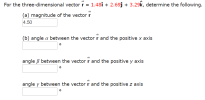 For the three-dimensional vector r = 1.481 + 2.69j + 3.29k, determine the following (a) magnitude of the vector r 4.50 (b) angle α between the vector r and the positive x axis angle B between the vector r and the positive y axis angle y between the vector r and the positive z axis
ite 9) Vector A has x component Ax = -10.0 m. Ã makes an angle of...
 ite 9) Vector A has x component Ax = -10.0 m. Ã makes an angle of 32.0° clockwise from the-y axis. wne d silt ahal B = -2.00 m î + 6.00 m j – 3.00 m k, and C = 2.00m i + 3.00m j – 6.00m k. Vector D = Å + B. Find the angle between vectors C and D.
Find the derivative, r'(t), of the vector function. r(t) = eti- j+ln(1 + 7t)k r'(t) =...
 Find the derivative, r'(t), of the vector function. r(t) = eti- j+ln(1 + 7t)k r'(t) = Find parametric equations for the tangent line to the curve with the given parametric equations at the specified point. T = 5e, y = te, c = tetp:/5, 0, 0) x(t), y(t), z(t) =
Consider the following vectors. A = (1.70 m) î + (3.00 m) Î B: 3.90 m,...
 Consider the following vectors. A = (1.70 m) î + (3.00 m) Î B: 3.90 m, at +65.0° C = (-4.00 m) i – (5.70 m) Î Õ: 5.00 m, at -230° (a) What is the sum of the four vectors in unit-vector notation? (b) What is the sum of the four vectors as a magnitude and an angle? magnitude direction • (counterclockwise from the positive x axis) m
Vector J has a magnitude of 3 and vector K has a magnitude of 7. They...
Vector J has a magnitude of 3 and vector K has a magnitude of 7. They are separated by an angle of 9 degrees. Find the magnitude of the following: J * K (Dot product) J x K (Cross product)
Vector field F = î 3y + ŷ (5 – 2x) + î (22 – 2)...
 Vector field F = î 3y + ŷ (5 – 2x) + î (22 – 2) is given. Find: (e) The surface integral of the normal component of the curl of F over the open hemisphere x + y2 + z = 4 above the x-y plane.
Evaluate the line integral ∫ F *dr where C is given by the vector function r(t)....
 Evaluate the line integral ∫ F *dr
where C is given by the vector function
r(t).
F(x, y, z) =
(x + y2) i +
xz j + (y + z)
k,
r(t) =
t2i +
t3j − 2t
k, 0 ≤ t ≤ 2
Evaluate the line integral ∫ F *dr
where C is given by the vector function
r(t).
F(x, y, z) =
(x + y2) i +
xz j + (y + z)
k,
r(t) =
t2i +
t3j − 2t
k, 0 ≤ t ≤ 2
a.what is the magnitude of the vector A+B+C? b.what is the angle between the positive x-axis...
 a.what is the magnitude of the vector A+B+C?
b.what is the angle between the positive x-axis and
the vector, measured clockwise in degrees?
c.What is the magnitude of the vector -A+2B+C?
d. What is the angle between the negative x-axis and
this vector, measured counterclockwise in degrees?
(2006) Problem 9: Consider the three vectors shown in the figure. They have magnitudes A|-30.5, B|-13, and IC|-332, and the labeled angles are A- 40°, ев 20°, and ec-15° Note that the figure...
a.what is the magnitude of the vector A+B+C?
b.what is the angle between the positive x-axis and
the vector, measured clockwise in degrees?
c.What is the magnitude of the vector -A+2B+C?
d. What is the angle between the negative x-axis and
this vector, measured counterclockwise in degrees?
(2006) Problem 9: Consider the three vectors shown in the figure. They have magnitudes A|-30.5, B|-13, and IC|-332, and the labeled angles are A- 40°, ев 20°, and ec-15° Note that the figure...
A particle P travels with constant speed on a circle of radius r = 2.40 m...
 A particle P travels
with constant speed on a circle of radius r = 2.40 m (see
the figure) and completes one revolution in 20.0 s. The particle
passes through O at time t = 0.
At t = 5.00 s, what is the particle's position vector?
Give (a) magnitude and (b)
direction (as an angle relative to the positive direction of
x.
At t = 7.50 s, what is the particle's position vector?
Give (c) magnitude and (d)
direction...
A particle P travels
with constant speed on a circle of radius r = 2.40 m (see
the figure) and completes one revolution in 20.0 s. The particle
passes through O at time t = 0.
At t = 5.00 s, what is the particle's position vector?
Give (a) magnitude and (b)
direction (as an angle relative to the positive direction of
x.
At t = 7.50 s, what is the particle's position vector?
Give (c) magnitude and (d)
direction...
 9. 0 -17.14ints SerPSE 103 AP 041 A veater is given by R = 1.70 i + 0.600 i + 3.07 (a) Find the magnitudes of the x, y, and a components. X (b) Find the magnitude of R. (C) Find the angle between R and the x axis, Find the angle between R and they axis. Find the angle between R and the z axis. Need Help? Read it Type here to search
 For the three-dimensional vector r = 1.481 + 2.69j + 3.29k, determine the following (a) magnitude of the vector r 4.50 (b) angle α between the vector r and the positive x axis angle B between the vector r and the positive y axis angle y between the vector r and the positive z axis
 ite 9) Vector A has x component Ax = -10.0 m. Ã makes an angle of 32.0° clockwise from the-y axis. wne d silt ahal B = -2.00 m î + 6.00 m j – 3.00 m k, and C = 2.00m i + 3.00m j – 6.00m k. Vector D = Å + B. Find the angle between vectors C and D.
 Find the derivative, r'(t), of the vector function. r(t) = eti- j+ln(1 + 7t)k r'(t) = Find parametric equations for the tangent line to the curve with the given parametric equations at the specified point. T = 5e, y = te, c = tetp:/5, 0, 0) x(t), y(t), z(t) =
 Consider the following vectors. A = (1.70 m) î + (3.00 m) Î B: 3.90 m, at +65.0° C = (-4.00 m) i – (5.70 m) Î Õ: 5.00 m, at -230° (a) What is the sum of the four vectors in unit-vector notation? (b) What is the sum of the four vectors as a magnitude and an angle? magnitude direction • (counterclockwise from the positive x axis) m
 Vector field F = î 3y + ŷ (5 – 2x) + î (22 – 2) is given. Find: (e) The surface integral of the normal component of the curl of F over the open hemisphere x + y2 + z = 4 above the x-y plane.
 Evaluate the line integral ∫ F *dr
where C is given by the vector function
r(t).
F(x, y, z) =
(x + y2) i +
xz j + (y + z)
k,
r(t) =
t2i +
t3j − 2t
k, 0 ≤ t ≤ 2
Evaluate the line integral ∫ F *dr
where C is given by the vector function
r(t).
F(x, y, z) =
(x + y2) i +
xz j + (y + z)
k,
r(t) =
t2i +
t3j − 2t
k, 0 ≤ t ≤ 2
 a.what is the magnitude of the vector A+B+C?
b.what is the angle between the positive x-axis and
the vector, measured clockwise in degrees?
c.What is the magnitude of the vector -A+2B+C?
d. What is the angle between the negative x-axis and
this vector, measured counterclockwise in degrees?
(2006) Problem 9: Consider the three vectors shown in the figure. They have magnitudes A|-30.5, B|-13, and IC|-332, and the labeled angles are A- 40°, ев 20°, and ec-15° Note that the figure...
a.what is the magnitude of the vector A+B+C?
b.what is the angle between the positive x-axis and
the vector, measured clockwise in degrees?
c.What is the magnitude of the vector -A+2B+C?
d. What is the angle between the negative x-axis and
this vector, measured counterclockwise in degrees?
(2006) Problem 9: Consider the three vectors shown in the figure. They have magnitudes A|-30.5, B|-13, and IC|-332, and the labeled angles are A- 40°, ев 20°, and ec-15° Note that the figure...
 A particle P travels
with constant speed on a circle of radius r = 2.40 m (see
the figure) and completes one revolution in 20.0 s. The particle
passes through O at time t = 0.
At t = 5.00 s, what is the particle's position vector?
Give (a) magnitude and (b)
direction (as an angle relative to the positive direction of
x.
At t = 7.50 s, what is the particle's position vector?
Give (c) magnitude and (d)
direction...
A particle P travels
with constant speed on a circle of radius r = 2.40 m (see
the figure) and completes one revolution in 20.0 s. The particle
passes through O at time t = 0.
At t = 5.00 s, what is the particle's position vector?
Give (a) magnitude and (b)
direction (as an angle relative to the positive direction of
x.
At t = 7.50 s, what is the particle's position vector?
Give (c) magnitude and (d)
direction...
Most questions answered within 3 hours.
-
Where is the error in this code sequence?
String s1 = "Hello";
String s2 = "ello";...
asked 10 months ago -
Financial data for Joel de Paris, Inc., for last year
follow:
Joel de Paris, Inc.
Balance...
asked 10 months ago -
Consider this reaction:
Al2(SO4)3 (aq)+ BaCl3
(aq) Al2Cl6 (aq)- +
3BaSO4(s) . What is the...
asked 10 months ago -
Suppose that Savneet is considering increasing her
recent random sample from 20 car rentals to 40...
asked 10 months ago -
Trucks arrive at an unloading terminal at an average rate of 120
per hour.
Trucks arrive...
asked 10 months ago -
Why are methanol and ethanol completely soluble in water while
octanol is not very little soluble....
asked 10 months ago -
A facilities manager at a university reads in a research report
that the mean amount of...
asked 10 months ago -
When the CuSO4 is rehydrated by adding water to the anhydrous
compound, is this an endothermic...
asked 10 months ago -
A ray of sunlight is passing from diamond into crown glass; the
angle of incidence is...
asked 10 months ago -
A block of mass 0.249 kg is placed on top of a light, vertical
spring of...
asked 10 months ago -
how do the kidneys compensate in the presences of acidosis
a) trigger hyperventilate
b) reserve acid...
asked 10 months ago -
Question 501 pts
The rental rate of capital to the firm increases. Which of the
following...
asked 10 months ago