
Homework Answers

Add Answer to:
3. Two solid cylinders with different radii (r and 2r) and lengths (21 and 1) and...
Two disks of identical mass but dif- ferent radii (r and 21) are spinning on frictionless bearings at the same angular...
 Two disks of identical mass but dif- ferent radii (r and 21) are spinning on frictionless bearings at the same angular speed w, but in opposite directions (Fig- ure 10-46). The two disks are brought slowly together. The re- sulting frictional force between the surfaces eventually brings them to a common angular velocity. What is the magnitude of that final angular velocity in terms of w.? 00 00
Consider two concentric, infinitely long cylinders. The cylinders are oriented such that the center-line is along the z-axis, and the radii exist in the r-direction. The inner cylinder has a radius o...
 Consider two concentric, infinitely long cylinders. The cylinders are oriented such that the center-line is along the z-axis, and the radii exist in the r-direction. The inner cylinder has a radius of ra and the outer cylinder has a radius Tb. The inner cylinder rotates with an angular velocity of w whereas the outer cylinder is stationary. There is no pressure gradient applied nor gravity. The fluid contained between the cylinders is assumed to be Netwonian, incompressible, isotropic and isothermal....
An incompressible Newtonian fluid is contained between two long concentric cylinders of radii AR (< 1) and R, as sho...
 An incompressible Newtonian fluid is contained between two long concentric cylinders of radii AR (< 1) and R, as shown in the figure. The inner cylinder rotates with an angular velocity Ω (a) Compute the velocity distribution between the cylinders. End effects caused by (b) Compute the torque required to hold the outer cylinder stationary. (8 Pts)
An incompressible Newtonian fluid is contained between two long concentric cylinders of radii AR (
An incompressible Newtonian fluid is contained between two long concentric cylinders of radii AR (< 1) and R, as shown in the figure. The inner cylinder rotates with an angular velocity Ω (a) Compute the velocity distribution between the cylinders. End effects caused by (b) Compute the torque required to hold the outer cylinder stationary. (8 Pts)
An incompressible Newtonian fluid is contained between two long concentric cylinders of radii AR (
Consider a turntable to be a circular disk of moment of inertia 0.142 kg⋅m2 rotating at...
Consider a turntable to be a circular disk of moment of inertia 0.142 kg⋅m2 rotating at a constant angular velocity 4.80 rad/s2 around an axis through the center and perpendicular to the plane of the disk (the disk's "primary axis of symmetry"). The axis of the disk is vertical and the disk is supported by frictionless bearings. The motor of the turntable is off, so there is no external torque being applied to the axis. Another disk (a record) is...
To understand how to use conservation of angular momentum to solve problems involving collisions of rotating...
 To understand how to use conservation of angular momentum to solve problems involving collisions of rotating bodies. Consider a turntable to be a circular disk of moment of inertia I_t rotating at a constant angular velocity omega_i around an axis through the center and perpendicular to the plane of the disk (the disk's "primary axis of symmetry"). The axis of the disk is vertical and the disk is supported by frictionless bearings. The motor of the turntable is off, so...
Two disks are mounted (like a merry-go-round) on low-friction bearings on the same axle and can...
 Two disks are mounted (like a merry-go-round) on low-friction bearings on the same axle and can be brought together so that they couple and rotate as one unit. The first disk, with rotational inertia 3.25 kg m2 about its central axis, is set spinning counterclockwise (which may be taken as the positive direction) at 181 rev/min. The second disk, with rotational inertia 7.95 kg.m2 about its central axis, is set spinning counterclockwise at 879 rev/min. They then couple together. (a)...
To understand how to use conservation of angular momentum to solve problems involving collisions of rotating bodies. (...
To understand how to use conservation of angular momentum to solve problems involving collisions of rotating bodies. (Figure 1) Consider a turntable to be a circular disk of moment of inertia It rotating at a constant angular velocity ωi around an axis through the center and perpendicular to the plane of the disk (the disk's "primary axis of symmetry"). The axis of the disk is vertical and the disk is supported by frictionless bearings. The motor of the turntable is...
6_1. A majorette in a parade is performing some acrobatic twirlings of her baton. Assume that the baton is a uniform ro...
 6_1. A majorette in a parade is performing some acrobatic
twirlings of her baton. Assume that the baton is a uniform rod of
mass 0.120 kg and length 80.0 cm.
a. Initially, the baton is spinning about a line through its center
at angular velocity 3.00 rad/s. (Part A figure) What is its angular
momentum? Express your answer in kilogram meters squared per
second.
6_2. Learning Goal: To understand how to use conservation of
angular momentum to solve problems involving...
6_1. A majorette in a parade is performing some acrobatic
twirlings of her baton. Assume that the baton is a uniform rod of
mass 0.120 kg and length 80.0 cm.
a. Initially, the baton is spinning about a line through its center
at angular velocity 3.00 rad/s. (Part A figure) What is its angular
momentum? Express your answer in kilogram meters squared per
second.
6_2. Learning Goal: To understand how to use conservation of
angular momentum to solve problems involving...
Could someone please help me with these questions? 1. Dr. Nelson is holding two weights at...
 Could someone please help me with these questions?
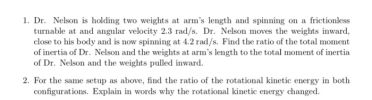
1. Dr. Nelson is holding two weights at arm's length and spinning on a frictionless turnable at and angular velocity 2.3 rad/s. Dr. Nelson moves the weights inward close to his body and is now spinning at 4.2 rad/s. Find the ratio of the total moment of inertia of Dr. Nelson and the weights at arm's length to the total moment of inertia of Dr. Nelson and the weights pulled inward. 2....
Could someone please help me with these questions?
1. Dr. Nelson is holding two weights at arm's length and spinning on a frictionless turnable at and angular velocity 2.3 rad/s. Dr. Nelson moves the weights inward close to his body and is now spinning at 4.2 rad/s. Find the ratio of the total moment of inertia of Dr. Nelson and the weights at arm's length to the total moment of inertia of Dr. Nelson and the weights pulled inward. 2....
A satellite consists two cylinders which can rotate relative to each other about the common axis of summetry. The rotation can be precisely controlled through a built-in motor. Both cyllinders can be...
 A satellite consists two cylinders which can rotate relative to
each other about the common axis of summetry. The rotation can be
precisely controlled through a built-in motor. Both cyllinders can
be asuumed to be uniform; they have the same mass, m = 10.0 kg, and
the same radius rc = 0.30m. The top cylinder has attached to it two
balls, each of which has mass 1.0 kg and radius rb = 0.1m. Each
ball is fastened to the end...
A satellite consists two cylinders which can rotate relative to
each other about the common axis of summetry. The rotation can be
precisely controlled through a built-in motor. Both cyllinders can
be asuumed to be uniform; they have the same mass, m = 10.0 kg, and
the same radius rc = 0.30m. The top cylinder has attached to it two
balls, each of which has mass 1.0 kg and radius rb = 0.1m. Each
ball is fastened to the end...
 Two disks of identical mass but dif- ferent radii (r and 21) are spinning on frictionless bearings at the same angular speed w, but in opposite directions (Fig- ure 10-46). The two disks are brought slowly together. The re- sulting frictional force between the surfaces eventually brings them to a common angular velocity. What is the magnitude of that final angular velocity in terms of w.? 00 00
 Consider two concentric, infinitely long cylinders. The cylinders are oriented such that the center-line is along the z-axis, and the radii exist in the r-direction. The inner cylinder has a radius of ra and the outer cylinder has a radius Tb. The inner cylinder rotates with an angular velocity of w whereas the outer cylinder is stationary. There is no pressure gradient applied nor gravity. The fluid contained between the cylinders is assumed to be Netwonian, incompressible, isotropic and isothermal....
 An incompressible Newtonian fluid is contained between two long concentric cylinders of radii AR (< 1) and R, as shown in the figure. The inner cylinder rotates with an angular velocity Ω (a) Compute the velocity distribution between the cylinders. End effects caused by (b) Compute the torque required to hold the outer cylinder stationary. (8 Pts)
An incompressible Newtonian fluid is contained between two long concentric cylinders of radii AR (
An incompressible Newtonian fluid is contained between two long concentric cylinders of radii AR (< 1) and R, as shown in the figure. The inner cylinder rotates with an angular velocity Ω (a) Compute the velocity distribution between the cylinders. End effects caused by (b) Compute the torque required to hold the outer cylinder stationary. (8 Pts)
An incompressible Newtonian fluid is contained between two long concentric cylinders of radii AR (
 To understand how to use conservation of angular momentum to solve problems involving collisions of rotating bodies. Consider a turntable to be a circular disk of moment of inertia I_t rotating at a constant angular velocity omega_i around an axis through the center and perpendicular to the plane of the disk (the disk's "primary axis of symmetry"). The axis of the disk is vertical and the disk is supported by frictionless bearings. The motor of the turntable is off, so...
 Two disks are mounted (like a merry-go-round) on low-friction bearings on the same axle and can be brought together so that they couple and rotate as one unit. The first disk, with rotational inertia 3.25 kg m2 about its central axis, is set spinning counterclockwise (which may be taken as the positive direction) at 181 rev/min. The second disk, with rotational inertia 7.95 kg.m2 about its central axis, is set spinning counterclockwise at 879 rev/min. They then couple together. (a)...
 6_1. A majorette in a parade is performing some acrobatic
twirlings of her baton. Assume that the baton is a uniform rod of
mass 0.120 kg and length 80.0 cm.
a. Initially, the baton is spinning about a line through its center
at angular velocity 3.00 rad/s. (Part A figure) What is its angular
momentum? Express your answer in kilogram meters squared per
second.
6_2. Learning Goal: To understand how to use conservation of
angular momentum to solve problems involving...
6_1. A majorette in a parade is performing some acrobatic
twirlings of her baton. Assume that the baton is a uniform rod of
mass 0.120 kg and length 80.0 cm.
a. Initially, the baton is spinning about a line through its center
at angular velocity 3.00 rad/s. (Part A figure) What is its angular
momentum? Express your answer in kilogram meters squared per
second.
6_2. Learning Goal: To understand how to use conservation of
angular momentum to solve problems involving...
 Could someone please help me with these questions?
1. Dr. Nelson is holding two weights at arm's length and spinning on a frictionless turnable at and angular velocity 2.3 rad/s. Dr. Nelson moves the weights inward close to his body and is now spinning at 4.2 rad/s. Find the ratio of the total moment of inertia of Dr. Nelson and the weights at arm's length to the total moment of inertia of Dr. Nelson and the weights pulled inward. 2....
Could someone please help me with these questions?
1. Dr. Nelson is holding two weights at arm's length and spinning on a frictionless turnable at and angular velocity 2.3 rad/s. Dr. Nelson moves the weights inward close to his body and is now spinning at 4.2 rad/s. Find the ratio of the total moment of inertia of Dr. Nelson and the weights at arm's length to the total moment of inertia of Dr. Nelson and the weights pulled inward. 2....
 A satellite consists two cylinders which can rotate relative to
each other about the common axis of summetry. The rotation can be
precisely controlled through a built-in motor. Both cyllinders can
be asuumed to be uniform; they have the same mass, m = 10.0 kg, and
the same radius rc = 0.30m. The top cylinder has attached to it two
balls, each of which has mass 1.0 kg and radius rb = 0.1m. Each
ball is fastened to the end...
A satellite consists two cylinders which can rotate relative to
each other about the common axis of summetry. The rotation can be
precisely controlled through a built-in motor. Both cyllinders can
be asuumed to be uniform; they have the same mass, m = 10.0 kg, and
the same radius rc = 0.30m. The top cylinder has attached to it two
balls, each of which has mass 1.0 kg and radius rb = 0.1m. Each
ball is fastened to the end...
Most questions answered within 3 hours.
-
Where is the error in this code sequence?
String s1 = "Hello";
String s2 = "ello";...
asked 10 months ago -
Financial data for Joel de Paris, Inc., for last year
follow:
Joel de Paris, Inc.
Balance...
asked 10 months ago -
Consider this reaction:
Al2(SO4)3 (aq)+ BaCl3
(aq) Al2Cl6 (aq)- +
3BaSO4(s) . What is the...
asked 10 months ago -
Suppose that Savneet is considering increasing her
recent random sample from 20 car rentals to 40...
asked 10 months ago -
Trucks arrive at an unloading terminal at an average rate of 120
per hour.
Trucks arrive...
asked 10 months ago -
Why are methanol and ethanol completely soluble in water while
octanol is not very little soluble....
asked 10 months ago -
A facilities manager at a university reads in a research report
that the mean amount of...
asked 10 months ago -
When the CuSO4 is rehydrated by adding water to the anhydrous
compound, is this an endothermic...
asked 10 months ago -
A ray of sunlight is passing from diamond into crown glass; the
angle of incidence is...
asked 10 months ago -
A block of mass 0.249 kg is placed on top of a light, vertical
spring of...
asked 10 months ago -
how do the kidneys compensate in the presences of acidosis
a) trigger hyperventilate
b) reserve acid...
asked 10 months ago -
Question 501 pts
The rental rate of capital to the firm increases. Which of the
following...
asked 10 months ago