
Homework Answers

Add Answer to:
Please all all parts with correct numbers and neatly show
work. Thank you
.) We consider...
PLEASE ONLY SOLVE THE LAST WHICH ARE d and e FOR ME. THANKS! P4, A clock...
 PLEASE ONLY SOLVE THE LAST WHICH ARE d and e FOR ME.
THANKS!
P4, A clock keeps time using the periodic motion of a simple pendulum. The pendulum consists of a string of length L and a bob of mass m 5.00kg attached to the end of the string. The pendulum has a period T-1.00s. The initial angle o(o) at 0 is equal to 0.175 rad. The bob is released from rest (ie. do at 0.The angle O between the...
PLEASE ONLY SOLVE THE LAST WHICH ARE d and e FOR ME.
THANKS!
P4, A clock keeps time using the periodic motion of a simple pendulum. The pendulum consists of a string of length L and a bob of mass m 5.00kg attached to the end of the string. The pendulum has a period T-1.00s. The initial angle o(o) at 0 is equal to 0.175 rad. The bob is released from rest (ie. do at 0.The angle O between the...
Please show all work. For this question. Also I would like to know if this is...
 Please show all work. For this question. Also I would
like to know if this is considered an easy problem.
4 A bulle of mass M. The in the figure below. mass m and speed v strikes and becomes embedded in a pendulum bob pendulum bob is suspended by a massless cord of length l as shown (a) (s points) Is energy conserved during this collision? Is energy conserved efter the collision? (b) (s points) Find the speed of the...
Please show all work. For this question. Also I would
like to know if this is considered an easy problem.
4 A bulle of mass M. The in the figure below. mass m and speed v strikes and becomes embedded in a pendulum bob pendulum bob is suspended by a massless cord of length l as shown (a) (s points) Is energy conserved during this collision? Is energy conserved efter the collision? (b) (s points) Find the speed of the...
(Please show the steps to the solutions, and draw a diagram if you can) 1) In...
 (Please show the steps to the solutions, and draw a diagram
if you can)
1) In a linear motion, velocity changes with time as Find
distance and displacement for the time interval from 1.5 s
to 5 s.
2) A projectile is launched from the edge of 50 m high
vertical cliff at an angle of above horizontal.
The projectile hits the ground at a distance of 150 m from the
bottom of the cliff. FInd the initial and final...
(Please show the steps to the solutions, and draw a diagram
if you can)
1) In a linear motion, velocity changes with time as Find
distance and displacement for the time interval from 1.5 s
to 5 s.
2) A projectile is launched from the edge of 50 m high
vertical cliff at an angle of above horizontal.
The projectile hits the ground at a distance of 150 m from the
bottom of the cliff. FInd the initial and final...
Please answer with the correct amount of significant figures. Thank you!! A simple pendulum has a...
 Please answer with the correct amount of significant
figures. Thank you!!
A simple pendulum has a mass of 0.650 kg and a length of 7.00 m. It is displaced through an angle of 8.0° and then released. Using the analysis model of a particle in simple harmonic motion, calculate the following. (Give your answer to the thousandths place.) (a) What is the maximum speed of the bob? m/s 4.0 (b) What is the maximum angular acceleration of the bob? |...
Please answer with the correct amount of significant
figures. Thank you!!
A simple pendulum has a mass of 0.650 kg and a length of 7.00 m. It is displaced through an angle of 8.0° and then released. Using the analysis model of a particle in simple harmonic motion, calculate the following. (Give your answer to the thousandths place.) (a) What is the maximum speed of the bob? m/s 4.0 (b) What is the maximum angular acceleration of the bob? |...
please give me answers to all the questions and i would really appreciate that thank you...
 please give me answers to all the questions and i would really
appreciate that
thank you
6. -0 points My Notes O Ask Your Teache A 10.1 kg object oscillates at the end of a vertical spring that has a spring constant of 2.20 x 10⁴ N/m. The effect of air resistance is represented by the damping coefficient b = 3.00 N-s/m (a) Calculate the frequency of the dampened oscillation. H2 (b) By what percentage does the amplitude of the...
please give me answers to all the questions and i would really
appreciate that
thank you
6. -0 points My Notes O Ask Your Teache A 10.1 kg object oscillates at the end of a vertical spring that has a spring constant of 2.20 x 10⁴ N/m. The effect of air resistance is represented by the damping coefficient b = 3.00 N-s/m (a) Calculate the frequency of the dampened oscillation. H2 (b) By what percentage does the amplitude of the...
Please show all steps and provide any explanations through either text or definitions/equations. GENERAL HOOKE Somewhere...
 Please show all steps and provide any explanations through
either text or definitions/equations.
GENERAL HOOKE Somewhere DEEP BELOW THE EARTH's surface, at an UNKNOWN displacement from the Earth's center, a particle of mass m is dangled from a long string, length L; the particle oscillates along a small arc according to the differential equation dt -0 Here, 0 refers to an angular displacement measured from the vertical and t refers to time. The particle's mass is given by m =...
Please show all steps and provide any explanations through
either text or definitions/equations.
GENERAL HOOKE Somewhere DEEP BELOW THE EARTH's surface, at an UNKNOWN displacement from the Earth's center, a particle of mass m is dangled from a long string, length L; the particle oscillates along a small arc according to the differential equation dt -0 Here, 0 refers to an angular displacement measured from the vertical and t refers to time. The particle's mass is given by m =...
please give me the answer to all of them thank you 8. -0 points My Notes...
 please give me the answer
to all of them
thank you
8. -0 points My Notes Ask Your Teacher A particle with a mass of 0.340 kg is attached to a horizontal spring with a force constant of 3.0ō N m At the moment t moving to the left. (Assume that the positive direction is to the right.) 0 the partice has s maximum speed of 75ms and s (a) Determine the particle's equation of motion, specifying its position as...
please give me the answer
to all of them
thank you
8. -0 points My Notes Ask Your Teacher A particle with a mass of 0.340 kg is attached to a horizontal spring with a force constant of 3.0ō N m At the moment t moving to the left. (Assume that the positive direction is to the right.) 0 the partice has s maximum speed of 75ms and s (a) Determine the particle's equation of motion, specifying its position as...
Please show all work. ,Thank you. Problem 2 A 0.090-kg ball is swung in a conical...
 Please show all work.
,Thank you.
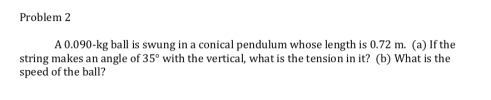
Problem 2 A 0.090-kg ball is swung in a conical pendulum whose length is 0.72 m. (a) If the string makes an angle of 35° with the vertical, what is the tension in it? (b) What is the speed of the ball?
Please show all work.
,Thank you.
Problem 2 A 0.090-kg ball is swung in a conical pendulum whose length is 0.72 m. (a) If the string makes an angle of 35° with the vertical, what is the tension in it? (b) What is the speed of the ball?
Please do all questions and show work. 1. (2 points) A 200 g mass attached to...
 Please do all questions and show work.
1. (2 points) A 200 g mass attached to a light spring oscillates on a frictionless, horizontal table. The mass is pulled 8 cm and released. A student finds that 12 oscillations takes 18 seconds. (a) What is the spring constant? (b) What is the maximum speed of the mass? 2. (3 points) The position of an object connected to a spring varies with time according to the expression x = (7.5 cm)cos...
Please do all questions and show work.
1. (2 points) A 200 g mass attached to a light spring oscillates on a frictionless, horizontal table. The mass is pulled 8 cm and released. A student finds that 12 oscillations takes 18 seconds. (a) What is the spring constant? (b) What is the maximum speed of the mass? 2. (3 points) The position of an object connected to a spring varies with time according to the expression x = (7.5 cm)cos...
please answer all parts, thank you. 2. A cart on a frictionless track is attached on...
 please answer all parts, thank you.
2. A cart on a frictionless track is attached on one side to a ideal spring. (The other side of the spring is fixed to the wall.) The cart has a mass of 1.20 kg. You compress the spring by 0.200 m and release the cart to oscillate at t = 0.00 s. The force needed to initially compress the spring is measured to be 10.0 N. (a) What is the angular frequency of...
please answer all parts, thank you.
2. A cart on a frictionless track is attached on one side to a ideal spring. (The other side of the spring is fixed to the wall.) The cart has a mass of 1.20 kg. You compress the spring by 0.200 m and release the cart to oscillate at t = 0.00 s. The force needed to initially compress the spring is measured to be 10.0 N. (a) What is the angular frequency of...
 PLEASE ONLY SOLVE THE LAST WHICH ARE d and e FOR ME.
THANKS!
P4, A clock keeps time using the periodic motion of a simple pendulum. The pendulum consists of a string of length L and a bob of mass m 5.00kg attached to the end of the string. The pendulum has a period T-1.00s. The initial angle o(o) at 0 is equal to 0.175 rad. The bob is released from rest (ie. do at 0.The angle O between the...
PLEASE ONLY SOLVE THE LAST WHICH ARE d and e FOR ME.
THANKS!
P4, A clock keeps time using the periodic motion of a simple pendulum. The pendulum consists of a string of length L and a bob of mass m 5.00kg attached to the end of the string. The pendulum has a period T-1.00s. The initial angle o(o) at 0 is equal to 0.175 rad. The bob is released from rest (ie. do at 0.The angle O between the...
 Please show all work. For this question. Also I would
like to know if this is considered an easy problem.
4 A bulle of mass M. The in the figure below. mass m and speed v strikes and becomes embedded in a pendulum bob pendulum bob is suspended by a massless cord of length l as shown (a) (s points) Is energy conserved during this collision? Is energy conserved efter the collision? (b) (s points) Find the speed of the...
Please show all work. For this question. Also I would
like to know if this is considered an easy problem.
4 A bulle of mass M. The in the figure below. mass m and speed v strikes and becomes embedded in a pendulum bob pendulum bob is suspended by a massless cord of length l as shown (a) (s points) Is energy conserved during this collision? Is energy conserved efter the collision? (b) (s points) Find the speed of the...
 (Please show the steps to the solutions, and draw a diagram
if you can)
1) In a linear motion, velocity changes with time as Find
distance and displacement for the time interval from 1.5 s
to 5 s.
2) A projectile is launched from the edge of 50 m high
vertical cliff at an angle of above horizontal.
The projectile hits the ground at a distance of 150 m from the
bottom of the cliff. FInd the initial and final...
(Please show the steps to the solutions, and draw a diagram
if you can)
1) In a linear motion, velocity changes with time as Find
distance and displacement for the time interval from 1.5 s
to 5 s.
2) A projectile is launched from the edge of 50 m high
vertical cliff at an angle of above horizontal.
The projectile hits the ground at a distance of 150 m from the
bottom of the cliff. FInd the initial and final...
 Please answer with the correct amount of significant
figures. Thank you!!
A simple pendulum has a mass of 0.650 kg and a length of 7.00 m. It is displaced through an angle of 8.0° and then released. Using the analysis model of a particle in simple harmonic motion, calculate the following. (Give your answer to the thousandths place.) (a) What is the maximum speed of the bob? m/s 4.0 (b) What is the maximum angular acceleration of the bob? |...
Please answer with the correct amount of significant
figures. Thank you!!
A simple pendulum has a mass of 0.650 kg and a length of 7.00 m. It is displaced through an angle of 8.0° and then released. Using the analysis model of a particle in simple harmonic motion, calculate the following. (Give your answer to the thousandths place.) (a) What is the maximum speed of the bob? m/s 4.0 (b) What is the maximum angular acceleration of the bob? |...
 please give me answers to all the questions and i would really
appreciate that
thank you
6. -0 points My Notes O Ask Your Teache A 10.1 kg object oscillates at the end of a vertical spring that has a spring constant of 2.20 x 10⁴ N/m. The effect of air resistance is represented by the damping coefficient b = 3.00 N-s/m (a) Calculate the frequency of the dampened oscillation. H2 (b) By what percentage does the amplitude of the...
please give me answers to all the questions and i would really
appreciate that
thank you
6. -0 points My Notes O Ask Your Teache A 10.1 kg object oscillates at the end of a vertical spring that has a spring constant of 2.20 x 10⁴ N/m. The effect of air resistance is represented by the damping coefficient b = 3.00 N-s/m (a) Calculate the frequency of the dampened oscillation. H2 (b) By what percentage does the amplitude of the...
 Please show all steps and provide any explanations through
either text or definitions/equations.
GENERAL HOOKE Somewhere DEEP BELOW THE EARTH's surface, at an UNKNOWN displacement from the Earth's center, a particle of mass m is dangled from a long string, length L; the particle oscillates along a small arc according to the differential equation dt -0 Here, 0 refers to an angular displacement measured from the vertical and t refers to time. The particle's mass is given by m =...
Please show all steps and provide any explanations through
either text or definitions/equations.
GENERAL HOOKE Somewhere DEEP BELOW THE EARTH's surface, at an UNKNOWN displacement from the Earth's center, a particle of mass m is dangled from a long string, length L; the particle oscillates along a small arc according to the differential equation dt -0 Here, 0 refers to an angular displacement measured from the vertical and t refers to time. The particle's mass is given by m =...
 please give me the answer
to all of them
thank you
8. -0 points My Notes Ask Your Teacher A particle with a mass of 0.340 kg is attached to a horizontal spring with a force constant of 3.0ō N m At the moment t moving to the left. (Assume that the positive direction is to the right.) 0 the partice has s maximum speed of 75ms and s (a) Determine the particle's equation of motion, specifying its position as...
please give me the answer
to all of them
thank you
8. -0 points My Notes Ask Your Teacher A particle with a mass of 0.340 kg is attached to a horizontal spring with a force constant of 3.0ō N m At the moment t moving to the left. (Assume that the positive direction is to the right.) 0 the partice has s maximum speed of 75ms and s (a) Determine the particle's equation of motion, specifying its position as...
 Please show all work.
,Thank you.
Problem 2 A 0.090-kg ball is swung in a conical pendulum whose length is 0.72 m. (a) If the string makes an angle of 35° with the vertical, what is the tension in it? (b) What is the speed of the ball?
Please show all work.
,Thank you.
Problem 2 A 0.090-kg ball is swung in a conical pendulum whose length is 0.72 m. (a) If the string makes an angle of 35° with the vertical, what is the tension in it? (b) What is the speed of the ball?
 Please do all questions and show work.
1. (2 points) A 200 g mass attached to a light spring oscillates on a frictionless, horizontal table. The mass is pulled 8 cm and released. A student finds that 12 oscillations takes 18 seconds. (a) What is the spring constant? (b) What is the maximum speed of the mass? 2. (3 points) The position of an object connected to a spring varies with time according to the expression x = (7.5 cm)cos...
Please do all questions and show work.
1. (2 points) A 200 g mass attached to a light spring oscillates on a frictionless, horizontal table. The mass is pulled 8 cm and released. A student finds that 12 oscillations takes 18 seconds. (a) What is the spring constant? (b) What is the maximum speed of the mass? 2. (3 points) The position of an object connected to a spring varies with time according to the expression x = (7.5 cm)cos...
 please answer all parts, thank you.
2. A cart on a frictionless track is attached on one side to a ideal spring. (The other side of the spring is fixed to the wall.) The cart has a mass of 1.20 kg. You compress the spring by 0.200 m and release the cart to oscillate at t = 0.00 s. The force needed to initially compress the spring is measured to be 10.0 N. (a) What is the angular frequency of...
please answer all parts, thank you.
2. A cart on a frictionless track is attached on one side to a ideal spring. (The other side of the spring is fixed to the wall.) The cart has a mass of 1.20 kg. You compress the spring by 0.200 m and release the cart to oscillate at t = 0.00 s. The force needed to initially compress the spring is measured to be 10.0 N. (a) What is the angular frequency of...
Most questions answered within 3 hours.
-
Where is the error in this code sequence?
String s1 = "Hello";
String s2 = "ello";...
asked 10 months ago -
Financial data for Joel de Paris, Inc., for last year
follow:
Joel de Paris, Inc.
Balance...
asked 10 months ago -
Consider this reaction:
Al2(SO4)3 (aq)+ BaCl3
(aq) Al2Cl6 (aq)- +
3BaSO4(s) . What is the...
asked 10 months ago -
Suppose that Savneet is considering increasing her
recent random sample from 20 car rentals to 40...
asked 10 months ago -
Trucks arrive at an unloading terminal at an average rate of 120
per hour.
Trucks arrive...
asked 10 months ago -
Why are methanol and ethanol completely soluble in water while
octanol is not very little soluble....
asked 10 months ago -
A facilities manager at a university reads in a research report
that the mean amount of...
asked 10 months ago -
When the CuSO4 is rehydrated by adding water to the anhydrous
compound, is this an endothermic...
asked 10 months ago -
A ray of sunlight is passing from diamond into crown glass; the
angle of incidence is...
asked 10 months ago -
A block of mass 0.249 kg is placed on top of a light, vertical
spring of...
asked 10 months ago -
how do the kidneys compensate in the presences of acidosis
a) trigger hyperventilate
b) reserve acid...
asked 10 months ago -
Question 501 pts
The rental rate of capital to the firm increases. Which of the
following...
asked 10 months ago