
Homework Answers

Add Answer to:
A hot-air balloonist, rising vertically with a constant velocity of magnitude v = 5.00 m/s, releases...
A hot-air balloonist, rising vertically with a constant speed of 5.00 m/s, releases a sandbag at...
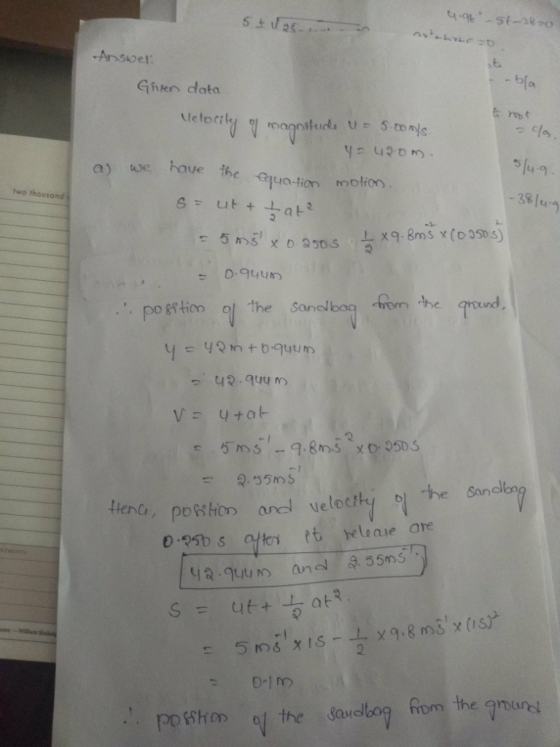
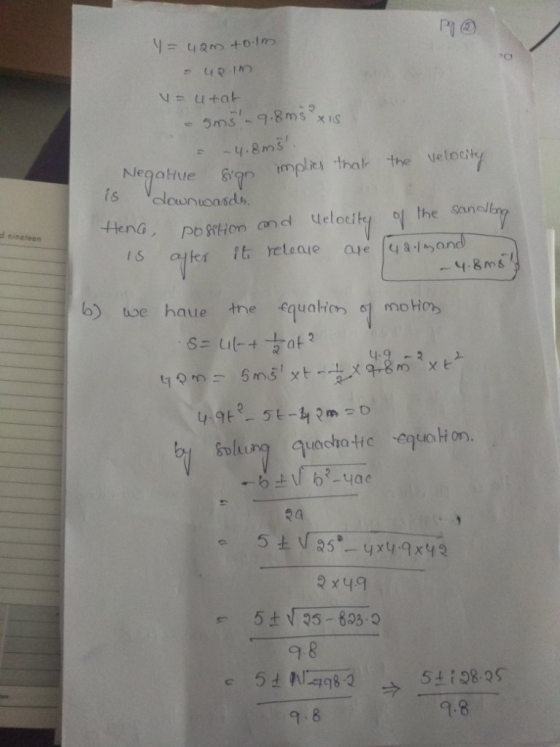
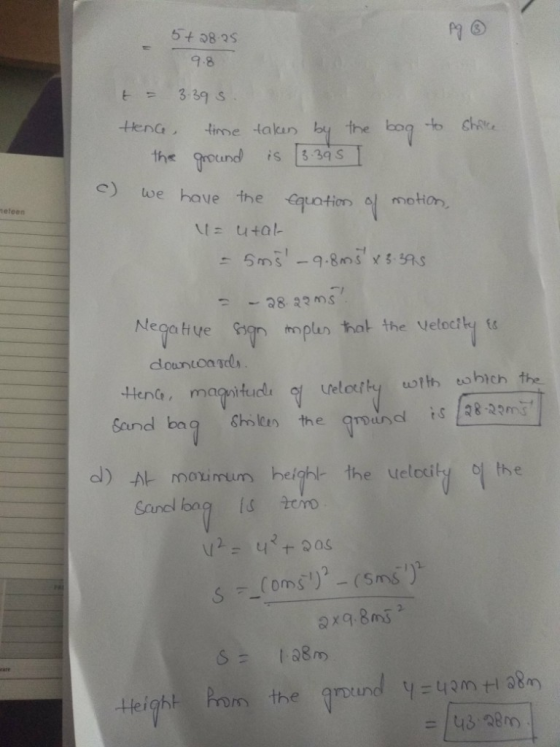
A hot-air balloonist, rising vertically with a constant speed of 5.00 m/s, releases a sandbag at the instant the balloon is 60.0 m above the ground. After it is released, the sandbag encounters no appreciable air resistance. a) Find the position and velocity of the sandbag at 0.200 s and 0.800 s after its release. b) How much time does it take for the sandbag to strike the ground after it is released?
2) Full of hot air. A hot-air balloonist, rising vertically with a constant speed of 5.00...
 2) Full of hot air. A hot-air balloonist, rising vertically with a constant speed of 5.00 m/s, releases a sandbag at the instant the balloon is 60.0 m above the ground. After it is released, the sandbag encounters no appreciable air resistance a) Find the position and velocity of the sandbag at 0.200 s and 0.800 s after its release. (6) How much time does it take for the sandbag to strike the ground after it is released? (4) b)
A hot-air balloonist, rising vertically with a constant speed of 5.00 m/s , releases a sandbag...
 A hot-air balloonist, rising vertically with a constant speed of
5.00 m/s , releases a sandbag at the instant the balloon is 40.0 m
above the ground. (See (Figure 1)) After it is released, the
sandbag encounters no appreciable air drag.
**only need help with parts E-J
Part A Compute the position of the sandbag at 0.270 s after its release. Express your answer in meters to three significant figures. h-41.0 m Previous Answers Correct PartB Compute the position of...
A hot-air balloonist, rising vertically with a constant speed of
5.00 m/s , releases a sandbag at the instant the balloon is 40.0 m
above the ground. (See (Figure 1)) After it is released, the
sandbag encounters no appreciable air drag.
**only need help with parts E-J
Part A Compute the position of the sandbag at 0.270 s after its release. Express your answer in meters to three significant figures. h-41.0 m Previous Answers Correct PartB Compute the position of...
A hot-air balloonist, rising vertically with a constant speed of 5.00 m/s , releases a sandbag...
 A hot-air balloonist, rising vertically with a constant speed of
5.00 m/s , releases a sandbag at the instant the balloon is 40.0 m
above the ground. After it is released, the sandbag encounters no
appreciable air drag.
Provide with all these sketches the exact x and y value's on the
graph and all the points. (Screenshot as example provided)
1.Sketch a graph of this bag’s acceleration as a function of
time.
2.Sketch a graph of this bag’s velocity as...
A hot-air balloonist, rising vertically with a constant speed of
5.00 m/s , releases a sandbag at the instant the balloon is 40.0 m
above the ground. After it is released, the sandbag encounters no
appreciable air drag.
Provide with all these sketches the exact x and y value's on the
graph and all the points. (Screenshot as example provided)
1.Sketch a graph of this bag’s acceleration as a function of
time.
2.Sketch a graph of this bag’s velocity as...
A balloonist, riding in the basket of a hot air balloon that is rising vertically with...
 A balloonist, riding in the basket of a hot air balloon that is rising vertically with a constant velocity of 10.0 m/s, releases a sandbag when the balloon is 40.8 m above the ground. Ignoring air resistance, what is the bag's speed when it hits the ground? Example: (Not in book) [x² sin (x") dx Let u = x
I'm so confused with this problem i would really appreciate the help with this one. Thank...
 I'm so confused with this
problem i would really appreciate the help with this one. Thank
you!!
Part A Constants Compute the position of the sandbag at 0.250 s after its release A hot-air balloonist, rising vertically with a constant speed of 5.00 m/s, releases a sandbag at the instant the balloon is 40.0 m above the ground. (See (Figure 1)) After it is released, the sandbag encounters no appreciable air drag Express your answer in meters to three significant...
I'm so confused with this
problem i would really appreciate the help with this one. Thank
you!!
Part A Constants Compute the position of the sandbag at 0.250 s after its release A hot-air balloonist, rising vertically with a constant speed of 5.00 m/s, releases a sandbag at the instant the balloon is 40.0 m above the ground. (See (Figure 1)) After it is released, the sandbag encounters no appreciable air drag Express your answer in meters to three significant...
help with part 'a' and part 'b' also part 'c' and 'd' c) Compute the position...
 help with part 'a' and part 'b'
also part 'c' and 'd'
c) Compute the position of the sandbag at a time 1.1ps
after its release
d) Compute the magnitude of the velocity of the
sandbag at a time 1.10s after its release
HW due 1/20 (longer than normal because of extra week) Exercise 2.44 A hot-air balloonist, rising vertically with a constant velocity of magnitude v 5.00 m/s, releases a sandbag at an instant when the balloon is a...
help with part 'a' and part 'b'
also part 'c' and 'd'
c) Compute the position of the sandbag at a time 1.1ps
after its release
d) Compute the magnitude of the velocity of the
sandbag at a time 1.10s after its release
HW due 1/20 (longer than normal because of extra week) Exercise 2.44 A hot-air balloonist, rising vertically with a constant velocity of magnitude v 5.00 m/s, releases a sandbag at an instant when the balloon is a...
A hot-air balloon rises at a velocity of 10 m/s. When the balloon is 60 meters...
 A hot-air balloon rises at a velocity of 10 m/s. When the
balloon is 60 meters above the ground, it releases a sandbag. After
release, the sandbag is in free fall. Using the four kinematics
equations listed below, provide your simplified equations using a
coordinate system whose y axis is positive up and the x axis
positive right such that the origin is located at the ground
level
tion: x=xo + vt 2 22a(-
A hot-air balloon rises at a velocity of 10 m/s. When the
balloon is 60 meters above the ground, it releases a sandbag. After
release, the sandbag is in free fall. Using the four kinematics
equations listed below, provide your simplified equations using a
coordinate system whose y axis is positive up and the x axis
positive right such that the origin is located at the ground
level
tion: x=xo + vt 2 22a(-
A hot air balloon is rising vertically with a velocity of 2.0 feet per second. A...
A hot air balloon is rising vertically with a velocity of 2.0 feet per second. A very small ball is released from the hot air balloon at the instant when it is 640 feet above the ground. Use a(t)=−32 ft/sec^2 as the acceleration due to gravity. 1. How many seconds after its release will the ball strike the ground? Round the answer to the nearest two decimal places. 2. At what velocity will it hit the ground?
A hot-air balloon is rising upward with a constant speed of 2.85 m/s. When the balloon...
A hot-air balloon is rising upward with a constant speed of 2.85 m/s. When the balloon is 2.80 m above the ground, the balloonist accidentally drops a compass over the side of the balloon. How much time elapses before the compass hits the ground? s
 2) Full of hot air. A hot-air balloonist, rising vertically with a constant speed of 5.00 m/s, releases a sandbag at the instant the balloon is 60.0 m above the ground. After it is released, the sandbag encounters no appreciable air resistance a) Find the position and velocity of the sandbag at 0.200 s and 0.800 s after its release. (6) How much time does it take for the sandbag to strike the ground after it is released? (4) b)
 A hot-air balloonist, rising vertically with a constant speed of
5.00 m/s , releases a sandbag at the instant the balloon is 40.0 m
above the ground. (See (Figure 1)) After it is released, the
sandbag encounters no appreciable air drag.
**only need help with parts E-J
Part A Compute the position of the sandbag at 0.270 s after its release. Express your answer in meters to three significant figures. h-41.0 m Previous Answers Correct PartB Compute the position of...
A hot-air balloonist, rising vertically with a constant speed of
5.00 m/s , releases a sandbag at the instant the balloon is 40.0 m
above the ground. (See (Figure 1)) After it is released, the
sandbag encounters no appreciable air drag.
**only need help with parts E-J
Part A Compute the position of the sandbag at 0.270 s after its release. Express your answer in meters to three significant figures. h-41.0 m Previous Answers Correct PartB Compute the position of...
 A hot-air balloonist, rising vertically with a constant speed of
5.00 m/s , releases a sandbag at the instant the balloon is 40.0 m
above the ground. After it is released, the sandbag encounters no
appreciable air drag.
Provide with all these sketches the exact x and y value's on the
graph and all the points. (Screenshot as example provided)
1.Sketch a graph of this bag’s acceleration as a function of
time.
2.Sketch a graph of this bag’s velocity as...
A hot-air balloonist, rising vertically with a constant speed of
5.00 m/s , releases a sandbag at the instant the balloon is 40.0 m
above the ground. After it is released, the sandbag encounters no
appreciable air drag.
Provide with all these sketches the exact x and y value's on the
graph and all the points. (Screenshot as example provided)
1.Sketch a graph of this bag’s acceleration as a function of
time.
2.Sketch a graph of this bag’s velocity as...
 A balloonist, riding in the basket of a hot air balloon that is rising vertically with a constant velocity of 10.0 m/s, releases a sandbag when the balloon is 40.8 m above the ground. Ignoring air resistance, what is the bag's speed when it hits the ground? Example: (Not in book) [x² sin (x") dx Let u = x
 I'm so confused with this
problem i would really appreciate the help with this one. Thank
you!!
Part A Constants Compute the position of the sandbag at 0.250 s after its release A hot-air balloonist, rising vertically with a constant speed of 5.00 m/s, releases a sandbag at the instant the balloon is 40.0 m above the ground. (See (Figure 1)) After it is released, the sandbag encounters no appreciable air drag Express your answer in meters to three significant...
I'm so confused with this
problem i would really appreciate the help with this one. Thank
you!!
Part A Constants Compute the position of the sandbag at 0.250 s after its release A hot-air balloonist, rising vertically with a constant speed of 5.00 m/s, releases a sandbag at the instant the balloon is 40.0 m above the ground. (See (Figure 1)) After it is released, the sandbag encounters no appreciable air drag Express your answer in meters to three significant...
 help with part 'a' and part 'b'
also part 'c' and 'd'
c) Compute the position of the sandbag at a time 1.1ps
after its release
d) Compute the magnitude of the velocity of the
sandbag at a time 1.10s after its release
HW due 1/20 (longer than normal because of extra week) Exercise 2.44 A hot-air balloonist, rising vertically with a constant velocity of magnitude v 5.00 m/s, releases a sandbag at an instant when the balloon is a...
help with part 'a' and part 'b'
also part 'c' and 'd'
c) Compute the position of the sandbag at a time 1.1ps
after its release
d) Compute the magnitude of the velocity of the
sandbag at a time 1.10s after its release
HW due 1/20 (longer than normal because of extra week) Exercise 2.44 A hot-air balloonist, rising vertically with a constant velocity of magnitude v 5.00 m/s, releases a sandbag at an instant when the balloon is a...
 A hot-air balloon rises at a velocity of 10 m/s. When the
balloon is 60 meters above the ground, it releases a sandbag. After
release, the sandbag is in free fall. Using the four kinematics
equations listed below, provide your simplified equations using a
coordinate system whose y axis is positive up and the x axis
positive right such that the origin is located at the ground
level
tion: x=xo + vt 2 22a(-
A hot-air balloon rises at a velocity of 10 m/s. When the
balloon is 60 meters above the ground, it releases a sandbag. After
release, the sandbag is in free fall. Using the four kinematics
equations listed below, provide your simplified equations using a
coordinate system whose y axis is positive up and the x axis
positive right such that the origin is located at the ground
level
tion: x=xo + vt 2 22a(-
Most questions answered within 3 hours.
-
Where is the error in this code sequence?
String s1 = "Hello";
String s2 = "ello";...
asked 10 months ago -
Financial data for Joel de Paris, Inc., for last year
follow:
Joel de Paris, Inc.
Balance...
asked 10 months ago -
Consider this reaction:
Al2(SO4)3 (aq)+ BaCl3
(aq) Al2Cl6 (aq)- +
3BaSO4(s) . What is the...
asked 10 months ago -
Suppose that Savneet is considering increasing her
recent random sample from 20 car rentals to 40...
asked 10 months ago -
Trucks arrive at an unloading terminal at an average rate of 120
per hour.
Trucks arrive...
asked 10 months ago -
Why are methanol and ethanol completely soluble in water while
octanol is not very little soluble....
asked 10 months ago -
A facilities manager at a university reads in a research report
that the mean amount of...
asked 10 months ago -
When the CuSO4 is rehydrated by adding water to the anhydrous
compound, is this an endothermic...
asked 10 months ago -
A ray of sunlight is passing from diamond into crown glass; the
angle of incidence is...
asked 10 months ago -
A block of mass 0.249 kg is placed on top of a light, vertical
spring of...
asked 10 months ago -
how do the kidneys compensate in the presences of acidosis
a) trigger hyperventilate
b) reserve acid...
asked 10 months ago -
Question 501 pts
The rental rate of capital to the firm increases. Which of the
following...
asked 10 months ago