
Homework Answers
Add Answer to:
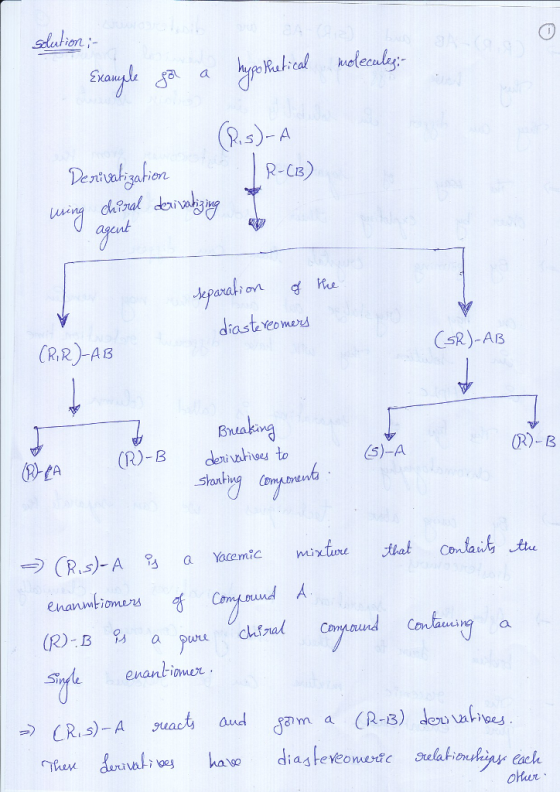
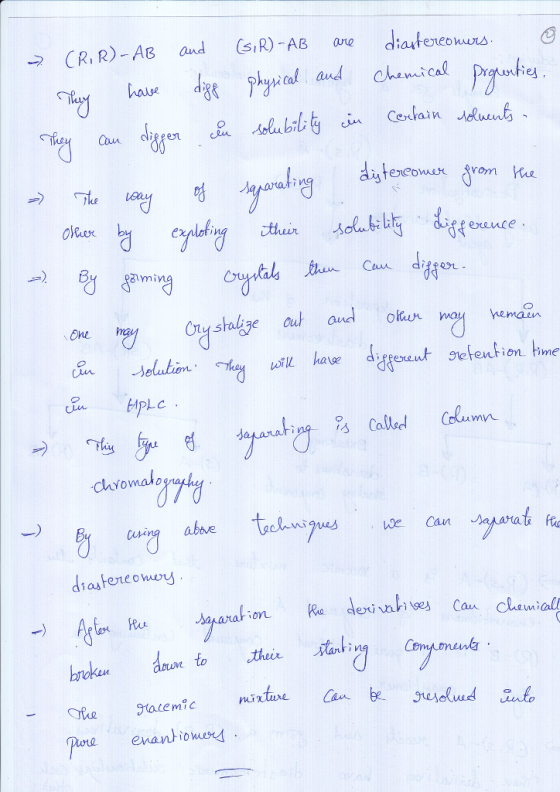
3. Explain with the example of a hypothetical molecule (R.S)-A the concept of separating enantiomers with...
Chirality: Resolution of Enantiomers Give one example of each of the following: Resolution of enantiomers using...
Chirality: Resolution of Enantiomers Give one example of each of the following: Resolution of enantiomers using a resolving agent Resolution of enantiomers using enzymatic resolution Resolution of enantiomers using a catalytic resolution
Give one example of each of the following: Resolution of enantiomers using a resolving agent Resolution...
Give one example of each of the following: Resolution of enantiomers using a resolving agent Resolution of enantiomers using enzymatic resolution Resolution of enantiomers using a catalytic resolution
Explain the concept of an international financial crisis give either a real or hypothetical example
Explain the concept of an international financial crisis give either a real or hypothetical example
3. The following molecule has carbon alumns in total and is an example of a (saturated...
 3. The following molecule has carbon alumns in total and is an example of a (saturated unsaturated) fatty acid with ſcis/trans) configuration. (1Spoints) 4. Draw the ritor Image of fe following molecule. Then, determine if they are enantiomers or identical. Circle the chiral center if prosent (15 points) CHE 1 5. Circle and label the carboxylic acid group, water group and alcohol group in the following reaction (30 points)
Enantiomers behave differently in the presence of other chiral molecules. Research the example of thalidomide to...
Enantiomers behave differently in the presence of other chiral molecules. Research the example of thalidomide to explain the significance of understanding the behaviour of different enantiomers, (remember to reference your sources, word count 300).
Enantiomers have the same physical properties and cannot be separated using typical laboratory method general, separation...
 Enantiomers have the same physical properties and cannot be separated using typical laboratory method general, separation can be achieved by converting a racemic mixture to two different diastereomers, which can then be separated Given the racemic amine and chiral resolving agent below, identify the two diastereomers formed. Use the following order X, Y, Z, where X refers to the configuration of the amine, while Y and Z refer to the configuration of the carboxylic acids R, R, R S, R,...
1. Identify all the chiral centers in the y all the chiral centers in the molecule...
 1. Identify all the chiral centers in the y all the chiral centers in the molecule below: 2. For each of the pairs of compounds, de indicate if they are identical, enantiomers, diastereomers, constitutional isomers or different compounds. 3. Identify the chiral centers in the diastereomers below and label each as R or S.
Explain the difference between enantiomers and diastereomers. Give one example of each.
Explain the difference between enantiomers and diastereomers. Give one example of each.
(R)-2-chloro-(S)-3-bromobutane and (S)-2-chloro-(S)-3-bromobutane are: A. enantiomers. B. diastereomers. C. meso compounds. D. the same molecule.
(R)-2-chloro-(S)-3-bromobutane and (S)-2-chloro-(S)-3-bromobutane are: A. enantiomers. B. diastereomers. C. meso compounds. D. the same molecule.
7) How many enantiomers are there of the molecule are there of the molecule shown bole...
 7) How many enantiomers are there of the molecule are there of the molecule shown bole CO2H 1 1 OH 1 CH2OH A) B)1 C)2 D) 3 E) 6 8) What term describes the structural relationship between (2R 3R.45)-2.3.4-trichloroheptane and (2S,3S,4R)-2,3,4-trichloroheptane? A) not isomers B) constitutional isomers C) enantiomers D) diastereomers E) conformers 9) Label cach asymmetric carbon in the molecule below as having the Ror S configuration. A) 1R, 2R B) IR, 2S C) IS, 2R D) IS, 2S...
 3. The following molecule has carbon alumns in total and is an example of a (saturated unsaturated) fatty acid with ſcis/trans) configuration. (1Spoints) 4. Draw the ritor Image of fe following molecule. Then, determine if they are enantiomers or identical. Circle the chiral center if prosent (15 points) CHE 1 5. Circle and label the carboxylic acid group, water group and alcohol group in the following reaction (30 points)
 Enantiomers have the same physical properties and cannot be separated using typical laboratory method general, separation can be achieved by converting a racemic mixture to two different diastereomers, which can then be separated Given the racemic amine and chiral resolving agent below, identify the two diastereomers formed. Use the following order X, Y, Z, where X refers to the configuration of the amine, while Y and Z refer to the configuration of the carboxylic acids R, R, R S, R,...
 1. Identify all the chiral centers in the y all the chiral centers in the molecule below: 2. For each of the pairs of compounds, de indicate if they are identical, enantiomers, diastereomers, constitutional isomers or different compounds. 3. Identify the chiral centers in the diastereomers below and label each as R or S.
 7) How many enantiomers are there of the molecule are there of the molecule shown bole CO2H 1 1 OH 1 CH2OH A) B)1 C)2 D) 3 E) 6 8) What term describes the structural relationship between (2R 3R.45)-2.3.4-trichloroheptane and (2S,3S,4R)-2,3,4-trichloroheptane? A) not isomers B) constitutional isomers C) enantiomers D) diastereomers E) conformers 9) Label cach asymmetric carbon in the molecule below as having the Ror S configuration. A) 1R, 2R B) IR, 2S C) IS, 2R D) IS, 2S...
Most questions answered within 3 hours.
-
Where is the error in this code sequence?
String s1 = "Hello";
String s2 = "ello";...
asked 10 months ago -
Financial data for Joel de Paris, Inc., for last year
follow:
Joel de Paris, Inc.
Balance...
asked 10 months ago -
Consider this reaction:
Al2(SO4)3 (aq)+ BaCl3
(aq) Al2Cl6 (aq)- +
3BaSO4(s) . What is the...
asked 10 months ago -
Suppose that Savneet is considering increasing her
recent random sample from 20 car rentals to 40...
asked 10 months ago -
Trucks arrive at an unloading terminal at an average rate of 120
per hour.
Trucks arrive...
asked 10 months ago -
Why are methanol and ethanol completely soluble in water while
octanol is not very little soluble....
asked 10 months ago -
A facilities manager at a university reads in a research report
that the mean amount of...
asked 10 months ago -
When the CuSO4 is rehydrated by adding water to the anhydrous
compound, is this an endothermic...
asked 10 months ago -
A ray of sunlight is passing from diamond into crown glass; the
angle of incidence is...
asked 10 months ago -
A block of mass 0.249 kg is placed on top of a light, vertical
spring of...
asked 10 months ago -
how do the kidneys compensate in the presences of acidosis
a) trigger hyperventilate
b) reserve acid...
asked 10 months ago -
Question 501 pts
The rental rate of capital to the firm increases. Which of the
following...
asked 10 months ago