
Homework Answers
Add Answer to:
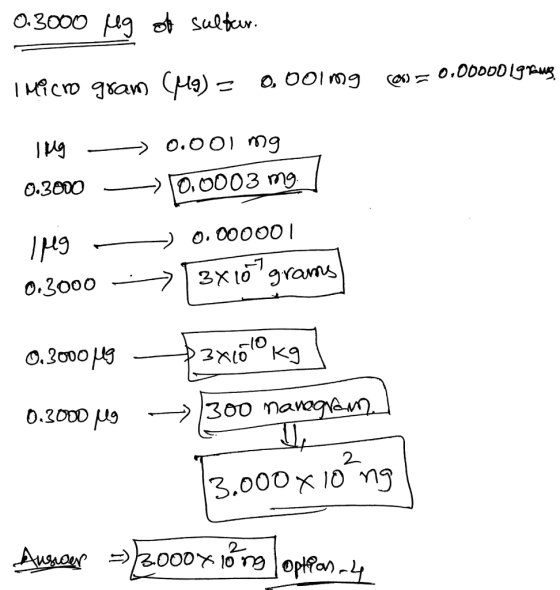
A student weighed 0.3000 μg of sulfur in the lab. This is the same mass as...
QUESTION 15 A student weighed 60.00 mg of sulfur in the lab. Convert this mass to...
 QUESTION 15 A student weighed 60.00 mg of sulfur in the lab. Convert this mass to ug and cg using clear calculations TT T Arial 3 (12pt) T- Path Click Save and Submit to save and submit. Click Save All Answers to save alla 12 3 5. R.
Question 4 2 pts In lab, a student weighed out 1.576 g of unknown in a beaker. The student added ...
 Question 4 2 pts In lab, a student weighed out 1.576 g of unknown in a beaker. The student added 58 mL DI water and followed the protocol in the lab to filter and dry the product, which had a final mass of 0.616 g. The filtrate was tested, and the student determined that CaCl2 2H2O was the limiting reactant. Determine the percent by mass composition of CaCl2 2H20 in the original unknown sample. Note: These numbers ate for calculation...
In a lab experiment, 6.9 g of Mg reacts with sulfur to form 16.0 g of...
 In a lab experiment, 6.9 g of Mg reacts with sulfur to form 16.0 g of magnesium sulfide. (a) Use the equation below to calculate the percentage by mass of Mg in magnesium sulfide. % X component = amount of component x.. total amount 4.9 % (b) How many grams of sulfur reacted? 49 How do you know? O law of constant composition O law of definite proportions O law of multiple proportions O law of conservation of mass
In lab, a student weighed out 3.281 g of an unknown salt. Her coffee cup calorimeter...
In lab, a student weighed out 3.281 g of an unknown salt. Her coffee cup calorimeter weighed 36.763 g. After adding water it weighed 94.732 g. Before the addition of salt, the temperature of the water in the coffee cup was 19.5 d e g r e e s C . After all the salt dissolved the maximum temperature was 25 d e g r e e s C . Calculate the enthalpy of solution for the salt, d e...
In a lab experiment, 6.3 g of Mg reacts with sulfur to form 14.6 g of...
 In a lab experiment, 6.3 g of Mg reacts with sulfur to form 14.6 g of magnesium sulfide. (a) Use the equation below to calculate the percentage by mass of Mg in magnesium sulfide. % X component amount of component x 400 total amount (b) How many grams of sulfur reacted? How do you know? law of constant composition law of conservation of mass law of definite proportions law of multiple proportions Need Help?
In lab, a student weighed out 3.605 g of an unknown salt. Her coffee cup calorimeter...
 In lab, a student weighed out 3.605 g of an unknown salt. Her coffee cup calorimeter weighed 38.959 g. After adding water it weighed 84.268 g. Before the addition of salt, the temperature of the water in the coffee cup was 19.9° C. After all the salt dissolved the maximum temperature was 17.4° C. Calculate the enthalpy of solution for the salt, AHsin Report your answer in J. You can practice the math using this virtual lab. Note: Use the...
Question 5 2.5 pts In lab, a student weighed out 3.852 g of an unknown salt....
 Question 5 2.5 pts In lab, a student weighed out 3.852 g of an unknown salt. Her coffee cup calorimeter weighed 39.845 g. After adding water it weighed 83.141 g. Before the addition of salt, the temperature of the water in the coffee cup was 17°C. After all the salt dissolved the maximum temperature was 21.7°C. Calculate the enthalpy of solution for the salt, AHIn Report your answer in J. You can practice the math using this virtual lab. Note:...
Question 5 2.5 pts In lab, a student weighed out 3.852 g of an unknown salt....
 Question 5 2.5 pts In lab, a student weighed out 3.852 g of an unknown salt. Her coffee cup calorimeter weighed 39.845 g. After adding water it weighed 83.141 g. Before the addition of salt, the temperature of the water in the coffee cup was 17°C. After all the salt dissolved the maximum temperature was 21.7°C. Calculate the enthalpy of solution for the salt, AHIn Report your answer in J. You can practice the math using this virtual lab. Note:...
Question 5 2.5 pts In lab, a student weighed out 3.578 g of an unknown salt. Her coffee cup calorimeter weighed 38.248...
 Question 5 2.5 pts In lab, a student weighed out 3.578 g of an unknown salt. Her coffee cup calorimeter weighed 38.248 g. After adding water it weighed 85.784 g. Before the addition of salt, the temperature of the water in the coffee cup was 21° C. After all the salt dissolved the maximum temperature was 18.3 °C. Calculate the enthalpy of solution for the salt, AHln. Report your answer in J. You can practice the math using this virtual...
(a) What is the density in units of g/mL ofa liquid with a mass of40.75 μg...
 (a) What is the density in units of g/mL ofa liquid with a mass of40.75 μg that occupies a volume of292 x 10-8 L? (b) Determine the mass in kg of 6.3 x 10 nL of the liquid.
 QUESTION 15 A student weighed 60.00 mg of sulfur in the lab. Convert this mass to ug and cg using clear calculations TT T Arial 3 (12pt) T- Path Click Save and Submit to save and submit. Click Save All Answers to save alla 12 3 5. R.
 Question 4 2 pts In lab, a student weighed out 1.576 g of unknown in a beaker. The student added 58 mL DI water and followed the protocol in the lab to filter and dry the product, which had a final mass of 0.616 g. The filtrate was tested, and the student determined that CaCl2 2H2O was the limiting reactant. Determine the percent by mass composition of CaCl2 2H20 in the original unknown sample. Note: These numbers ate for calculation...
 In a lab experiment, 6.9 g of Mg reacts with sulfur to form 16.0 g of magnesium sulfide. (a) Use the equation below to calculate the percentage by mass of Mg in magnesium sulfide. % X component = amount of component x.. total amount 4.9 % (b) How many grams of sulfur reacted? 49 How do you know? O law of constant composition O law of definite proportions O law of multiple proportions O law of conservation of mass
 In a lab experiment, 6.3 g of Mg reacts with sulfur to form 14.6 g of magnesium sulfide. (a) Use the equation below to calculate the percentage by mass of Mg in magnesium sulfide. % X component amount of component x 400 total amount (b) How many grams of sulfur reacted? How do you know? law of constant composition law of conservation of mass law of definite proportions law of multiple proportions Need Help?
 In lab, a student weighed out 3.605 g of an unknown salt. Her coffee cup calorimeter weighed 38.959 g. After adding water it weighed 84.268 g. Before the addition of salt, the temperature of the water in the coffee cup was 19.9° C. After all the salt dissolved the maximum temperature was 17.4° C. Calculate the enthalpy of solution for the salt, AHsin Report your answer in J. You can practice the math using this virtual lab. Note: Use the...
 Question 5 2.5 pts In lab, a student weighed out 3.852 g of an unknown salt. Her coffee cup calorimeter weighed 39.845 g. After adding water it weighed 83.141 g. Before the addition of salt, the temperature of the water in the coffee cup was 17°C. After all the salt dissolved the maximum temperature was 21.7°C. Calculate the enthalpy of solution for the salt, AHIn Report your answer in J. You can practice the math using this virtual lab. Note:...
 Question 5 2.5 pts In lab, a student weighed out 3.852 g of an unknown salt. Her coffee cup calorimeter weighed 39.845 g. After adding water it weighed 83.141 g. Before the addition of salt, the temperature of the water in the coffee cup was 17°C. After all the salt dissolved the maximum temperature was 21.7°C. Calculate the enthalpy of solution for the salt, AHIn Report your answer in J. You can practice the math using this virtual lab. Note:...
 Question 5 2.5 pts In lab, a student weighed out 3.578 g of an unknown salt. Her coffee cup calorimeter weighed 38.248 g. After adding water it weighed 85.784 g. Before the addition of salt, the temperature of the water in the coffee cup was 21° C. After all the salt dissolved the maximum temperature was 18.3 °C. Calculate the enthalpy of solution for the salt, AHln. Report your answer in J. You can practice the math using this virtual...
 (a) What is the density in units of g/mL ofa liquid with a mass of40.75 μg that occupies a volume of292 x 10-8 L? (b) Determine the mass in kg of 6.3 x 10 nL of the liquid.
Most questions answered within 3 hours.
-
Where is the error in this code sequence?
String s1 = "Hello";
String s2 = "ello";...
asked 11 months ago -
Financial data for Joel de Paris, Inc., for last year
follow:
Joel de Paris, Inc.
Balance...
asked 11 months ago -
Consider this reaction:
Al2(SO4)3 (aq)+ BaCl3
(aq) Al2Cl6 (aq)- +
3BaSO4(s) . What is the...
asked 11 months ago -
Suppose that Savneet is considering increasing her
recent random sample from 20 car rentals to 40...
asked 11 months ago -
Trucks arrive at an unloading terminal at an average rate of 120
per hour.
Trucks arrive...
asked 11 months ago -
Why are methanol and ethanol completely soluble in water while
octanol is not very little soluble....
asked 11 months ago -
A facilities manager at a university reads in a research report
that the mean amount of...
asked 11 months ago -
When the CuSO4 is rehydrated by adding water to the anhydrous
compound, is this an endothermic...
asked 11 months ago -
A ray of sunlight is passing from diamond into crown glass; the
angle of incidence is...
asked 11 months ago -
A block of mass 0.249 kg is placed on top of a light, vertical
spring of...
asked 11 months ago -
how do the kidneys compensate in the presences of acidosis
a) trigger hyperventilate
b) reserve acid...
asked 11 months ago -
Question 501 pts
The rental rate of capital to the firm increases. Which of the
following...
asked 11 months ago