-
Write a short summary of conclusions on the linearity and whether your results are consistent with Beer’s Law relationship. If not, what could be the possible reasons for errors andhow would you improve your experimental process? (even if you had accurate values, comment from the perspective of a different student who might not get good results
Homework Answers
Beer's law states that
A c where A is
absorption and c is the concentration of the solution. So
absorbance and concentration have a linear relationship according
to Beers Law and they satisfy a y = m*x type of straight line i.e.
a straight line with zero intercept. Now if we look into the
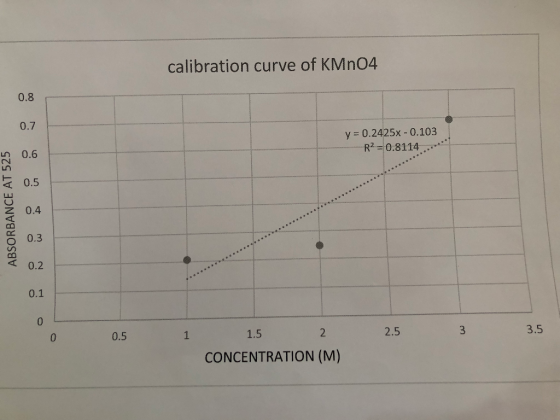
experimental data and fitted line we can see that the fitted line
has an equation y = 0.2425x-0.103. This is inconsistent with Beer's
law as the intercept should have been zero. Moreover none of the
experimental points are on the fitted line which is evident from
the R2 value of 0.8114. R2 measures the
goodness of the fit and is best when nearly equal to 1. So
evidently there are many errors associated with the experiment.
The major source of error in a Beer's law experiment arises from concentration. Beer's law is only valid for low concentration ranges, not for high concentrations. So if the experiment was performed at lower concentrations then a better data set could have been obtained. Other sources of experimental errors can arise from improper cleaning of the cuvette before measurement. If some other material is present in the cuvette or sample from the one data point is not cleaned properly then light can be absorbed by them which will impose error. So each time cuvette needs to be cleaned properly.
Add Answer to:
Write a short summary of conclusions on the linearity and
whether your results are consistent with...
Most questions answered within 3 hours.
-
Where is the error in this code sequence?
String s1 = "Hello";
String s2 = "ello";...
asked 10 months ago -
Financial data for Joel de Paris, Inc., for last year
follow:
Joel de Paris, Inc.
Balance...
asked 10 months ago -
Consider this reaction:
Al2(SO4)3 (aq)+ BaCl3
(aq) Al2Cl6 (aq)- +
3BaSO4(s) . What is the...
asked 10 months ago -
Suppose that Savneet is considering increasing her
recent random sample from 20 car rentals to 40...
asked 10 months ago -
Trucks arrive at an unloading terminal at an average rate of 120
per hour.
Trucks arrive...
asked 10 months ago -
Why are methanol and ethanol completely soluble in water while
octanol is not very little soluble....
asked 10 months ago -
A facilities manager at a university reads in a research report
that the mean amount of...
asked 10 months ago -
When the CuSO4 is rehydrated by adding water to the anhydrous
compound, is this an endothermic...
asked 10 months ago -
A ray of sunlight is passing from diamond into crown glass; the
angle of incidence is...
asked 10 months ago -
A block of mass 0.249 kg is placed on top of a light, vertical
spring of...
asked 10 months ago -
how do the kidneys compensate in the presences of acidosis
a) trigger hyperventilate
b) reserve acid...
asked 10 months ago -
Question 501 pts
The rental rate of capital to the firm increases. Which of the
following...
asked 10 months ago