
Homework Answers
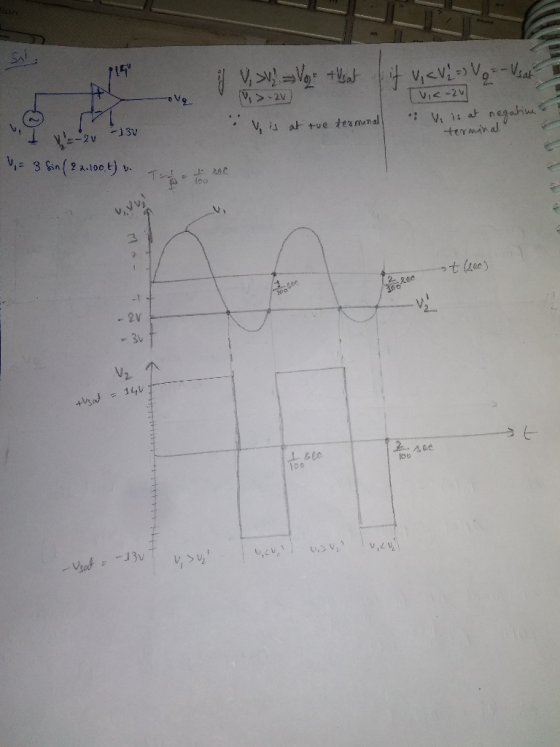
if it is helpful to u, please like/thumbsup..
Add Answer to:
0+15V a ComPARATOR with VSAT = 14V -VSAT = -13v A + trisu Nz 1 TYPICAL...
Please include all steps in the solution, thank you in advance! ar IDEAL OP-Ame W ที่...
 Please include all steps in the solution, thank you in
advance!
ar IDEAL OP-Ame W ที่ 11 2 Lumta 'o' FIND Vz IN TERMS of V, & Vz. CHINT: CAN you find THE NON-INVERTING Amplifier IN THIS CIRCUIT ? you CAN USE What you know ABOUT THIS AMPLIFIER to solue for V3 ) 0 +ISV al ComPARATOX Wim Vas 14v -13V Jisu Nz <> TYPICAL VAlves USING A 741 Op-Arne AS A COMPARATOR If V, - 3 sin (21.100.t)v, sketen...
Please include all steps in the solution, thank you in
advance!
ar IDEAL OP-Ame W ที่ 11 2 Lumta 'o' FIND Vz IN TERMS of V, & Vz. CHINT: CAN you find THE NON-INVERTING Amplifier IN THIS CIRCUIT ? you CAN USE What you know ABOUT THIS AMPLIFIER to solue for V3 ) 0 +ISV al ComPARATOX Wim Vas 14v -13V Jisu Nz <> TYPICAL VAlves USING A 741 Op-Arne AS A COMPARATOR If V, - 3 sin (21.100.t)v, sketen...
1. Use supply voltage +/- 15V and design a comparator op-amp circuit where the output becomes...
1. Use supply voltage +/- 15V and design a comparator op-amp circuit where the output becomes maximum positive when the input is higher then 5V. 2. Sketch the output voltage relative to the input voltage of the circuit. 3. How can we get maximum negative output voltage when the input voltage is bigger then 5V?
ECE 202- Experiment 3-PreLab Homework NTROD TION TOTHE INTEG IRO T OP AMP VOLTAGE COMPARATOR 1....
 ECE 202- Experiment 3-PreLab Homework NTROD TION TOTHE INTEG IRO T OP AMP VOLTAGE COMPARATOR 1. Op Amp functions in two different modes, depending on the way it is connected in the circuit a) If there is no return loop, t is used to compare values of two input terminals (or as Explain how vo changes depending on the values of vi and v Vo . what are max and/or min values for v and vo? 2·The circuit shown below...
Problem # 3 For the summing opamp circuit, assume that the opamp is powered with +15V and-15V. Th...
 Problem # 3 For the summing opamp circuit, assume that the opamp is powered with +15V and-15V. The input voltages are VI and V2 and the output voltage is Vout. Rf 15 V U1 R1 R2 Vout 741 V2 (A -15 V 1. Find the relation between the output Vout and the inputs VI and V2 2. Assume that RI-2kS2, R2-3 ㏀ and Rf-6kS2, Vin is a sinewave with viinpp-2V, V2DC- IV, plot Vin() and Vout(0) 3. Assume that you...
Question 6 3 pts 1. Compare your experimental results to the previously-computed theoretical values. 2. Explain...
 Question 6 3 pts 1. Compare your experimental results to the previously-computed theoretical values. 2. Explain your observation from the oscilloscope output waveform. HTML Editor IEE xx E E A B I UA T ECE 12pt Paragraph Use the circuit diagram as shown in Figure A below to conduct the experiment and answer the questions 1 to 6. VCC VCC 15V 15V U2 U1 Voutt R3 1.0k Vout2 741 + 741 R1 2.2kQ VEE 4 VEE -15V Vin 0.75 V(p-p)...
Problem 2 110 points) For an ideal op-amp model and a typical 741 op-amp chip, the...
 Problem 2 110 points) For an ideal op-amp model and a typical 741 op-amp chip, the following partial table is provided. 1. Furnish the two (2) missing responses in the "Typical Value" column from the attached UM741 data sheet. Note: Use the "Typ" column on the data sheet for your responses. 2. Furnish the four (4) missing responses in the "Ideal Value” column from what you remember in class about the ideal op amp model Ideal Value Typical Value Parameter...
Problem # 1 [15 Points] Consider the following PDE which describes a typical heat-flow problem PDE: ut = ↵2uxx, 0 < x < 1, 0 < t < 1 BCs: ux(0, t)=0 ux(1, t)=0 0 < t < 1 IC...
Problem # 1 [15 Points] Consider the following PDE which describes a typical heat-flow problem PDE: ut = ↵2uxx, 0 < x < 1, 0 < t < 1 BCs: ux(0, t)=0 ux(1, t)=0 0 < t < 1 IC: u(x, 0) = sin(⇡x), 0 x 1 (a) What is your physical interpretation of the above problem? (b) Can you draw rough sketches of the solution for various values of time? (c) What about the steady-state temperature?
can you please solve this using a software simulator like multisim or something similar ?? VCC...
 can you please solve this using a software simulator like
multisim or something similar ??
VCC VCC 15V 15V U2 7 3 + U1 6 3 Vouth 741 R3 + Vout1 2 6 R1 741 2 1.0k 2 2.2k2 VEE -15V VEE -15V Vin= 0.75 Vp-p) @ 2 kHz R2 R4 4.7k2 10kΩ Figure A Op-amp U1&U2 • Use myDAQ's oscilloscope to capture the input waveform Vin (oh Channel 0) and the final output waveform Vout2 (on Channel 1) superintposed....
can you please solve this using a software simulator like
multisim or something similar ??
VCC VCC 15V 15V U2 7 3 + U1 6 3 Vouth 741 R3 + Vout1 2 6 R1 741 2 1.0k 2 2.2k2 VEE -15V VEE -15V Vin= 0.75 Vp-p) @ 2 kHz R2 R4 4.7k2 10kΩ Figure A Op-amp U1&U2 • Use myDAQ's oscilloscope to capture the input waveform Vin (oh Channel 0) and the final output waveform Vout2 (on Channel 1) superintposed....
)Consider the wave equation for a vibrating string of semi-infnite length with a fixed end at z = 0, t > 0 a(0,t) = 0, and initial conditions 0 < x < oo u(z,0) = 1-cos(nz), ut(x,0) = 0,...
 )Consider the wave equation for a vibrating string of semi-infnite length with a fixed end at z = 0, t > 0 a(0,t) = 0, and initial conditions 0 < x < oo u(z,0) = 1-cos(nz), ut(x,0) = 0, Complete the table below with the values of u(0.5, t) at the specified time instants 0.5 0.5 x 0.5 0.5 0.5 2 0.5 0.75 t 0.25 u(x,t)
)Consider the wave equation for a vibrating string of semi-infnite length with a fixed...
)Consider the wave equation for a vibrating string of semi-infnite length with a fixed end at z = 0, t > 0 a(0,t) = 0, and initial conditions 0 < x < oo u(z,0) = 1-cos(nz), ut(x,0) = 0, Complete the table below with the values of u(0.5, t) at the specified time instants 0.5 0.5 x 0.5 0.5 0.5 2 0.5 0.75 t 0.25 u(x,t)
)Consider the wave equation for a vibrating string of semi-infnite length with a fixed...
Please do not copy the previous answer for this question. and please explain and write clearly....
 Please do not copy the previous answer for this question. and
please explain and write clearly. Many thanks!
Please answer questions 1,2,3 for n=1,8=2,a=3,B=4,8=5 The component values in the circuit shown in Fig. I are: • • • • vs(t) = A sin (2 reft) mV, where A = (2000+ n) and f = (10+8) Hz Ri -(1000 + a)2 R2-(1000+B) 22 R, (1000+ €) 22 For example, if n = 8,8 = 5 and a=1, Vs(t) = 2.008 sin(...
Please do not copy the previous answer for this question. and
please explain and write clearly. Many thanks!
Please answer questions 1,2,3 for n=1,8=2,a=3,B=4,8=5 The component values in the circuit shown in Fig. I are: • • • • vs(t) = A sin (2 reft) mV, where A = (2000+ n) and f = (10+8) Hz Ri -(1000 + a)2 R2-(1000+B) 22 R, (1000+ €) 22 For example, if n = 8,8 = 5 and a=1, Vs(t) = 2.008 sin(...
 Please include all steps in the solution, thank you in
advance!
ar IDEAL OP-Ame W ที่ 11 2 Lumta 'o' FIND Vz IN TERMS of V, & Vz. CHINT: CAN you find THE NON-INVERTING Amplifier IN THIS CIRCUIT ? you CAN USE What you know ABOUT THIS AMPLIFIER to solue for V3 ) 0 +ISV al ComPARATOX Wim Vas 14v -13V Jisu Nz <> TYPICAL VAlves USING A 741 Op-Arne AS A COMPARATOR If V, - 3 sin (21.100.t)v, sketen...
Please include all steps in the solution, thank you in
advance!
ar IDEAL OP-Ame W ที่ 11 2 Lumta 'o' FIND Vz IN TERMS of V, & Vz. CHINT: CAN you find THE NON-INVERTING Amplifier IN THIS CIRCUIT ? you CAN USE What you know ABOUT THIS AMPLIFIER to solue for V3 ) 0 +ISV al ComPARATOX Wim Vas 14v -13V Jisu Nz <> TYPICAL VAlves USING A 741 Op-Arne AS A COMPARATOR If V, - 3 sin (21.100.t)v, sketen...
 ECE 202- Experiment 3-PreLab Homework NTROD TION TOTHE INTEG IRO T OP AMP VOLTAGE COMPARATOR 1. Op Amp functions in two different modes, depending on the way it is connected in the circuit a) If there is no return loop, t is used to compare values of two input terminals (or as Explain how vo changes depending on the values of vi and v Vo . what are max and/or min values for v and vo? 2·The circuit shown below...
 Problem # 3 For the summing opamp circuit, assume that the opamp is powered with +15V and-15V. The input voltages are VI and V2 and the output voltage is Vout. Rf 15 V U1 R1 R2 Vout 741 V2 (A -15 V 1. Find the relation between the output Vout and the inputs VI and V2 2. Assume that RI-2kS2, R2-3 ㏀ and Rf-6kS2, Vin is a sinewave with viinpp-2V, V2DC- IV, plot Vin() and Vout(0) 3. Assume that you...
 Question 6 3 pts 1. Compare your experimental results to the previously-computed theoretical values. 2. Explain your observation from the oscilloscope output waveform. HTML Editor IEE xx E E A B I UA T ECE 12pt Paragraph Use the circuit diagram as shown in Figure A below to conduct the experiment and answer the questions 1 to 6. VCC VCC 15V 15V U2 U1 Voutt R3 1.0k Vout2 741 + 741 R1 2.2kQ VEE 4 VEE -15V Vin 0.75 V(p-p)...
 Problem 2 110 points) For an ideal op-amp model and a typical 741 op-amp chip, the following partial table is provided. 1. Furnish the two (2) missing responses in the "Typical Value" column from the attached UM741 data sheet. Note: Use the "Typ" column on the data sheet for your responses. 2. Furnish the four (4) missing responses in the "Ideal Value” column from what you remember in class about the ideal op amp model Ideal Value Typical Value Parameter...
 can you please solve this using a software simulator like
multisim or something similar ??
VCC VCC 15V 15V U2 7 3 + U1 6 3 Vouth 741 R3 + Vout1 2 6 R1 741 2 1.0k 2 2.2k2 VEE -15V VEE -15V Vin= 0.75 Vp-p) @ 2 kHz R2 R4 4.7k2 10kΩ Figure A Op-amp U1&U2 • Use myDAQ's oscilloscope to capture the input waveform Vin (oh Channel 0) and the final output waveform Vout2 (on Channel 1) superintposed....
can you please solve this using a software simulator like
multisim or something similar ??
VCC VCC 15V 15V U2 7 3 + U1 6 3 Vouth 741 R3 + Vout1 2 6 R1 741 2 1.0k 2 2.2k2 VEE -15V VEE -15V Vin= 0.75 Vp-p) @ 2 kHz R2 R4 4.7k2 10kΩ Figure A Op-amp U1&U2 • Use myDAQ's oscilloscope to capture the input waveform Vin (oh Channel 0) and the final output waveform Vout2 (on Channel 1) superintposed....
 )Consider the wave equation for a vibrating string of semi-infnite length with a fixed end at z = 0, t > 0 a(0,t) = 0, and initial conditions 0 < x < oo u(z,0) = 1-cos(nz), ut(x,0) = 0, Complete the table below with the values of u(0.5, t) at the specified time instants 0.5 0.5 x 0.5 0.5 0.5 2 0.5 0.75 t 0.25 u(x,t)
)Consider the wave equation for a vibrating string of semi-infnite length with a fixed...
)Consider the wave equation for a vibrating string of semi-infnite length with a fixed end at z = 0, t > 0 a(0,t) = 0, and initial conditions 0 < x < oo u(z,0) = 1-cos(nz), ut(x,0) = 0, Complete the table below with the values of u(0.5, t) at the specified time instants 0.5 0.5 x 0.5 0.5 0.5 2 0.5 0.75 t 0.25 u(x,t)
)Consider the wave equation for a vibrating string of semi-infnite length with a fixed...
 Please do not copy the previous answer for this question. and
please explain and write clearly. Many thanks!
Please answer questions 1,2,3 for n=1,8=2,a=3,B=4,8=5 The component values in the circuit shown in Fig. I are: • • • • vs(t) = A sin (2 reft) mV, where A = (2000+ n) and f = (10+8) Hz Ri -(1000 + a)2 R2-(1000+B) 22 R, (1000+ €) 22 For example, if n = 8,8 = 5 and a=1, Vs(t) = 2.008 sin(...
Please do not copy the previous answer for this question. and
please explain and write clearly. Many thanks!
Please answer questions 1,2,3 for n=1,8=2,a=3,B=4,8=5 The component values in the circuit shown in Fig. I are: • • • • vs(t) = A sin (2 reft) mV, where A = (2000+ n) and f = (10+8) Hz Ri -(1000 + a)2 R2-(1000+B) 22 R, (1000+ €) 22 For example, if n = 8,8 = 5 and a=1, Vs(t) = 2.008 sin(...
Most questions answered within 3 hours.
-
Where is the error in this code sequence?
String s1 = "Hello";
String s2 = "ello";...
asked 10 months ago -
Financial data for Joel de Paris, Inc., for last year
follow:
Joel de Paris, Inc.
Balance...
asked 10 months ago -
Consider this reaction:
Al2(SO4)3 (aq)+ BaCl3
(aq) Al2Cl6 (aq)- +
3BaSO4(s) . What is the...
asked 10 months ago -
Suppose that Savneet is considering increasing her
recent random sample from 20 car rentals to 40...
asked 10 months ago -
Trucks arrive at an unloading terminal at an average rate of 120
per hour.
Trucks arrive...
asked 10 months ago -
Why are methanol and ethanol completely soluble in water while
octanol is not very little soluble....
asked 10 months ago -
A facilities manager at a university reads in a research report
that the mean amount of...
asked 10 months ago -
When the CuSO4 is rehydrated by adding water to the anhydrous
compound, is this an endothermic...
asked 10 months ago -
A ray of sunlight is passing from diamond into crown glass; the
angle of incidence is...
asked 10 months ago -
A block of mass 0.249 kg is placed on top of a light, vertical
spring of...
asked 10 months ago -
how do the kidneys compensate in the presences of acidosis
a) trigger hyperventilate
b) reserve acid...
asked 10 months ago -
Question 501 pts
The rental rate of capital to the firm increases. Which of the
following...
asked 10 months ago