
Homework Answers
Add Answer to:
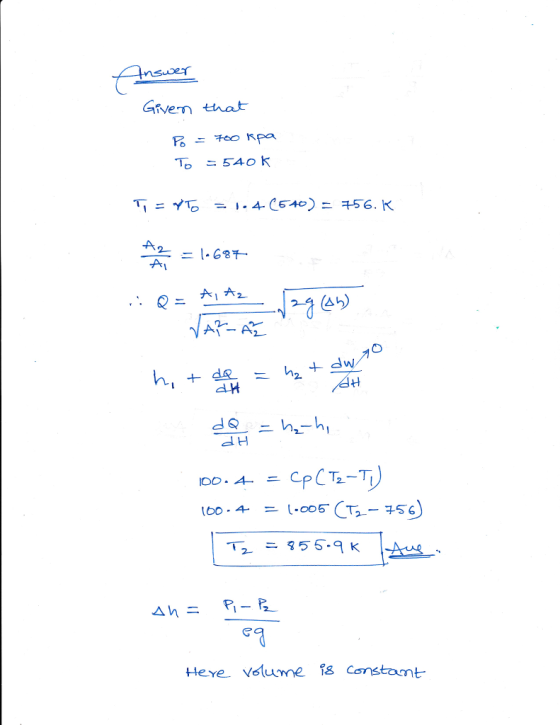
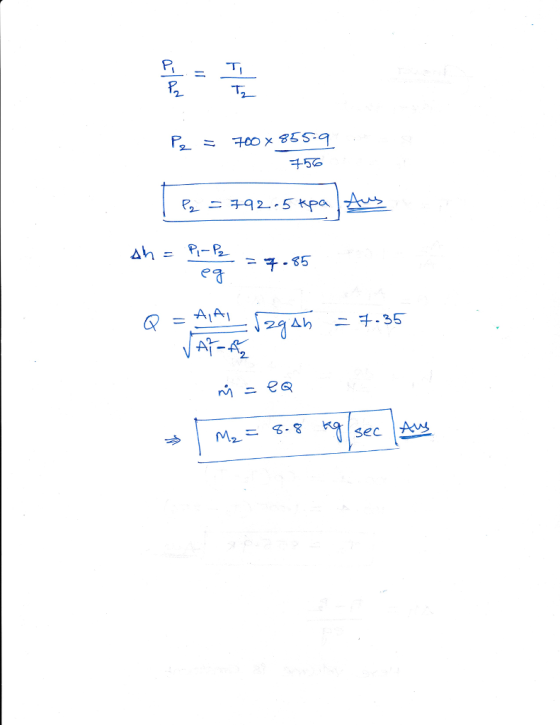
9. A constant-area duct connected to a C-D nozzle with 1,687. The nozzle is fed by...
1. (15 pts) A converging-diverging nozzle has an area ratio of 2, i.e., the exit (or duct) area is 2 times the throa...
 1. (15 pts) A converging-diverging nozzle has an area ratio of 2, i.e., the exit (or duct) area is 2 times the throat area, which is 80 cm2. The nozzle is supplied from a tank containing air (y 1.4 and R 287 J/kg K) at 100 kPa and 300K. For both cases shown in Fig. , find the maximum mass flow possible through the nozzle and the range of back pressures over which the mass flow can be attained. For...
1. (15 pts) A converging-diverging nozzle has an area ratio of 2, i.e., the exit (or duct) area is 2 times the throa...
 1. (15 pts) A converging-diverging nozzle has an area ratio of 2, i.e., the exit (or duct) area is 2 times the throat area, which is 80 cm2. The nozzle is supplied from a tank containing air (y 1.4 and R 287 J/kg K) at 100 kPa and 300K. For both cases shown in Fig. , find the maximum mass flow possible through the nozzle and the range of back pressures over which the mass flow can be attained. For...
Problem 2 was... Air exapands in a frictionless adiabatic flow through a converging-diverging nozzle at a...
 Problem 2 was...
Air exapands in a frictionless adiabatic flow through a
converging-diverging nozzle at a mass flow rate of 2.5 kg/s. Source
stagnation condition are 1.1 Mpa and 115 C. If the nozzle exit
pressure is 141 kPa, and there are no shocks in the nozzle, find
the (a) the exit area Ae; (b) the throat At.
And I got (a) Ae = 1.11 * 10^(-3) m^2 and (b) At = 1.87 *
10^(-3) m^2
3. For the nozzle...
Problem 2 was...
Air exapands in a frictionless adiabatic flow through a
converging-diverging nozzle at a mass flow rate of 2.5 kg/s. Source
stagnation condition are 1.1 Mpa and 115 C. If the nozzle exit
pressure is 141 kPa, and there are no shocks in the nozzle, find
the (a) the exit area Ae; (b) the throat At.
And I got (a) Ae = 1.11 * 10^(-3) m^2 and (b) At = 1.87 *
10^(-3) m^2
3. For the nozzle...
Question 4 Soalan 4] (a) A supersonic nozzle is attached to a constant diameter circular duct...
 Question 4 Soalan 4] (a) A supersonic nozzle is attached to a constant diameter circular duct at its exit The duct diameter is the same as the nozzle exit diameter. Nozzle exit cross- section area is three times that of its throat. The gas (k1.4, R = 287 J/kg-K ) enters the nozzle with pressure and temperature of 10 bar and 600 K respectively with negligible velocity. If a normal shock occurs at a section in the diverging part of...
(a) A supersonic nozzle is attached to a constant diameter circular duct at its exit The...
 (a) A supersonic nozzle is attached to a constant diameter circular duct at its exit The duct diameter is the same as the nozzle exit diameter. Nozzle exit cross section area is three times that of its throat. The gas (k-14, R 287 Jg K) enters the nozzle with pressure and temperature of 10 bar and 600 Krespectively with negligible velocity. If a normal shock occurs at a section in the diverging part of the nozzle where the area ratio...
Fundamentals-of-Compressible-Fluid-Dynamics Balachandran CHAPTER 4 6. A conical diffuser of 15 cm...
Fundamentals-of-Compressible-Fluid-Dynamics Balachandran CHAPTER 4 6. A conical diffuser of 15 cm has an area ratio of 4. If the pressure, temperature and velocity at the inlet section are 0.69 bar, 340 K and 180 m/s, estimate the exit pressure and exit velocity. What will be the change in impulse function. [Ans. p2 = 0.8074 bar; V2 = 45 m/s; F2 - F1 = 4167.5 N] 7. The Mach number at inlet and exit of a supersonic diffuser are 3 and...
3. Air enters a constant area duct at a Mach number of 0.14, a pressure of 195 kPa, and a temperature of 25 °C. Heat is added to the air that flows through the duct at a rate of 65 kJ/kg of air. A...
 3. Air enters a constant area duct at a Mach number of 0.14, a pressure of 195 kPa, and a temperature of 25 °C. Heat is added to the air that flows through the duct at a rate of 65 kJ/kg of air. Assuming that the flow is steady and that the effects of wall friction can be ignored, find the temperature, pressure, and Mach number at which the air leaves the duct. Assume that the air behaves as a...
2. An aircraft with a single turbojet engine (with an inlet area of 1 m2) is...
 2. An aircraft with a single turbojet engine (with an inlet area of 1 m2) is flying at cruising condition with a flight Mach number of 0.7. The ambient temperature and pressure are 250 K and 100 kPa, respectively. The engine compressor pressure ratio is 12, and the turbine inlet temperature is 1200 K. Assume all mechanical components are operating at isentropic condition and the specific heat can be considered a constant (throughout the entire engine) of 1 kJ/(kg K)....
5-30 Air enters an adiabatic nozzle steadily at 300 kPa, 200°C, and 30 m/s and leaves...
 5-30 Air enters an adiabatic nozzle steadily at 300 kPa, 200°C, and 30 m/s and leaves at 100 kPa and 180 m/s. The inlet area of the nozzle is 80 cm². Determine (a) the mass flow rate through the nozzle, (b) the exit temperature of the air, and (c) the exit area of the nozzle. Answers: (a) 0.5304 kg/s, (b) 184.6°C, (c) 38.7 cm P = 300 kPa T, = 200°C Vi = 30 m/s A = 80 cm AIR...
8-C) As shown below water is pumped and sprayed through a nozzle into the atmosphere at 20 m/s at...
 8-C) As shown below water is pumped and sprayed through a nozzle into the atmosphere at 20 m/s at an elevation 10 m above the reservoir surface. The mass flow rate is 40 kg/s and the volumetric flow rate is 0.040 m3/s. The large diameter inlet pipe total length is 50 m. The pump effidency is 65%. The longer smaller diameter pipe leaving the pump is 200 m in total length. The pipes have different diameters as indicated below. The...
 1. (15 pts) A converging-diverging nozzle has an area ratio of 2, i.e., the exit (or duct) area is 2 times the throat area, which is 80 cm2. The nozzle is supplied from a tank containing air (y 1.4 and R 287 J/kg K) at 100 kPa and 300K. For both cases shown in Fig. , find the maximum mass flow possible through the nozzle and the range of back pressures over which the mass flow can be attained. For...
 1. (15 pts) A converging-diverging nozzle has an area ratio of 2, i.e., the exit (or duct) area is 2 times the throat area, which is 80 cm2. The nozzle is supplied from a tank containing air (y 1.4 and R 287 J/kg K) at 100 kPa and 300K. For both cases shown in Fig. , find the maximum mass flow possible through the nozzle and the range of back pressures over which the mass flow can be attained. For...
 Problem 2 was...
Air exapands in a frictionless adiabatic flow through a
converging-diverging nozzle at a mass flow rate of 2.5 kg/s. Source
stagnation condition are 1.1 Mpa and 115 C. If the nozzle exit
pressure is 141 kPa, and there are no shocks in the nozzle, find
the (a) the exit area Ae; (b) the throat At.
And I got (a) Ae = 1.11 * 10^(-3) m^2 and (b) At = 1.87 *
10^(-3) m^2
3. For the nozzle...
Problem 2 was...
Air exapands in a frictionless adiabatic flow through a
converging-diverging nozzle at a mass flow rate of 2.5 kg/s. Source
stagnation condition are 1.1 Mpa and 115 C. If the nozzle exit
pressure is 141 kPa, and there are no shocks in the nozzle, find
the (a) the exit area Ae; (b) the throat At.
And I got (a) Ae = 1.11 * 10^(-3) m^2 and (b) At = 1.87 *
10^(-3) m^2
3. For the nozzle...
 Question 4 Soalan 4] (a) A supersonic nozzle is attached to a constant diameter circular duct at its exit The duct diameter is the same as the nozzle exit diameter. Nozzle exit cross- section area is three times that of its throat. The gas (k1.4, R = 287 J/kg-K ) enters the nozzle with pressure and temperature of 10 bar and 600 K respectively with negligible velocity. If a normal shock occurs at a section in the diverging part of...
 (a) A supersonic nozzle is attached to a constant diameter circular duct at its exit The duct diameter is the same as the nozzle exit diameter. Nozzle exit cross section area is three times that of its throat. The gas (k-14, R 287 Jg K) enters the nozzle with pressure and temperature of 10 bar and 600 Krespectively with negligible velocity. If a normal shock occurs at a section in the diverging part of the nozzle where the area ratio...
 3. Air enters a constant area duct at a Mach number of 0.14, a pressure of 195 kPa, and a temperature of 25 °C. Heat is added to the air that flows through the duct at a rate of 65 kJ/kg of air. Assuming that the flow is steady and that the effects of wall friction can be ignored, find the temperature, pressure, and Mach number at which the air leaves the duct. Assume that the air behaves as a...
 2. An aircraft with a single turbojet engine (with an inlet area of 1 m2) is flying at cruising condition with a flight Mach number of 0.7. The ambient temperature and pressure are 250 K and 100 kPa, respectively. The engine compressor pressure ratio is 12, and the turbine inlet temperature is 1200 K. Assume all mechanical components are operating at isentropic condition and the specific heat can be considered a constant (throughout the entire engine) of 1 kJ/(kg K)....
 5-30 Air enters an adiabatic nozzle steadily at 300 kPa, 200°C, and 30 m/s and leaves at 100 kPa and 180 m/s. The inlet area of the nozzle is 80 cm². Determine (a) the mass flow rate through the nozzle, (b) the exit temperature of the air, and (c) the exit area of the nozzle. Answers: (a) 0.5304 kg/s, (b) 184.6°C, (c) 38.7 cm P = 300 kPa T, = 200°C Vi = 30 m/s A = 80 cm AIR...
 8-C) As shown below water is pumped and sprayed through a nozzle into the atmosphere at 20 m/s at an elevation 10 m above the reservoir surface. The mass flow rate is 40 kg/s and the volumetric flow rate is 0.040 m3/s. The large diameter inlet pipe total length is 50 m. The pump effidency is 65%. The longer smaller diameter pipe leaving the pump is 200 m in total length. The pipes have different diameters as indicated below. The...
Most questions answered within 3 hours.
-
Where is the error in this code sequence?
String s1 = "Hello";
String s2 = "ello";...
asked 10 months ago -
Financial data for Joel de Paris, Inc., for last year
follow:
Joel de Paris, Inc.
Balance...
asked 10 months ago -
Consider this reaction:
Al2(SO4)3 (aq)+ BaCl3
(aq) Al2Cl6 (aq)- +
3BaSO4(s) . What is the...
asked 10 months ago -
Suppose that Savneet is considering increasing her
recent random sample from 20 car rentals to 40...
asked 10 months ago -
Trucks arrive at an unloading terminal at an average rate of 120
per hour.
Trucks arrive...
asked 10 months ago -
Why are methanol and ethanol completely soluble in water while
octanol is not very little soluble....
asked 10 months ago -
A facilities manager at a university reads in a research report
that the mean amount of...
asked 10 months ago -
When the CuSO4 is rehydrated by adding water to the anhydrous
compound, is this an endothermic...
asked 10 months ago -
A ray of sunlight is passing from diamond into crown glass; the
angle of incidence is...
asked 10 months ago -
A block of mass 0.249 kg is placed on top of a light, vertical
spring of...
asked 10 months ago -
how do the kidneys compensate in the presences of acidosis
a) trigger hyperventilate
b) reserve acid...
asked 10 months ago -
Question 501 pts
The rental rate of capital to the firm increases. Which of the
following...
asked 10 months ago