
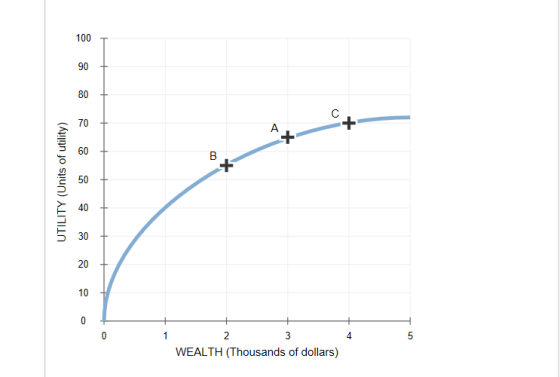
 ?The choices for the fill in
part are risk adverse/risk friendly. The second choices are
would/would not. The third choice are less than/greater than.
?The choices for the fill in
part are risk adverse/risk friendly. The second choices are
would/would not. The third choice are less than/greater than.
Homework Answers
Add Answer to:
?The choices for the fill in
part are risk adverse/risk friendly. The second choices are
would/would...
5. Understanding risk aversion Suppose your fr end Gilberto offers you the following bet: He will...
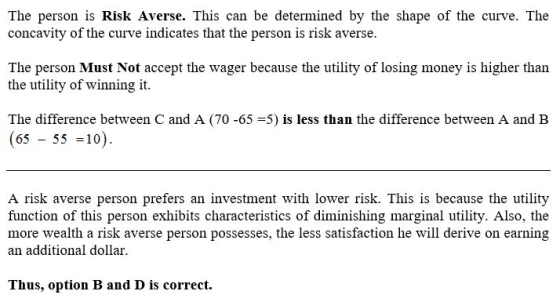
 risk friendly / risk-averse
would / would not
greater than / less than
5. Understanding risk aversion Suppose your fr end Gilberto offers you the following bet: He will flip、coin and pay you S3,000 if it lands heads up and collect S3 000 from you if it lands tails up. Currently, your level of wealth is $9,000. The graph shows your uility function from wealth. Use the graph to answer te ollowing questions 83 60 43 2D WEALTH (Thoueards cr...
risk friendly / risk-averse
would / would not
greater than / less than
5. Understanding risk aversion Suppose your fr end Gilberto offers you the following bet: He will flip、coin and pay you S3,000 if it lands heads up and collect S3 000 from you if it lands tails up. Currently, your level of wealth is $9,000. The graph shows your uility function from wealth. Use the graph to answer te ollowing questions 83 60 43 2D WEALTH (Thoueards cr...
2. (20) Suppose your VN-M utility is u(w) = ln w. You are offered to bet...
 2. (20) Suppose your VN-M utility is u(w) = ln w. You are offered to bet on a coin flip which lands heads with probability p. If you bet $x, you win in case of a head, and lose x in case of a tail. Your initial wealth is wo. How much would you bet?
2. (20) Suppose your VN-M utility is u(w) = ln w. You are offered to bet...
 2. (20) Suppose your VN-M utility is u(w) = ln w. You are offered to bet on a coin flip which lands heads with probability p. If you bet $x, you win o in case of a head, and lose x in case of a tail. Your initial wealth is w. How much would you bet?
Your current wealth is M=$100 and your utility function is U=M2. You have received a ticket...
Your current wealth is M=$100 and your utility function is U=M2. You have received a ticket that allows you to participate in the following fair gamble: in a coin flip, you will receive $40 if the coin lands on heads and lose $40 if it lands on tails. A. What is the expected value of this gamble? What is the expected utility of this gamble? B. What is the lowest price for which you would sell your ticket?
(20 points) Clarice is an expected utility maximizer and her utility function over money is given...
 (20 points) Clarice is an expected utility maximizer and her utility function over money is given by u = cả. Clarice's friend, Hannibal, has offered to bet with her $1,000 on the outcome of the toss of a coin. That is, if the coin comes up heads, Clarice must pay Hannibal $1,000 and if the coin comes up tail, Hannibal must pay Clarice $1,000. The coin is a fair coin, so that the probability of heads and the probability of...
Consider a game in which a coin will be flipped three times. For each heads you will be paid $100. Assume that the...
 Consider a game in which a coin will be flipped three times. For each heads you will be paid $100. Assume that the coin comes up heads with probability 1/3. a. Construct a table of the possibilities and probabilities in this game. Probability Outcome Possibilities 0 heads, 3 tails / 1 heads, 2 tails 2 2 heads, 1 tails 3 3 heads, 0 tails b. Compute the expected value of the game. The expected value of the game is $...
Consider a game in which a coin will be flipped three times. For each heads you...
 Consider a game in which a coin will be flipped three times. For each heads you will be paid $100. Assume that the coin comes up heads with probability 1/3. a. Construct a table of the possibilities and probabilities in this game. Probability Outcome Possibilities 0 heads, 3 tails / 1 heads, 2 tails 2 2 heads, 1 tails 3 3 heads, 0 tails b. Compute the expected value of the game. The expected value of the game is $...
Risk averse people are willing to pay LESS THAN the monetary value of a gamble 4. What is the maximum you would be will...
 Risk averse people are willing to pay LESS THAN the monetary value of a gamble 4. What is the maximum you would be willing to pay for lottery that offers a 25% chance of winning $100 and a 75% chance of winning 0? The EMV = $25. Would you pay $25? Your risk averse preferences are u(x) = x1/2 What is the most you would pay to play this gamble? Provide a Utility of Wealth Diagram
Students conducted an experiment to determine whether the Belgium-minted Euro coin was equally likely to land...
 Students conducted an experiment to determine whether the Belgium-minted Euro coin was equally likely to land heads up or tails up. Coins were spun on a smooth surface, and in 330 spins, 180 landed with the heads side up (a) Should the students interpret this result as convincing evidence that the proportion of the time the coin would land heads up is not 0.5? Test the relevant hypotheses using α decimal places.) 0.01. (Round your test statistic to two decimal...
2. An accountant for a small manufacturing plan t collected the following random sample to study...
 2. An accountant for a small manufacturing plan t collected the following random sample to study the the selling price. Round all your relationship between x answers to one decimal place. cular item and y the cost to make a part 47 23 52 71 78 128 70 152 198 a. [4 pts] Create a scatter diagram. (2 pts] Using only the scatter diagram, would you estimate the correlation coefficient to be positive, close to zero, or negative? Explain your...
 risk friendly / risk-averse
would / would not
greater than / less than
5. Understanding risk aversion Suppose your fr end Gilberto offers you the following bet: He will flip、coin and pay you S3,000 if it lands heads up and collect S3 000 from you if it lands tails up. Currently, your level of wealth is $9,000. The graph shows your uility function from wealth. Use the graph to answer te ollowing questions 83 60 43 2D WEALTH (Thoueards cr...
risk friendly / risk-averse
would / would not
greater than / less than
5. Understanding risk aversion Suppose your fr end Gilberto offers you the following bet: He will flip、coin and pay you S3,000 if it lands heads up and collect S3 000 from you if it lands tails up. Currently, your level of wealth is $9,000. The graph shows your uility function from wealth. Use the graph to answer te ollowing questions 83 60 43 2D WEALTH (Thoueards cr...
 2. (20) Suppose your VN-M utility is u(w) = ln w. You are offered to bet on a coin flip which lands heads with probability p. If you bet $x, you win in case of a head, and lose x in case of a tail. Your initial wealth is wo. How much would you bet?
 2. (20) Suppose your VN-M utility is u(w) = ln w. You are offered to bet on a coin flip which lands heads with probability p. If you bet $x, you win o in case of a head, and lose x in case of a tail. Your initial wealth is w. How much would you bet?
 (20 points) Clarice is an expected utility maximizer and her utility function over money is given by u = cả. Clarice's friend, Hannibal, has offered to bet with her $1,000 on the outcome of the toss of a coin. That is, if the coin comes up heads, Clarice must pay Hannibal $1,000 and if the coin comes up tail, Hannibal must pay Clarice $1,000. The coin is a fair coin, so that the probability of heads and the probability of...
 Consider a game in which a coin will be flipped three times. For each heads you will be paid $100. Assume that the coin comes up heads with probability 1/3. a. Construct a table of the possibilities and probabilities in this game. Probability Outcome Possibilities 0 heads, 3 tails / 1 heads, 2 tails 2 2 heads, 1 tails 3 3 heads, 0 tails b. Compute the expected value of the game. The expected value of the game is $...
 Consider a game in which a coin will be flipped three times. For each heads you will be paid $100. Assume that the coin comes up heads with probability 1/3. a. Construct a table of the possibilities and probabilities in this game. Probability Outcome Possibilities 0 heads, 3 tails / 1 heads, 2 tails 2 2 heads, 1 tails 3 3 heads, 0 tails b. Compute the expected value of the game. The expected value of the game is $...
 Risk averse people are willing to pay LESS THAN the monetary value of a gamble 4. What is the maximum you would be willing to pay for lottery that offers a 25% chance of winning $100 and a 75% chance of winning 0? The EMV = $25. Would you pay $25? Your risk averse preferences are u(x) = x1/2 What is the most you would pay to play this gamble? Provide a Utility of Wealth Diagram
 Students conducted an experiment to determine whether the Belgium-minted Euro coin was equally likely to land heads up or tails up. Coins were spun on a smooth surface, and in 330 spins, 180 landed with the heads side up (a) Should the students interpret this result as convincing evidence that the proportion of the time the coin would land heads up is not 0.5? Test the relevant hypotheses using α decimal places.) 0.01. (Round your test statistic to two decimal...
 2. An accountant for a small manufacturing plan t collected the following random sample to study the the selling price. Round all your relationship between x answers to one decimal place. cular item and y the cost to make a part 47 23 52 71 78 128 70 152 198 a. [4 pts] Create a scatter diagram. (2 pts] Using only the scatter diagram, would you estimate the correlation coefficient to be positive, close to zero, or negative? Explain your...
Most questions answered within 3 hours.
-
Where is the error in this code sequence?
String s1 = "Hello";
String s2 = "ello";...
asked 11 months ago -
Financial data for Joel de Paris, Inc., for last year
follow:
Joel de Paris, Inc.
Balance...
asked 11 months ago -
Consider this reaction:
Al2(SO4)3 (aq)+ BaCl3
(aq) Al2Cl6 (aq)- +
3BaSO4(s) . What is the...
asked 11 months ago -
Suppose that Savneet is considering increasing her
recent random sample from 20 car rentals to 40...
asked 11 months ago -
Trucks arrive at an unloading terminal at an average rate of 120
per hour.
Trucks arrive...
asked 11 months ago -
Why are methanol and ethanol completely soluble in water while
octanol is not very little soluble....
asked 11 months ago -
A facilities manager at a university reads in a research report
that the mean amount of...
asked 11 months ago -
When the CuSO4 is rehydrated by adding water to the anhydrous
compound, is this an endothermic...
asked 11 months ago -
A ray of sunlight is passing from diamond into crown glass; the
angle of incidence is...
asked 11 months ago -
A block of mass 0.249 kg is placed on top of a light, vertical
spring of...
asked 11 months ago -
how do the kidneys compensate in the presences of acidosis
a) trigger hyperventilate
b) reserve acid...
asked 11 months ago -
Question 501 pts
The rental rate of capital to the firm increases. Which of the
following...
asked 11 months ago