
Homework Answers
![0.500 VHM Woo 110 100 Alwzoru magnitude of ticas 14469)]z 2 + ² View 2 ) Masri-lede in decibels 2010g (0.5) +2010g (W) -A1 w=](http://img.homeworklib.com/questions/f0c94680-ae8b-11ea-ae8d-0925fc99bf04.png?x-oss-process=image/resize,w_560)
Add Answer to:
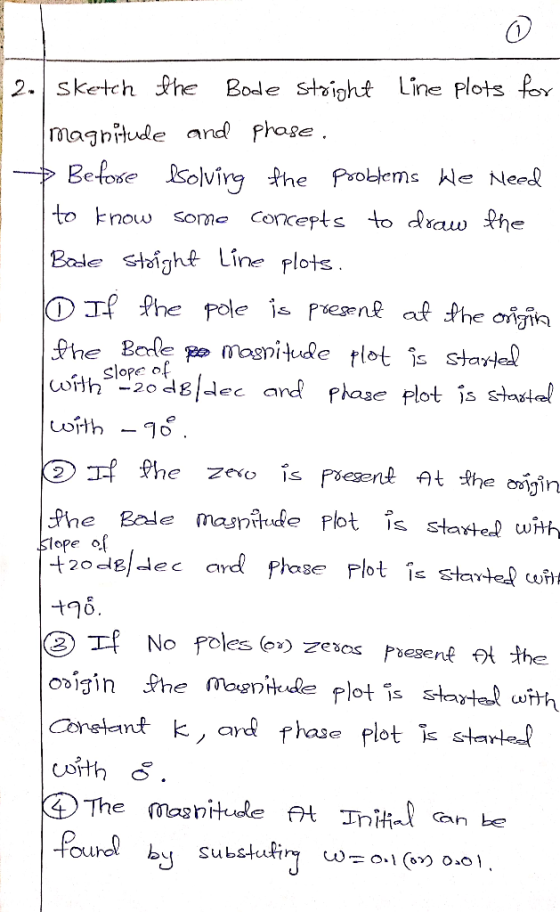
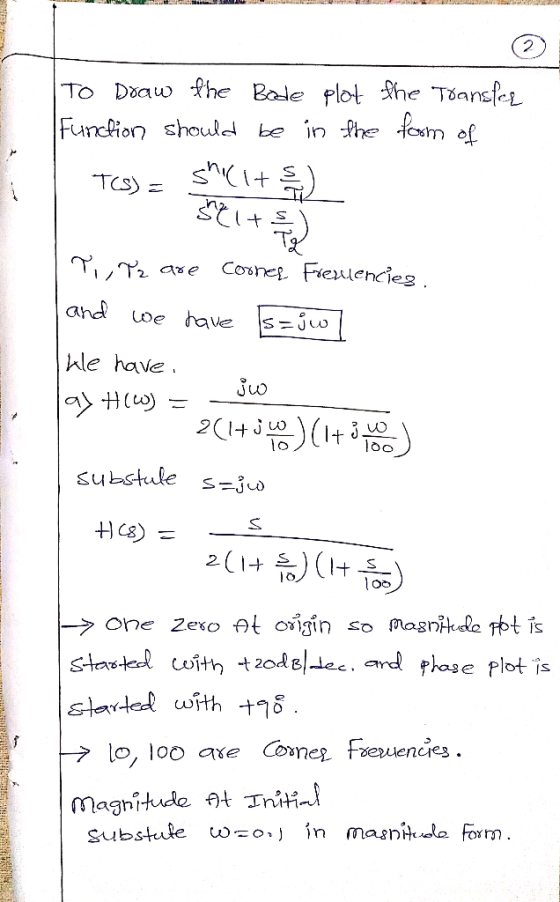
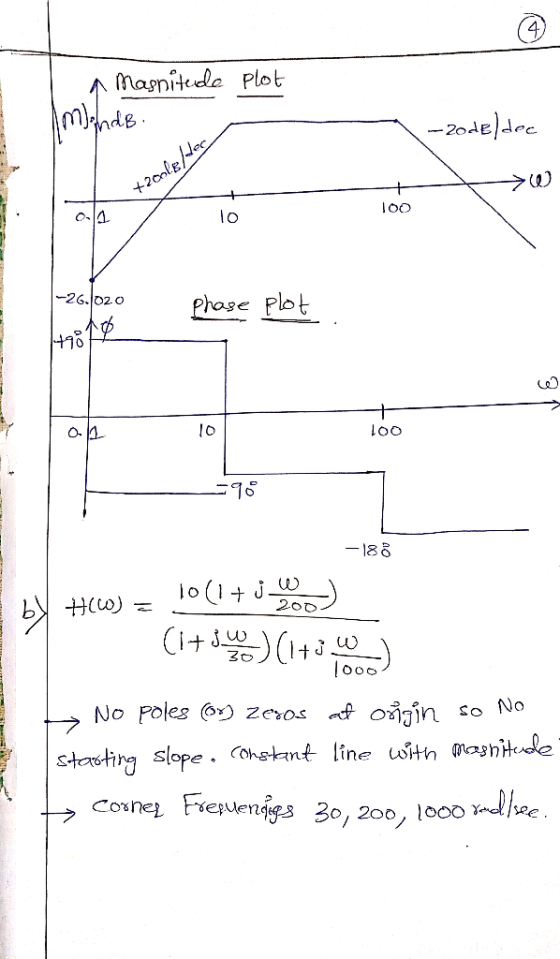
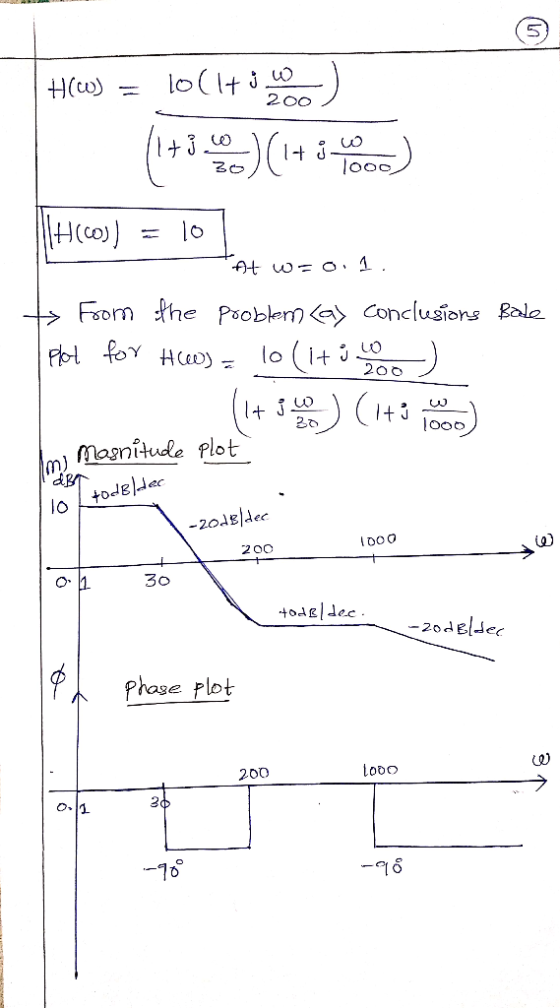
2. Sketch the Bode straight line plots for magnitude and phase. a) H60) = a[i*3 (veja)...
For the following transfer function, sketch approximate straight-line Bode plots, including magnitude and phase plots. Show...
 For the following transfer function, sketch approximate
straight-line Bode plots, including magnitude and phase plots. Show
all steps clearly
10 4 (A)G(s)-7 s (s 2s +100)
For the following transfer function, sketch approximate
straight-line Bode plots, including magnitude and phase plots. Show
all steps clearly
10 4 (A)G(s)-7 s (s 2s +100)
2. Use straight line approximation to sketch bode (gain and phase) plots for 1000s G1(s) s+...
 2. Use straight line approximation to sketch bode (gain and phase) plots for 1000s G1(s) s+ IG+ 10 ()G)0 1 100 s(s2 +2s+100) Make corrections for complex poles, and indicate initial gain/slope, phase, and initial and final phases on the plots
3 Bode sketch 40 pts Sketch the Bode asymptotic magnitude and asymptotic phase plots for G(s)
 3 Bode sketch 40 pts Sketch the Bode asymptotic magnitude and asymptotic phase plots for G(s)
Sketch the straight-line approximation Bode plot diagrams (magnitude and phase) 110s for H[s] You might want...
 Sketch the straight-line approximation Bode plot diagrams (magnitude and phase) 110s for H[s] You might want to examine Examples E.1 and E.2 in (s+10)(s+100)´ the textbook. Based on your straight-line Bode plot sketch, answer the following questions. The questions are: a. Identify the transfer function written in time constant form. b. The phase of H[s] at low frequencies is? c. The magnitude plot has what slope at low frequencies? d. The magnitude plot has what slope at high frequencies? e....
Please plot on semi-log scale for both magnitude and phase separately B. Sketch the Bode plots...
 Please plot on semi-log scale for both magnitude and phase
separately
B. Sketch the Bode plots for the magnitude and the phase for the transfer function: 10(S + 1) H(S) = S(S + 10)(8 + 100)
Please plot on semi-log scale for both magnitude and phase
separately
B. Sketch the Bode plots for the magnitude and the phase for the transfer function: 10(S + 1) H(S) = S(S + 10)(8 + 100)
Generate Bode magnitude and phase plots (straight-line approximations) for the following voltage transfer functions j100ω 0.4(50+ju)...
 Generate Bode magnitude and phase plots (straight-line approximations) for the following voltage transfer functions j100ω 0.4(50+ju) (ju) H(4) = (40+,804) (10+350u)
For the following closed-loop transfer functions, sketch the bode plots (magnitude and phase), id...
 For the following closed-loop transfer functions, sketch the bode plots (magnitude and phase), iden- tifying the zero gain, the slopes (in Decibels) and the high-frequency cutt-off rate. Then verify with Matlab C()101 100) s 0.1) (s 10) 100 s(s +10)2 G(s) = (56) G(s) = s+10(s+100)
For the following closed-loop transfer functions, sketch the bode plots (magnitude and phase), iden- tifying the zero gain, the slopes (in Decibels) and the high-frequency cutt-off rate. Then verify with Matlab C()101 100) s...
For the following closed-loop transfer functions, sketch the bode plots (magnitude and phase), iden- tifying the zero gain, the slopes (in Decibels) and the high-frequency cutt-off rate. Then verify with Matlab C()101 100) s 0.1) (s 10) 100 s(s +10)2 G(s) = (56) G(s) = s+10(s+100)
For the following closed-loop transfer functions, sketch the bode plots (magnitude and phase), iden- tifying the zero gain, the slopes (in Decibels) and the high-frequency cutt-off rate. Then verify with Matlab C()101 100) s...
Sketch the approximate Bode magnitude and phase plots for the following transfer functions by hand. a....
 Sketch the approximate Bode magnitude and phase plots for the following transfer functions by hand. a. G(s) b. G(s)- 200 (s2 +2s)(0.1s +1) s+1 s2 +2s +100
Bode Plots Sketch the Bode plot magnitude and phase for each of the three open-loop transfer...
Bode Plots Sketch the Bode plot magnitude and phase for each of the three open-loop transfer functions listed below. Verify your results using the bode m function in MATLAB.(a) \(G(s)=\frac{100}{s(0.1 s+1)(0.01 s+1)}\)(b) \(G(s)=\frac{1}{(s+1)^{2}\left(s^{2}+s+9\right)}\)(c) \(G(s)=\frac{16000 s}{(s+1)(s+100)\left(s^{2}+5 s+1600\right)}\)
I need help with this Bode Plots assignment 2. (5 points) Follow the steps (a-c) described below for the following tra...
 I need help with this Bode Plots
assignment
2. (5 points) Follow the steps (a-c) described below for the following transfer function. Do the steps in order! 1+ 10 1+ 10 a. On a 'blank Bode plot' grid, plot the Bode plot straight line hand sketch approximation for magnitude for the frequency range from 1000 to ω.*1000. Be sure, though, that the corner frequency aligns with an appropriate vertical line on the grid. b. On graph paper, directly below the...
I need help with this Bode Plots
assignment
2. (5 points) Follow the steps (a-c) described below for the following transfer function. Do the steps in order! 1+ 10 1+ 10 a. On a 'blank Bode plot' grid, plot the Bode plot straight line hand sketch approximation for magnitude for the frequency range from 1000 to ω.*1000. Be sure, though, that the corner frequency aligns with an appropriate vertical line on the grid. b. On graph paper, directly below the...
 For the following transfer function, sketch approximate
straight-line Bode plots, including magnitude and phase plots. Show
all steps clearly
10 4 (A)G(s)-7 s (s 2s +100)
For the following transfer function, sketch approximate
straight-line Bode plots, including magnitude and phase plots. Show
all steps clearly
10 4 (A)G(s)-7 s (s 2s +100)
 2. Use straight line approximation to sketch bode (gain and phase) plots for 1000s G1(s) s+ IG+ 10 ()G)0 1 100 s(s2 +2s+100) Make corrections for complex poles, and indicate initial gain/slope, phase, and initial and final phases on the plots
 3 Bode sketch 40 pts Sketch the Bode asymptotic magnitude and asymptotic phase plots for G(s)
 Sketch the straight-line approximation Bode plot diagrams (magnitude and phase) 110s for H[s] You might want to examine Examples E.1 and E.2 in (s+10)(s+100)´ the textbook. Based on your straight-line Bode plot sketch, answer the following questions. The questions are: a. Identify the transfer function written in time constant form. b. The phase of H[s] at low frequencies is? c. The magnitude plot has what slope at low frequencies? d. The magnitude plot has what slope at high frequencies? e....
 Please plot on semi-log scale for both magnitude and phase
separately
B. Sketch the Bode plots for the magnitude and the phase for the transfer function: 10(S + 1) H(S) = S(S + 10)(8 + 100)
Please plot on semi-log scale for both magnitude and phase
separately
B. Sketch the Bode plots for the magnitude and the phase for the transfer function: 10(S + 1) H(S) = S(S + 10)(8 + 100)
 Generate Bode magnitude and phase plots (straight-line approximations) for the following voltage transfer functions j100ω 0.4(50+ju) (ju) H(4) = (40+,804) (10+350u)
 For the following closed-loop transfer functions, sketch the bode plots (magnitude and phase), iden- tifying the zero gain, the slopes (in Decibels) and the high-frequency cutt-off rate. Then verify with Matlab C()101 100) s 0.1) (s 10) 100 s(s +10)2 G(s) = (56) G(s) = s+10(s+100)
For the following closed-loop transfer functions, sketch the bode plots (magnitude and phase), iden- tifying the zero gain, the slopes (in Decibels) and the high-frequency cutt-off rate. Then verify with Matlab C()101 100) s...
For the following closed-loop transfer functions, sketch the bode plots (magnitude and phase), iden- tifying the zero gain, the slopes (in Decibels) and the high-frequency cutt-off rate. Then verify with Matlab C()101 100) s 0.1) (s 10) 100 s(s +10)2 G(s) = (56) G(s) = s+10(s+100)
For the following closed-loop transfer functions, sketch the bode plots (magnitude and phase), iden- tifying the zero gain, the slopes (in Decibels) and the high-frequency cutt-off rate. Then verify with Matlab C()101 100) s...
 Sketch the approximate Bode magnitude and phase plots for the following transfer functions by hand. a. G(s) b. G(s)- 200 (s2 +2s)(0.1s +1) s+1 s2 +2s +100
 I need help with this Bode Plots
assignment
2. (5 points) Follow the steps (a-c) described below for the following transfer function. Do the steps in order! 1+ 10 1+ 10 a. On a 'blank Bode plot' grid, plot the Bode plot straight line hand sketch approximation for magnitude for the frequency range from 1000 to ω.*1000. Be sure, though, that the corner frequency aligns with an appropriate vertical line on the grid. b. On graph paper, directly below the...
I need help with this Bode Plots
assignment
2. (5 points) Follow the steps (a-c) described below for the following transfer function. Do the steps in order! 1+ 10 1+ 10 a. On a 'blank Bode plot' grid, plot the Bode plot straight line hand sketch approximation for magnitude for the frequency range from 1000 to ω.*1000. Be sure, though, that the corner frequency aligns with an appropriate vertical line on the grid. b. On graph paper, directly below the...
Most questions answered within 3 hours.
-
Where is the error in this code sequence?
String s1 = "Hello";
String s2 = "ello";...
asked 10 months ago -
Financial data for Joel de Paris, Inc., for last year
follow:
Joel de Paris, Inc.
Balance...
asked 10 months ago -
Consider this reaction:
Al2(SO4)3 (aq)+ BaCl3
(aq) Al2Cl6 (aq)- +
3BaSO4(s) . What is the...
asked 10 months ago -
Suppose that Savneet is considering increasing her
recent random sample from 20 car rentals to 40...
asked 10 months ago -
Trucks arrive at an unloading terminal at an average rate of 120
per hour.
Trucks arrive...
asked 10 months ago -
Why are methanol and ethanol completely soluble in water while
octanol is not very little soluble....
asked 10 months ago -
A facilities manager at a university reads in a research report
that the mean amount of...
asked 10 months ago -
When the CuSO4 is rehydrated by adding water to the anhydrous
compound, is this an endothermic...
asked 10 months ago -
A ray of sunlight is passing from diamond into crown glass; the
angle of incidence is...
asked 10 months ago -
A block of mass 0.249 kg is placed on top of a light, vertical
spring of...
asked 10 months ago -
how do the kidneys compensate in the presences of acidosis
a) trigger hyperventilate
b) reserve acid...
asked 10 months ago -
Question 501 pts
The rental rate of capital to the firm increases. Which of the
following...
asked 10 months ago