A solution is made by dissolving 0.0200 mol of HF in 1.00 kg of water. The...
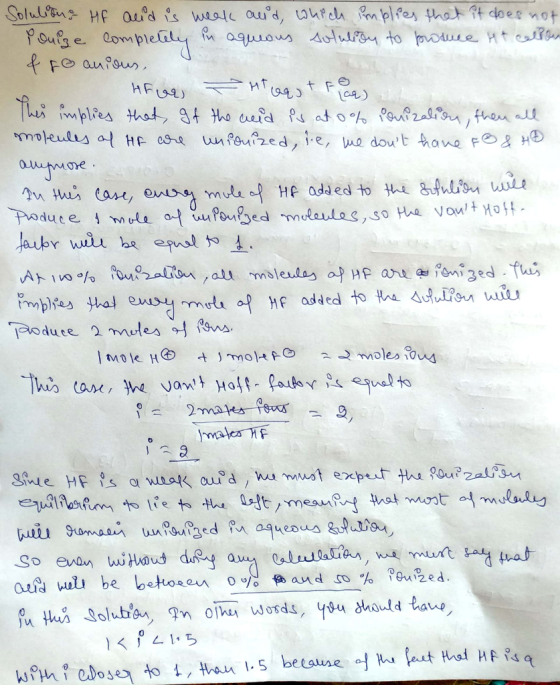
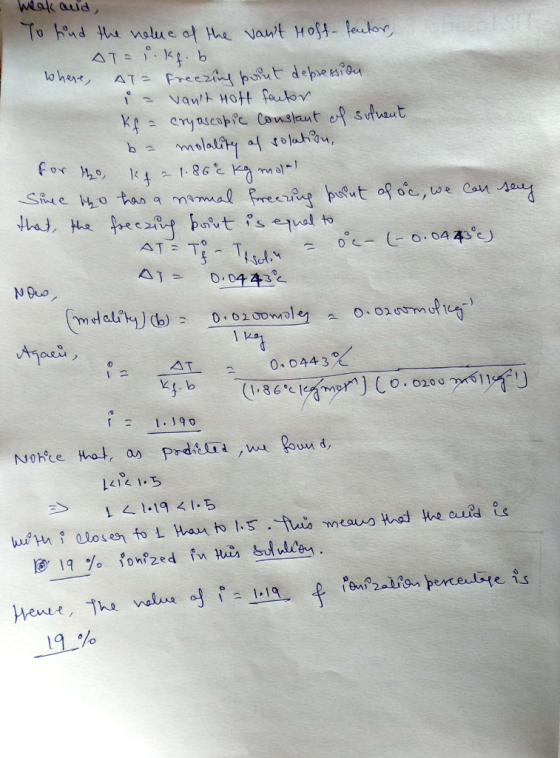
A solution is made by dissolving 0.0200 mol of HF in 1.00 kg of water. The solution was found to freeze at –0.0443 °C. Calculate the value of i and estimate the percent ionization of HF in this solution.
Homework Answers
Add Answer to:
A solution is made by dissolving 0.0200 mol of HF in 1.00 kg of
water. The...
For an aqueous solution of HF, determine the van't Hoff factor assuming 0% ionization. For the...
 For an aqueous solution of HF, determine the van't Hoff factor assuming 0% ionization. For the same solution, determine the van't Hoff factor assuming 100% ionization. A solution is made by dissolving 0.0300 mol HF in 1.00 kg of water. The solution was found to freeze at -0.0644°C. Calculate the value of i and estimate the percent ionization of HF in this solution.
A solution is made by dissolving 0.745 mol of nonelectrolyte solute in 853 g of benzene....
A solution is made by dissolving 0.745 mol of nonelectrolyte solute in 853 g of benzene. Calculate the freezing point and boiling point of the solution. The normal freezing point of benzene is 5.49 °C and the normal boiling point of benzene is 80.1 °C. Assuming 100% dissociation, calculate the freezing point and boiling point of 0.570 mol of AgNO3 in 1.00 kg of water.
Calculate the pH of a buffer solution prepared by dissolving 1.79 mol of HF and 2.26...
Calculate the pH of a buffer solution prepared by dissolving 1.79 mol of HF and 2.26 mol of NaF in water to make a total volume of 1.25 L of solution. The Ka of HF is 6.8*10^-4. A) 3.57 B) 3.47 C) 3.27 D) 3.37 E) 3.68 Please let me know what answer is correct and how to work it. Thank You!
A solution was made by dissolving 5.80 mg of hemoglobin in water to give a final...
A solution was made by dissolving 5.80 mg of hemoglobin in water to give a final volume of 1.00 mL. The osmotic pressure of this solution was 2.22×10⁻³ atm at 25.0°C. Calculate the molar mass of hemoglobin, which is a molecular compound and a nonelectrolyte. = g/mol
A solution was made by dissolving 5.60 mg of hemoglobin in water to give a final...
A solution was made by dissolving 5.60 mg of hemoglobin in water to give a final volume of 1.00 mL. The osmotic pressure of this solution was 2.14×10⁻³ atm at 25.0°C. Calculate the molar mass of hemoglobin, which is a molecular compound and a nonelectrolyte. Give your answer in g/mol.
A solution is made by dissolving 1.00 g of the ligand salen (C16H16N2O2) in enough water...
A solution is made by dissolving 1.00 g of the ligand salen (C16H16N2O2) in enough water to make to make 1.00 L of solution. Determine the concentration of the resulting solution.
Calculate the percent by mass of a solution made by dissolving 34.0g of NH3 in 2.00...
Calculate the percent by mass of a solution made by dissolving 34.0g of NH3 in 2.00 x 10^3 mL of water. (molar mass NH3 = 17.04 g/mol, density of H20 = 1.00 g/mL).
An aqueous solution was made up by dissolving 34.5 g of sucrose, C12H22O11, in enough water...
An aqueous solution was made up by dissolving 34.5 g of sucrose, C12H22O11, in enough water to make 250 cm^3 of solution. The mass density of the resulting solution was 1040 kg/m^3. Calculate the molar concentration and molarity of sucrose in the solution. Answer: 0,388 mol/kg
a 1.00 L buffer solution comtains 0.10 M HF and 0.05 M NaF. the value of...
a 1.00 L buffer solution comtains 0.10 M HF and 0.05 M NaF. the value of the acid ionization constant, Ka, for HF is 3.5 x 10^-4. a) calculate the new PH after addimg 0.010 mol of NaOh to the buffer. b) calculate the ph of the 1.00 L of the solution upon addition of 40.0 mL of 1.0 mL of 1.0 M HCL to the original buffer solution.
A solution of 10.0 g of HF in 500 g of water freezes at -1.98 °C....
A solution of 10.0 g of HF in 500 g of water freezes at -1.98 °C. Calculate the percent ionization of the HF solution.
 For an aqueous solution of HF, determine the van't Hoff factor assuming 0% ionization. For the same solution, determine the van't Hoff factor assuming 100% ionization. A solution is made by dissolving 0.0300 mol HF in 1.00 kg of water. The solution was found to freeze at -0.0644°C. Calculate the value of i and estimate the percent ionization of HF in this solution.
Most questions answered within 3 hours.
-
Where is the error in this code sequence?
String s1 = "Hello";
String s2 = "ello";...
asked 10 months ago -
Financial data for Joel de Paris, Inc., for last year
follow:
Joel de Paris, Inc.
Balance...
asked 10 months ago -
Consider this reaction:
Al2(SO4)3 (aq)+ BaCl3
(aq) Al2Cl6 (aq)- +
3BaSO4(s) . What is the...
asked 10 months ago -
Suppose that Savneet is considering increasing her
recent random sample from 20 car rentals to 40...
asked 10 months ago -
Trucks arrive at an unloading terminal at an average rate of 120
per hour.
Trucks arrive...
asked 10 months ago -
Why are methanol and ethanol completely soluble in water while
octanol is not very little soluble....
asked 10 months ago -
A facilities manager at a university reads in a research report
that the mean amount of...
asked 10 months ago -
When the CuSO4 is rehydrated by adding water to the anhydrous
compound, is this an endothermic...
asked 10 months ago -
A ray of sunlight is passing from diamond into crown glass; the
angle of incidence is...
asked 10 months ago -
A block of mass 0.249 kg is placed on top of a light, vertical
spring of...
asked 10 months ago -
how do the kidneys compensate in the presences of acidosis
a) trigger hyperventilate
b) reserve acid...
asked 10 months ago -
Question 501 pts
The rental rate of capital to the firm increases. Which of the
following...
asked 10 months ago