6. The formula dS = dQ/T makes it look like a system can only increase its...
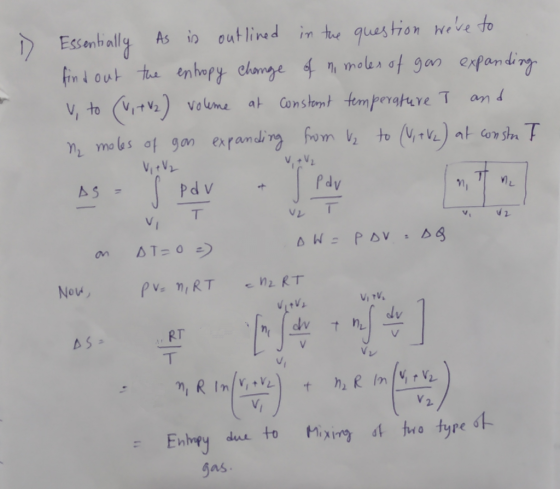
6. The formula dS = dQ/T makes it look like a system can only increase its entropy by absorbing heat. You must however remember that this equation is only true for reversible processes. Entropy can change for a system without absorbing any heat. Consider the following scenario. You are given an insulated container with two compartments. The whole container is at the temperature T which remains constant. One compartment has a volume V1 and has n1 moles of an ideal gas. The other has n2 moles of a different ideal gas in a volume V2. The partition between the compartments is punctured. Find the entropy increase for this process. This process is clearly not reversible - the pressure for example would be poorly defined. Do not use the Sakur-Tetrode formula. Calculate the entropy increase by considering a reversible process where each gas expands isothermally, one from V1 to V1 + V2 an the other from V2 to V1 +V2. First just take one gas expanding from V1 to V1 +V2 at constant T. Since T is constant you know that ∆U = 0 and hence ∆Q = ∆W. You can easily find W from the pressure work and hence the increase in entropy for this gas. Note very carefully the logic of this calculation. We have:
(a) An irreversible process: gas 1 and gas 2 rapidly expand into their neighbour’s container. Everything is insulated, and there is no change in temperature and no heat flow into the system. In the end we have a volume V1 + V2 filled with the two gases. We cannot use dS = dQ/T here because the process is not reversible - it certainly does not go through a series of equilibrium states.
(b) A reversible process where we imagine each gas expanding isothermally and reversibly from their initial volumes to V1 + V2. This reversible process does involve a transfer of heat to both gases. Here we can use dS = dQ/T.
Where we end in cases (a) and (b) is at the same state: two gases in a volume V1 + V2 at a temperature T, so the entropy change must be the same - Entropy is a State Function. However, note that in case (a) there is no work done and no heat absorbed, whereas in case b there is work done and heat absorbed. This problem is so tricky because we are told the gases are in an insulated container - no heat can flow to them - but we have then turned around and totally violated this prohibition to calculate the entropy change. An analogy with mechanics might be as follows. You have a mass m resting on the perfectly hard ground in London. What is the gravitational potential energy change in bringing it to rest on the perfectly hard ground in Canberra? We can take a path that tunnels into the ground in London, passes through the centre of the earth and emerges in Canberra. The work against gravity involved in this path is the change in gravitational potential energy, even though it violates the idea of having perfectly har ground. In any case this problem shows that the entropy of a system can change with no heat flow into or out of it - just by mixing.
Homework Answers
Add Answer to:
6. The formula dS = dQ/T makes it look like a system can only
increase its...
. (40 points) Consider an insulated container of volume V2. N idea gas molecules are initially...
 . (40 points) Consider an insulated container of volume V2. N idea gas molecules are initially confined within volume V, by a piston and the remaining volume V2 - Vi is in vacuum. Let T,, P1, E1, S, Al, Hi, G, be the temperature, pressure, energy, entropy, Helmholtz free energy, enthalpy, and Gibbs free energy of the ideal gas at this state, respectively V1 V2-V Using Sackur-Tetrode equation for the entropy of ideal gas where kB R/NA is Boltzmann's constant...
A closed system of 2 moles of helium gas ( monatomic) (M=4 g/mol) goes through the...
A closed system of 2 moles of helium gas ( monatomic) (M=4 g/mol) goes through the following reversible process: Process1->2: Isothermic expansion at T=400k form V1=.03 m^3 to V2=.12 m^3 Process 2->3: Adiabatic expansion to T= 325 K and V3 = .2 m^3 Process 3->4: Isothermic compression at T=325K to P4 = 1.1*10^5 Pa Process 4->1: Adiabatic compression (from state 4 back to state 1) A) sketch a PV diagram of tis cycle B) sketch a ST diagram of this...
The change in internal energy of a system (ΔE) can be described in terms of heat...
The change in internal energy of a system (ΔE) can be described in terms of heat (q) and work (w) according to the equation ΔE = q + w. The conversion of 40 g of liquid H2O to steam at 1.0 atm leads to an increase in its volume. This expansion exerts 4.545 kJ of work on the surroundings. If the increase in internal energy of the H2O is 85.724 kJ, how much heat energy does this vaporization process use?...
only 6...7...and 8 The Gibbs function of a thermodynamic system is defined by G H- TS. If the system is consisting of two phases 1 and 2 of a single substance and maintained at a constant temperat...
 only 6...7...and 8
The Gibbs function of a thermodynamic system is defined by G H- TS. If the system is consisting of two phases 1 and 2 of a single substance and maintained at a constant temperature and pressure, the equilibriunm condition for the coexistence of these two phases is that the specific Gibbs functions are equal Consider now a first-order phase change between the phase 1 and the phase 2. At the phase boundary, the equilibrium condition for the...
only 6...7...and 8
The Gibbs function of a thermodynamic system is defined by G H- TS. If the system is consisting of two phases 1 and 2 of a single substance and maintained at a constant temperature and pressure, the equilibriunm condition for the coexistence of these two phases is that the specific Gibbs functions are equal Consider now a first-order phase change between the phase 1 and the phase 2. At the phase boundary, the equilibrium condition for the...
1. The Redlich-Kwong equation of state is given by P=_RT___ A _ _ V-RI2,, - 0.0866 - where 4-0.42748RT - B - P (The R-K...
 1. The Redlich-Kwong equation of state is given by P=_RT___ A _ _ V-RI2,, - 0.0866 - where 4-0.42748RT - B - P (The R-K constants can be calculated from the critical temperature and pressure of the gas.) This EOS was introduced in 1949 and is adequate for calculations of gas phase properties when P, </2 T, a) Derive an expression for the work associated with an isothermal reversible volume change of a R-K gas between two volumes V, and...
 . (40 points) Consider an insulated container of volume V2. N idea gas molecules are initially confined within volume V, by a piston and the remaining volume V2 - Vi is in vacuum. Let T,, P1, E1, S, Al, Hi, G, be the temperature, pressure, energy, entropy, Helmholtz free energy, enthalpy, and Gibbs free energy of the ideal gas at this state, respectively V1 V2-V Using Sackur-Tetrode equation for the entropy of ideal gas where kB R/NA is Boltzmann's constant...
 only 6...7...and 8
The Gibbs function of a thermodynamic system is defined by G H- TS. If the system is consisting of two phases 1 and 2 of a single substance and maintained at a constant temperature and pressure, the equilibriunm condition for the coexistence of these two phases is that the specific Gibbs functions are equal Consider now a first-order phase change between the phase 1 and the phase 2. At the phase boundary, the equilibrium condition for the...
only 6...7...and 8
The Gibbs function of a thermodynamic system is defined by G H- TS. If the system is consisting of two phases 1 and 2 of a single substance and maintained at a constant temperature and pressure, the equilibriunm condition for the coexistence of these two phases is that the specific Gibbs functions are equal Consider now a first-order phase change between the phase 1 and the phase 2. At the phase boundary, the equilibrium condition for the...
 1. The Redlich-Kwong equation of state is given by P=_RT___ A _ _ V-RI2,, - 0.0866 - where 4-0.42748RT - B - P (The R-K constants can be calculated from the critical temperature and pressure of the gas.) This EOS was introduced in 1949 and is adequate for calculations of gas phase properties when P, </2 T, a) Derive an expression for the work associated with an isothermal reversible volume change of a R-K gas between two volumes V, and...
Most questions answered within 3 hours.
-
Where is the error in this code sequence?
String s1 = "Hello";
String s2 = "ello";...
asked 10 months ago -
Financial data for Joel de Paris, Inc., for last year
follow:
Joel de Paris, Inc.
Balance...
asked 10 months ago -
Consider this reaction:
Al2(SO4)3 (aq)+ BaCl3
(aq) Al2Cl6 (aq)- +
3BaSO4(s) . What is the...
asked 10 months ago -
Suppose that Savneet is considering increasing her
recent random sample from 20 car rentals to 40...
asked 10 months ago -
Trucks arrive at an unloading terminal at an average rate of 120
per hour.
Trucks arrive...
asked 10 months ago -
Why are methanol and ethanol completely soluble in water while
octanol is not very little soluble....
asked 10 months ago -
A facilities manager at a university reads in a research report
that the mean amount of...
asked 10 months ago -
When the CuSO4 is rehydrated by adding water to the anhydrous
compound, is this an endothermic...
asked 10 months ago -
A ray of sunlight is passing from diamond into crown glass; the
angle of incidence is...
asked 10 months ago -
A block of mass 0.249 kg is placed on top of a light, vertical
spring of...
asked 10 months ago -
how do the kidneys compensate in the presences of acidosis
a) trigger hyperventilate
b) reserve acid...
asked 10 months ago -
Question 501 pts
The rental rate of capital to the firm increases. Which of the
following...
asked 10 months ago