1. An industrial chemist is studying the rate of the Haber synthesis: N2 + 3H2 →...
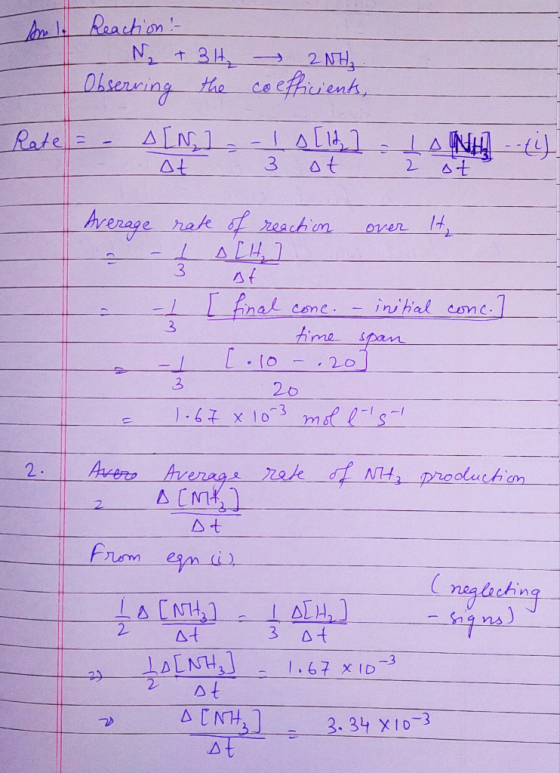
1. An industrial chemist is studying the rate of the Haber synthesis: N2 + 3H2 → 2NH3. Starting with a closed reactor containing 1.15 mol/L of N2 and 0.20 mol/L of H2, she finds that the H2 concentration has fallen to 0.10 mol/L after 20. seconds. What is the average rate of reaction of H2 over this time? (Enter in mol/liter/sec).
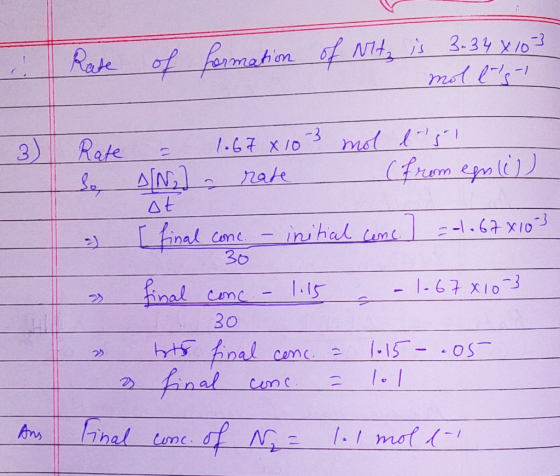
2. What is the average rate of NH3 production for this example? (Enter in mol/liter/sec).
3. Estimate the N2 concentration after 30 seconds? (Enter in mol/liter).
Homework Answers
Add Answer to:
1. An industrial chemist is studying the rate of the Haber
synthesis: N2 + 3H2 →...
An industrial chemist is studying the rate of the Haber synthesis: N2 + 3H2 ? 2NH3....
An industrial chemist is studying the rate of the Haber synthesis: N2 + 3H2 ? 2NH3. Starting with a closed reactor containing 1.00 mol/L of N2 and 0.30 mol/L of H2, she finds that the H2 concentration has fallen to 0.16 mol/L after 30. seconds. What is the average rate of reaction of H2 over this time? (Enter in mol/liter/sec). What is the average rate of NH3 production for this example? (Enter in mol/liter/sec). Estimate the N2 concentration after 25...
An industrial chemist is studying the rate of the Haber synthesis: N2 + 3H2 → 2NH3....
An industrial chemist is studying the rate of the Haber synthesis: N2 + 3H2 → 2NH3. Starting with a closed reactor containing 1.25 mol/L of N2 and 0.35 mol/L of H2, she finds that the H2 concentration has fallen to 0.14 mol/L after 20. seconds. What is the average rate of reaction of H2 over this time? (Enter in mol/liter/sec). What is the average rate of NH3 production for this example? (Enter in mol/liter/sec). Estimate the N2 concentration after 20...
Chapter 13, Question 14 Parameterization A chemist is studying the rate of the Haber synthesis: N2...
 Chapter 13, Question 14 Parameterization A chemist is studying the rate of the Haber synthesis: N2 + 3H2 2 NH3 Starting with a closed reactor containing 1.25 mol/L of N2 and 0.50 mol/L of Hz, the chemist finds that the H2 concentration has fallen to 0.25 mol/L in 27 seconds. What is the relative rate of reaction over this time? the tolerance is +/-29 LINK TO TEXT What is the average rate of NH3 production? the tolerance is +/-2% What...
Chapter 13, Question 14 Parameterization A chemist is studying the rate of the Haber synthesis: N2...
 Chapter 13, Question 14 Parameterization A chemist is studying the rate of the Haber synthesis: N2 + 3H2 2 NH3 Starting with a closed reactor containing 1.25 mol/L of N, and 0.50 mol/L of H7, the chemist finds that the Hy concentration has fallen to 0.25 mol/L in 46 seconds. What is the relative rate of reaction over this time? M/S the tolerance is +/-2% What is the average rate of NH3 production? M/S the tolerance is +/-2% LINK TO...
Consider the Haber synthesis of gaseous NH3 (ΔH∘f = -46.1 kJ/mol; ΔG∘f = -16.5 kJ/mol): N2(g)+3H2(g)→2NH3(g)...
Consider the Haber synthesis of gaseous NH3 (ΔH∘f = -46.1 kJ/mol; ΔG∘f = -16.5 kJ/mol): N2(g)+3H2(g)→2NH3(g) What are the equilibrium constants Kp and Kc for the reaction at 350 K ? You may assume that ΔH∘ and ΔS∘ are independent of temperature.
One of the most extensively studied reactions of industrial chemistry is the synthesis of ammonia. N2(g)...
One of the most extensively studied reactions of industrial chemistry is the synthesis of ammonia. N2(g) + 3H2(g) = 2NH3(g) The standard Gibbs energy of formation of NH3(g) is -16.5 kJ mol-1at 298 K. What is the reaction Gibbs energy when the partial pressures of N2, H2, and NH3 (assumed to be ideal gases) are 3.0 bar, 1.0 bar, and 4.0 bar, respectively ?
4) Synthesis of ammonia by the Haber process occurs by the reaction N2(g) + 3H2(8) 52NH3(8)...
 4) Synthesis of ammonia by the Haber process occurs by the reaction N2(g) + 3H2(8) 52NH3(8) Species ah(kJ mol-1) 4S(J mol-1 K-1) H2(g) 0 130.7 N2(g) 0 191.6 NH3(g) -46.1 192.5 Assuming that AH and 45 are essentially unchanged in the temperature ranging from 25 °C to 400 °C: a. Calculate K at 25°C. b. Calculate K at 400C. (R = 8.314 J mol-1 K-1)
The reaction for the Haber process, the industrial production of ammonia, is N2(g) + 3 H2(g)...
 The reaction for the Haber process, the industrial production of ammonia, is N2(g) + 3 H2(g) + 2 NH3(g) Assume that under certain laboratory conditions ammonia is produced at the rate of 2.98 x 10⁻⁵ mol L-15-1. At what rate is nitrogen consumed? At what rate is hydrogen consumed? N2 is consumed at the rate of mol L-15-1 H2 is consumed at the rate of mol L-15-1
The Haber process is the principal method for fixing nitrogen (converting N2 to nitrogen compounds). N2(g)+3H2(g)→2NH3(g)...
The Haber process is the principal method for fixing nitrogen (converting N2 to nitrogen compounds). N2(g)+3H2(g)→2NH3(g) Assume that the reactant gases are completely converted to NH3(g) and that the gases behave ideally. a)What volume of NH3(g) can be produced from 143 L N2(g) and 399 L of H2(g) if the gases are measured at 315∘C and 5.05 atm ? b)What volume of NH3(g) measured at 25∘C and 742 mmHg , can be produced from 143 L N2(g) and 399 L...
Question 8 1 pts The Haber process for the production of ammonia is the main industrial...
 Question 8 1 pts The Haber process for the production of ammonia is the main industrial process of producing ammonia today. Prior to developing this process, ammonia was difficult to produce on an industrial scale. The reaction for the Haber process is: N2(g) + 3H2(g) = 2 NH3(g). Using the following values, determine the equilibrium constant for this reaction at 25°C. Substance AGR°(kJ/mol) N H2 NH3 - 16.4 Enter your answer to three significant figures.
 Chapter 13, Question 14 Parameterization A chemist is studying the rate of the Haber synthesis: N2 + 3H2 2 NH3 Starting with a closed reactor containing 1.25 mol/L of N2 and 0.50 mol/L of Hz, the chemist finds that the H2 concentration has fallen to 0.25 mol/L in 27 seconds. What is the relative rate of reaction over this time? the tolerance is +/-29 LINK TO TEXT What is the average rate of NH3 production? the tolerance is +/-2% What...
 Chapter 13, Question 14 Parameterization A chemist is studying the rate of the Haber synthesis: N2 + 3H2 2 NH3 Starting with a closed reactor containing 1.25 mol/L of N, and 0.50 mol/L of H7, the chemist finds that the Hy concentration has fallen to 0.25 mol/L in 46 seconds. What is the relative rate of reaction over this time? M/S the tolerance is +/-2% What is the average rate of NH3 production? M/S the tolerance is +/-2% LINK TO...
 4) Synthesis of ammonia by the Haber process occurs by the reaction N2(g) + 3H2(8) 52NH3(8) Species ah(kJ mol-1) 4S(J mol-1 K-1) H2(g) 0 130.7 N2(g) 0 191.6 NH3(g) -46.1 192.5 Assuming that AH and 45 are essentially unchanged in the temperature ranging from 25 °C to 400 °C: a. Calculate K at 25°C. b. Calculate K at 400C. (R = 8.314 J mol-1 K-1)
 The reaction for the Haber process, the industrial production of ammonia, is N2(g) + 3 H2(g) + 2 NH3(g) Assume that under certain laboratory conditions ammonia is produced at the rate of 2.98 x 10⁻⁵ mol L-15-1. At what rate is nitrogen consumed? At what rate is hydrogen consumed? N2 is consumed at the rate of mol L-15-1 H2 is consumed at the rate of mol L-15-1
 Question 8 1 pts The Haber process for the production of ammonia is the main industrial process of producing ammonia today. Prior to developing this process, ammonia was difficult to produce on an industrial scale. The reaction for the Haber process is: N2(g) + 3H2(g) = 2 NH3(g). Using the following values, determine the equilibrium constant for this reaction at 25°C. Substance AGR°(kJ/mol) N H2 NH3 - 16.4 Enter your answer to three significant figures.
Most questions answered within 3 hours.
-
Where is the error in this code sequence?
String s1 = "Hello";
String s2 = "ello";...
asked 11 months ago -
Financial data for Joel de Paris, Inc., for last year
follow:
Joel de Paris, Inc.
Balance...
asked 11 months ago -
Consider this reaction:
Al2(SO4)3 (aq)+ BaCl3
(aq) Al2Cl6 (aq)- +
3BaSO4(s) . What is the...
asked 11 months ago -
Suppose that Savneet is considering increasing her
recent random sample from 20 car rentals to 40...
asked 11 months ago -
Trucks arrive at an unloading terminal at an average rate of 120
per hour.
Trucks arrive...
asked 11 months ago -
Why are methanol and ethanol completely soluble in water while
octanol is not very little soluble....
asked 11 months ago -
A facilities manager at a university reads in a research report
that the mean amount of...
asked 11 months ago -
When the CuSO4 is rehydrated by adding water to the anhydrous
compound, is this an endothermic...
asked 11 months ago -
A ray of sunlight is passing from diamond into crown glass; the
angle of incidence is...
asked 11 months ago -
A block of mass 0.249 kg is placed on top of a light, vertical
spring of...
asked 11 months ago -
how do the kidneys compensate in the presences of acidosis
a) trigger hyperventilate
b) reserve acid...
asked 11 months ago -
Question 501 pts
The rental rate of capital to the firm increases. Which of the
following...
asked 11 months ago