Write a matlab program to apply Horner's algorithm to evaluate the sum of the first four...
Homework Answers
Below is the code for your question:
clc%clears console
clear all%clears the history
close all;
syms f(x)
f(x)=sin(x);
F=f;
count=0;
j=0;
while(count~=4)
F=diff(F);
if(F(0)~=0)
count=count+1;
end
j=j+1;
end
sum=0;
for i=j:-1:0
sum=sum*x/(i+1)+(F);
F=int(F);
end
disp(sum)
fprintf('Taylor series with fith first 4 non zero sums of sinx at
x=1 is: %.10f',eval(sum(1)));
execution:
 ------------------------------------------------------Thank
you-------------------------------------------------------
------------------------------------------------------Thank
you-------------------------------------------------------
Add Answer to:
Write a matlab program to apply Horner's algorithm to evaluate
the sum of the first four...
Write a MATLAB script, which asks the user to input the angle xd (in deg) and...
 Write a MATLAB script, which asks the user to input the angle xd (in deg) and then approximates sine of the angle using the first 5 terms of Taylor series as follows: n+12n-1 sin n-1 (2n-1)! 1 Note that x in Taylor's equation is in radian, so make sure to do the conversion first Start with defining the vector n=1:5 and then use element-wise operation and basic MATLAB commands to calculate the summation. To calculate the factorial of any number,...
In Matlab Write a MATLAB program to calculate the sum of first 100 terms of the...
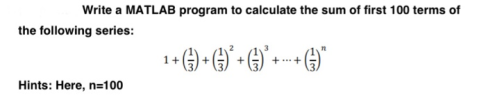 In
Matlab
Write a MATLAB program to calculate the sum of first 100 terms of the following series: 1+()+()*+(3) + + ... + Hints: Here, n=100
In
Matlab
Write a MATLAB program to calculate the sum of first 100 terms of the following series: 1+()+()*+(3) + + ... + Hints: Here, n=100
1.(10 points) Write a MATLAB program to calculate the sum of first 100 terms of the...
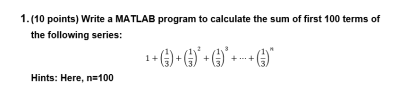 1.(10 points) Write a MATLAB program to calculate the sum of first 100 terms of the following series: 100)*)* ...-) Hints: Here, n=100
photo of the code please and an explnation if possible, Construct a simple MATLAB function program...
 photo of the code please and an explnation if possible,
Construct a simple MATLAB function program my_factorial which calculates product of first n positive integer numbers (i.e. find factorial n!). For full points: - Make sure you protect the code from illogical use (n must be positive integer) - Test the function by comparing with built in MATLAB function factorial(n) - Make sure you test your function for any limitations. O marks) -3. Using my factorial function from the previous...
photo of the code please and an explnation if possible,
Construct a simple MATLAB function program my_factorial which calculates product of first n positive integer numbers (i.e. find factorial n!). For full points: - Make sure you protect the code from illogical use (n must be positive integer) - Test the function by comparing with built in MATLAB function factorial(n) - Make sure you test your function for any limitations. O marks) -3. Using my factorial function from the previous...
MATLAB ONLY!! PLEASE WRITE IN COMPUTER SO I CAN COPY PASTE!!! ANSWER COMPLETELY, USE FOR LOOPS....
 MATLAB ONLY!! PLEASE WRITE IN COMPUTER SO I CAN COPY
PASTE!!! ANSWER COMPLETELY, USE FOR LOOPS.
THE PROGRAM TO BE MODIFIED IS THE NEXT ONE:
clc
clear
% Approximate the value of e ^ x using the Taylor Series
x = input( 'Enter the value of x for e^x. x = ' );
t = input( 'Enter the amount of desired terms. t = ' );
i = 1;
e_taylor = 0; % initializing the variable for the
accumulator
while...
MATLAB ONLY!! PLEASE WRITE IN COMPUTER SO I CAN COPY
PASTE!!! ANSWER COMPLETELY, USE FOR LOOPS.
THE PROGRAM TO BE MODIFIED IS THE NEXT ONE:
clc
clear
% Approximate the value of e ^ x using the Taylor Series
x = input( 'Enter the value of x for e^x. x = ' );
t = input( 'Enter the amount of desired terms. t = ' );
i = 1;
e_taylor = 0; % initializing the variable for the
accumulator
while...
run/call tle un/cd to compute the sum of the first 15 terms of the series: th (b) It is desired 14 n3 - 20 n2 + 5n, 110) 1,2,..15 n Develop a pseudocode of the required program. roposed algorithm in...
 run/call tle un/cd to compute the sum of the first 15 terms of the series: th (b) It is desired 14 n3 - 20 n2 + 5n, 110) 1,2,..15 n Develop a pseudocode of the required program. roposed algorithm in a flow chart if it is solved using a for loop ow the p () Write a MATLAB script file using for loop
run/call tle un/cd to compute the sum of the first 15 terms of the series: th (b)...
run/call tle un/cd to compute the sum of the first 15 terms of the series: th (b) It is desired 14 n3 - 20 n2 + 5n, 110) 1,2,..15 n Develop a pseudocode of the required program. roposed algorithm in a flow chart if it is solved using a for loop ow the p () Write a MATLAB script file using for loop
run/call tle un/cd to compute the sum of the first 15 terms of the series: th (b)...
Consider making a function (mini program to complete a specific task) for each of the scenarios...
Consider making a function (mini program to complete a specific task) for each of the scenarios below. State what the purpose of the function is in your own words, specify input that is needed by the function, what output is expected from the functions, and the step by step process that will obtain the output from the input (the algorithm). In addition to these 4 items also specify test data that can be used for each problem. Remember to describe...
Write a program that approximates the sum of this geometric series using a user- specified number...
Write a program that approximates the sum of this geometric series using a user- specified number of terms. For example, if you named your program approx, calling approx(3) should use the first 3 terms of the series to calculate the approximation: Approximate result = 1/2 + 1/4 + 1/8 = 0.875... Note: the values are all powers of 1⁄2: (1/2)1, (1/2)2, (1/2)3, ... Next, have your program calculate the difference (rounded to 3 decimal places) between the value “1” and...
This is a matlab HW that I need the code for, if someone could help me figure this out it would b...
 This is a matlab HW that I need the code for, if someone could
help me figure this out it would be appreciated.
The value of t can be estimated from the following equation: in your script file, estimate the value of π for any number of terms. You must ask the user for the desired number of terms and calculate the absolute error/difference between your calculation and the built-in MATLAB value ofpi. Display your results with the following message...
This is a matlab HW that I need the code for, if someone could
help me figure this out it would be appreciated.
The value of t can be estimated from the following equation: in your script file, estimate the value of π for any number of terms. You must ask the user for the desired number of terms and calculate the absolute error/difference between your calculation and the built-in MATLAB value ofpi. Display your results with the following message...
Data clustering and the k means algorithm. However, I'm not able to list all of the...
 Data clustering and the k means algorithm. However, I'm
not able to list all of the data sets but they include: ecoli.txt,
glass.txt, ionoshpere.txt, iris_bezdek.txt, landsat.txt,
letter_recognition.txt, segmentation.txt vehicle.txt, wine.txt and
yeast.txt.
Input: Your program should be non-interactive (that is, the program should not interact with the user by asking him/her explicit questions) and take the following command-line arguments: <F<K><I><T> <R>, where F: name of the data file K: number of clusters (positive integer greater than one) I: maximum number...
Data clustering and the k means algorithm. However, I'm
not able to list all of the data sets but they include: ecoli.txt,
glass.txt, ionoshpere.txt, iris_bezdek.txt, landsat.txt,
letter_recognition.txt, segmentation.txt vehicle.txt, wine.txt and
yeast.txt.
Input: Your program should be non-interactive (that is, the program should not interact with the user by asking him/her explicit questions) and take the following command-line arguments: <F<K><I><T> <R>, where F: name of the data file K: number of clusters (positive integer greater than one) I: maximum number...
 Write a MATLAB script, which asks the user to input the angle xd (in deg) and then approximates sine of the angle using the first 5 terms of Taylor series as follows: n+12n-1 sin n-1 (2n-1)! 1 Note that x in Taylor's equation is in radian, so make sure to do the conversion first Start with defining the vector n=1:5 and then use element-wise operation and basic MATLAB commands to calculate the summation. To calculate the factorial of any number,...
 In
Matlab
Write a MATLAB program to calculate the sum of first 100 terms of the following series: 1+()+()*+(3) + + ... + Hints: Here, n=100
In
Matlab
Write a MATLAB program to calculate the sum of first 100 terms of the following series: 1+()+()*+(3) + + ... + Hints: Here, n=100
 1.(10 points) Write a MATLAB program to calculate the sum of first 100 terms of the following series: 100)*)* ...-) Hints: Here, n=100
 photo of the code please and an explnation if possible,
Construct a simple MATLAB function program my_factorial which calculates product of first n positive integer numbers (i.e. find factorial n!). For full points: - Make sure you protect the code from illogical use (n must be positive integer) - Test the function by comparing with built in MATLAB function factorial(n) - Make sure you test your function for any limitations. O marks) -3. Using my factorial function from the previous...
photo of the code please and an explnation if possible,
Construct a simple MATLAB function program my_factorial which calculates product of first n positive integer numbers (i.e. find factorial n!). For full points: - Make sure you protect the code from illogical use (n must be positive integer) - Test the function by comparing with built in MATLAB function factorial(n) - Make sure you test your function for any limitations. O marks) -3. Using my factorial function from the previous...
 MATLAB ONLY!! PLEASE WRITE IN COMPUTER SO I CAN COPY
PASTE!!! ANSWER COMPLETELY, USE FOR LOOPS.
THE PROGRAM TO BE MODIFIED IS THE NEXT ONE:
clc
clear
% Approximate the value of e ^ x using the Taylor Series
x = input( 'Enter the value of x for e^x. x = ' );
t = input( 'Enter the amount of desired terms. t = ' );
i = 1;
e_taylor = 0; % initializing the variable for the
accumulator
while...
MATLAB ONLY!! PLEASE WRITE IN COMPUTER SO I CAN COPY
PASTE!!! ANSWER COMPLETELY, USE FOR LOOPS.
THE PROGRAM TO BE MODIFIED IS THE NEXT ONE:
clc
clear
% Approximate the value of e ^ x using the Taylor Series
x = input( 'Enter the value of x for e^x. x = ' );
t = input( 'Enter the amount of desired terms. t = ' );
i = 1;
e_taylor = 0; % initializing the variable for the
accumulator
while...
 run/call tle un/cd to compute the sum of the first 15 terms of the series: th (b) It is desired 14 n3 - 20 n2 + 5n, 110) 1,2,..15 n Develop a pseudocode of the required program. roposed algorithm in a flow chart if it is solved using a for loop ow the p () Write a MATLAB script file using for loop
run/call tle un/cd to compute the sum of the first 15 terms of the series: th (b)...
run/call tle un/cd to compute the sum of the first 15 terms of the series: th (b) It is desired 14 n3 - 20 n2 + 5n, 110) 1,2,..15 n Develop a pseudocode of the required program. roposed algorithm in a flow chart if it is solved using a for loop ow the p () Write a MATLAB script file using for loop
run/call tle un/cd to compute the sum of the first 15 terms of the series: th (b)...
 This is a matlab HW that I need the code for, if someone could
help me figure this out it would be appreciated.
The value of t can be estimated from the following equation: in your script file, estimate the value of π for any number of terms. You must ask the user for the desired number of terms and calculate the absolute error/difference between your calculation and the built-in MATLAB value ofpi. Display your results with the following message...
This is a matlab HW that I need the code for, if someone could
help me figure this out it would be appreciated.
The value of t can be estimated from the following equation: in your script file, estimate the value of π for any number of terms. You must ask the user for the desired number of terms and calculate the absolute error/difference between your calculation and the built-in MATLAB value ofpi. Display your results with the following message...
 Data clustering and the k means algorithm. However, I'm
not able to list all of the data sets but they include: ecoli.txt,
glass.txt, ionoshpere.txt, iris_bezdek.txt, landsat.txt,
letter_recognition.txt, segmentation.txt vehicle.txt, wine.txt and
yeast.txt.
Input: Your program should be non-interactive (that is, the program should not interact with the user by asking him/her explicit questions) and take the following command-line arguments: <F<K><I><T> <R>, where F: name of the data file K: number of clusters (positive integer greater than one) I: maximum number...
Data clustering and the k means algorithm. However, I'm
not able to list all of the data sets but they include: ecoli.txt,
glass.txt, ionoshpere.txt, iris_bezdek.txt, landsat.txt,
letter_recognition.txt, segmentation.txt vehicle.txt, wine.txt and
yeast.txt.
Input: Your program should be non-interactive (that is, the program should not interact with the user by asking him/her explicit questions) and take the following command-line arguments: <F<K><I><T> <R>, where F: name of the data file K: number of clusters (positive integer greater than one) I: maximum number...
Most questions answered within 3 hours.
-
Where is the error in this code sequence?
String s1 = "Hello";
String s2 = "ello";...
asked 11 months ago -
Financial data for Joel de Paris, Inc., for last year
follow:
Joel de Paris, Inc.
Balance...
asked 11 months ago -
Consider this reaction:
Al2(SO4)3 (aq)+ BaCl3
(aq) Al2Cl6 (aq)- +
3BaSO4(s) . What is the...
asked 11 months ago -
Suppose that Savneet is considering increasing her
recent random sample from 20 car rentals to 40...
asked 11 months ago -
Trucks arrive at an unloading terminal at an average rate of 120
per hour.
Trucks arrive...
asked 11 months ago -
Why are methanol and ethanol completely soluble in water while
octanol is not very little soluble....
asked 11 months ago -
A facilities manager at a university reads in a research report
that the mean amount of...
asked 11 months ago -
When the CuSO4 is rehydrated by adding water to the anhydrous
compound, is this an endothermic...
asked 11 months ago -
A ray of sunlight is passing from diamond into crown glass; the
angle of incidence is...
asked 11 months ago -
A block of mass 0.249 kg is placed on top of a light, vertical
spring of...
asked 11 months ago -
how do the kidneys compensate in the presences of acidosis
a) trigger hyperventilate
b) reserve acid...
asked 11 months ago -
Question 501 pts
The rental rate of capital to the firm increases. Which of the
following...
asked 11 months ago