
Homework Answers

Add Answer to:
61. For each reaction, calculate AHX, ASixn, and AG x at 25 °C and state whether...
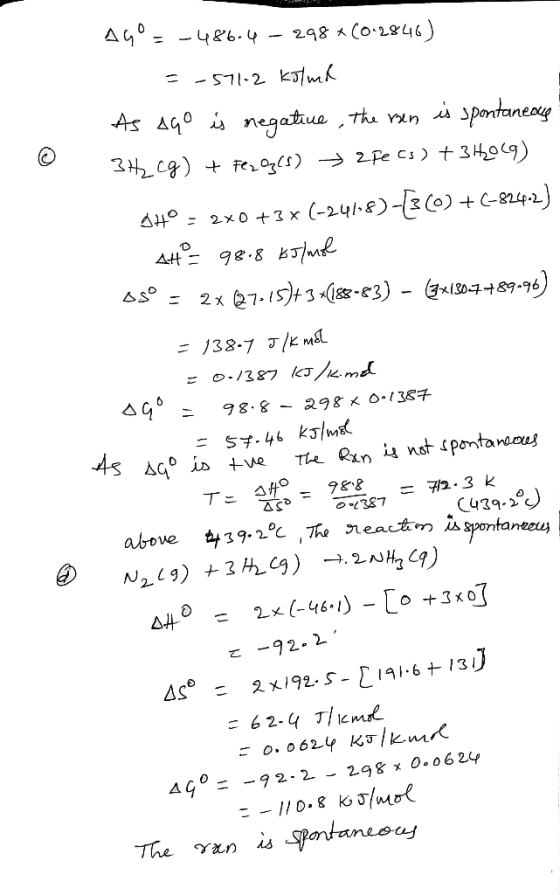
63) Use standard free energies of formation to calculate ΔG° at 25°C for each reaction in Problem...
 answer #63 by using #61
63) Use standard free energies of formation to calculate ΔG° at 25°C for each reaction in Problem 61. How do the values of AG° calcu- lated this way compare to those calculated from ΔΗ' and AS? Which of the two methods could be used to determine how ΔG changes with temperature? İN or each reaction, calculate Δ Hon, Δ-mn, and ΔGon at 25°C and state whether the reaction is spontaneous. If the reaction is not...
answer #63 by using #61
63) Use standard free energies of formation to calculate ΔG° at 25°C for each reaction in Problem 61. How do the values of AG° calcu- lated this way compare to those calculated from ΔΗ' and AS? Which of the two methods could be used to determine how ΔG changes with temperature? İN or each reaction, calculate Δ Hon, Δ-mn, and ΔGon at 25°C and state whether the reaction is spontaneous. If the reaction is not...
1. Calculate AG°for the following reaction at 25°C using AG ° = AH ° - TAS°...
 1. Calculate AG°for the following reaction at 25°C using AG ° = AH ° - TAS° Fe2O3 (s) + 3 H2(g) → 2 Fe (s) + 3 H2O (1) 2. Calculate AG ° for the same reaction using AG°f values Fe2O3 (s) 3 H2(g) → 2 Fe (s) + + 3 H20 (1) + 3. Calculate AGº of the following reaction: 2C (s) H 2 (g) → C2H 2 (g) Use Hess' Law, AG° = AG°1 + AG°2 + AG°3...
3.(15pts) In each case, find the missing AH. (kJ/mole) (a) If 2 Al(s) + Fe2O3(s) ---->...
 3.(15pts) In each case, find the missing AH. (kJ/mole) (a) If 2 Al(s) + Fe2O3(s) ----> Al2O3(s) + 2 Fe(s) AH,xº = -851.5kJ/mol then 1/8 Al2O3(s) + 1/4 Fe(s) --> 1/4 Al(s) + 1/8 Fe2O3(s) AHX = ? (b) If CaO(8) + 3 C(s) --> CaC2(s) + CO(g) AH,” = 464,8 kJ/mol then 6 CaO(s) + 18 C(s) ---> 6 CaCz(s) +6 CO(g) AHX = ? (c) If N2(g) + 2 O2(g) ---> N204(g) and 2 NO2(g) ----> N2(g) +...
3) Answer all parts of the following question. a. The reaction: Al(s) + Fe2O3(s) → Fe(s)...
3) Answer all parts of the following question. a. The reaction: Al(s) + Fe2O3(s) → Fe(s) + Al2O3(s) has ΔH = -847.6 kJ and ΔS = -41.3 J/K at 25°C. Calculate ΔG and determine if it is spontaneous. b. Above what temperature does the following reaction become nonspontaneous? FeO(s) + CO(g) → CO2(g) + Fe(s) ΔH = -11.0 kJ; ΔS = -17.4 J/K c. Find ΔSsurr and predict whether or not this reaction will be spontaneous at 398 K. NH3(g)...
the first one is supposed to be meant spontaneous. thanks ction to be non-spontaneous at any...
 the first one is supposed to be meant spontaneous. thanks
ction to be non-spontaneous at any temperature, which of the following В. Tur a chemical reaction to b conditions must be met? AS > 0, AITO AS > 0, AIT <0 AS <0, AHP <0 AS <0, AHP>0 D. 2. Place the following in on lowing in order of decreasing standard molar entropy. N204(8) NO(g) NO2(g) 204 > NO2 > NO B) NO > NO2 > N204 E) NO2 >...
the first one is supposed to be meant spontaneous. thanks
ction to be non-spontaneous at any temperature, which of the following В. Tur a chemical reaction to b conditions must be met? AS > 0, AITO AS > 0, AIT <0 AS <0, AHP <0 AS <0, AHP>0 D. 2. Place the following in on lowing in order of decreasing standard molar entropy. N204(8) NO(g) NO2(g) 204 > NO2 > NO B) NO > NO2 > N204 E) NO2 >...
Determine the value of AG for the following reaction: Fe2O3 (s) + 3 H2(g) → 2...
 Determine the value of AG for the following reaction: Fe2O3 (s) + 3 H2(g) → 2 Fe(s) + 3 H2O(g) Fe2O3(s) H2(g) Fe(s) H2O(g) AHf (kJ/mol) -824.2 0 0 -241.8 Sº (J/K mol) 87.4 130.6 27.3 188.8
3. Predict the sign (positive or negative) on the entropy change for each of these reactions....
 3. Predict the sign (positive or negative) on the entropy change for each of these reactions. (a) 2 SO2 (g) + O2 (g) → 2 SO3 (g) Negative (b) 2 NH3 (g) → N2 (g) + 3 H2 (g) (c) CO (g) + 2 H2 (g) → CH3OH (1) 4. For the reaction: 2NO2 (g) + N204 (g) at 298 K, The value of AH° and AS™ are -58.03 kJ and -176.6J/K, respectively. (a) What is the value of AG°...
A-D 9. Use the data given below for the following reaction at 25 C. Fe 04...
 A-D
9. Use the data given below for the following reaction at 25 C. Fe 04 (s)+ 4 H2(g) 3 Fe (s) + 4 H2O (1), (12+4+4+10-30) Fe Oa(S) 146.4 APH (kJ/mol) -1118.4 H:(g) 130.6 H2O(I) Fe(s) 27.28 S' (J/K/mol) 69.61 -285.83 0 (5+5+2+5=12) (a) Calculate AS,ys, AS,urr, ASuniy and AG at 25°C. ASy's Hh 172 (b) Is the reaction spontaneous at 25°C from entropic point of view? (4) (c) Is the reaction spontaneous at 25°C from free energy point...
A-D
9. Use the data given below for the following reaction at 25 C. Fe 04 (s)+ 4 H2(g) 3 Fe (s) + 4 H2O (1), (12+4+4+10-30) Fe Oa(S) 146.4 APH (kJ/mol) -1118.4 H:(g) 130.6 H2O(I) Fe(s) 27.28 S' (J/K/mol) 69.61 -285.83 0 (5+5+2+5=12) (a) Calculate AS,ys, AS,urr, ASuniy and AG at 25°C. ASy's Hh 172 (b) Is the reaction spontaneous at 25°C from entropic point of view? (4) (c) Is the reaction spontaneous at 25°C from free energy point...
Calculate the standard change in Gibbs free energy for the reaction at 25 °C. Refer to...
 Calculate the standard change in Gibbs free energy for the reaction at 25 °C. Refer to the AGⓇ values. 3 H2(g) + Fe, 0,(s) 2 Fe(s) + 3 H2O(g) AG" Calculate the standard change in Gibbs free energy for the reaction at 25 °C. Standard Gibbs free energy of formation values can be found in this table. C,H,(8) +4 C1,() 2 CCI, (1) + H2(g) AGE. kJ/mol
Predict whether the entropy change of the system in each of the following is positive or negative.
1. O2(g) → 2O(g)2. N2 (g, 10 atm) → N2 (g, 1atm)3. 6CO2(g) + 6H2O(g) → C6H12O6(g) + 6O2(g)4. 2 H2 (g) + O2 (g) → 2 H2O (l)5. NH4Cl (s) → NH3(g) + HCl (g)
 answer #63 by using #61
63) Use standard free energies of formation to calculate ΔG° at 25°C for each reaction in Problem 61. How do the values of AG° calcu- lated this way compare to those calculated from ΔΗ' and AS? Which of the two methods could be used to determine how ΔG changes with temperature? İN or each reaction, calculate Δ Hon, Δ-mn, and ΔGon at 25°C and state whether the reaction is spontaneous. If the reaction is not...
answer #63 by using #61
63) Use standard free energies of formation to calculate ΔG° at 25°C for each reaction in Problem 61. How do the values of AG° calcu- lated this way compare to those calculated from ΔΗ' and AS? Which of the two methods could be used to determine how ΔG changes with temperature? İN or each reaction, calculate Δ Hon, Δ-mn, and ΔGon at 25°C and state whether the reaction is spontaneous. If the reaction is not...
 1. Calculate AG°for the following reaction at 25°C using AG ° = AH ° - TAS° Fe2O3 (s) + 3 H2(g) → 2 Fe (s) + 3 H2O (1) 2. Calculate AG ° for the same reaction using AG°f values Fe2O3 (s) 3 H2(g) → 2 Fe (s) + + 3 H20 (1) + 3. Calculate AGº of the following reaction: 2C (s) H 2 (g) → C2H 2 (g) Use Hess' Law, AG° = AG°1 + AG°2 + AG°3...
 3.(15pts) In each case, find the missing AH. (kJ/mole) (a) If 2 Al(s) + Fe2O3(s) ----> Al2O3(s) + 2 Fe(s) AH,xº = -851.5kJ/mol then 1/8 Al2O3(s) + 1/4 Fe(s) --> 1/4 Al(s) + 1/8 Fe2O3(s) AHX = ? (b) If CaO(8) + 3 C(s) --> CaC2(s) + CO(g) AH,” = 464,8 kJ/mol then 6 CaO(s) + 18 C(s) ---> 6 CaCz(s) +6 CO(g) AHX = ? (c) If N2(g) + 2 O2(g) ---> N204(g) and 2 NO2(g) ----> N2(g) +...
 the first one is supposed to be meant spontaneous. thanks
ction to be non-spontaneous at any temperature, which of the following В. Tur a chemical reaction to b conditions must be met? AS > 0, AITO AS > 0, AIT <0 AS <0, AHP <0 AS <0, AHP>0 D. 2. Place the following in on lowing in order of decreasing standard molar entropy. N204(8) NO(g) NO2(g) 204 > NO2 > NO B) NO > NO2 > N204 E) NO2 >...
the first one is supposed to be meant spontaneous. thanks
ction to be non-spontaneous at any temperature, which of the following В. Tur a chemical reaction to b conditions must be met? AS > 0, AITO AS > 0, AIT <0 AS <0, AHP <0 AS <0, AHP>0 D. 2. Place the following in on lowing in order of decreasing standard molar entropy. N204(8) NO(g) NO2(g) 204 > NO2 > NO B) NO > NO2 > N204 E) NO2 >...
 Determine the value of AG for the following reaction: Fe2O3 (s) + 3 H2(g) → 2 Fe(s) + 3 H2O(g) Fe2O3(s) H2(g) Fe(s) H2O(g) AHf (kJ/mol) -824.2 0 0 -241.8 Sº (J/K mol) 87.4 130.6 27.3 188.8
 3. Predict the sign (positive or negative) on the entropy change for each of these reactions. (a) 2 SO2 (g) + O2 (g) → 2 SO3 (g) Negative (b) 2 NH3 (g) → N2 (g) + 3 H2 (g) (c) CO (g) + 2 H2 (g) → CH3OH (1) 4. For the reaction: 2NO2 (g) + N204 (g) at 298 K, The value of AH° and AS™ are -58.03 kJ and -176.6J/K, respectively. (a) What is the value of AG°...
 A-D
9. Use the data given below for the following reaction at 25 C. Fe 04 (s)+ 4 H2(g) 3 Fe (s) + 4 H2O (1), (12+4+4+10-30) Fe Oa(S) 146.4 APH (kJ/mol) -1118.4 H:(g) 130.6 H2O(I) Fe(s) 27.28 S' (J/K/mol) 69.61 -285.83 0 (5+5+2+5=12) (a) Calculate AS,ys, AS,urr, ASuniy and AG at 25°C. ASy's Hh 172 (b) Is the reaction spontaneous at 25°C from entropic point of view? (4) (c) Is the reaction spontaneous at 25°C from free energy point...
A-D
9. Use the data given below for the following reaction at 25 C. Fe 04 (s)+ 4 H2(g) 3 Fe (s) + 4 H2O (1), (12+4+4+10-30) Fe Oa(S) 146.4 APH (kJ/mol) -1118.4 H:(g) 130.6 H2O(I) Fe(s) 27.28 S' (J/K/mol) 69.61 -285.83 0 (5+5+2+5=12) (a) Calculate AS,ys, AS,urr, ASuniy and AG at 25°C. ASy's Hh 172 (b) Is the reaction spontaneous at 25°C from entropic point of view? (4) (c) Is the reaction spontaneous at 25°C from free energy point...
 Calculate the standard change in Gibbs free energy for the reaction at 25 °C. Refer to the AGⓇ values. 3 H2(g) + Fe, 0,(s) 2 Fe(s) + 3 H2O(g) AG" Calculate the standard change in Gibbs free energy for the reaction at 25 °C. Standard Gibbs free energy of formation values can be found in this table. C,H,(8) +4 C1,() 2 CCI, (1) + H2(g) AGE. kJ/mol
Most questions answered within 3 hours.
-
Where is the error in this code sequence?
String s1 = "Hello";
String s2 = "ello";...
asked 11 months ago -
Financial data for Joel de Paris, Inc., for last year
follow:
Joel de Paris, Inc.
Balance...
asked 11 months ago -
Consider this reaction:
Al2(SO4)3 (aq)+ BaCl3
(aq) Al2Cl6 (aq)- +
3BaSO4(s) . What is the...
asked 11 months ago -
Suppose that Savneet is considering increasing her
recent random sample from 20 car rentals to 40...
asked 11 months ago -
Trucks arrive at an unloading terminal at an average rate of 120
per hour.
Trucks arrive...
asked 11 months ago -
Why are methanol and ethanol completely soluble in water while
octanol is not very little soluble....
asked 11 months ago -
A facilities manager at a university reads in a research report
that the mean amount of...
asked 11 months ago -
When the CuSO4 is rehydrated by adding water to the anhydrous
compound, is this an endothermic...
asked 11 months ago -
A ray of sunlight is passing from diamond into crown glass; the
angle of incidence is...
asked 11 months ago -
A block of mass 0.249 kg is placed on top of a light, vertical
spring of...
asked 11 months ago -
how do the kidneys compensate in the presences of acidosis
a) trigger hyperventilate
b) reserve acid...
asked 11 months ago -
Question 501 pts
The rental rate of capital to the firm increases. Which of the
following...
asked 11 months ago