The table bellow gives the concentrations of C2H4O (g) as a function of time at 690K...
The table bellow gives the concentrations of C2H4O (g) as a
function of time at 690K for the following reaction equation: C2H4O
(g) -------> CH4 (g) + CO (g)
[C2H4O]/ M t/min
0.0860 0
0.0465 52
0.0355 75
0.0274 97
0.0174 135
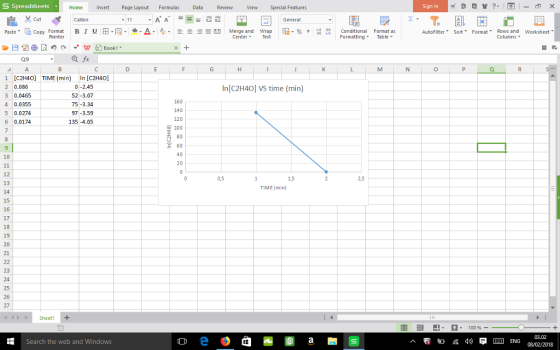
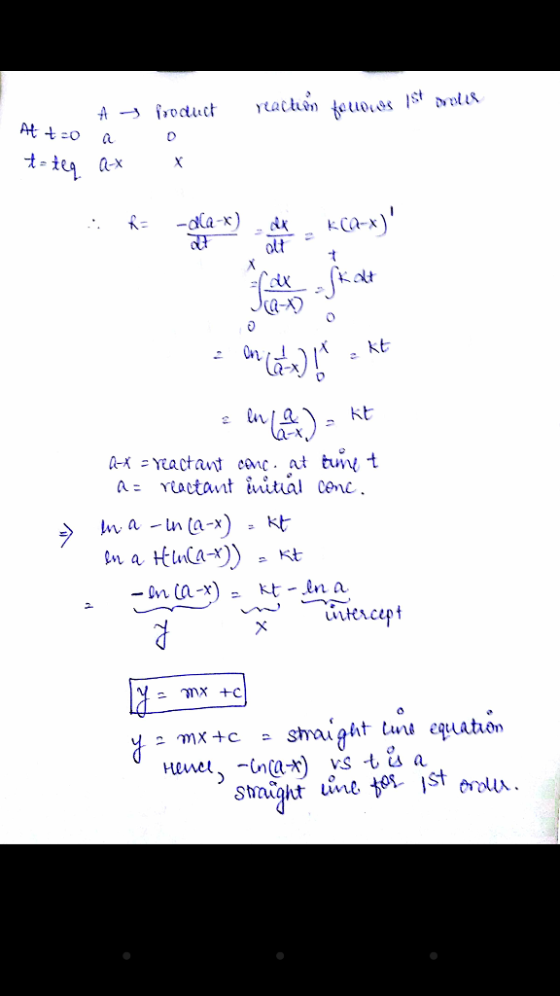
Verify that this is a first order reaction by plotting 1n
([C2H40]/M versus time and determine the value of the rate
constant.
Homework Answers
Add Answer to:
The table bellow gives the concentrations of C2H4O (g) as a
function of time at 690K...
What is the order and the rate constant for the reaction: C2H40 (g) CH4 (g) +...
 What is the order and the rate constant for the reaction: C2H40 (g) CH4 (g) + CO (g) given the data: (C2H40] t(min) 0.0860 0 0.0465 50 0.0355 72 0.0274 93 0.0174 130 The compound SO2Cl2 decomposes in a first order reaction SO2Cl2(g) → SO2 (g) + Cl2 (g) that has a half life of 4.47 x 10⁴ at 600 K. If the reaction is begun with 1.6 * 10-3 mol of pure SO2Cl2 in a 2.0L flask, at what...
The data below show the concentration of N2O5 versus time for the following reaction: N2O5(g)→NO3(g)+NO2(g) Time...
The data below show the concentration of N2O5 versus time for the following reaction: N2O5(g)→NO3(g)+NO2(g) Time (s) [N2O5] (M) 0 1.000 25 0.822 50 0.677 75 0.557 100 0.458 125 0.377 150 0.310 175 0.255 200 0.210 Predict the concentration of N2O5 at 280 s . The following reaction was monitored as a function of time: AB→A+B A plot of 1/[AB] versus time yields a straight line with slope 5.8×10⁻² (M⋅s)−1 . You may want to reference (Page) section 13.4...
1. Table 1 shows the temperature-time data were recorded for the reaction between 50.0 mL of 1.06 M HA (a we...
 1. Table 1 shows the temperature-time data were recorded for the reaction between 50.0 mL of 1.06 M HA (a weak acid) and 50.0 mL of 0.90 MNH OH, ammonium hydroxide (a weak base, also known as aqueous ammonia) The solutions were mixed after 60 s of approximately constant temperature readings of 24.20°C. Table 1: Temperature-time Data Time (s) Temperature (C) Time (s) Temperature C) 31 90 24.25 30.9 105 24.22 15 120 30.8 24.20 30 30.7 135 24.20 45...
 What is the order and the rate constant for the reaction: C2H40 (g) CH4 (g) + CO (g) given the data: (C2H40] t(min) 0.0860 0 0.0465 50 0.0355 72 0.0274 93 0.0174 130 The compound SO2Cl2 decomposes in a first order reaction SO2Cl2(g) → SO2 (g) + Cl2 (g) that has a half life of 4.47 x 10⁴ at 600 K. If the reaction is begun with 1.6 * 10-3 mol of pure SO2Cl2 in a 2.0L flask, at what...
 1. Table 1 shows the temperature-time data were recorded for the reaction between 50.0 mL of 1.06 M HA (a weak acid) and 50.0 mL of 0.90 MNH OH, ammonium hydroxide (a weak base, also known as aqueous ammonia) The solutions were mixed after 60 s of approximately constant temperature readings of 24.20°C. Table 1: Temperature-time Data Time (s) Temperature (C) Time (s) Temperature C) 31 90 24.25 30.9 105 24.22 15 120 30.8 24.20 30 30.7 135 24.20 45...
Most questions answered within 3 hours.
-
Where is the error in this code sequence?
String s1 = "Hello";
String s2 = "ello";...
asked 10 months ago -
Financial data for Joel de Paris, Inc., for last year
follow:
Joel de Paris, Inc.
Balance...
asked 10 months ago -
Consider this reaction:
Al2(SO4)3 (aq)+ BaCl3
(aq) Al2Cl6 (aq)- +
3BaSO4(s) . What is the...
asked 10 months ago -
Suppose that Savneet is considering increasing her
recent random sample from 20 car rentals to 40...
asked 10 months ago -
Trucks arrive at an unloading terminal at an average rate of 120
per hour.
Trucks arrive...
asked 10 months ago -
Why are methanol and ethanol completely soluble in water while
octanol is not very little soluble....
asked 10 months ago -
A facilities manager at a university reads in a research report
that the mean amount of...
asked 10 months ago -
When the CuSO4 is rehydrated by adding water to the anhydrous
compound, is this an endothermic...
asked 10 months ago -
A ray of sunlight is passing from diamond into crown glass; the
angle of incidence is...
asked 10 months ago -
A block of mass 0.249 kg is placed on top of a light, vertical
spring of...
asked 10 months ago -
how do the kidneys compensate in the presences of acidosis
a) trigger hyperventilate
b) reserve acid...
asked 10 months ago -
Question 501 pts
The rental rate of capital to the firm increases. Which of the
following...
asked 10 months ago