
Homework Answers


If any doubt please comment me
Add Answer to:
gmor reaion tlr am in condition(20) 2. For the following circuit, write the differential equation for...
2) For the following circuit, analyze the current IR3 through resistor Rz: a) Write the differential...
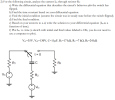 2) For the following circuit, analyze the current IR3 through resistor Rz: a) Write the differential equation that describes the circuit's behavior after the switch has flipped. b) Find the time constant based on your differential equation. c) Find the initial condition assume the circuit was in steady state before the switch flipped). d) Find the final condition. e) Based on your answers to a-d, write the solution to your differential equation IR3 as a function of time). f) Plot...
A. Write down the differential equation describing the circuit for an arbitrary time-dependent voltage V (t),...
 A. Write down the differential equation describing the circuit for an arbitrary time-dependent voltage V (t), in terms of the inductance L, capacitance C and resistance R of the circuit. B. Determine an analytic solution when the voltage is switched off [V(t) = ol. First, express your solution in terms of arbitrary coefficients as appropriate. Then, determine those coefficients for the initial conditions where the current is given by I(に0)-10 and satisfies I'(t = 0) = 0. C. Determine the...
A. Write down the differential equation describing the circuit for an arbitrary time-dependent voltage V (t),...
 A. Write down the differential equation describing the circuit for an arbitrary time-dependent voltage V (t), in terms of the inductance L, capacitance C and resistance R of the circuit. B. Determine an analytic solution when the voltage is switched off [V(t) = ol. First, express your solution in terms of arbitrary coefficients as appropriate. Then, determine those coefficients for the initial conditions where the current is given by I(に0)-10 and satisfies I'(t = 0) = 0. C. Determine the...
derive a differential equation for ??(?) (The current through the indcutor) for the circuit. Define state...
 derive a differential
equation for ??(?) (The current through the indcutor) for the
circuit. Define state variables, to compute ??(?) and ??(?)(voltage
across the inductor).
t 0 C w 2 L 8 he circuit parameters in the circuit in Fig. P12.31 are R 1600 2; L 200 mH; and C 200 nF. If ,(t)-6 mA, find
derive a differential
equation for ??(?) (The current through the indcutor) for the
circuit. Define state variables, to compute ??(?) and ??(?)(voltage
across the inductor).
t 0 C w 2 L 8 he circuit parameters in the circuit in Fig. P12.31 are R 1600 2; L 200 mH; and C 200 nF. If ,(t)-6 mA, find
Consider the partial differential equation together with the boundary conditions u(0, t) 0 and u(1,t)0 for t20 and the initial condition u(z,0) = z(1-2) for 0 < x < 1. (a) If n is a positive in...
 Consider the partial differential equation together with the boundary conditions u(0, t) 0 and u(1,t)0 for t20 and the initial condition u(z,0) = z(1-2) for 0 < x < 1. (a) If n is a positive integer, show that the function , sin(x), satisfies the given partial differential equation and boundary conditions. (b) The general solution of the partial differential equation that satisfies the boundary conditions is Write down (but do not evaluate) an integral that can be used to...
2. Consider the following partial differential equation (a) Separate this equation into two ordin...
 2. Consider the following partial differential equation (a) Separate this equation into two ordinary differential equations (b) Translate the following boundary conditions on the above partial differential equation to conditions on the ordinary differential equations found above.
2. Consider the following partial differential equation (a) Separate this equation into two ordinary differential equations (b) Translate the following boundary conditions on the above partial differential equation to conditions on the ordinary differential equations found above.
2. Consider the following partial differential equation (a) Separate this equation into two ordinary differential equations (b) Translate the following boundary conditions on the above partial differential equation to conditions on the ordinary differential equations found above.
Partial differential equation-wave equation
 One end of the pipe is closed, which corresponds to the boundary conditionu(0, t) = 0, for t > 0. The other end of the pipe is open, which correspondsto the boundary condition ux(L, t) = 0, for t > 0.(a) Suppose that µ < 0, so µ = −k^2 for some k > 0. Find the non-trivial solution X(x) that satisfies equations (3), stating clearly what values k is allowed to take.(b) Write down the general solution of equation...
(1 point) Solve the following differential equation with the given boundary conditions -If there are infinitely...
 (1 point) Solve the following differential equation with the given boundary conditions -If there are infinitely many solutions, use c for any undetermined constants - If there are no solutions, write No Solution - Write answers as functions of 2 (ie.y=y(2)). y" +9y=0 • A) Boundary conditions: y(0) = 2 • B) Boundary conditions: y(0) = 2 y= No Solution • C) Boundary conditions: y(0) = 2 No Solution
help on these 4 multiple choice questions Question 40 2 About the differential equation that describes...
 help on these 4 multiple choice questions
Question 40 2 About the differential equation that describes the elastic curve for a beam Which of the following statements is false; For a beam made with a single uniformes constant For a promotic beam is constant For a primi beam is constant For a beam with varying cross-section will change with location Question 41 2 pts About the differential equation that describes the elastic curve for a beam which of the following...
help on these 4 multiple choice questions
Question 40 2 About the differential equation that describes the elastic curve for a beam Which of the following statements is false; For a beam made with a single uniformes constant For a promotic beam is constant For a primi beam is constant For a beam with varying cross-section will change with location Question 41 2 pts About the differential equation that describes the elastic curve for a beam which of the following...
Problem 2 (15 points) Use the circuit given to answer the following questions. a. On the...
 Problem 2 (15 points) Use the circuit given to answer the following questions. a. On the figure, identify and label the different currents in this circuit. Be sure to give them directions. [2 point] b. Use Kirchoff's loop rule to write down equations for all 3 possible loops that could be used to solve for the currents in this circuit (You do not need to solve them!) 19 points = V, - IR, - V2 - IR4 so Vo vz...
 2) For the following circuit, analyze the current IR3 through resistor Rz: a) Write the differential equation that describes the circuit's behavior after the switch has flipped. b) Find the time constant based on your differential equation. c) Find the initial condition assume the circuit was in steady state before the switch flipped). d) Find the final condition. e) Based on your answers to a-d, write the solution to your differential equation IR3 as a function of time). f) Plot...
 A. Write down the differential equation describing the circuit for an arbitrary time-dependent voltage V (t), in terms of the inductance L, capacitance C and resistance R of the circuit. B. Determine an analytic solution when the voltage is switched off [V(t) = ol. First, express your solution in terms of arbitrary coefficients as appropriate. Then, determine those coefficients for the initial conditions where the current is given by I(に0)-10 and satisfies I'(t = 0) = 0. C. Determine the...
 A. Write down the differential equation describing the circuit for an arbitrary time-dependent voltage V (t), in terms of the inductance L, capacitance C and resistance R of the circuit. B. Determine an analytic solution when the voltage is switched off [V(t) = ol. First, express your solution in terms of arbitrary coefficients as appropriate. Then, determine those coefficients for the initial conditions where the current is given by I(に0)-10 and satisfies I'(t = 0) = 0. C. Determine the...
 derive a differential
equation for ??(?) (The current through the indcutor) for the
circuit. Define state variables, to compute ??(?) and ??(?)(voltage
across the inductor).
t 0 C w 2 L 8 he circuit parameters in the circuit in Fig. P12.31 are R 1600 2; L 200 mH; and C 200 nF. If ,(t)-6 mA, find
derive a differential
equation for ??(?) (The current through the indcutor) for the
circuit. Define state variables, to compute ??(?) and ??(?)(voltage
across the inductor).
t 0 C w 2 L 8 he circuit parameters in the circuit in Fig. P12.31 are R 1600 2; L 200 mH; and C 200 nF. If ,(t)-6 mA, find
 Consider the partial differential equation together with the boundary conditions u(0, t) 0 and u(1,t)0 for t20 and the initial condition u(z,0) = z(1-2) for 0 < x < 1. (a) If n is a positive integer, show that the function , sin(x), satisfies the given partial differential equation and boundary conditions. (b) The general solution of the partial differential equation that satisfies the boundary conditions is Write down (but do not evaluate) an integral that can be used to...
 2. Consider the following partial differential equation (a) Separate this equation into two ordinary differential equations (b) Translate the following boundary conditions on the above partial differential equation to conditions on the ordinary differential equations found above.
2. Consider the following partial differential equation (a) Separate this equation into two ordinary differential equations (b) Translate the following boundary conditions on the above partial differential equation to conditions on the ordinary differential equations found above.
2. Consider the following partial differential equation (a) Separate this equation into two ordinary differential equations (b) Translate the following boundary conditions on the above partial differential equation to conditions on the ordinary differential equations found above.
 (1 point) Solve the following differential equation with the given boundary conditions -If there are infinitely many solutions, use c for any undetermined constants - If there are no solutions, write No Solution - Write answers as functions of 2 (ie.y=y(2)). y" +9y=0 • A) Boundary conditions: y(0) = 2 • B) Boundary conditions: y(0) = 2 y= No Solution • C) Boundary conditions: y(0) = 2 No Solution
 help on these 4 multiple choice questions
Question 40 2 About the differential equation that describes the elastic curve for a beam Which of the following statements is false; For a beam made with a single uniformes constant For a promotic beam is constant For a primi beam is constant For a beam with varying cross-section will change with location Question 41 2 pts About the differential equation that describes the elastic curve for a beam which of the following...
help on these 4 multiple choice questions
Question 40 2 About the differential equation that describes the elastic curve for a beam Which of the following statements is false; For a beam made with a single uniformes constant For a promotic beam is constant For a primi beam is constant For a beam with varying cross-section will change with location Question 41 2 pts About the differential equation that describes the elastic curve for a beam which of the following...
 Problem 2 (15 points) Use the circuit given to answer the following questions. a. On the figure, identify and label the different currents in this circuit. Be sure to give them directions. [2 point] b. Use Kirchoff's loop rule to write down equations for all 3 possible loops that could be used to solve for the currents in this circuit (You do not need to solve them!) 19 points = V, - IR, - V2 - IR4 so Vo vz...
Most questions answered within 3 hours.
-
Where is the error in this code sequence?
String s1 = "Hello";
String s2 = "ello";...
asked 11 months ago -
Financial data for Joel de Paris, Inc., for last year
follow:
Joel de Paris, Inc.
Balance...
asked 11 months ago -
Consider this reaction:
Al2(SO4)3 (aq)+ BaCl3
(aq) Al2Cl6 (aq)- +
3BaSO4(s) . What is the...
asked 11 months ago -
Suppose that Savneet is considering increasing her
recent random sample from 20 car rentals to 40...
asked 11 months ago -
Trucks arrive at an unloading terminal at an average rate of 120
per hour.
Trucks arrive...
asked 11 months ago -
Why are methanol and ethanol completely soluble in water while
octanol is not very little soluble....
asked 11 months ago -
A facilities manager at a university reads in a research report
that the mean amount of...
asked 11 months ago -
When the CuSO4 is rehydrated by adding water to the anhydrous
compound, is this an endothermic...
asked 11 months ago -
A ray of sunlight is passing from diamond into crown glass; the
angle of incidence is...
asked 11 months ago -
A block of mass 0.249 kg is placed on top of a light, vertical
spring of...
asked 11 months ago -
how do the kidneys compensate in the presences of acidosis
a) trigger hyperventilate
b) reserve acid...
asked 11 months ago -
Question 501 pts
The rental rate of capital to the firm increases. Which of the
following...
asked 11 months ago